TSA Rules for Curling Irons in Carry-On Luggage Explained
This post contains affiliate links. As an Amazon Associate, we earn from qualifying purchases.
Yes, a curling iron can go in carry-on luggage. The answer splits on power: plug-in models have no restrictions, but cordless curling irons powered by lithium-ion batteries, lithium metal, or butane/gas are allowed only in your carry-on bag. They must have a safety cover fitted over the heating element and be protected from accidental activation. The FAA limits lithium-ion batteries to 100 Watt-hours.
That split isn’t a suggestion. It’s federal regulation 49 CFR 175.10. Plug-in tools are inert hunks of metal and plastic to the FAA. Swap the cord for a battery or a gas cartridge, and you’ve introduced a hazardous material with a documented fire risk in aircraft cargo holds.
What follows is the mechanic’s breakdown: the specific battery specs that pass, the exact packing steps that avoid a checkpoint delay, and the one international rule that contradicts what your tool’s manual might say.
Key Takeaways
- Cordless curling irons with lithium or butane power are carry-on only; plug-in models can go anywhere.
- The FAA caps lithium-ion batteries at 100 Watt-hours (Wh); lithium metal batteries cannot exceed 2 grams of lithium content.
- You are limited to one gas/butane-powered curling iron per person, and spare fuel cartridges are completely banned.
- A securely fitted safety cover over the heating element is non-negotiable for cordless models, pack it so it cannot turn on.
- International flights, especially to places like New Zealand, may have stricter rules requiring battery isolation, overriding manufacturer claims.
The Cordless vs. Plug-In Split (And Why It Matters)
The regulation doesn’t care about curls. It cares about chemistry and containment.
Plug-in curling irons, straighteners, and wands are simple resistive heaters. No internal energy source, no volatile fuel. To the TSA prohibited items list and FAA PackSafe, they’re as inert as a hairbrush. Pack them in your carry-on bag or checked bag, no rules, no limits.
Where this goes sideways: Assuming “cordless” means “unrestricted.” The moment you add a battery or gas cartridge, you’re carrying a potential ignition source. The FAA recorded 89 battery incident reports for smoke, fire, or extreme heat on flights in a recent year, the highest count since at least 2016.
Cordless tools change the equation. A lithium-ion battery stores enough energy to short and enter thermal runaway. A butane cartridge holds compressed, flammable gas. In the pressurized, oxygen-rich environment of a cargo hold, a malfunction isn’t just a dead tool. It’s an uncontained fire with no one there to put it out. That’s why the rule exists: keep it in the cabin where a flight attendant has a fire extinguisher and thirty seconds to react.
| Power Type | Allowed in Carry-On? | Allowed in Checked Bag? | Critical Restriction |
|---|---|---|---|
| Plug-In (Corded) | Yes | Yes | None. |
| Cordless (Lithium-ion) | Yes | No | Battery must be ≤ 100 Wh. Must have safety cover. |
| Cordless (Lithium Metal) | Yes | No | Lithium content ≤ 2 grams. Must have safety cover. |
| Cordless (Butane/Gas) | Yes (1 per person) | No | No spare cartridges. Safety cover mandatory. |
Decoding the Battery Specs: 100 Wh and 2 Grams
You can’t just eyeball a battery. The limits are precise numbers from the FAA hazardous materials guidance.
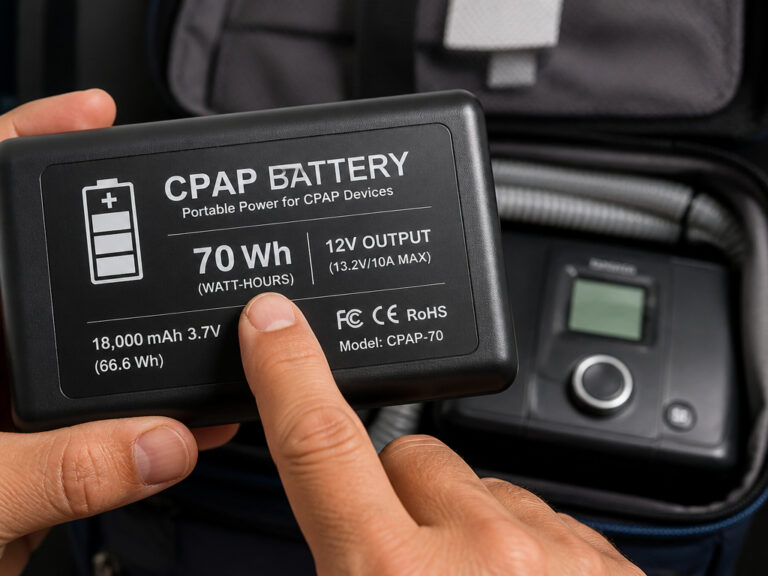
For a lithium-ion battery, the ceiling is 100 Watt-hours (Wh). This is a measure of energy capacity, not physical size. You’ll find this number printed on the battery itself or in the tool’s manual under “specifications.” Most cordless hairstyling tools like the Revlon One-Step or similar hot brushes use batteries well under this limit, often in the 20-40 Wh range. A professional-grade cordless curling wand might push closer.
For a lithium metal battery (non-rechargeable, often found in older devices), the limit is 2 grams of lithium content. This is rarer in modern styling tools.
The technical snippet: Under 49 CFR 175.10(a)(14), battery-powered heat-producing devices are permitted as carry-on or checked baggage only if the heating element or battery is isolated to prevent unintentional activation. Each installed lithium battery must meet UN testing standards, with lithium-ion batteries not exceeding 100 Wh and lithium metal batteries not exceeding 2 grams of lithium content.
If your tool’s battery is removable, you have a safety net. A damaged, recalled, or swelling battery must not fly. Pull it out and carry it separately in a protective case if you must transport it. The airline can refuse any device that looks like it might “create sparks or generate a dangerous evolution of heat.”
The Gas-Powered Rule: One Tool, No Spares
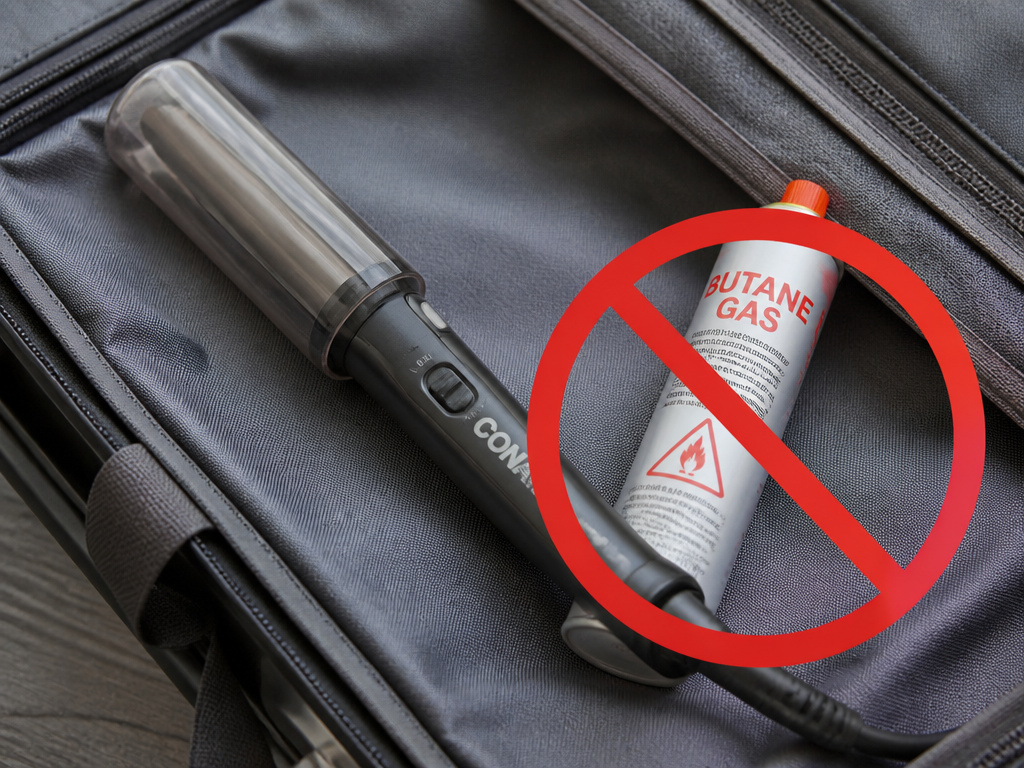 Butane curling irons, like those from brands such as Helen of Troy, operate under a different clause of the same regulation.
The FAA passenger baggage rules are explicit: you may carry one hair curler containing a hydrocarbon gas like butane in your carry-on baggage only. The safety cover must be securely fitted. Most importantly, gas refills are not permitted in carry-on or checked baggage. Don’t try to sneak a spare cartridge in your toiletry kit. It will be confiscated as a hazardous material.
This rule exists because a spare cartridge, unprotected inside a tool, is a pure fuel source. It’s more dangerous than the tool itself. If you’re traveling for a long time, plan to buy a refill at your destination or switch to a different tool.
How to Pack a Cordless Curling Iron for a Flight
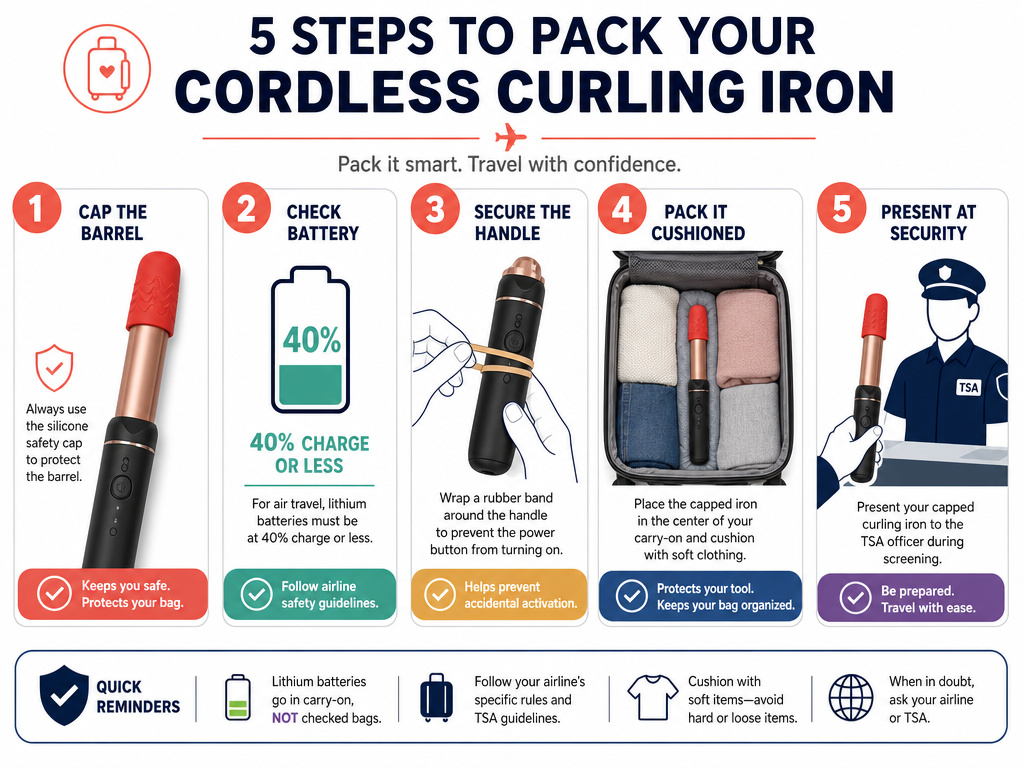 Packing it wrong gets it pulled from your bag. Follow this sequence.
- Fit the Safety Cover. This is the red or black silicone cap that came with the tool. Stretch it fully over the entire barrel until it’s snug. This isn’t just for bumps; it prevents the heating element from contacting anything conductive like loose change or keys.
- Discharge the Battery Partially. Don’t ship it fully charged. A charge between 30% and 50% is the most stable state for a lithium-ion battery during transport. It reduces stress on the cells.
- Prevent Activation. Many tools have a manual lock switch. Engage it. If there’s no lock, the safety cover itself might act as a button blocker. For extra security, wrap a rubber band around the handle to keep the trigger depressed in the “off” position.
- Cushion and Center in Your Bag. Place the tool in the center of your carry-on luggage, surrounded by soft items like clothing. Do not pack it in an external pocket or at the bottom where it can be crushed. The goal is to protect it from impact that could damage the battery casing.
- Keep it Accessible. Be ready to present it separately if asked. A TSA officer may want to inspect it to verify the safety cover is fitted, just as they might with other TSA approved items that have special conditions.
Skipping the safety cover is the most common mistake. The officer sees a bare heating element and now has a prohibited item. You’re either surrendering the tool or missing your flight.
International Travel and the “Isolation” Wild Card
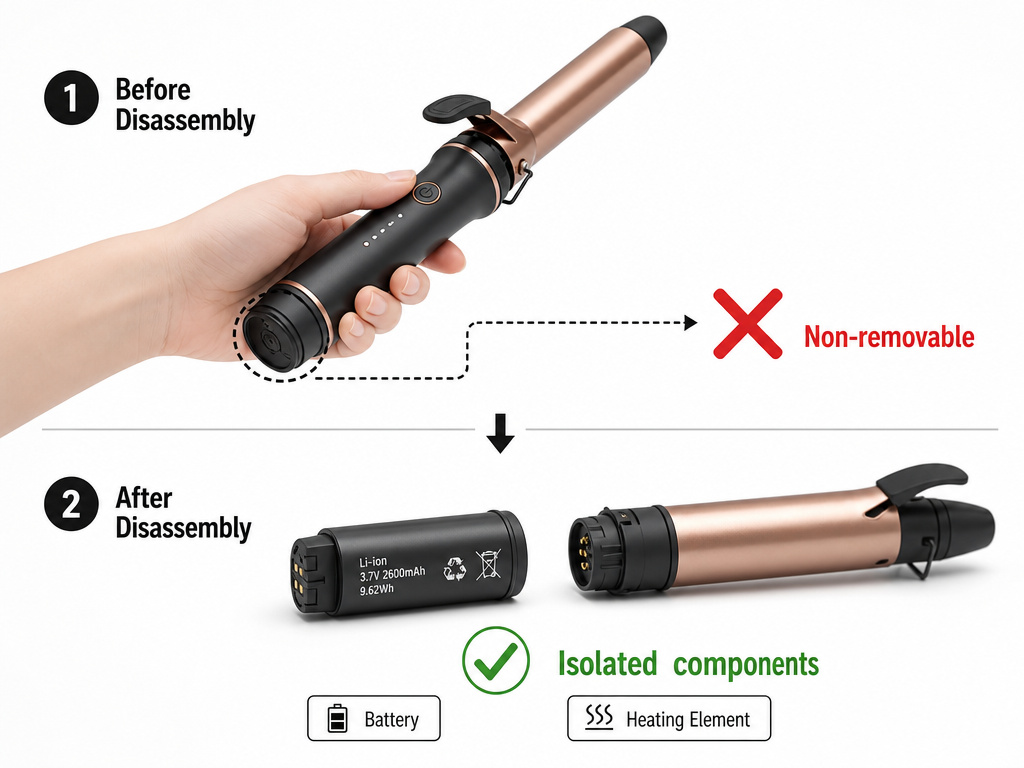 Your domestic TSA rules are one thing. Another country’s civil aviation authority writes its own playbook.
New Zealand’s Civil Aviation Authority (CAA) presents the starkest example. Their rule states that for a battery-powered hair styling device to travel, the battery and heating element must be isolated by removal of the battery, the heating element, or some other component.
Easy to miss: The NZ CAA explicitly warns, “Even if manufacturers say these devices are ‘safe for travel’ on a plane,’ if the battery, heating element, or other component cannot be removed, and the device contains a built-in rechargeable battery it cannot travel.”
This means a popular all-in-one cordless curling iron with a non-removable battery might be fine for a Chicago to New York flight but could be confiscated at Auckland Airport. The onus is on you to check your destination’s specific regulations. When in doubt, travel with a plug-in model and a universal adapter. It’s the only guarantee.
What About Other Styling Tools?
The logic extends. It’s about the power source, not the tool’s function.
- Cordless Hair Straighteners: Same rules as cordless curling irons. Carry-on only with safety cover.
- Cordless Hot Brushes/Blow Dryer Brushes: Same rules. Carry-on only with safety cover.
- Plug-in Versions of All the Above: No restrictions.
- Beard Trimmers, Electric Razors: Typically have smaller batteries and are generally allowed in both carry-on and checked bags, but it’s always safer to check the specific TSA item-specific guidance.
The principle is universal. If it has a cord you plug into a wall, you’re fine. If it has a self-contained power source, you need to know its specs and pack it in your carry-on within the rules. This is part of understanding your complete carry-on luggage weight and size restrictions.
Frequently Asked Questions
Can I put a curling iron in my checked luggage?
Yes, but only if it’s a plug-in model with no battery or gas cartridge. Any cordless curling iron powered by lithium-ion, lithium metal, or butane is forbidden in checked baggage by FAA regulation. Packing one there risks confiscation and fines.
How do I know if my curling iron battery is under 100 Wh?
Check the label on the battery or the tool’s user manual. The Watt-hour (Wh) rating should be printed. If you only see voltage (V) and milliamp-hours (mAh), you can calculate it: (V) x (mAh) / 1000 = Wh. For example, a 3.7V battery with 2600mAh capacity is (3.7 * 2600) / 1000 = 9.62 Wh, which is well under the limit.
What happens if my cordless curling iron is taken by TSA?
If your tool violates the rules (e.g., no safety cover, in a checked bag), the TSA officer will not allow it through the checkpoint. You have three options: 1) Have someone not flying take it back, 2) Surrender it for destruction, or 3) Exit security and mail it to yourself (subject to postal regulations for batteries). You cannot negotiate.
Can I bring a cordless curling iron on an international flight?
You must check with your airline and the aviation authority of your destination country. Many follow similar rules, but some, like New Zealand, have stricter “battery isolation” requirements that can override the manufacturer’s “travel-safe” designation. A plug-in model is always the safer international choice.
Does the TSA consider a curling iron a personal item?
No. A curling iron packed inside your carry-on luggage is just an item within that bag. It does not count as your personal item, like a tote bag or backpack for flying, which is a separate bag under the seat.
Before You Go
Pack the plug-in version whenever possible. It’s the only tool with zero hassle. If you must travel with a cordless model, treat it like the hazardous material the regulations say it is: know its battery rating, clamp on that safety cover, and keep it in your carry-on. Double-check international rules, your tool’s “flight mode” might not be enough. Finally, give it a test run at home. Make sure the safety cover stays put and the lock switch works. Finding that out at 5 AM in a security line is a terrible way to start a trip.