What Is Allowed in Carry-On Luggage | The Complete Guide
This post contains affiliate links. As an Amazon Associate, we earn from qualifying purchases.
You can bring most personal items in carry-on luggage, but they must follow two sets of rules: the TSA’s security rules for what can go through the checkpoint, and the FAA’s hazardous materials (dangerous goods) regulations for what is safe to fly. Liquids follow the 3-1-1 rule, lithium batteries under 100 watt-hours are fine, and sharp tools must be under 7 inches.
The difference between those two rulebooks is where most travelers get tripped up. The TSA officer decides if your item is a security risk at the checkpoint, but the FAA’s rules are about the chemical and physical dangers an item poses inside the aircraft’s cabin and cargo hold. Something the TSA might pass through, like a large but empty camping stove, could still be an FAA violation if it reeks of fuel vapors.
What follows is a breakdown of the two rule systems, the exact specs for liquids and batteries, and a list of common items sorted by where they land. This isn’t a guess. It’s pulled straight from the .gov pages the officers use.
Key Takeaways
- The 3-1-1 rule for liquids is a TSA security rule: containers must be 3.4 oz (100 ml) or less, all fitting in one quart-sized bag.
- Lithium-ion batteries are regulated by the FAA for safety: under 100 watt-hours (Wh) are always allowed in carry-on; 101-160 Wh need airline approval and are limited to two spare packs.
- Sharp tools like screwdrivers and wrenches under 7 inches are TSA-approved; anything longer or with a blade (like a saw) must be checked.
- Medically necessary liquids (formula, breast milk, medication) are exempt from the 3-1-1 rule but must be declared for separate screening.
- The final decision always rests with the TSA officer at the checkpoint, even if an item is generally permitted.
The Two Rulebooks: TSA Security vs. FAA Hazardous Materials
You are answering to two different federal agencies when you pack a carry-on. The Transportation Security Administration (TSA) sets the security rules for what can pass through the checkpoint. Their focus is on threats to the aircraft and passengers. The Federal Aviation Administration (FAA) sets the hazardous materials regulations, often called “dangerous goods” rules, which govern what is physically safe to bring aboard an aircraft due to risks like fire, explosion, or chemical leaks.
Common mistake: Assuming an item is fine just because it’s not on the TSA’s prohibited list. Aerosol insecticide isn’t a TSA security threat, but its propellant makes it a flammable aerosol under FAA rules, so it’s banned from carry-ons entirely.
The FAA’s PackSafe for air travel chart is the bible for dangerous goods. The TSA’s carry-on permitted items list is your checkpoint guide. An item must pass both tests. This dual-layer system explains why some rules seem contradictory until you see which agency is driving them.
The 3-1-1 Liquids Rule Explained
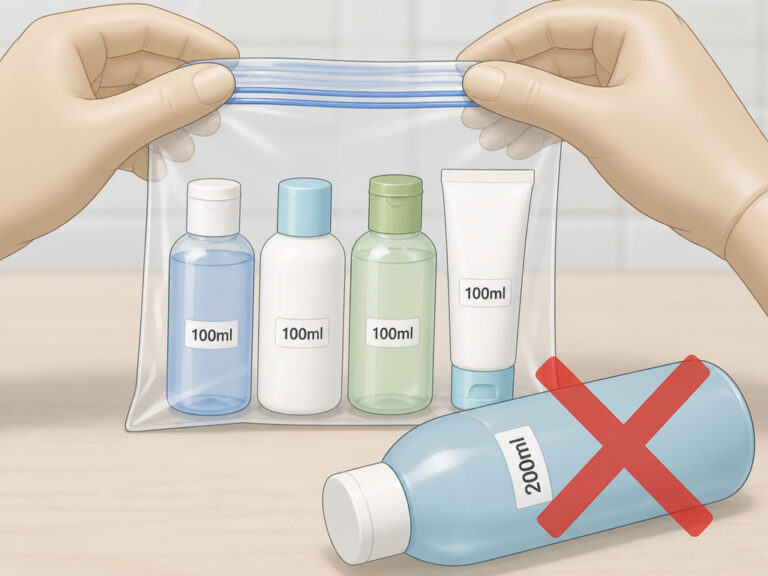
The TSA’s 3-1-1 rule is the standard for liquids, aerosols, gels, creams, and pastes in carry-on bags. You can find the full details on the TSA’s 3-1-1 rule documentation.
- 3: Each container must be 3.4 ounces (100 milliliters) or less.
- 1: All containers must fit in one clear, quart-sized, resealable bag.
- 1: One bag per passenger.
The bag must be placed in a bin for separate X-ray screening. If your toothpaste is 4 ounces, it must go in checked baggage. This rule is a security measure to limit the total volume of potential explosives or harmful chemicals a passenger can bring into the cabin.
| Item Type | Rule Application | What Happens If You Break It |
|---|---|---|
| Shampoo, conditioner, lotion | Must follow 3-1-1 | Container will be confiscated at checkpoint. |
| Prescription liquid medicine | Exempt from 3-1-1. Declare for inspection. | Allowed in reasonable quantities for the trip. |
| Baby formula & breast milk | Exempt from 3-1-1. Declare for inspection. | Allowed in reasonable quantities, even if child is not present. |
| Duty-free liquids > 3.4 oz | Must be in a secure, tamper-evident bag with receipt. | Will require additional screening; may be denied if bag is opened. |
The exemption for medically necessary liquids is critical. This includes all prescription medications, over-the-counter medicines, baby formula, breast milk, and toddler food. You don’t need to squeeze your insulin or infant’s meal into a tiny bag. You must declare these items to the officer for separate screening. The same goes for the ice packs or gel packs needed to keep them cool.
The Battery and Power Bank Rules (FAA)
Lithium batteries are the most tightly regulated common item because they can overheat and enter “thermal runaway,” a chemical fire that is difficult to extinguish at 30,000 feet. The FAA’s rules, referenced in their aviation hazardous materials regulations, are strict and based on watt-hours (Wh).
- 0-100 Wh: Always allowed in carry-on baggage. This covers nearly all laptops, phones, cameras, and small power banks.
- 101-160 Wh: Require airline approval before travel. You are limited to two spare batteries of this size in carry-on only. They are forbidden in checked bags.
- Over 160 Wh: Forbidden on passenger aircraft (e.g., large power stations, generators).
Where this goes sideways: Traveling with a recalled or damaged battery. The FAA explicitly forbids these aboard an aircraft in any baggage unless the battery has been removed or made safe. If your laptop battery is under a recall notice, do not fly with it installed.
How to find the watt-hour rating: It should be printed on the battery (e.g., “Wh: 95”). If you only see voltage (V) and amp-hours (Ah) or milliamp-hours (mAh), calculate it: Volts x Amp-hours = Watt-hours. For mAh, divide by 1000 first (e.g., 3.7V x 10,000mAh / 1000 = 37Wh).
All spare batteries, including your power bank, must be protected from short circuits. Terminals should be taped or each battery placed in its own original retail box or a plastic bag. Your vaping device or e-cigarette? Carry-on only. Never in checked baggage.
Tools, Sharp Objects, and Sporting Goods
 This category is mostly governed by TSA security rules. The guiding principle is that any tool or object that could be used as a weapon must be scrutinized.
- Allowed (carry-on): Screwdrivers, wrenches, and pliers under 7 inches in length. Small, travel-sized tools like a Leatherman Style PS (which has no blade) are fine.
- Prohibited (carry-on): Tools over 7 inches, saws (any kind), drills with bits attached, hammers, crowbars, and any tool with a blade (like a utility knife).
- Sporting Goods: Baseball bats, golf clubs, hockey sticks, pool cues, all prohibited in carry-on. Check them.
The line at 7 inches is a bright one. A 6-inch adjustable wrench is okay. An 8-inch wrench is not. When in doubt, check the TSA’s official TSA item rules database for your specific item. Remember, even if a tool is permitted, the officer has final say. If that wrench looks like it could bludgeon someone, they can still take it.
Medications, Food, and Other Personal Items
 For most solid foods, snacks, and non-liquid medications, the rules are straightforward. You can pack them.
Solid Foods: Sandwiches, fruit, granola bars, crackers, all fine in carry-on. Spreads like peanut butter or jam? If it’s a gel or paste, the 3-1-1 rule applies. A 16-oz jar of peanut butter must be checked.
Medications: Pills, tablets, and solid forms are unlimited in carry-on. It’s smart to keep them in their original prescription bottles, but it’s not a TSA requirement. The requirement is for labeling, not the bottle itself. Liquid medications, as noted, are exempt from the 3-1-1 rule but must be declared.
Other Common Items:
- Lighters: One disposable lighter (like a Bic) is allowed in carry-on. Torch lighters (jet lighters) are forbidden.
- Aerosols: Aside from personal care items (hairspray, deodorant) that follow the 3-1-1 rule, most aerosols are restricted. Aerosol insecticide, for example, is banned from carry-ons but can go in checked bags if not labeled as hazardous material.
- Camping Gear: Empty fuel canisters are a hard no. A camping stove can only go if it is completely empty of all fuel and cleaned of all vapor and residue.
Frequently Asked Questions
Are razors allowed in carry-on luggage?
Disposable razors and cartridge razors (like Gillette Fusion) are allowed. Safety razors where the blade is exposed and removable are not permitted. Electric razors are always allowed.
Can I bring my own alcohol on the plane?
Mini-bottles of alcohol are allowed in carry-on only if they comply with the 3-1-1 rule and fit in your quart-sized bag. You cannot consume your own alcohol on the plane.
Are knitting needles or sewing scissors allowed?
Knitting needles and crochet hooks are typically allowed, but the final decision is with the officer. Small, blunt-tipped sewing scissors (with blades under 4 inches) are generally permitted. Large or sharp fabric scissors must be checked.
Is a cordless hair curling iron allowed?
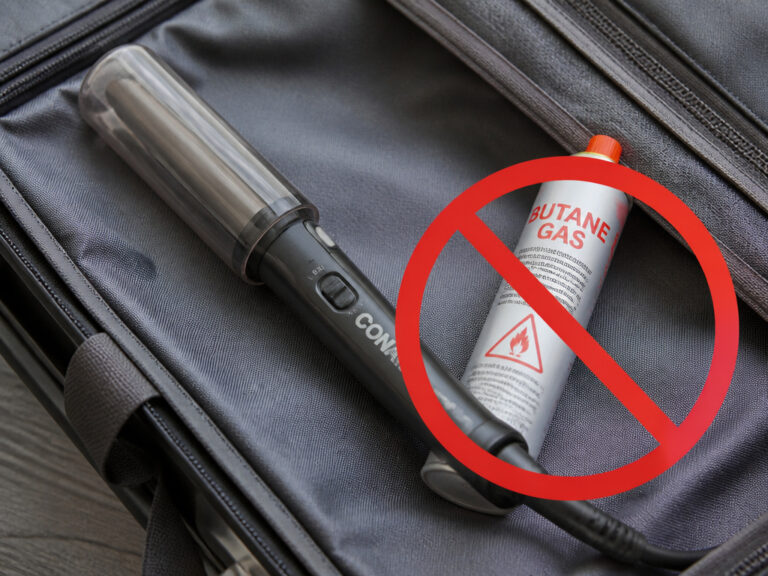
Cordless curling irons that use butane gas cartridges are allowed in carry-on bags only. The safety cap must be securely on the heating element, and the device must be protected from accidental activation. Spare gas cartridges are forbidden in both carry-on and checked bags.
What about smart bags with lithium batteries?
Bags with non-removable lithium batteries are forbidden in checked baggage. They must be carried on, and the battery must be turned off. If the battery is removable, you can check the bag only after removing the battery and carrying it in the cabin.
The Bottom Line
Packing a carry-on is about matching your items to two checklists: the TSA’s security list and the FAA’s hazardous materials list. Liquids under 3.4 oz, batteries under 100 watt-hours, and tools under 7 inches will almost always pass. Your prescription meds and baby formula get a pass on the liquid rules, but you have to speak up at security.
Double-check the TSA’s item-by-item database for anything unusual. If you’re still unsure, the FAA’s mantra applies: “When in doubt, leave it out.” Putting a questionable item in checked baggage is sometimes an option, but never for lithium batteries or anything flammable. The goal isn’t just to get through the checkpoint, it’s to get everyone to the destination safely.