Carry-On Razors: Are They Allowed? The Complete TSA Guide
This post contains affiliate links. As an Amazon Associate, we earn from qualifying purchases.
Yes, you can bring most razors in your carry-on luggage, but the rule hinges on a single, visible fact: is the blade exposed? Disposable and cartridge razors, with their enclosed plastic heads, pass without question. Electric razors are treated as electronics. Safety razors and straight razors with their blades attached are prohibited in carry-on and must go in checked baggage.
That’s the official TSA line, printed on their website. The catch is the officer at the X-ray belt holds the final card. They can flag anything that looks like a weapon, regardless of the published list. This means a safety razor handle might pass one day and get pulled the next, depending on who’s looking and how it scans.
What follows: a breakdown of the five razor types by their TSA classification, the one clause that overrides every rule, and the practical packing moves that keep you moving at security.
Key Takeaways
- The blade’s exposure is the only thing that matters. If it’s visible and removable, it’s a carry-on no-go.
- TSA officers have final discretion. Even a permitted item can be confiscated if it appears dangerous or triggers an alarm.
- Connecting flights reset the rules. An item cleared at your departure airport can be taken at a connecting airport with stricter local enforcement.
- Electric razors with lithium batteries must fly in the cabin. This is an FAA fire-safety rule, not a TSA suggestion.
- Shaving cream and gels are liquids. They must follow the 3-1-1 rule unless you’re at an airport with new CT scanners.
The 5 Razor Types & Where They Can Go
Forget brand names and marketing categories. Airport security sorts razors by one feature: can the blade be used as a weapon right now? This binary splits your shaving kit into two clear piles.
The published TSA sharp objects overview page frames it as a question of risk. An exposed edge is a risk. A blade sealed inside plastic is not. This logic explains why the rules seem contradictory until you see the line.
| Razor Type | Carry-On Luggage | Checked Luggage | Why It’s Allowed or Not |
|---|---|---|---|
| Disposable Razor (e.g., Bic) | Yes | Yes | The blade is permanently fixed inside a plastic housing. No exposed edge. |
| Cartridge Razor (e.g., Gillette Mach3, Venus) | Yes | Yes | The cutting blades are sealed inside a replaceable cartridge. No exposed edge. |
| Electric Razor / Shaver | Yes | Yes | Treated as an electronic device. The cutting mechanism is behind a metal foil or guard. |
| Safety Razor | Handle only: Yes With blade: No |
Yes | The double-edge blade is exposed, removable, and razor-sharp. The metal handle alone is inert. |
| Straight Razor (Cut-throat) | No | Yes | The entire item is a long, exposed cutting blade. It is always classified as a weapon. |
Where this goes sideways: Assuming “safety razor” means it’s safe for carry-on. The name is a historic relic. To the TSA, a safety razor with its blade fitted is a box of loose, sharp metal squares. It gets confiscated on sight.
Disposable & Cartridge Razors: The No-Stress Default
These are the workhorses of travel shaving. A Gillette Mach3 or a simple Bic disposable passes through security 99 times out of 100 because their design solves the TSA’s problem. The cutting edges are impossible to access without destroying the plastic unit. There’s no weapon to make.
Pack them anywhere. I keep a cartridge razor in my dopp kit year-round because I never have to think about it. The only minor headache is the 3-1-1 rule for your shaving gel or cream, but that’s a separate battle.
Electric Razors: The Electronics Lane
Your Braun or Philips shaver isn’t judged as a blade. It’s an appliance. The official TSA electric razor policy lists it plainly: “Carry On Bags: Yes, Checked Bags: Yes.”
You’ll still need to pull it out of your bag at security if you’re in a standard lane, just like a laptop. In a TSA PreCheck lane or at a checkpoint with new CT scanners, you can leave it packed. The real rule isn’t from the TSA—it’s from the FAA, and it concerns the battery inside.
Safety Razors: The Handle/Blade Split That Confuses Everyone
This is the most common point of failure. The TSA’s own safety razor blade rules state: “A Safety Razor is allowed through the screening checkpoint without the blade. The blade must be removed prior to entering the checkpoint.”
Common mistake: Forgetting to remove the blade at home. TSA officers are not authorized to remove it for you. If you reach the belt with the blade installed, you have two bad choices: surrender the blade (and maybe the whole razor) or exit security, find your checked bag (if you have one), and start the line over.
You can carry the bare metal handle in your carry-on. In practice, this is a hassle. You must store the loose blade safely for checked baggage or discard it. Most frequent flyers who prefer a safety razor just buy a travel cartridge razor instead.
Straight Razors: No Discussion
These are never allowed in the cabin. The long, open blade is a classic weapon profile. Pack it in checked luggage, and sheath it properly to protect baggage handlers. Even in checked bags, a straight razor should be in a hard case.
The One Rule That Overrides All Others: Officer Discretion
You can memorize the table above and still lose your razor. Every TSA page, including the Federal Register, carries this clause: “The final decision rests with the TSA officer on whether an item is allowed through the checkpoint.”
A screener has discretion to prohibit an individual from carrying an item into a sterile area… If the screener determines that the item is a weapon, explosive, or incendiary, regardless of whether the item is on the prohibited items list.
This isn’t a scare tactic. It’s the reality of security. An officer might see a safety razor handle and think it could be used as a blunt object. A cartridge razor with a worn, cracked head might look altered. An electric razor with strange internal components might trigger a secondary search where the officer simply decides it’s not worth the risk.
Your goal is to make their decision easy. Pack razors in plain sight within your toiletry kit, not buried under wires and tools. Use a clear bag for liquids. The less cluttered and suspicious your bag looks on the X-ray, the smoother it goes.
The Lithium Battery Caveat for Electric Razors
If your electric razor is cordless or rechargeable, you’ve just entered FAA territory. The FAA PackSafe passenger guide is clear: spare lithium batteries and devices containing them are strongly preferred in the cabin.
Why? A lithium battery fire in the cabin can be seen and extinguished. A fire in the cargo hold, fueled by a damaged battery in your checked razor, can be catastrophic. This is why airlines freak out about smart luggage with non-removable batteries.
For electric razors:
- Corded (plug-in) razors: No battery, no special rules. Pack anywhere.
- Cordless razors with internal batteries: Carry-on is strongly recommended. If you must check it, make sure the razor is powered off and protected from accidental activation.
- Razors with removable batteries: Take the battery out and carry it in your cabin bag. The razor body can go in checked luggage.
This rule explains the Reddit report from Auckland International, where AA batteries for an electric razor were confiscated from carry-on. The officer likely insisted they be packed in a specific, isolated way to prevent contact. Rules vary slightly by country, but the principle is global: keep potential ignition sources where they can be monitored.
Navigating Connecting Flights & International Borders
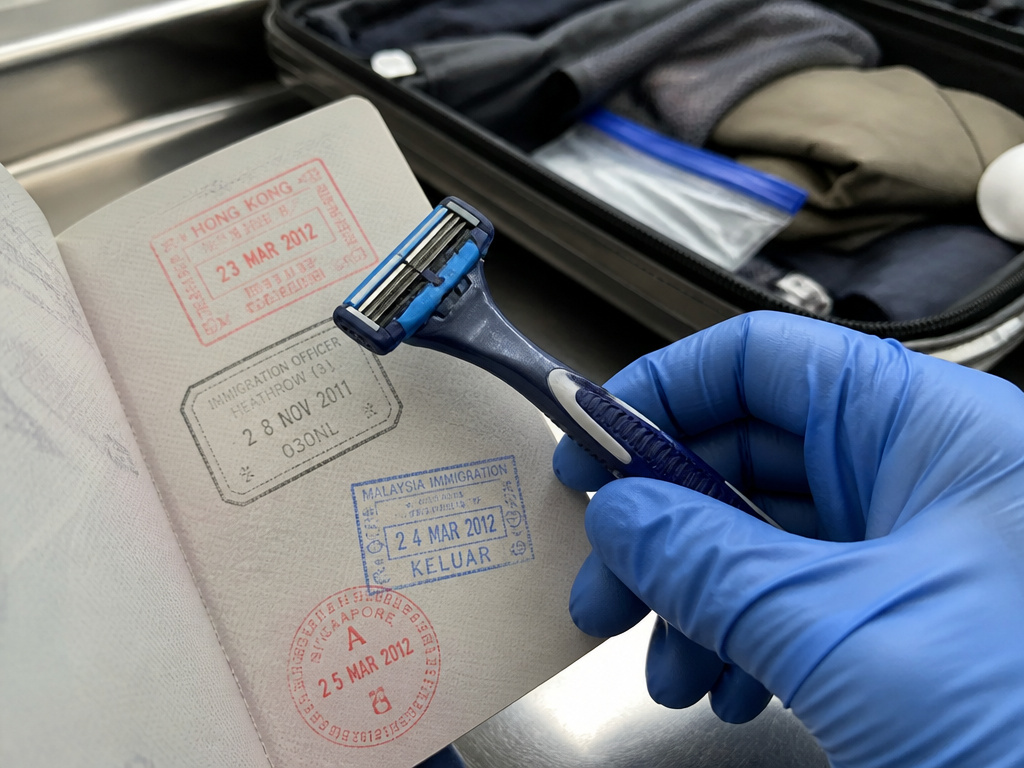
Your razor’s journey isn’t over once it clears your home airport. Security is enforced by the jurisdiction you are physically in.
- Domestic U.S. Connecting flight: TSA rules apply again at your connection. If your razor was fine in Orlando, it’ll be fine in Atlanta.
- International connection: This is the risk zone. You clear security in the country of your connection. The UK’s GOV.UK rules are similar to TSA, but other countries can be stricter. A cartridge razor accepted in the U.S. Could be questioned elsewhere.
- Final destination security: Some countries, like Israel, conduct outgoing security interviews and may inspect all bags, including carry-ons, at the gate with different criteria.
The safe play for any multi-leg international trip is to put questionable items—like a safety razor handle you’re unsure about—in checked baggage from the start. You can’t be asked to surrender what isn’t there.
Packing Your Shaving Kit for a Hass-Free Security Experience
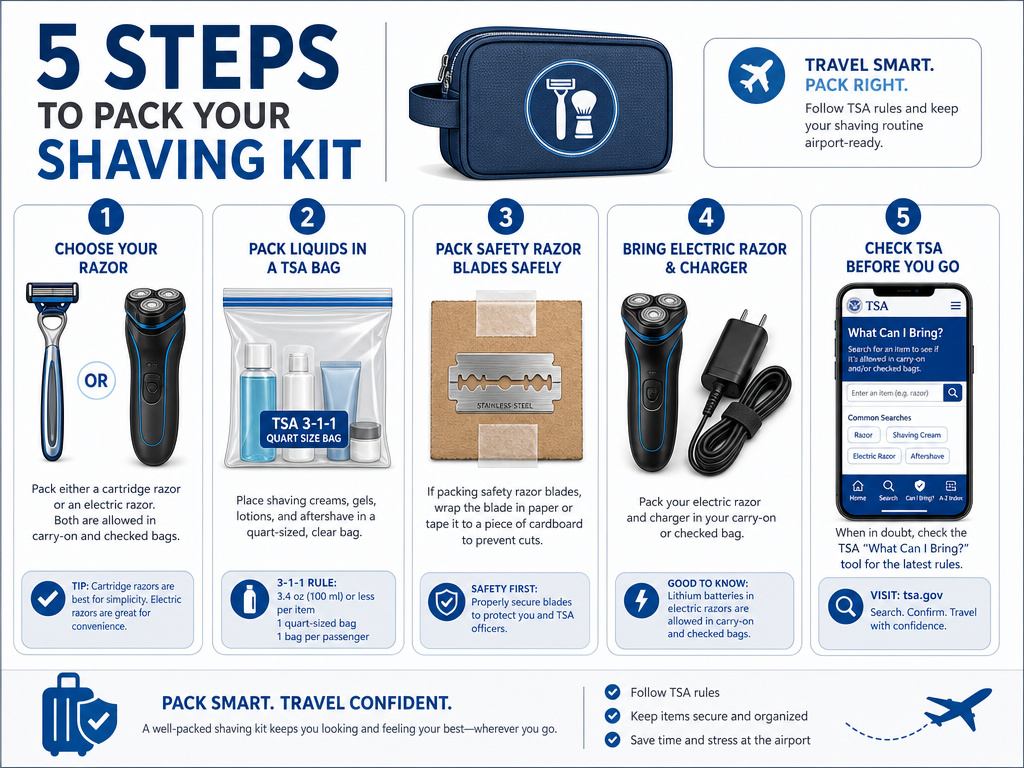
A little prep the night before beats a frantic bag dump at the checkpoint. Follow this sequence.
1. Choose your travel razor. For most people, a cartridge razor or a compact electric is the simplest. It removes all doubt. 2. Address the liquids. Shaving cream, gel, aftershave—all liquids. They go in containers 3.4 oz or less, inside one clear quart-sized bag. Solid shaving soap or a stick is a brilliant workaround. 3. Isolate sharp items. If you’re checking a safety razor blade or straight razor, wrap it in cardboard and tape, or use a dedicated blade bank. Don’t let it rattle loose. 4. Power down and pack smart. For electric razors, ensure they’re off. Pack the razor and charger together in an easy-to-access part of your carry-on. 5. Use the TSA tool. When in doubt, use the “What Can I Bring?” tool on the TSA website. It’s the official source and updates regularly.
Remember, the TSA’s list of prohibited items is your baseline, not your guarantee. Your packing strategy should build in a margin of safety around officer judgment.
Frequently Asked Questions
Can I bring a safety razor in my carry-on if I remove the blade?
Yes, but only the handle. The loose blade must go in your checked luggage. The TSA page explicitly states officers will not remove the blade for you. Practically, it’s easier to just pack the entire razor in your checked bag.
Are electric razors allowed in carry-on?
Yes. Electric razors are always permitted in carry-on luggage. The FAA recommends keeping battery-powered ones in the cabin. You may need to remove it from your bag for separate X-ray screening in standard lanes.
What happens if TSA finds a prohibited razor in my bag?
The officer will give you options. You can voluntarily surrender it, return it to your car (if time allows), or, if you have a checked bag, go back to the airline counter to stow it. You cannot proceed with it in your carry-on.
Can I bring shaving cream on the plane?
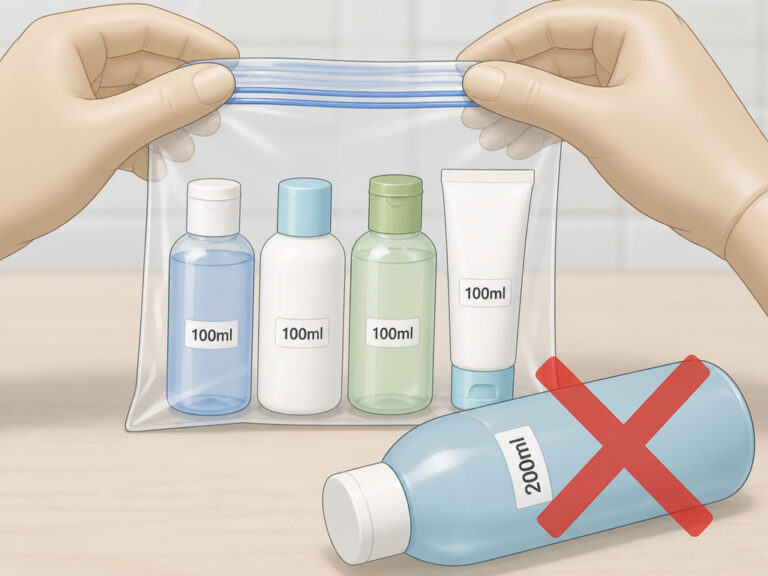
Yes, but it must follow the 3-1-1 liquids rule: containers of 3.4 ounces (100ml) or less, all fitting in one clear, quart-sized bag. Some airports with new CT scanners are relaxing this rule, but you should never assume yours has them.
Does TSA PreCheck change the razor rules?
No. TSA PreCheck does not change what is allowed. It changes the screening process: you can leave your shoes on, your liquids bag and laptop in your carry-on, and your electric razor packed. The same razor types are permitted or prohibited.
Before You Go
The rule for razors isn’t complicated, but it is absolute. If the blade can cut a baggage handler, it can’t fly in the cabin. Pack with that in mind, give the officer at the scanner no reason to take a second look, and you’ll keep your shave and your boarding time.
When you’re double-checking your razors in hand luggage, also take a moment to review your airline’s specific backpack carry-on rules. Size and weight limits for your carry-on bag and personal item are just as important as what’s inside them. Each carrier has its own policy—Delta’s rules for a backpack and carry-on differ from Southwest’s policy on backpacks and carry-ons, and budget airlines like Frontier Airlines’ backpack size and fee policy are notoriously strict. A razor is no good if your whole bag gets gate-checked.