What Size Luggage Is Carry On Delta? Official 45-Inch Rule
This post contains affiliate links. As an Amazon Associate, we earn from qualifying purchases.
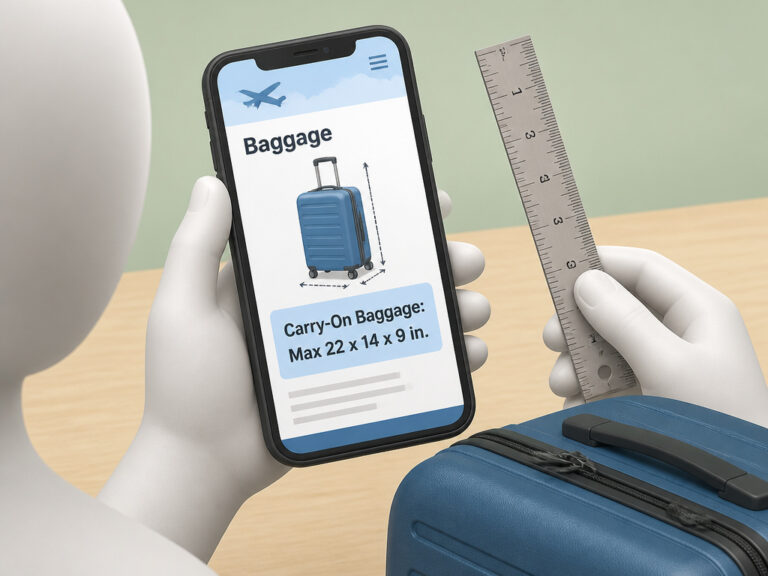
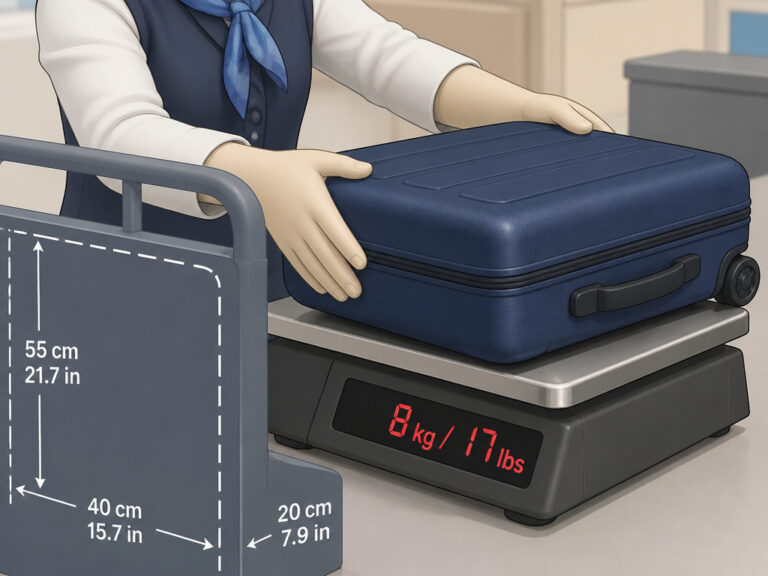
Delta’s carry-on size is 22 inches long by 14 inches wide by 9 inches deep (56x35x23 cm), including handles and wheels. This adds up to a 45-inch linear limit (length+width+height). Every passenger gets one free carry-on bag plus one personal item, but bags on Delta Connection flights with 50 seats or fewer get a pink gate-check tag every time.
That linear measurement is the number gate agents actually check. A bag that fits the 22x14x9 dimensions but bulges past 45 total inches fails. The rule comes from the FAA carry-on baggage advisory circular, which mandates all carry-on items must fit under a seat or in an enclosed storage compartment.
What follows: the three ways agents spot an oversized bag before you even reach the sizer, the aircraft types where your carry-on never flies in the cabin, and the one bag feature that guarantees a gate check.
Key Takeaways
- Delta’s 45 linear inch limit (22″x14″x9″) is stricter than the individual dimensions. A bag that measures 23″x13″x9″ fails despite fitting the 9″ depth, because 23+13+9=45.
- Delta Connection flights on aircraft with 50 seats or less do not allow full-size carry-ons in the cabin. Your bag gets a pink Gate Claim/Planeside tag and is returned at the jetbridge.
- Gate agents use a metal sizer box at major hubs. A hard-shell bag with an expansion zipper unzipped even one inch will not drop in cleanly, triggering a $35–$65 checked bag fee.
- Delta publishes no carry-on weight limit for most routes. Singapore routes cap carry-ons at 7 kg (15 lbs); Beijing and Shanghai routes cap them at 10 kg (22 lbs).
- The personal item has no published dimensions. It must fit under the seat in front of you. A backpack stuffed into an overhead bin counts as your carry-on, not your personal item.
The 22x14x9 Rule and the 45-Inch Linear Limit
Look at your bag’s manufacturer tag. Many list dimensions like 22″x14″x9″. That matches Delta’s specific Delta Air Lines carry-on dimensions. The catch is the plus sign.
Delta’s carry-on bag cannot exceed 22 x 14 x 9 inches (56 x 35 x 23 cm) including handles and wheels. The Federal Aviation Administration (FAA) mandates that all carry-on items fit under a seat or in an enclosed storage compartment, and Delta uses a 45-inch linear total (length+width+height) to enforce this.
The linear limit is the real filter. It catches bags that are slightly over in one dimension but under in another. A 23-inch tall bag that is only 13 inches wide and 9 inches deep hits 45 linear inches exactly. That bag fails. The sizer box is a 22x14x9 metal frame; the 23-inch bag will not drop in.
This is not a suggestion. The FAA advisory circular on baggage gives airlines the framework, and Delta’s policy is the implementation. Your bag must fit in an overhead bin or under the seat without forcing the bin door. Flight attendants are not allowed to help you stow it, so if you can’t lift it and seat it cleanly, it’s getting tagged.
| Dimension | Delta’s Limit (Inches) | Delta’s Limit (Centimeters) | What It Includes |
|---|---|---|---|
| Length | 22″ | 56 cm | Handle extended |
| Width | 14″ | 35 cm | Wheels & side pockets |
| Depth | 9″ | 23 cm | Any expansion zipper |
| Linear Total | 45″ | 114 cm | L + W + D |
Why does the linear total matter? Overhead bin compartments are rectangular spaces. A bag that is too long, even if slim, can block the bin latch. A bag that is too wide can prevent the bin from closing. The 45-inch rule ensures the bag’s volume fits the bin’s usable space.
Where this goes sideways: Measuring your bag empty at home. A soft-sided suitcase packed full gains an inch in every dimension. The seams strain. The sizer box at Gate B24 measures what you’re holding, not what the tag said in the store.
How Delta Actually Enforces Carry-On Size at the Gate
Delta does not weigh carry-ons on domestic routes. They measure. Enforcement is a three-step funnel that starts before you reach the podium.
First, visual profiling. An experienced gate agent spots an oversized bag from 20 feet away. Common triggers are a hard-shell bowed outward at the sides, a soft-sided bag with seams clearly straining, or two smaller bags bundled together to look like one carry-on. The agent isn’t trying to ruin your trip. They are managing boarding speed under time pressure, and they’ve seen every trick.
Second, the metal sizer box. Many Delta gates, consistently at Atlanta (ATL), New York (JFK), Los Angeles (LAX), and Seattle (SEA), have a physical metal frame at the podium. The test is simple: your bag must drop into it cleanly with the handle collapsed and no forcing. You don’t get to angle it.
Third, the pink tag. If your bag fails the sizer, or if you are on a Delta Connection flight with 50 seats or less, it gets a pink Gate Claim/Planeside tag. The bag is valet-checked and loaded in the cargo bin. You pick it up on the jetbridge after landing, not at baggage claim. This service is free, but it adds 10-15 minutes to your deplaning time.
Common mistake: Assuming a “carry-on sized” bag is always compliant. Manufacturers label bags as “carry-on” based on a generic 22-inch height. They often ignore the 14-inch width and 9-inch depth, producing bags that are 22x15x10. That’s 47 linear inches, two inches over Delta’s limit.
The carry-on size limit is absolute during busy periods. On a half-full Tuesday morning flight, you might slide through. On a Sunday evening flight from a hub, the sizer comes out and the pink tags flow.
The Delta Connection Pink-Tag Rule (50 Seats or Less)
This is the policy that surprises travelers most. If your flight is operated by a Delta Connection carrier on an aircraft with 50 seats or fewer, you are only permitted a personal item in the cabin.
Your full-size carry-on gets a pink tag every single time. There is no discretion. The overhead bins on these regional jets, like the Bombardier CRJ-200, are physically too small for standard roll-aboard luggage. The carry-on allowance changes from two bags to one.
| Flight Type | Carry-On Allowed in Cabin? | Personal Item | What Happens to Your Carry-On |
|---|---|---|---|
| Mainline Delta (A320, 737, etc.) | Yes | Yes | Overhead bin |
| Delta Connection (51+ seats) | Yes | Yes | Overhead bin (space is tight) |
| Delta Connection (≤50 seats) | No | Yes | Pink-tagged, gate-checked |
How do you know your aircraft type? Check your reservation on Delta.com or the Fly Delta app. The aircraft model is listed next to the flight number. If you see “CRJ-200,” “ERJ-145,” or “Embraer 175,” assume the pink tag.
Assistive devices like wheelchairs or CPAP machines are exempt from this restriction. They are not counted toward your Delta personal item policy limit. The same exemption applies to child safety seats and strollers.
Skip this if: You are traveling with a crew-approved bag like the Travelpro Platinum Elite. Even a compliant bag on a 50-seat jet gets tagged. The rule is about aircraft capacity, not your bag’s dimensions.
Hard Shell vs Soft-Sided: The Sizer Box Showdown
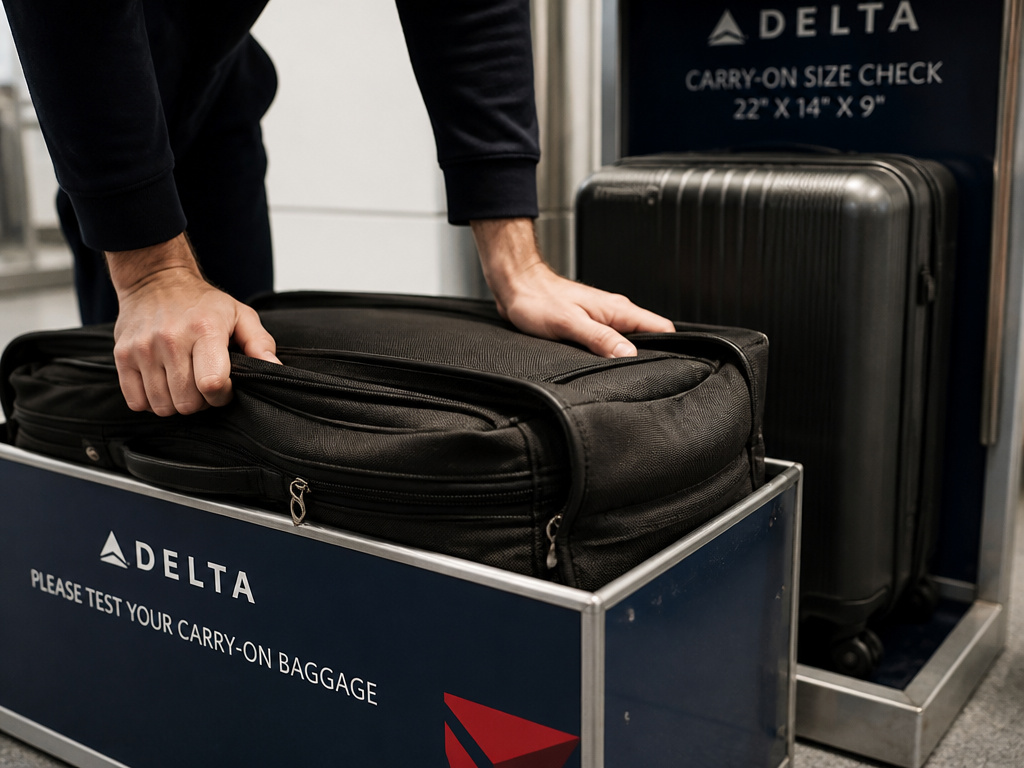
Your bag’s construction decides whether you pass the metal frame test. This is where the guide to measuring carry-on luggage meets material science.
Hard-shell suitcases (polycarbonate or aluminum) maintain their shape. A 22x14x9 hard-shell measures 22x14x9 when empty and when full. That consistency is an advantage at the sizer box. The Away The Carry-On is built to this exact spec, 55.9cm x 35.6cm x 22.9cm. It pushes right to the limit.
The weakness is the expansion zipper. Unzip it even one inch, and a 22-inch hard-shell becomes a 23-inch bag. The sizer box doesn’t know or care what it measured at the factory. It measures what you’re holding. If you used the expansion, you fail.
Soft-sided suitcases (nylon or polyester) compress. You can often overpack them and still squeeze them into the sizer with a firm push. This is a short-term victory. A bag forced into an overhead bin puts pressure on the bin door and the latch. If a flight attendant cannot close the bin without using force, your bag comes out. It gets a pink tag.
The part nobody mentions: Wheels and handles are included in the 22-inch height. A bag with bulky inline skate wheels or a protruding telescopic handle loses an inch of interior space. The Samsonite Winfield 3 DLX accounts for this; its wheels are recessed and the handle collapses flush.
For most travelers, a hard-shell like the Away or Samsonite is the safer bet for consistent sizing. For the frequent flyer who needs to cram in one more item, a soft-sided bag like the Travelpro offers forgiveness, but only if you’re willing to play compression roulette at the gate.
Personal Items, Basic Economy, and What “Fits Under the Seat” Really Means
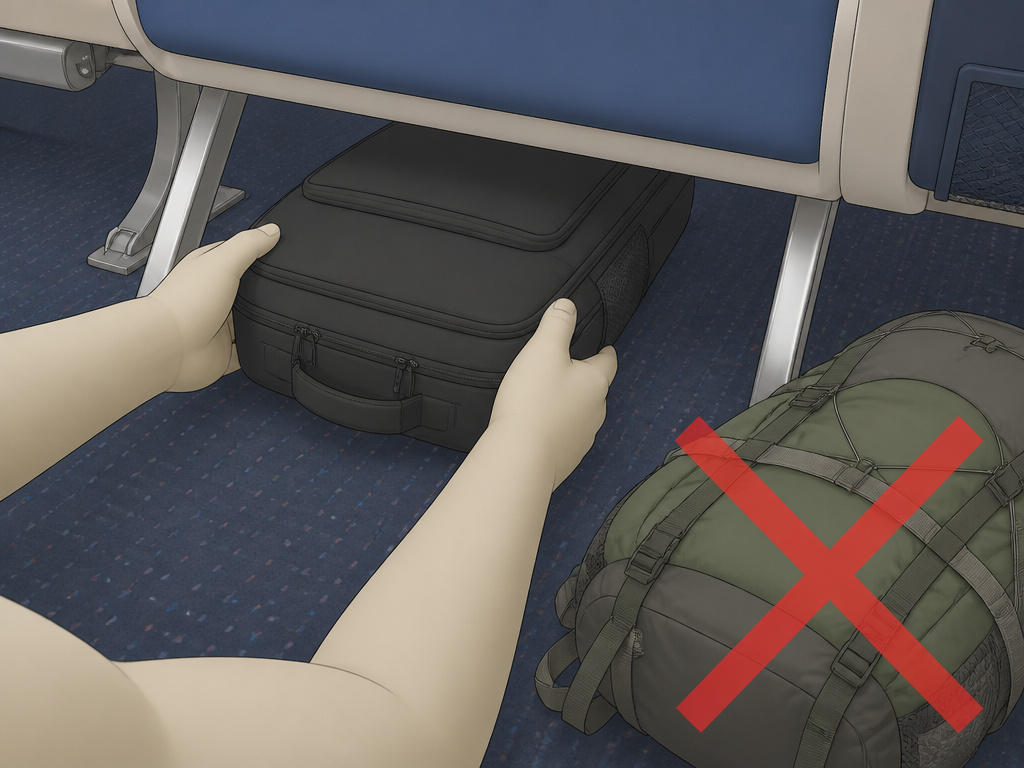
Delta’s personal item has no published dimensions. The rule is functional: it must fit under the seat in front of you. This is separate from your carry-on plus backpack allowance.
A standard laptop backpack or a medium purse almost always qualifies. A stuffed 40-liter hiking backpack does not. If you have to force it under the seat, encroach on your legroom, or lift the seat to wedge it in, it’s too big. In that case, the flight attendant may ask you to stow it in the overhead bin. That action converts your personal item into your carry-on for that flight. Your roll-aboard would then need to be checked.
Delta Main Basic (Basic Economy) includes a free carry-on bag on domestic routes. This is a key difference from United, which bans full-size carry-ons for its Basic Economy passengers. The catch is boarding order. Main Basic boards in Group 8, last. On a full flight, overhead bins fill by Group 5. If you board late and the bins are full, your carry-on will be gate-checked. You still get it back at the jetbridge, but you lose bin access.
On transatlantic routes to/from Europe, Delta Main Basic changes: personal item only, no carry-on. This rule catches travelers who researched domestic policy and assumed it applied everywhere. A carry-on brought to the gate will be checked, and regular checked bag fees apply.
The short version: Your personal item is a small backpack, purse, or laptop bag. If you can’t slide it under the seat with one hand, it’s not a personal item. On a small regional jet, that under-seat space is even smaller.
Carry-On Weight Limits and International Exceptions

For most Delta flights, there is no published carry-on weight limit. You will almost never see a scale at a domestic gate. The airline carry-on weight limits are a non-issue within the U.S.
Two exceptions exist for international routes, dictated by the destination country’s regulations: 1. Singapore routes: Carry-ons are capped at 7 kg (approximately 15 lbs). 2. Beijing and Shanghai routes: Carry-ons are capped at 10 kg (approximately 22 lbs).
These weight limits are enforced at the initial check-in counter for your itinerary. If you have a connecting flight, the limit applies at the start of your journey. A bag over the limit must be checked, and standard checked bag fees apply.
Why the weight limit on only some routes? It’s about ground handling infrastructure and local aviation authority rules. Singapore’s Changi Airport, for example, has strict rules on manual handling weights for baggage loaded into overhead bins.
Domestically, the only weight concern is your own ability to lift the bag. Flight attendants cannot assist you. If you struggle to heave a 40-pound bag into the overhead, you’ll draw attention from the gate agent on your next flight. They remember faces.
Frequently Asked Questions
Does a 22-inch suitcase always count as a Delta carry-on?
Not always. A 22-inch carry-on must also be no wider than 14 inches and no deeper than 9 inches. Many 22-inch suitcases are 15 inches wide or 10 inches deep, putting them over the 45 linear inch limit. Check all three dimensions.
Can I bring a carry-on and a backpack on Delta?
Yes. Delta’s two-bag rule allows one carry-on for the overhead bin and one personal item (like a backpack) for under the seat. If your backpack is too large and must go overhead, it becomes your carry-on, and your roll-aboard would need to be checked.
How does Delta’s size compare to Southwest’s?
Delta’s 22″x14″x9″ (45 linear inches) is identical to the Southwest carry-on size. The major difference is that Southwest has no “Basic Economy” fare that restricts bin access; all passengers get the same carry-on rights regardless of boarding group.
What if my carry-on is slightly too big?
If it fails the sizer box at the gate, you have two options. You can pay the standard checked bag fee ($45 for the first bag domestically) and check it to your final destination. Or, if space allows, the agent may pink-tag it for free gate-check, returning it to you on the jetbridge.
Are diaper bags considered a personal item?
Officially, yes. Delta’s policy states a diaper bag counts as your carry-on or personal item. In practice, many gate agents will allow it as an extra item if you are traveling with an infant. This is not guaranteed, so don’t pack essentials in a diaper bag you may be forced to check.
Before You Go
Delta’s carry-on size rules are clear: 22x14x9 inches, 45 linear inches total. The sizer box at major hubs is real. The pink-tag rule for small regional jets is absolute.
Buy a bag built to that exact specification, like the Away The Carry-On or the Samsonite Winfield 3 DLX. Never use the expansion zipper. Assume your bag will be gate-checked on any flight operated by a 50-seat regional jet.
Measure your packed bag at home, including wheels and handles. If the sum of length, width, and depth is 45 inches or less, you’ll walk past the sizer. If it’s 46, you’re rolling the dice.