How to Measure Carry On Luggage: The Official 3-Step Rule
This post contains affiliate links. As an Amazon Associate, we earn from qualifying purchases.
Measure your carry-on luggage from the bottom of the wheels to the top of the handle, across the widest point for width, and from the deepest front pocket to the back. Those three numbers, height, width, depth, must each be less than or equal to your airline’s published dimensions, with the bag fully packed. A bag marketed as “22-inch” often measures 23.5 inches when you include the wheels and handle.
The difference between those two numbers is where the gate-check fee hits. The airline’s sizer is a rigid metal box; if your bag doesn’t slide in with the handle up, you pay. This process involves matching a physical object to a fixed aperture under the watch of an agent with a quota.
What follows: the FAA’s official measurement method, the three places every soft-sided bag fails, and the one spec you must verify on your airline’s website before you ever pack a sock.
Key Takeaways
- The FAA’s official measurement starts at the bottom of the wheels, not the base of the bag. Missing this adds an inch you’ll lose at the gate.
- Marketing labels lie. A “22-inch” bag is often 23.5 inches with the handle up. Always measure the actual object, not the tag.
- Measure your bag fully packed. Soft-sided luggage can bulge 2 inches at the seams, turning a compliant empty shell into an oversize liability.
- Frontier and Southwest use larger sizers (25x16x10 in and 24x16x10 in) than the standard 22x14x9 in used by Delta, American, and United. Flying the wrong airline with a maxed-out bag is a guaranteed check.
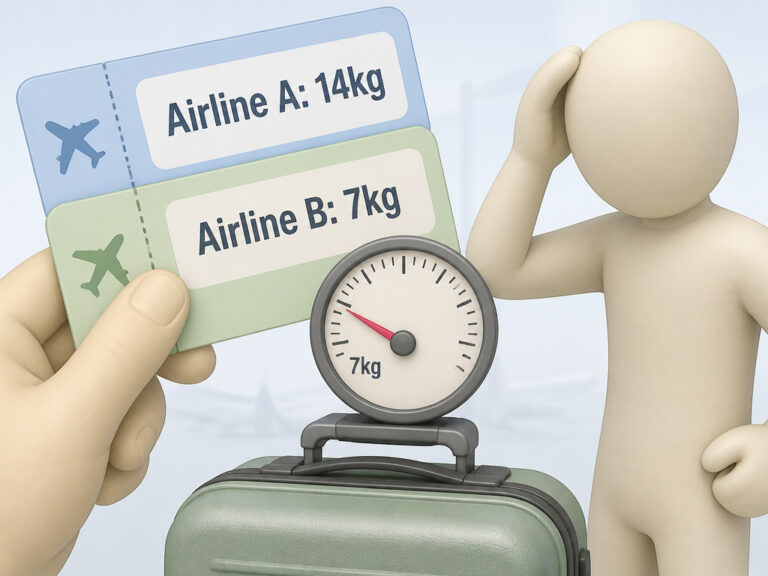
- International and budget carriers enforce weight limits between 15 and 22 pounds. A compliant-size bag over the weight limit still gets checked.
The 3-Step FAA Measurement Method (With Pictures)
Forget the “standard” advice. The FAA’s Advisory Circular 121-29B outlines the real procedure airlines use to judge stowage, and it’s the only method that matches what a gate agent sees. The goal is to see if your bag fits in a specific overhead bin without force, blocking the aisle, or falling out when the door opens.
Step 1: Measure Height from the Floor Up
Place your bag upright on a hard floor. Extend the handle fully. Run a flexible measuring tape from the floor (the very bottom of the wheels or feet) straight up to the highest point of the extended handle. This is your bag’s true height. The rigid metal sizer at the gate includes this exact clearance.
Common mistake: Measuring from the bottom of the bag’s shell, not the wheels. Wheels add between 0.5 and 1.5 inches. That half-inch overage is the difference between boarding and a $65 gate-check fee.
Step 2: Measure Width at the Widest Point
Width is the side-to-side measurement. For a rectangular suitcase, this is usually straightforward. For bags with curved sides or bulging pockets, you must find the widest point. Place the tape across the bag’s belly, not its tapered top. Include any side handles or compression straps that protrude.
Step 3: Measure Depth from Front to Back, Fully Packed
This is where soft-sided bags fail. Depth is the front-to-back measurement. For hard-shell luggage, measure from the most forward point (often a front pocket zipper) to the very back of the shell. For soft bags, you must measure them fully packed. An empty duffel might be 9 inches deep; stuffed, it can bulge to 11.
| Measurement | What to Include | Tool to Use | The Penalty for Getting It Wrong |
|---|---|---|---|
| Height | Bottom of wheels/feet to top of fully extended handle. | Flexible measuring tape. | Bag won’t slide into the sizer; automatic gate check. |
| Width | The absolute widest point, including side handles and any bulge. | Flexible measuring tape. | Bag jams in the sizer or blocks the aisle during stowage. |
| Depth | Deepest front point to the very back, with the bag fully packed. | Flexible measuring tape, with the bag packed. | Bag protrudes into the aisle from the overhead bin, a direct FAA violation. |
Once you have your three numbers, compare them directly to your airline’s published carry-on dimensions. Do not add them together yet, that’s for linear inches, which is a separate check some airlines use.
Why Your “22-Inch” Bag Is Probably 23.5 Inches
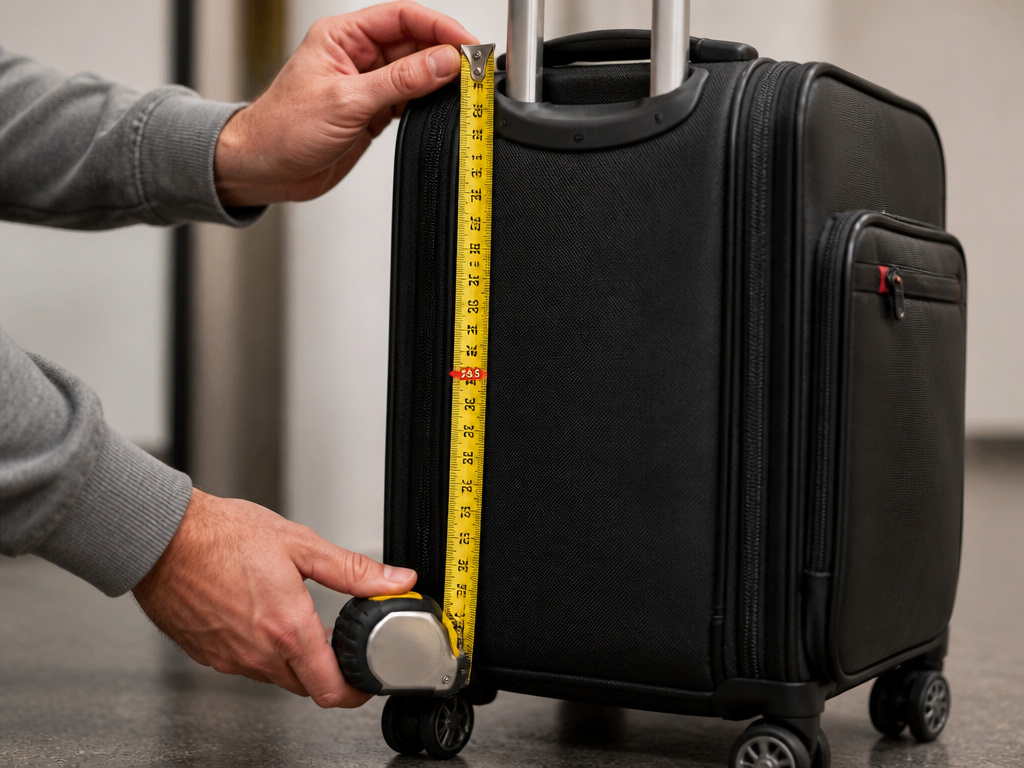 Luggage brands measure the shell, not the travel-ready object. The Samsonite Winfield 2, marketed as a 22-inch carry-on, measures 23.5 inches tall with the handle up. The Briggs & Riley Baseline 22″ is better, coming in at 21.75 inches with the handle included, but you only know that if you check the spec sheet or measure it yourself.
This discrepancy reveals how the industry sells bags that look compliant on a store shelf but fail at the jet bridge. The sizer doesn’t care about the marketing label on your tag.
Where this goes sideways: Assuming the number on the tag is the number the airline uses. It’s not. The airline uses the external dimensions of the bag as presented for stowage, wheels and handle included.
Your defense is a tape measure and the manufacturer’s detailed spec sheet, not the big font on the sales page. Before you buy, search for the model number and “dimensions with wheels and handle.” If you can’t find it, assume the bag is at least 1.5 inches taller than advertised.
Hard-Shell vs. Soft-Sided: A Measurement That Actually Works
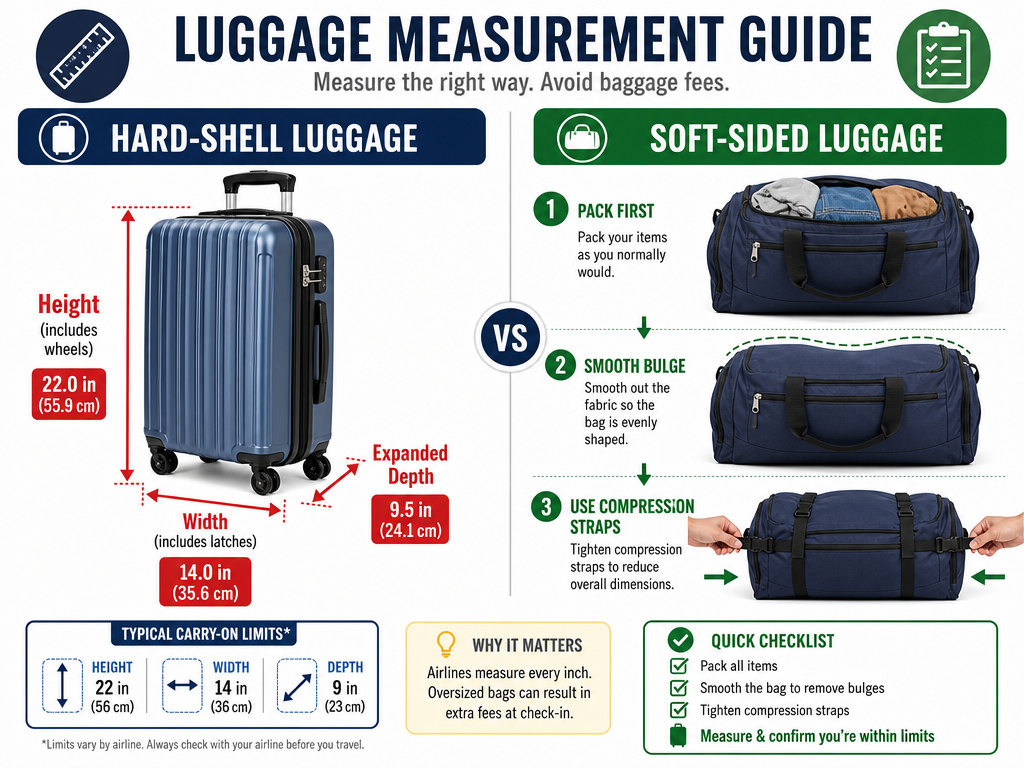 The material changes the game. A hard-shell spinner has fixed dimensions. A soft-sided duffel or backpack is a shape-shifter. Your measurement technique must adapt.
For Hard-Shell Luggage (Spinners, Clamshells)
The dimensions are fixed, but the devil is in the protrusions. 1. Wheels and feet are part of the height. Period. 2. Side-mounted TSA locks or latches count toward width. If they stick out 0.25 inches, add that. 3. Measure with the bag empty but expanded if it has an expansion zipper. That extra inch is unusable on most airlines.
For Soft-Sided Luggage (Duffels, Backpacks, Rollers)
You are measuring potential, not reality. A half-full bag is a liar. 1. Pack it first. Fill it with the clothes and shoes you intend to travel with. This is non-negotiable. 2. Smooth out the bulge. Use your hands to press the bag into its natural packed shape, then measure. 3. Compression straps are your friend. Pull them tight before measuring to minimize depth.
The table below shows where each type typically fails the sizer test.
| Bag Type | Most Common Failure Point | Why It Happens | The Fix |
|---|---|---|---|
| Hard-Shell Spinner | Height (wheels + handle) | Brand measures the shell; airline measures wheels to handle. | Subtract 1.5 inches from the airline’s limit before shopping. |
| Soft-Sided Roller | Depth (front to back bulge) | Bag appears slim empty, bulges when packed. | Measure fully packed, with compression straps engaged. |
| Travel Backpack | Width (overstuffed sides) | Packing cubes and extra layers push width beyond specs. | Use a narrower packing cube system and don’t overstuff the main compartment. |
| Duffel Bag | All three dimensions | Unstructured fabric expands in every direction when full. | Choose a duffel rated 2 inches smaller than your airline’s limit in every dimension. |
What Airlines Actually Measure (It’s Not Just Size)
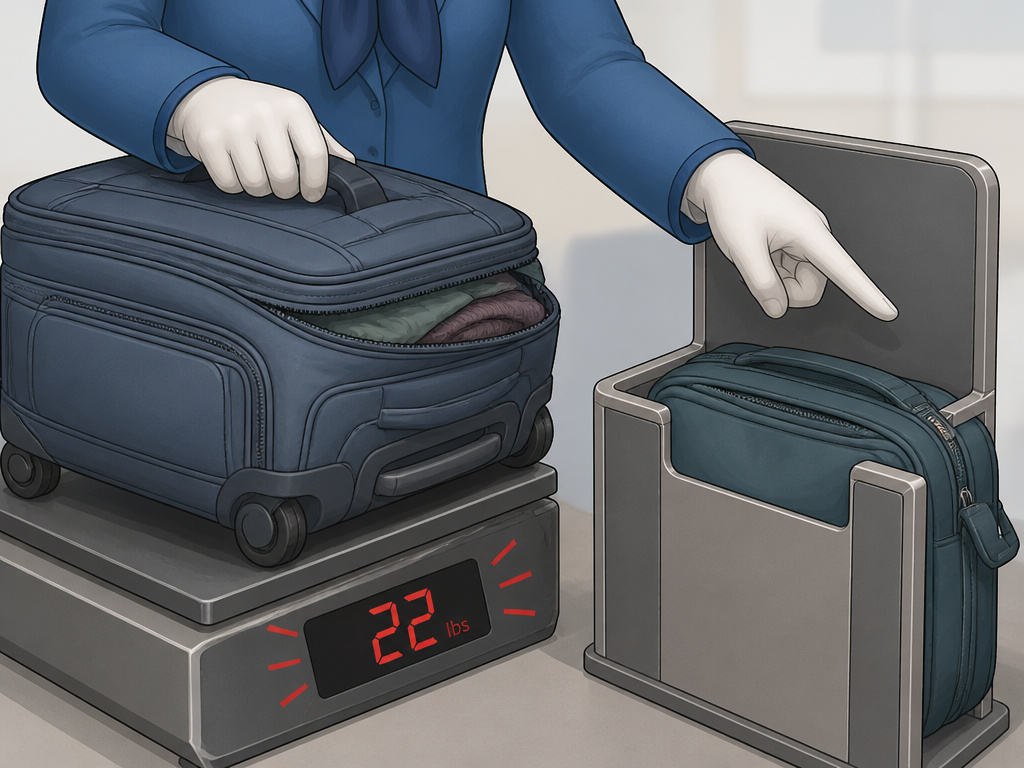 A gate agent’s job is to get the plane boarded on time with all bags safely stowed. The sizer is their tool, but their eyes are trained on two other factors: weight and bin fit.
The Weight Check You Didn’t Expect
Most major US carriers (Delta, American, United, JetBlue) don’t publish a carry-on weight limit. But many international and budget airlines do, and they enforce it. Emirates, Qatar Airways, and Singapore Airlines cap carry-ons at 15 pounds. Ryanair and Vueling use a 22-pound limit. A British Airways business-class passenger gets 51 pounds.
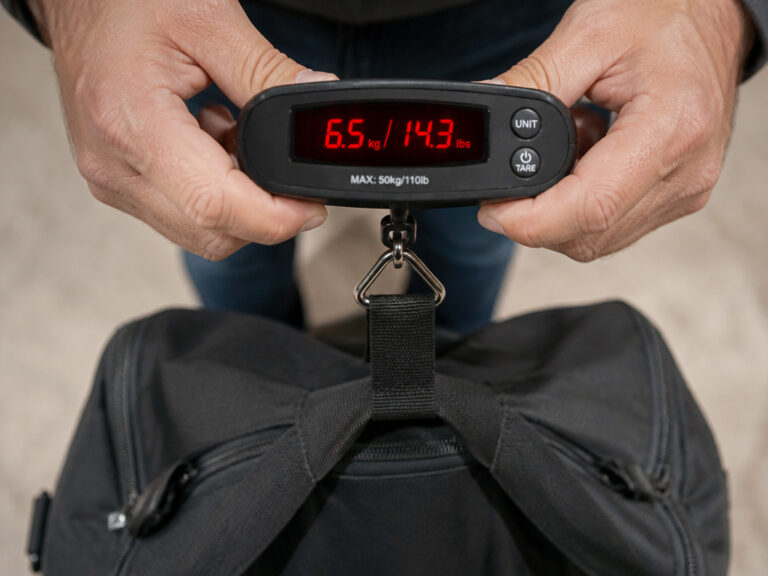
If your bag looks heavy, they will weigh it. A compliant-size bag over the weight limit still gets tagged for the hold.
The “Bin Fit” Rule
This comes straight from the FAA advisory circular on baggage. Flight attendants are instructed to ensure bags fit securely in overhead bins “without using force” and that there is “little or no chance of baggage falling out when the bin doors are opened.” If your bag is a tight squeeze or you have to jam it in, it’s technically non-compliant. An agent can, and will, ask you to check it.
Carry-On Size Limits: A Side-by-Side Airline Guide
There is no single standard. The most common U.S. Limit is 22 x 14 x 9 inches. The most generous common limit is Frontier’s 25 x 16 x 10 inches. The strictest common limit is 55 x 38 x 20 cm (21.7 x 15 x 7.9 inches) used by Emirates, Qatar Airways, and others.
You must check your specific airline. Here’s a quick reference for U.S. Carriers:
| Airline | Carry-On Dimensions (H x W x D) | Weight Limit | The Catch |
|---|---|---|---|
| Delta, American, United, Alaska, JetBlue | 22 x 14 x 9 in | Usually none | The “standard” size. Bags marketed as 22-inch often exceed this. |
| Southwest Airlines | 24 x 16 x 10 in | None | More generous depth. A bag that’s tight on Delta might fit here. |
| Frontier Airlines | 25 x 16 x 10 in | 35 lbs | Largest standard sizer. But they charge for carry-ons on most fares. |
| Hawaiian Airlines | 22 x 14 x 9 in | 25 lbs | Standard size but with a strictly enforced weight limit. |
| Allegiant Air | 22 x 16 x 10 in | None | Standard height, wider and deeper. Good for bulkier items. |
International carriers are a different story. They are stricter, and weight limits are the rule, not the exception. Always verify the carry-on luggage size limits for your specific carrier and route on their official website 24 hours before departure. Basic economy fares often have different, and more restrictive, rules.
How to Use Linear Inches (And When It Matters)
Some airlines, like Air Canada and Delta for certain international routes, use a “linear inches” rule. This is the sum of your bag’s height, width, and depth. The common maximum is 45 linear inches (22+14+9=45).
Calculate: Height + Width + Depth = Total Linear Inches.
Check: Is the total at or under your airline’s limit (often 45″)?
This system benefits oddly-shaped bags that might fail one dimension but are small in the others. A long, thin bag might be 24x12x9 (45 linear inches) and pass, even though its height exceeds the standard 22-inch rule. However, if an airline lists both dimensional limits and a linear inch limit, you must satisfy both.
The Personal Item Loophole (And Its Limits)
Your personal item, a backpack, purse, or laptop bag, is your backup space. Most airlines require it to fit under the seat in front of you. Standard dimensions are around 18 x 14 x 8 inches, but many airlines, like Delta and Southwest, just use a “fit under the seat” test.
This is not a free pass for a second carry-on. If your personal item is too bulky, the flight attendant can require you to stow it overhead, consuming your carry-on space. If the overheads are full, that bag may be gate-checked. The best personal items are slim and compressible.
Frequently Asked Questions
What if my carry-on is slightly over the size limit?
If it’s soft-sided, you might get away with underpacking it so it compresses into the sizer. If it’s hard-sided or you’re flying a strict budget airline like Ryanair, you will be charged. “Slightly over” is still over. The sizer is metal and does not flex.
Do I include the wheels when measuring carry on luggage?
Yes. Always. The FAA carry-on baggage advisory circular defines stowage dimensions as the bag’s external measurements, including all protruding parts. The sizer box accounts for wheel height. If your wheels add an inch, your bag needs to be an inch shorter in the shell.
How can I find my airline’s exact carry-on size?
Go to the airline’s official website, navigate to “Baggage” or “Travel Info,” and look for “carry-on baggage” or “cabin baggage” rules. Do not rely on third-party travel sites, as airline policies change. Bookmark the page and check again before you fly.
Is a backpack considered a carry-on or a personal item?
It depends on its size. If it fits under the seat in front of you (typically under 18x14x8 inches), it’s a personal item. If you need to put it in the overhead bin, it’s your carry-on. You cannot bring two items that both require overhead space.
What happens if my bag doesn’t fit in the overhead bin?
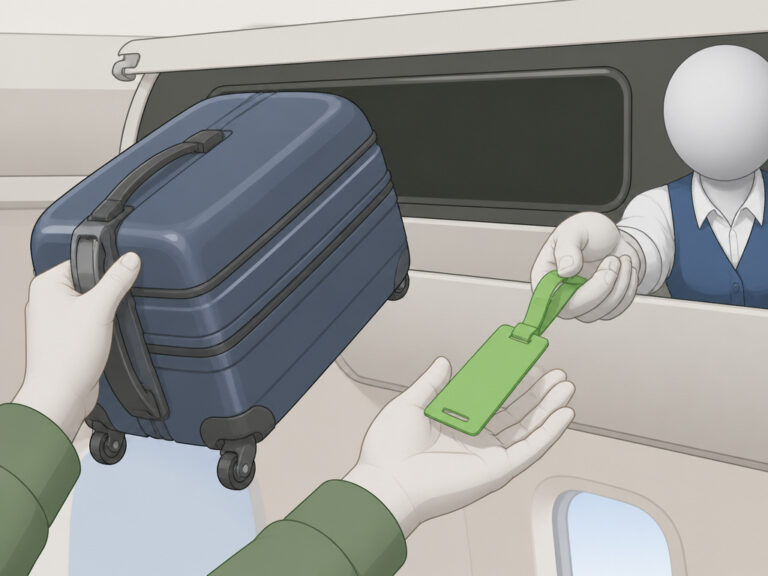
The flight attendant will tag it and send it to the aircraft’s hold. You’ll collect it at baggage claim, not the jet bridge. On many airlines, gate-checking a bag that was deemed too large is more expensive than checking it at the ticket counter.
Before You Go
Measure your bag with a flexible measuring tape, wheels to handle, fully packed. Then check your airline’s website for the numbers. Not the marketing tag, not last year’s rule, today’s rule. The maximum carry-on size for your specific flight is the only spec that matters. Trust the tape, not the tag. That five-minute check is cheaper than a $65 surprise at the gate.