What Is the Carry-On Luggage Size Limit? | The 3-Spec Rule
This post contains affiliate links. As an Amazon Associate, we earn from qualifying purchases.
The size limit for carry-on luggage is a 3-part rule you must check for your specific airline: 1) the maximum dimensions (often 22 x 14 x 9 inches), 2) the linear-inch total (often 45 inches), and 3) any weight limit (starting around 11 lb). These measurements always include wheels, handles, and external pockets. The most common standard, per IATA and FAA guidelines, is 22 x 14 x 9 inches or 56 x 45 x 25 cm.
That 22 x 14 x 9 inch box is the gate agent’s visual benchmark. If your bag visibly bulges past those lines, you’re flagged before a tape measure comes out. The real limit isn’t a single number, it’s the strictest rule among the three that apply to your ticket, your aircraft, and the gate agent’s discretion on a full flight.
What follows: the exact numbers from primary sources, the difference between linear-inch and dimensional math, and the specific airlines where the standard rules bend or break. By the end, you’ll know which bag to grab and how to pack it so the sizer box never becomes a problem.
Key Takeaways
- The IATA’s global reference is 56 x 45 x 25 cm (22 x 18 x 10 in), but most US airlines enforce a tighter 22 x 14 x 9 inch box for overhead bin compatibility.
- Linear-inch totals (length + width + height) matter for airlines like Delta and American; 45 inches is the common ceiling, but your bag must also fit the individual dimension limits.
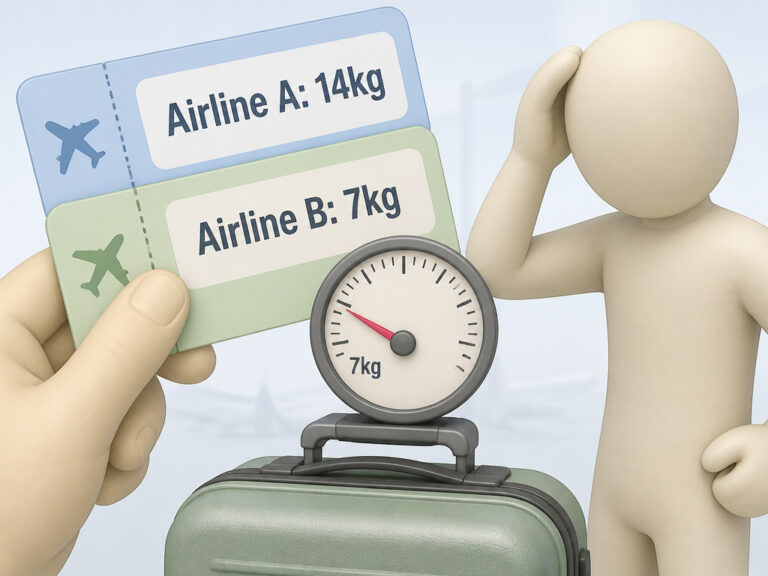
- Weight limits for carry-ons are standard outside the US, often starting at 5 kg (11 lb), and are strictly enforced by European and Asian carriers.
- Regional jets (50 seats or less) often ban standard roll-aboards; only a personal item that fits under-seat is permitted.
- Enforcement is visual in the US but mechanical in Europe, where gate sizer boxes are common and non-compliant bags incur immediate fees.
The Standard Carry-On Size Limit (IATA & FAA)
You need two numbers, not one. The first is the industry baseline. The second is the operational reality inside the aircraft cabin.
The International Air Transport Association (IATA) sets a general reference for global airlines: 56 x 45 x 25 cm, or about 22 x 18 x 10 inches. This figure, published in their official passenger baggage rules, includes every external protrusion. Think of it as the outer envelope for what could be allowed. IATA also notes that weight limits commonly start at 5 kg (11 lb).
Where this goes sideways: Assuming the IATA dimensions are your airline’s policy. They are a reference, not a guarantee. Most US carriers use a smaller box to ensure bins close without force, which is an FAA safety mandate.
The Federal Aviation Administration (FAA) doesn’t set a universal size. Instead, its Advisory Circular AC121-29B mandates that airlines must have a program to ensure carry-ons are stowed safely. The critical line: “flight attendants should not place items in overhead bins that exceed bin weight limits and that they should be able to close the bins without using force.” This is why the 22 x 14 x 9 inch rule emerged, it’s the approximate internal dimension of a standard overhead bin on a Boeing 737 or Airbus A320.
So your bag must satisfy two masters: the airline’s published policy (derived from bin size) and the FAA’s requirement that it be stowable without a struggle. A bag that fits the 22x18x10 IATA reference but is a soft-sided duffel crammed to bursting will fail the “close without force” test every time.
How Airlines Measure: Dimensions vs. Linear Inches
This is the calculation that catches people. There are two measurement systems, and some airlines use both.
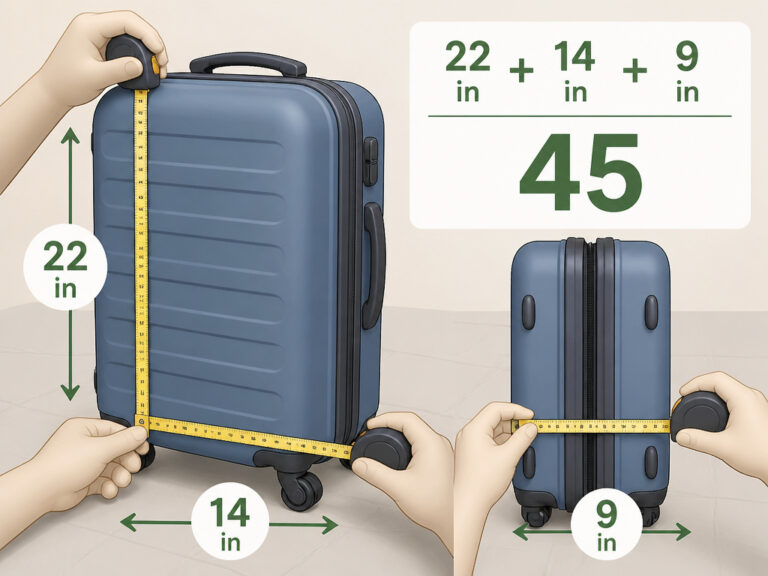
Dimensional Limits are the most straightforward: your bag’s height, width, and depth must each be less than or equal to the airline’s maximum for that dimension. For example, a 22 x 14 x 9 inch rule means your bag can be 22″ tall, 14″ wide, and 9″ deep. Exceed any one of those, and you’re over.
Linear Inches is a sum. You add the bag’s length, width, and height together. A common limit is 45 linear inches. A bag measuring 22 x 14 x 9 inches equals 45 linear inches exactly (22+14+9=45). This system gives you flexibility, a bag that’s 20 x 15 x 10 inches also equals 45 linear inches.
Common mistake: Buying a bag marketed as “45 linear inch compliant” without checking the individual dimensions. Delta’s policy is the clearest example: your bag must not exceed 45 linear inches total AND each individual dimension must not exceed 22” x 14” x 9”. The linear inch rule is a secondary check, not a primary one.
Most US legacy carriers (Delta, American, United) post dimensional limits. Southwest uses a linear-inch system (24 x 16 x 10 in, which sums to 50 linear inches). The budget carriers (Spirit, Frontier) use strict dimensional boxes. Always find your airline’s specific “carry-on baggage” page and read the exact phrasing.
| Measurement Type | How It Works | Example Limit | Airline Example |
|---|---|---|---|
| Dimensional | Each side (H x W x D) must be ≤ limit. | 22″ x 14″ x 9″ | United, JetBlue, Alaska |
| Linear Inch | H + W + D must be ≤ limit. | 45 linear inches | Delta (with dimensional caps) |
| Weight-Only | Only the weight is restricted; size must be “reasonable.” | 7 kg (15.4 lb) | Many international carriers |
Airline-Specific Limits and Where They Get Strict
The standard 22x14x9 is a good starting point, but it’s not a universal passport. You must check your carrier. Policies fracture along three lines: mainline vs. Regional, domestic vs. International, and full-service vs. Budget.
Delta Air Lines is a prime case study in layered rules. Their official carry-on baggage page states the FAA-aligned 22” x 14” x 9” dimensions and a 45 linear inch total. However, their key exception is for Delta Connection flights on aircraft with 50 seats or less. On those regional jets, you are “only permitted to carry personal items on board.” Your roll-aboard will be gate-checked.
International carriers often use slightly different dimensions. Qatar Airways uses 20 x 15 x 10 inches (50 linear inches). Many European airlines use a 21.5 x 15.5 x 9 inch benchmark. The IATA’s 56x45x25cm is more commonly referenced overseas.
Worth knowing before you start: European and budget carrier enforcement is mechanical, not visual. They station sizer boxes at the gate. If your bag doesn’t slide in easily, you’re paying a fee, often more expensive than checking a bag would have been at the ticket counter. In the US, enforcement is spotty until the flight is full; then gate agents become strict.
The budget airline trap is real. Spirit and Frontier’s “personal item” is all you get on a bare fare. Their carry-on bag is an extra paid option, and its size limit is often smaller than the standard (e.g., 22 x 18 x 10 inches for Spirit’s paid carry-on). They measure at the gate with sizer boxes, and the fees for non-compliance are punitive.
The 4 Tools You Need (And One You Don’t)

You don’t need a professional luggage gauge. You need verification tools that fit in your pocket.
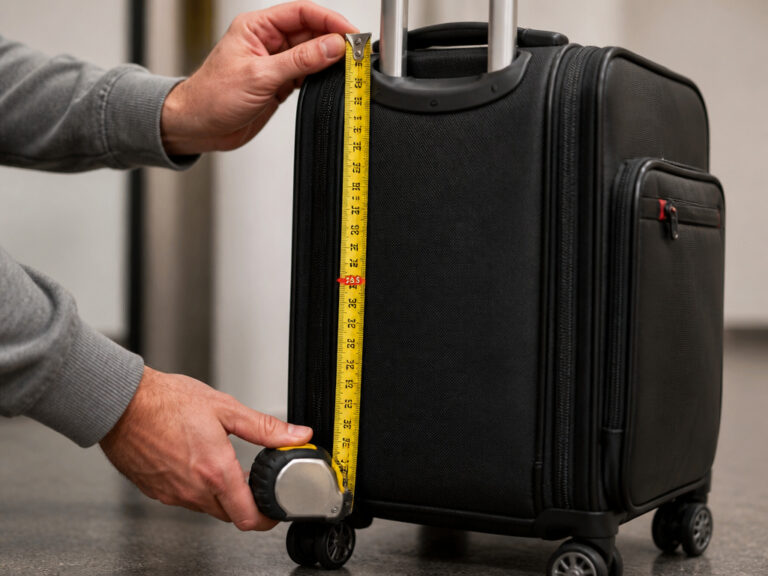
- A Flexible Tape Measure. This is non-negotiable. Measure your bag at its absolute widest points, including wheels that protrude and padded handles. Do this when the bag is fully packed as you intend to travel.
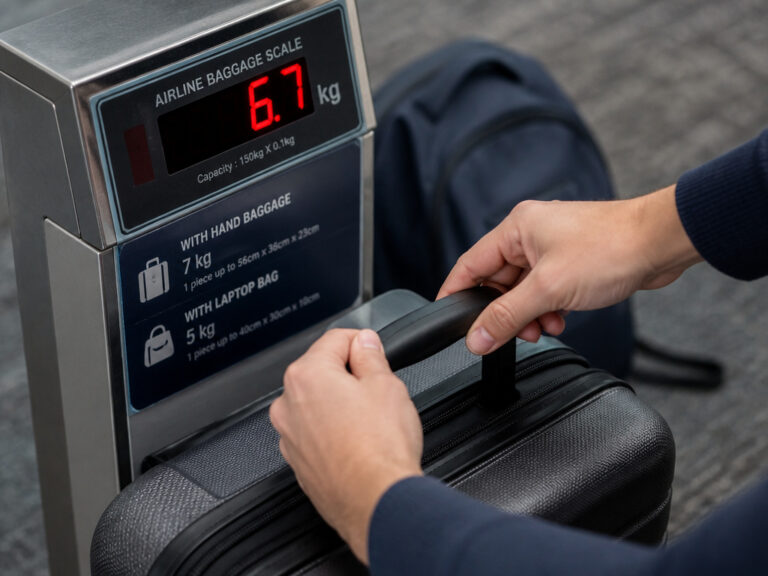
- A Portable Luggage Scale. If you’re flying outside the US, this is your second most important tool. Hook it to your bag’s handle and lift. Many international carriers have 7-8 kg (15-18 lb) limits. A stuffed 22″ carry-on can easily hit 12 kg.
- Your Airline’s Mobile App. The most current policy lives here, not on third-party booking sites. Search “baggage” in the app’s help section.
- A Critical Eye. Before you leave home, look at your bag. Does it sag? Do the side pockets bulge? Does the expanded zipper strain? If it looks fat, it will be flagged. Compression packing cubes are a better investment than a new bag.
The tool you don’t need? The “expandable” suitcase feature. Expanding your bag for the return trip is how you guarantee it won’t fit in the sizer box on the way home. That feature is for checked luggage, not carry-ons.
What Counts as a Personal Item (And Why It Matters)

The personal item is your escape valve. On a full flight or a regional jet, it’s the only bag guaranteed to stay with you.
A personal item must fit under the seat in front of you. Dimensions are rarely specified but generally must be smaller than 18 x 14 x 8 inches. Approved items include: – A handbag, purse, or belt bag. – A laptop bag or briefcase. – A small backpack. – A diaper bag.
The part nobody mentions: A stiff “personal item” duffel, even if it meets paper dimensions, can fail the under-seat test. The space under the seat is an irregular shape, narrowed by the seat supports. A bag that doesn’t compress vertically won’t slide in. This is why soft-sided backpacks are the most reliable personal items.
Your personal item is also your lifeline for heavy items if you face a surprise weight check. Be ready to shift your laptop, camera, or dense souvenirs from your carry-on to your personal item in 30 seconds at the gate. The agent is weighing the carry-on, not you.
Frequently Asked Questions
Is a 24-inch suitcase allowed as a carry-on?
No. A 24-inch suitcase exceeds the maximum dimensions for every major US and international airline. It will not fit in the overhead bin of a standard aircraft and will be gate-checked. The largest compliant carry-on is typically 22 inches in height.
Do airlines actually measure every bag?
Enforcement is inconsistent but predictable. In the US, agents rarely measure unless the bag looks oversized or the flight is full. In Europe and on budget airlines worldwide, physical sizer boxes at the gate are common, and measurement is frequent. Assume you will be measured on any non-US carrier.
What happens if my carry-on is slightly too big?
If it’s slightly over and the flight has space, you might get a pass with a warning. If the flight is full or the agent is strict, you will be required to “gate-check” the bag. This means it’s tagged and placed in the aircraft hold, and you collect it on the jet bridge after landing. There is usually no fee for this, but you lose access to your bag during the flight.
Can I bring a carry-on and a backpack?
Yes, on most full-service airlines. The standard allowance is one carry-on bag (for the overhead bin) and one personal item (like a backpack for under the seat). However, always verify your fare class; basic economy fares on some airlines only include a personal item.
Are the measurements with or without wheels?
Always with. Every airline’s stated carry-on dimensions include all external parts: wheels, handles, side pockets, and any other protrusions. When you measure, your tape must go over the wheels at the bag’s widest point.
The Bottom Line
The size limit for carry-on luggage isn’t a mystery. It’s a published spec you must look up for your specific airline. Ignore the generic “standard size” guides. Your process is simple: find your airline’s baggage policy page, note the exact dimensions and weight limit, then measure your packed bag with a tape measure.
For most domestic US travelers, a bag that is truly 22 x 14 x 9 inches and isn’t overstuffed will pass. For everyone else, especially those flying internationally, on regional jets, or with budget carriers, the rules tighten. Your backpack is your best friend. When in doubt, pack less. The goal is to walk onto the plane, not negotiate at the gate.