Understanding Airline Carry On Luggage Weight Limit Rules
This post contains affiliate links. As an Amazon Associate, we earn from qualifying purchases.
Carry-on luggage weight limits are set by each airline, not by a single global rule. The most common standard is 7 kilograms (about 15 pounds), but limits can range from 5 kg (11 lb) to 12 kg (26 lb) or be absent entirely on some U.S. Domestic flights. Your ticket’s fare class, frequent flyer status, and the aircraft type on your route can all change what you’re allowed to carry on board.
That 7 kg figure is just a starting point. An airline’s published policy is the final word, and gate agents have wide latitude to enforce it, especially on budget carriers and smaller regional planes where space and weight are tight. The limit exists primarily to protect baggage handlers from injury, not to squeeze extra fees from you, though that can be a side effect.
What follows: a breakdown of where the standard comes from, why it’s not really about the plane’s total weight, and how to find and prepare for your specific airline’s rules. We’ll cover the common pitfalls, from the infamous “pockets rule” to medical device exemptions, and give you a reliable method to avoid surprise fees at the gate.
Key Takeaways
- The 7 kg (15 lb) limit is an IATA guideline, not a law. Your airline’s published policy overrules it.
- Weight limits protect baggage handlers from repetitive strain injuries, not the aircraft’s total weight.
- Budget airlines and small regional jets (like the ATR-72) enforce limits most strictly, often including items in your pockets.
- Medical devices like CPAP machines are typically exempt from weight limits but require advance notification.
- Weigh your bag at home with a handheld scale. Knowing your weight is the single best defense against fees.
Why Weight Limits Exist (It’s Not the Plane)
Common mistake: Assuming the weight limit is about total aircraft load. A 747’s fuel weighs over 180,000 kg. Your bag is a rounding error.
The real reason is ergonomics. Baggage handlers lift thousands of bags per shift. International guidelines recommend a single checked bag not exceed 23 kg (50 lb) for this reason. Carry-on bags, which passengers theoretically handle themselves, have a lower threshold to prevent strain when they are inevitably gate-checked and must be loaded by the ramp team.
A Reddit discussion from aviation workers clarifies the point: “The workers on the other hand? There’s a limit to what one human can safely lift (all day, every day). If it’s too heavy it needs to be a team-lift, which fucks up the whole loading system.” The per-bag limit exists so one person can safely lift it. You could pay for ten checked bags totaling 230 kg, but each individual bag must be liftable.
This FAA carry-on baggage advisory focuses on safe stowage in the cabin, ensuring bins close without force and nothing blocks aisles, but the underlying safety logic for checked bags drives the weight standards that spill over into cabin baggage.
The Standard 7 kg (15 lb) Rule. And Where It Bends
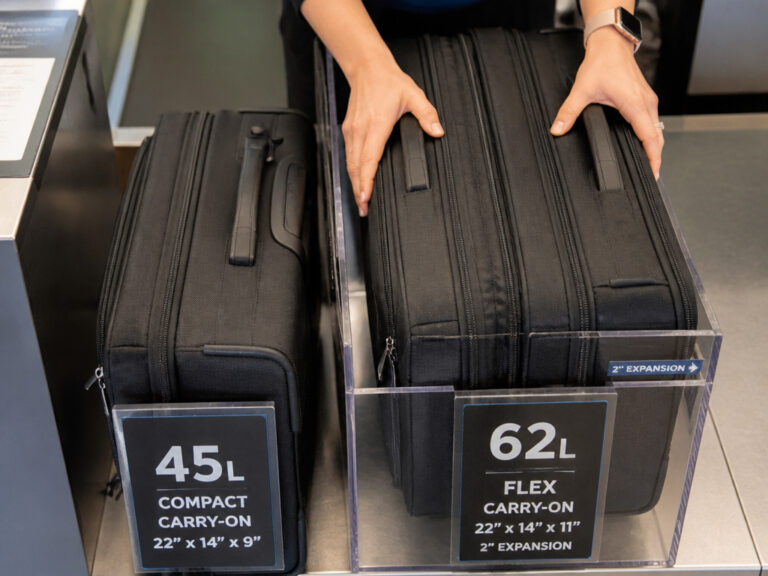
The International Air Transport Association (IATA) suggests a common maximum for carry-on baggage dimensions: 56 x 45 x 25 cm (22 x 18 x 10 in). For weight, they note that “some airlines also apply weight limits, typically starting at 5 kg (11 lb).” In practice, 7 kg (15 lb) has become a global benchmark for economy class on full-service and budget airlines alike.
But this is only a guideline. As the IATA passenger baggage rules state, “Carry-on baggage allowances may vary by airline, cabin class, and aircraft type.” Your contract of carriage is with the airline, not IATA.
| Airline Type | Typical Economy Carry-On Weight Limit | Notes & Strictest Enforcers |
|---|---|---|
| U.S. Domestic Majors (Delta, American, United) | Often no weight limit | Size is the primary constraint; weight may be enforced if bag appears excessively heavy. |
| European/Asian Full-Service (Lufthansa, ANA, Singapore) | 8 kg (17.5 lb) to 12 kg (26 lb) | Higher limits common; ANA’s total for one bag + personal item is 10 kg (22 lb). |
| Global Budget Carriers (Ryanair, EasyJet, Jetstar) | 7 kg (15 lb) to 10 kg (22 lb) | Strict, pre-boarding weigh-ins common. Jetstar is infamous for the “pockets rule.” |
| Regional/Small Aircraft (Air New Zealand domestic, Boutique) | 7 kg (15 lb) or less | Weight is critical on small planes like the ATR-72 with limited overhead space and balance concerns. |
The variance means you cannot rely on the IATA standard alone. You must check your airline’s website. Look for “Baggage Allowance” or “Cabin Baggage” under the “Travel Info” section. Your limit is there.
How Airlines Enforce Limits: The Gate Agent’s Discretion

A published limit is one thing. Enforcement is another. On a wide-body jet with half-empty overhead bins, you might skate by with a 10 kg bag. On a packed A320 for a budget airline, they will check.
Pre-boarding weigh-ins are the most direct method. Airlines like Jetstar, AirAsia, and Ryanair are known to spot-check or systematically weigh bags at the gate. This is where the infamous “pockets rule” emerges, as documented in a traveler’s complaint: “I took my jacket out of my luggage, as well as my wallet, keys and phone charger, shoved them into my pockets, and weighed the luggage at 7 kg. However, the attendants said all of those things, including my jacket, had to be counted towards the luggage weight, even if they are in my pockets.”
The agent’s logic is sound. If you remove items to meet the limit at the scale, those items are still part of your carry-on load. The best defense is to arrive with your bag already under limit, with wearable items already on you or in a personal item that isn’t being weighed.
Where this goes sideways: Assuming a sympathetic agent will let 500 grams slide. On a tight connection with a queue forming behind you, they won’t. One traveler was charged a 50€ fee for being 50 grams (0.05 kg) over a 23 kg checked bag limit. They ate a quarter of a chocolate bar to make weight.
Medical Devices, Personal Items, and What Doesn’t Count

Most airlines exempt certain necessary items from your carry-on weight allowance. This is not a universal right, but a common courtesy backed by policy.
Medical devices like CPAP machines, portable oxygen concentrators, and diabetic supplies are typically exempt. You must notify the airline in advance, often 48 hours before departure. The device might not count against your limit, but it still must fit under the seat or in the overhead bin. As one Air New Zealand passenger noted, “I was fortunately allowed to bring my CPAP as a medical device.”
Personal items are a grayer area. A purse, laptop bag, or small backpack is usually allowed in addition to your main carry-on. However, budget airlines may specify size dimensions for this item and will weigh it if it’s suspiciously bulky. It’s not a free pass for a second heavy bag.
Duty-free purchases made at the airport after security are generally permitted on top of your allowance. Keep the receipt handy.
The rule of thumb: if it’s essential for your health or well-being during the flight, and you’ve cleared it with the airline, it probably won’t be weighed. If it’s just more stuff, it counts.
How to Pack Within Any Limit

Beating the scale is a matter of strategy, not strength. Here is the sequence that works.
- Know your enemy. Look up your airline’s weight limit on their website. Write it down. Assume it will be enforced.
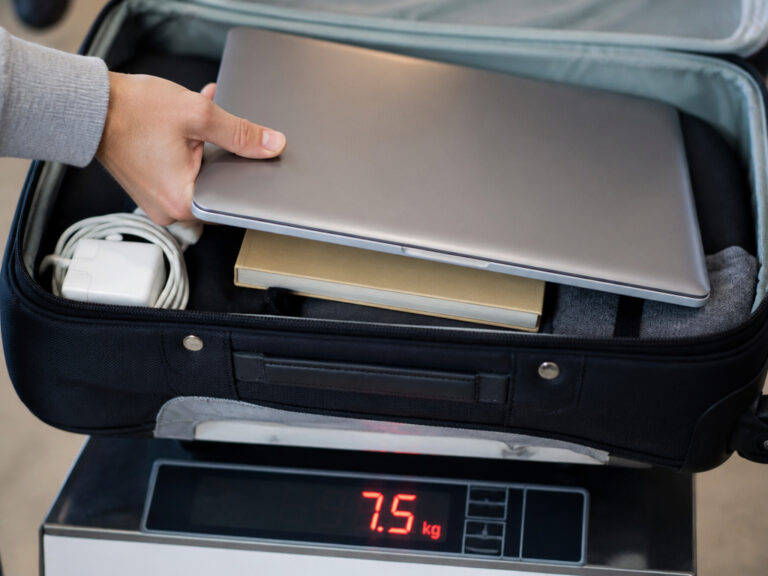
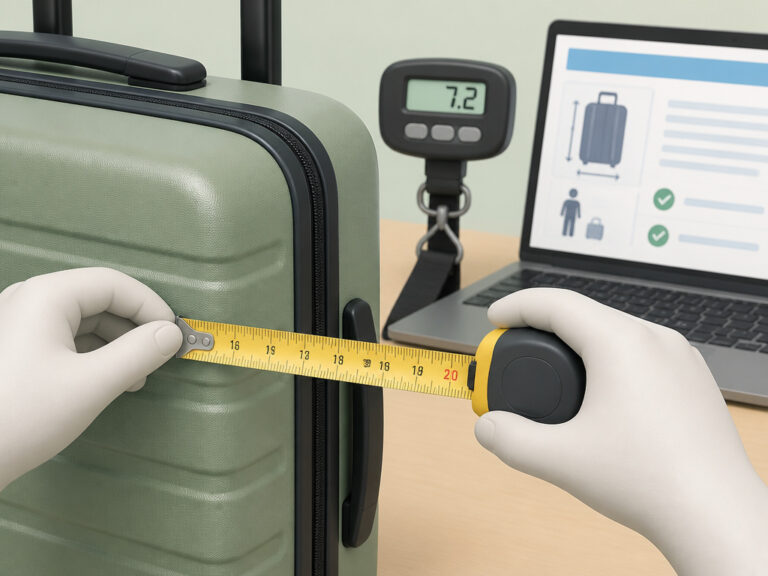
- Weigh early, weigh often. Use a handheld luggage scale. These cost less than a single airport coffee and remove all guesswork. Weigh your bag fully packed at home. Then weigh it again before you leave for the airport.
- Choose your packables. Heaviest items are electronics, books, and toiletries. Wear your bulkiest jacket and heaviest shoes on the plane. Load your personal item (a lightweight backpack) with your laptop, tablet, and camera.
- Leverage your personal item. This is your secret weapon. A slim backpack can hold 3-4 kg of dense electronics, taking significant weight off your main roller bag.
- Be ready to pivot. Have a plan for what you’ll jettison if you’re over at the gate. Know which less-essential item you can mail home, leave with a friend, or (in a true pinch) discard.
The goal is to never have a nervous conversation at the check-in counter. Your bag should be under limit, your personal item reasonably sized, and your attitude prepared. That is how you avoid fees.
Frequently Asked Questions
Do U.S. Airlines have carry-on weight limits?
Most major U.S. Airlines (Delta, American, United, Southwest) do not publish a weight limit for carry-on bags for domestic flights. Their restriction is purely dimensional. However, agents can enforce a subjective “must be able to lift it into the overhead bin” rule. For international flights operated by these carriers, the partner airline’s or the destination country’s rules may apply, which often include weight limits.
What happens if my carry-on is overweight?
You have three options, none of them pleasant. First, you can pay an overweight fee, which can range from $50 to $200 at the gate. Second, you can remove items and either wear them, stuff them into a companion’s bag, or abandon them. Third, the airline may force you to check the bag, potentially incurring a checked bag fee plus an overweight fee. On a full flight, a gate-checked bag might also end up at your final destination on a later flight.
Can I pre-pay for extra carry-on weight?
No. Airlines sell extra checked baggage allowance, but they do not sell extra carry-on weight allowance. The limit is a safety and operational constraint, not a revenue tier. If your bag is over, you must reduce its weight or check it.
Why is my carry-on weighed but not my personal item?
It often comes down to time and precedent. Weighing every purse and laptop bag would slow boarding to a crawl. The main carry-on is the item most likely to be gate-checked and handled by staff, so it’s the primary target. If your personal item is obviously a second suitcase, they have the right to weigh it too.
Are backpacks subject to weight limits?
Yes. A backpack is considered a carry-on bag if it meets the size limits. If you’re traveling with just a backpack, it must comply with the same weight restrictions as a roller bag. Many travelers use a backpack as their “personal item” alongside a small roller bag, which is the most efficient way to maximize your total allowed weight.
The Bottom Line
The carry-on weight limit is a variable, not a constant. Treat the 7 kg (15 lb) standard as a minimum expectation, not a guarantee. Your specific flight’s rules are buried in your airline’s website under “Baggage Allowance”, find them.
Pack with a handheld scale. Wear your heavy layers. Use your personal item strategically for dense electronics. Understand that the rule exists for the safety of the workers who handle your bag when you can’t, not as an arbitrary cash grab.
That knowledge turns a potential stress point into a solved problem. You walk past the scale at the gate, your bag glides into the overhead bin, and you take your seat. No fees, no arguments, no last-minute chocolate consumption. That’s the whole point of checking the rules before you zip up your bag.