How Big Is a Carry On Bag? The Airline-Specific Size Guide
This post contains affiliate links. As an Amazon Associate, we earn from qualifying purchases.
A carry on bag’s size is defined by your airline, not a universal rule. The most common published limit is 22 x 14 x 9 inches (56 x 36 x 23 cm), but that only fits about 21 major carriers. The bag that actually fits 97% of airlines, 106 out of 109 in 2026 data, measures 55 x 35 x 20 cm (21.7 x 13.8 x 7.9 in). Width is the usual dealbreaker, not height.
That gap between the common advice and the data-driven fit is where gate-check fees live. Airlines publish limits for their specific overhead bins and weight capacities, which change with the aircraft model and your fare class. The bag you buy should target the strictest airline on your typical route, not the average.
What follows is the breakdown of standards, the hidden rules from baggage handling systems, and the specific models that clear the bar without guesswork.
Key Takeaways
- The published “standard” of 22″ x 14″ x 9″ is a common limit but fits only about 20% of global airlines.
- A 55 x 35 x 20 cm (21.7 x 13.8 x 7.9 in) bag fits 106 of 109 airlines, the closest thing to a universal carry-on.
- Always measure your bag including every wheel, handle, and external pocket. An empty bag that’s “close” will be over when packed.
- US airlines rarely enforce weight limits for carry-ons; European and Asian carriers often do, with typical limits of 7-10 kg (15-22 lbs).
- Your ticket’s fare class (Basic Economy, etc.) can strip your carry-on allowance, leaving only a personal item.
The Real-World Standard That Actually Fits
Forget the generic “22 x 14 x 9” sign in the department store. That’s a common US airline dimension, but it’s not a global pass. Real data from airline aggregators paints a different picture.
A 2026 analysis of 109 global airlines found that a bag measuring 55 x 35 x 20 centimeters fits 106 of them, a 97% clearance rate. The widely marketed “cabin approved” size of 56 x 45 x 25 cm fits only 13 airlines, or 11%.
The difference is width. Overhead bins on many regional and narrow-body aircraft, especially those used by budget carriers in Europe and Asia, have shallow shelf-like bins. A bag that’s 45 cm wide won’t slide in sideways and is too deep to lay flat. The 35 cm width is the critical spec that lets the bag orient correctly in the tight space.
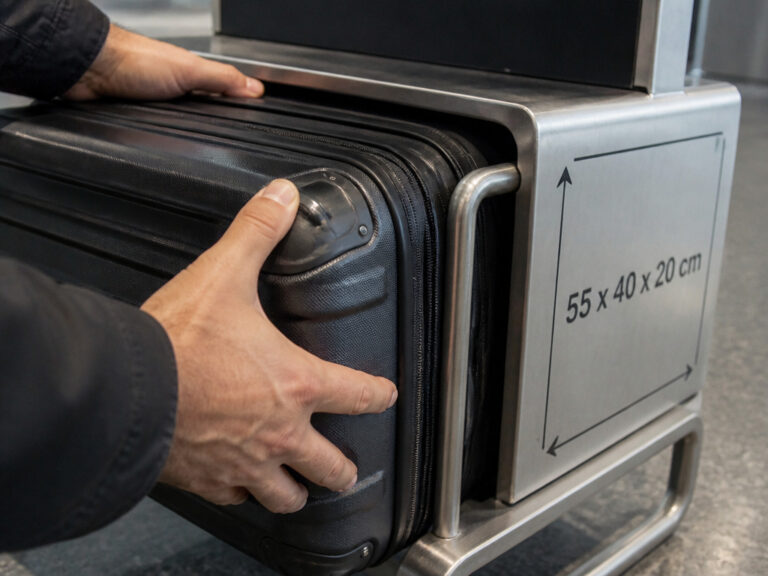
This isn’t about a minor squeeze. A gate agent’s sizer box is an exact metal frame. If your bag doesn’t slide in freely without force, it gets a bright orange tag and goes below. The fee at that moment is always higher than pre-paying for a checked bag.
| Bag Dimension (cm) | Bag Dimension (in) | Airlines It Fits (out of 109) | Primary Use Case |
|---|---|---|---|
| 55 x 35 x 20 cm | 21.7 x 13.8 x 7.9 in | 106 (97%) | Universal fit, strict budget airlines (Ryanair, Wizz Air) |
| 56 x 36 x 23 cm | 22 x 14 x 9 in | ~21 (19%) | Major US carriers (Delta, American, United) |
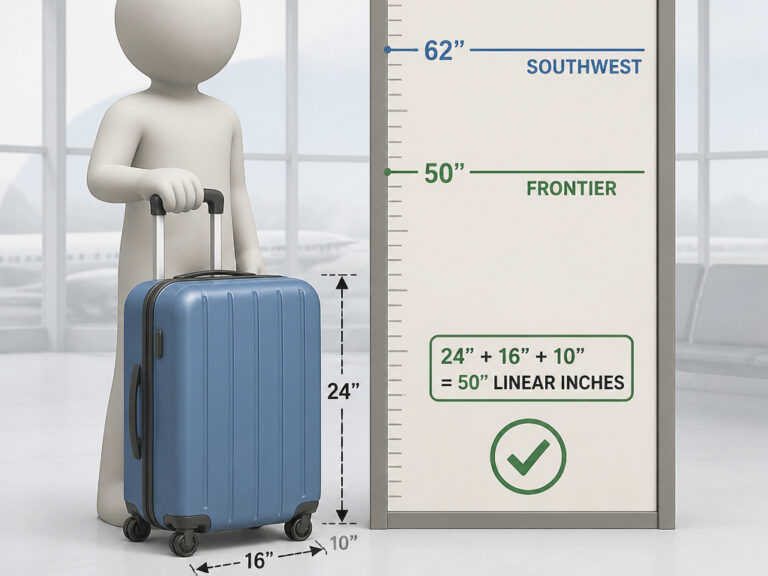
| 56 x 45 x 25 cm | 22 x 17.7 x 9.8 in | 13 (11%) | Generous US carriers (Southwest, Frontier) |
Where this goes sideways: Buying a bag labeled “cabin approved” without checking its width. That label is marketing, not a certification. The 45 cm width is the trap, it looks sleek in a store but jams at the gate on every Ryanair, easyJet, or Emirates flight.
So your first carry-on size decision is geographic. If you only fly domestically within the US on major carriers, the 22x14x9 standard is safe. If your itinerary includes a European city-hopping trip on budget airlines, you need the 55x35x20 cm discipline.
Why Rules Vary: Bins, Weight, and Fare Class
Airlines don’t set size limits arbitrarily. They’re solving a physical packing problem with financial incentives layered on top.
Overhead bin dimensions are designed by the aircraft manufacturer, not the airline. A Boeing 737-800 has different bin geometry than an Airbus A320, even though they’re direct competitors. Airlines that operate mixed fleets sometimes publish a single limit that fits their smallest bin, which is why checking the specific aircraft on your route is a pro move.
Weight limits exist for two hard reasons. First, flight attendants must be able to safely lift and stow a bag in turbulence. The FAA carry-on baggage advisory circular explicitly states bins must close without force and items must not fall out when opened. A 15 kg bag risks both. Second, every kilogram in the cabin counts against the aircraft’s total weight-and-balance calculation, which is a direct fuel cost.
Common mistake: Assuming “no published weight limit” means no limit. If a flight attendant cannot safely lift your bag into the bin, they can and will gate-check it. The test is a one-handed lift to shoulder height.
Your ticket’s fare class is the wild card. Basic Economy on United or Blue Basic on JetBlue often restricts you to a single personal item that fits under the seat. Paying for a “carry-on bag” is an extra purchase. This is the core of the budget airline model, the base fare covers a seat and a small under-seat bag only.
This fare-based restriction is why understanding the carry-on definition for your specific ticket is non-negotiable. The Wikipedia entry on hand luggage notes that these policies are a direct financial incentive, a shift from the old model where a carry-on was included.
The Tools and Gear That Hit the Mark
You need a bag that matches the 55x35x20 cm spec in its external dimensions, including every protrusion. Here are the models that do it, and why they work.
The Pelican Air 1535 is the benchmark for a reason. Its exterior dimensions are 21.96″ x 13.97″ x 8.98″, a direct match for the 22x14x9 standard with a fraction of an inch to spare. It’s built from a single mold, so those dimensions don’t bulge when packed. The trade-off is weight; at nearly 10 lbs empty, you burn a significant portion of a 15 lb weight allowance before adding clothes.
For most travelers, a lightweight hardshell or softside roller is the practical choice. The Travelpro Maxlite 5 hits the 56x36x23 cm spec and weighs only 2.4 kg (5.3 lbs). The Away Carry-On (The Bigger Carry-On) is another precise 56x35x23 cm hitter. These are the workhorses.
If you want the one bag that clears the most gates worldwide, look for a model marketed for “international travel” or “budget airline approved.” These are typically 55x35x20 cm or 54x35x20 cm. They are not always easy to find in big-box stores, which still stock the wider, non-compliant sizes.
The part nobody mentions: Wheels and handles add 1-2 inches to a bag’s height. A bag listed as 21″ tall often measures 23″ with the handle fully extended and wheels on the ground. That’s the measurement the sizer box uses.
When you measure your carry-on, do it fully packed for a trip, with the handle extended. That’s the only measurement that matters.
Personal Items vs. Carry-On: The Two-Bag System
 Most airlines allow a two-bag system: one carry-on for the overhead bin and one personal item for under the seat. The personal item is your backup plan and your critical-items holder.
The typical personal item limit is 18 x 14 x 8 inches. It must fit under the seat without blocking your legs or protruding into the aisle. This isn’t a gentle suggestion, flight attendants will make you re-stow a bag that obstructs the aisle, as per the FAA AC 121-29B document on cabin safety.
A good personal item is soft-sided and compressible. A structured laptop bag often fails because it can’t squish under the seat. A 20-liter backpack like the Osprey Daylite or a slim duffel is the reliable play.
Skip this if: You’re flying a budget airline that charges for overhead bin access. On Frontier or Spirit, your “free” bag is the personal item only. Your 18x14x8 bag becomes your entire luggage system. Pack accordingly.
This two-bag strategy is why carry-on luggage dimensions are only half the equation. Your personal item’s capacity and flexibility determine whether you can actually travel without checking a bag.
Weight Limits and the Scales at the Gate
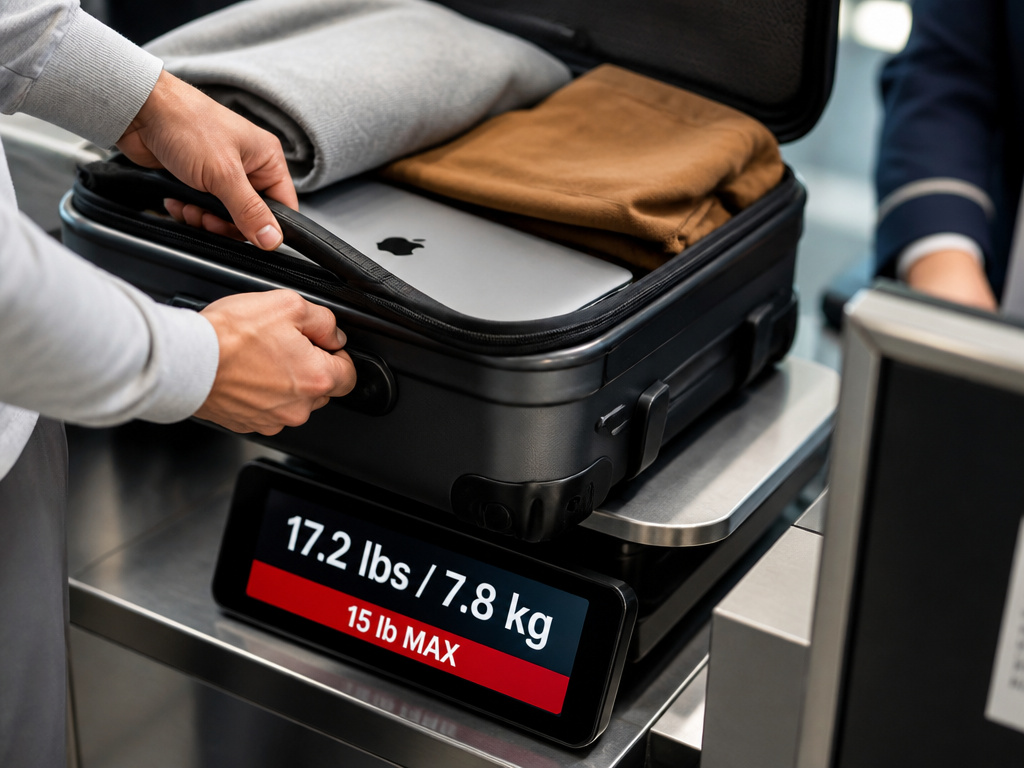 US fliers get a pass here. Major carriers like American, Delta, and United rarely weigh carry-ons at the gate. Their focus is on physical dimensions. The assumption is that if you can heave it into the bin, it’s fine.
That assumption ends when you fly internationally. Carriers like Lufthansa (17.6 lb), Qatar Airways (15 lb), and Emirates (15 lb) enforce weight limits strictly. They have scales at the check-in counter and often at the gate. Exceed the limit, and you’re checking the bag and paying a fee.
The math is simple but brutal. A typical carry-on suitcase like the Briggs & Riley Baseline weighs about 8 lbs empty. Under a 15 lb limit, you have 7 lbs for everything else, clothes, toiletries, electronics. That’s one pair of jeans, two shirts, and a laptop.
This is where material choice matters. A polycarbonate hardshell is often lighter than a ballistic nylon softside. A bag without a built-in battery pack (which is banned anyway) saves another pound. Every ounce you save on the bag itself is an ounce of clothing you can pack.
TL;DR: For US-only travel, don’t stress weight. For any international itinerary, assume your bag will be weighed and pack to a 7-10 kg (15-22 lb) total.
How to Measure and Test Your Bag Before You Fly
 Guessing doesn’t work. You need a verification step.
- Pack it for a real trip. Don’t measure it empty. Fill it with the clothes and shoes you’d actually take. This changes its shape and rigidity.
- Use a rigid tape measure. A soft sewing tape can give a false reading. Measure at the bag’s widest, tallest, and deepest points, including wheels and handles in their travel position.
- Check for protrusions. Do the side handles stick out? Does the telescopic handle create a bulge? These count.
- Build a mock sizer box. Use a cardboard box cut to your airline’s exact internal dimensions (e.g., 55x35x20 cm). If your bag doesn’t slide in smoothly, it fails.
This process takes ten minutes and saves a $75 gate-check fee. It turns the abstract size restrictions into a physical test you can pass at home.
Frequently Asked Questions
What is the most common carry-on bag size?
The most common published limit is 56 x 36 x 23 cm (22 x 14 x 9 in), used by about 21 major airlines. However, the most universally fitting size is 55 x 35 x 20 cm (21.7 x 13.8 x 7.9 in), which fits 97% of airlines.
Do wheels and handles count in carry-on size?
Yes. Always. Airlines measure the bag’s total external dimensions, including all wheels, handles, side grips, and external pockets. The sizer box at the gate is sized for the total envelope of your bag.
Can I take a carry-on and a personal item?
On most full-service airlines, yes. You are typically allowed one carry-on bag for the overhead bin and one smaller personal item for under the seat. Budget airlines like Frontier and Spirit often charge extra for the overhead bag, allowing only a free personal item.
What happens if my carry-on is too big?
If it doesn’t fit in the sizer box at the gate, the airline will tag it as gate-checked baggage. It will be placed in the aircraft’s cargo hold, and you will retrieve it at baggage claim. A fee is charged, usually higher than checking a bag at the ticket counter.
Are carry-on weight limits enforced?
In the United States, they are rarely enforced by major carriers if the bag fits size limits. For international flights, especially on European and Asian airlines, weight limits are strictly enforced at check-in and the gate.
The Bottom Line
The question “how big is a carry on bag” has two answers. The common answer is 22 x 14 x 9 inches. The real answer, the one that determines whether you walk on or pay up, is 55 x 35 x 20 centimeters.
Buy your bag based on the strictest airline you plan to fly, not the most generous. Measure it packed, with handles out. Your carry-on bag size is a spec you control before you ever get to the airport. Get it right, and the overhead bin is yours.