How to Measure a Carry On Bag to Avoid Airline Size Fees
This post contains affiliate links. As an Amazon Associate, we earn from qualifying purchases.
To measure a carry-on bag, you need a flexible tape measure and must record three numbers: height (including wheels and extended handle), width at the widest point, and depth. For most US airlines, your bag must not exceed 22 x 14 x 9 inches, a limit set by the FAA. The single biggest mistake is measuring the bag empty, soft-sided luggage can bulge over the limit when fully packed.
The 22 x 14 x 9 inch rule is the maximum physical space the Federal Aviation Administration allocates for a single item in an overhead bin or under a seat. The FAA’s carry-on baggage size regulations exist so flight attendants can close bins without force and nothing falls out during turbulence.Your bag is competing for that space with a hundred others on a full flight.
What follows is the mechanic’s method. We’ll break down the two ways airlines state their limits, the five non-negotiable measurement steps, and the stark difference between how a US legacy carrier and a European budget airline will judge your bag at the gate. By the end, you’ll be able to look at any suitcase and know in ten seconds whether it’s a candidate for a smooth boarding or a costly gate-check.
Key Takeaways
- Always measure your bag fully packed and zipped closed. An empty soft-sided bag can be deceptively slim.
- Include every protruding part: wheels, handles, side pockets, and expansion zippers. Airlines count it all.
- Know your airline’s specific carry-on size limits, “standard” is a myth, and budget carriers are stricter.
- A flexible measuring tape beats a rigid ruler for accuracy on curved luggage corners and bulging fabric.
- Gate-check fees are punitive, often double the cost of a pre-paid checked bag, and enforcement is rising.
Why “Close Enough” Isn’t a Strategy Anymore
A gate agent with a sizer box doesn’t see your favorite weekender. They see a binary test: fit or fail. The old leeway, the “just squish it” pass, is largely gone. In 2026, airlines installed more automated gate scanners and trained staff to be consistent.
The financial penalty for failing is straightforward. If your bag doesn’t fit, you’ll gate-check it. That fee typically runs between $60 and $100 on the spot. Pre-paying for the same checked bag online might cost $30. You’re paying a 100% impatience tax for not measuring correctly at home.
The core problem most travelers face is measuring the wrong thing. They check the tag on their ’22-inch’ suitcase and assume they’re safe.But that tag rarely includes the wheels and handle in its number. You need to verify the real-world dimensions yourself.
Common mistake: Measuring a soft-sided bag empty. The fabric can bulge 2-3 inches in every direction when stuffed, turning a compliant bag into an oversized one before you even leave home.
Maximum Dimensions vs. Linear Inches: The Two Rules
Airlines state their limits in one of two formats. You must know which one your carrier uses.
Maximum Dimensions is the most common rule. Your bag’s height, width, and depth must each be less than or equal to the airline’s listed maximums. For Delta, American, United, and JetBlue, that’s 22″ x 14″ x 9″. Each individual measurement is a hard cap.
Linear Inches is a sum rule. You add the height, width, and depth together. The total cannot exceed the airline’s limit, often 45 linear inches. Qatar Airways uses this method: 20 x 15 x 10 inches individually, but also a 45-inch total. Some airlines, like Delta, use both: your bag must pass the 22x14x9 test and the 45-linear-inch test.
| Rule Type | How It Works | Example Airline | Key Pitfall |
|---|---|---|---|
| Maximum Dimensions | Height ≤ H, Width ≤ W, Depth ≤ D. Each a separate check. | Delta (22″ x 14″ x 9″) | A bag that’s 23″ tall fails, even if width/depth are tiny. |
| Linear Inches | Height + Width + Depth ≤ Total. | Qatar (45 linear inches) | A bag that’s 22x14x10 sums to 46 inches and fails. |
If your airline’s website mentions both, your bag must satisfy both conditions. The maximum carry-on size is the absolute ceiling.
The 5-Step Measurement Process (And Why Most People Fail Step 3)
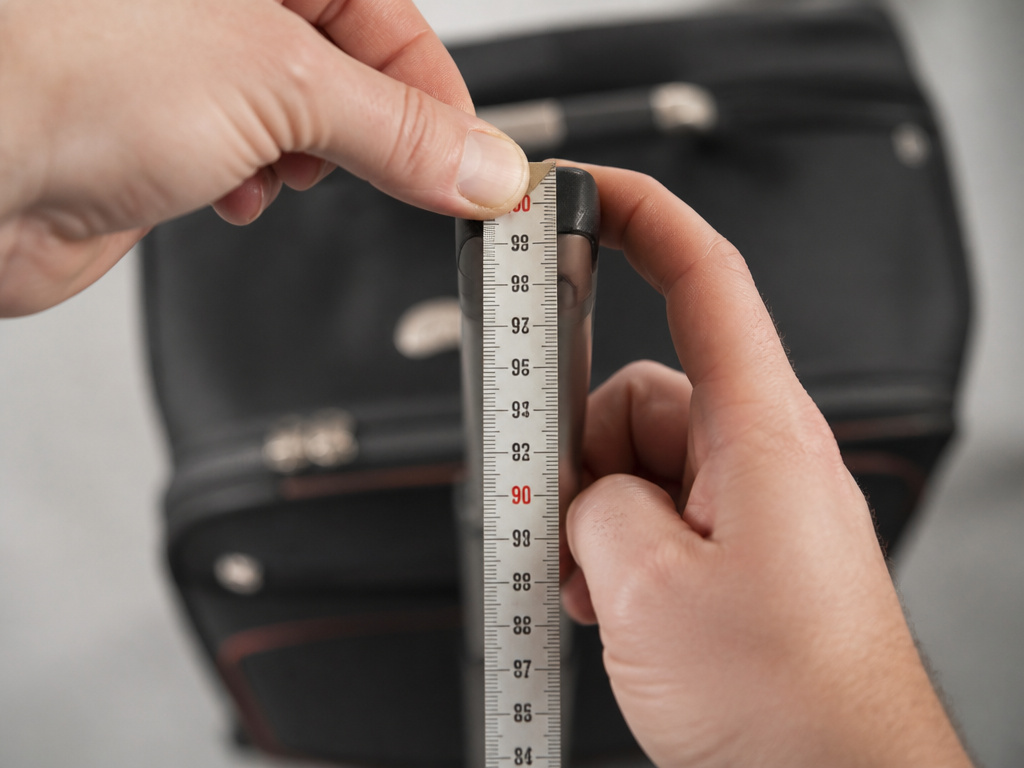
Grab a flexible cloth or vinyl measuring tape. A metal carpenter’s tape stays rigid and won’t hug the curves of your bag, giving a false reading. Do this on a hard, flat floor, not carpet.
Step 1: Pack the Bag Completely
This is the step everyone wants to skip. Don’t. Zip it up. Pull all compression straps tight. Smooth out any bulging pockets with your hands. You are measuring the object you will hand to the gate agent, not its empty skeleton.
Step 2: Measure the Height
Stand the bag upright on its wheels. Run the tape from the floor (bottom of the wheels) to the very top of the handle. If the handle telescopes, extend it fully. That’s your true height. This one catches more people than any other.
Step 3: Measure the Width
Lay the bag flat on its back. Find the widest point. This is often across side handles or bulging front pockets. Don’t assume it’s the center. Measure straight across from left to right at that widest spot.
Step 4: Measure the Depth
With the bag still on its back, measure from the front (the side facing up) straight down to the back. Include any external zippered compartments or expansion panels that add bulk. For a bag with an expansion zipper, measure it fully expanded.
Step 5: Do the Math
Write down the three numbers: H, W, D. Check them individually against your airline’s maximum dimensions. Then add them together. Check that sum against the linear inch limit, if one exists.
A proper accurate carry-on measurement process turns a guessing game into a yes-or-no answer. It takes five minutes and saves you from a $100 surprise.
Where this goes sideways? Step 2. People measure from the top of the bag’s body, ignoring the two inches of wheel and the three inches of handle grip. That’s five inches of error before you even start. The airline’s sizer box starts at the floor.
Soft-Sided vs. Hard-Shell Luggage: A Measurement Split
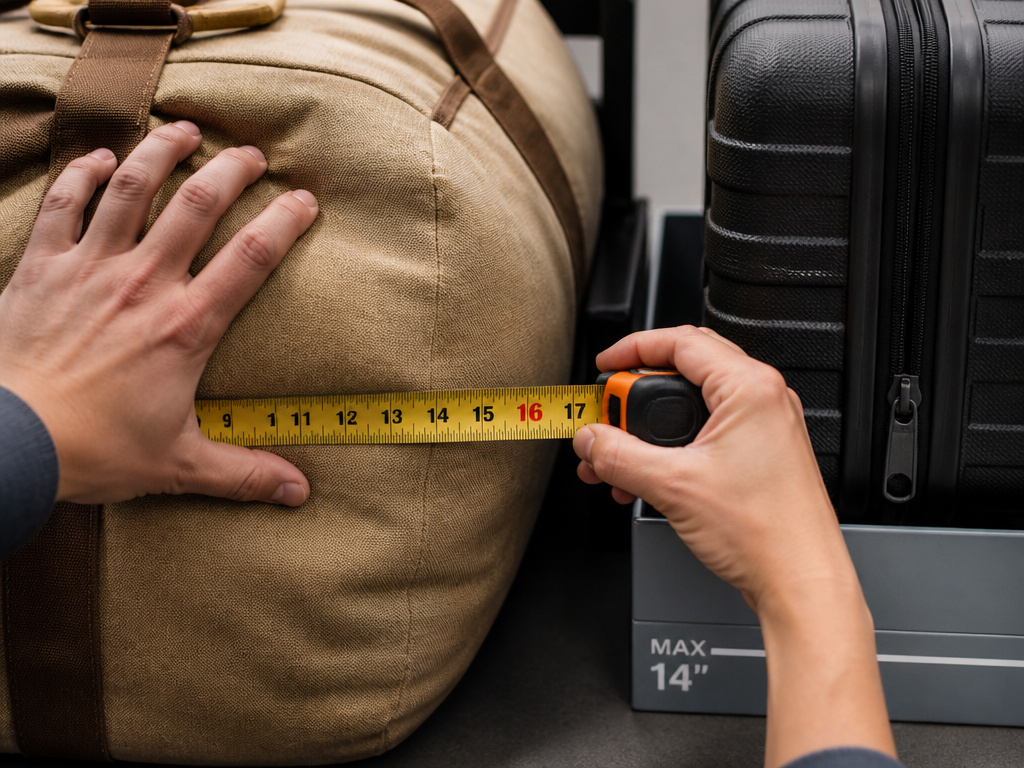
The material of your bag changes the measurement strategy. A hard-shell spinner is predictable. A canvas duffel is a shape-shifter.
Soft-Sided Luggage (Duffels, Backpacks, Fabric Rollers)
The fabric gives. When you pack it, it expands outward in all directions. You must measure it under realistic tension. * Pro: Often more forgiving in a stuffed overhead bin if slightly undersized. * Con: Can easily exceed limits when fully packed, even if the tag says it’s compliant. * Measurement Rule: Measure fully packed, zipped, and compressed. If you have to sit on it to close it, it’s already too big.
Hard-Shell Luggage (Polycarbonate, ABS Spinners)
The dimensions are fixed. What you measure empty is very close to what you’ll measure full. * Pro: No surprise bulging. The carry-on bag dimensions are stable. * Con: No flexibility at all. If it’s 22.1 inches tall, it’s failed. It won’t compress. * Measurement Rule: Pay extra attention to permanent protrusions. Side-mounted TSA locks and integrated handles often stick out further than the main shell.
The takeaway? If you live out of a soft duffel, buy one that’s visibly smaller than the limit when empty. You need the headroom. If you prefer the organization of a hard-shell, you can ride right against the limit, but you must verify the true numbers yourself.
Airline Enforcement: The Stark US vs. Europe Divide
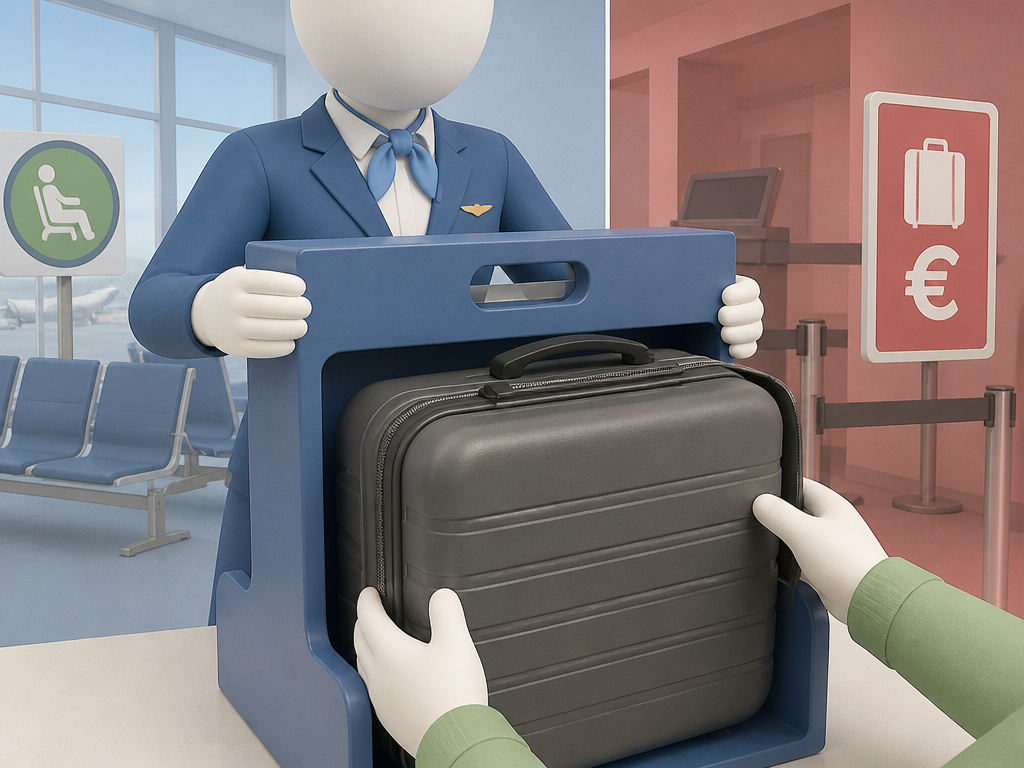
Your measurement is only as good as the person checking it. Enforcement is not global.
US Legacy Carriers (Delta, American, United)
Enforcement is often visual and inconsistent. Gate agents rarely use a sizer unless a bag looks obviously huge. Their official carry-on size limits are the FAA’s 22″ x 14″ x 9″, but the main trigger for action is a full flight. If overhead space runs out, even compliant bags can be gate-checked for free. Weight limits are almost never checked.
European & Budget Carriers (Ryanair, easyJet, Spirit, Frontier)
Enforcement is strict, automated, and financial. Sizer boxes are placed at the gate. Bags are routinely weighed. The limits are the law, and the penalty for exceeding them is a high gate-check fee. These airlines often use slightly different, sometimes smaller, dimensions. Frontier’s generous 24″ x 16″ x 10″ is an outlier; many budget carriers are tighter.
| Airline Type | Typical Enforcement | Weight Check? | Consequence of Failure |
|---|---|---|---|
| US Legacy (Delta, UA) | Visual, inconsistent. Sizer used only for obvious violations. | Almost never | Free gate-check if space is full. |
| US Budget (Spirit, Frontier) | Active use of sizers at gate pre-board. | Sometimes | High gate-check fee ($60-$100). |
| European Budget (Ryanair) | Mandatory sizer box, often pre-security. | Frequently | Very high fee (€50-€100), strict no-exceptions. |
This is why knowing your airline’s specific airline carry-on rules is non-negotiable. What works on Delta may bankrupt you on Ryanair.
The Tools You Actually Need (And One You Don’t)
You can overcomplicate this. Don’t.
The Essential Tool: A Flexible Measuring Tape
A sewing-style cloth tape is perfect. It costs almost nothing, wraps around curved corners, and gives you a true contour measurement. Keep one in your luggage.
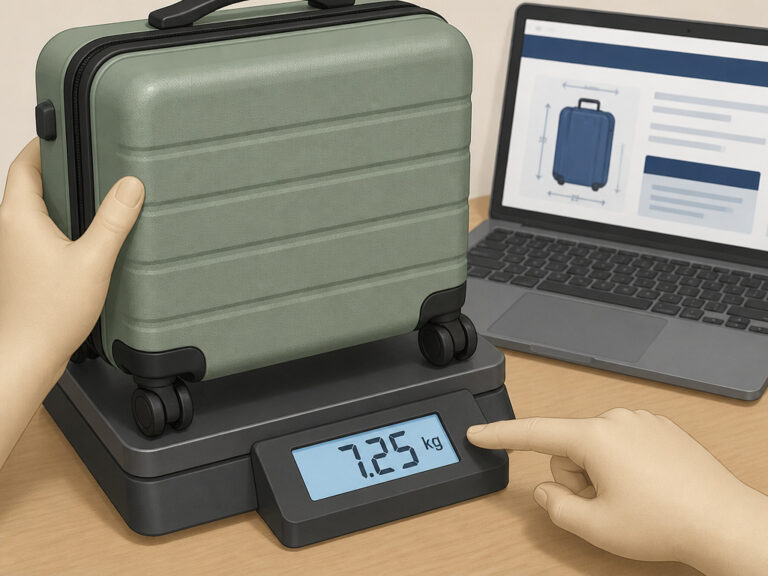
The Optional Helper: A Luggage Scale
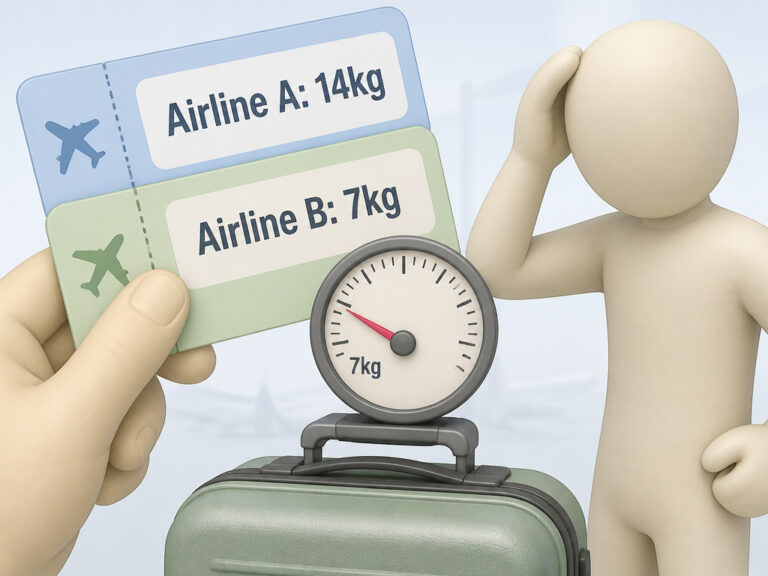
If you’re flying an Asian or Middle Eastern carrier (Emirates, Qatar, Singapore Airlines) with a 7-10 kg (15-22 lb) carry-on weight limit, a small digital luggage scale is worth it. US carriers basically never check.
The Red Herring: The “22-Inch” Bag Tag
Ignore it. That number is a retail sizing convention, not a measurement. It typically refers to the interior cavity or the bag’s body excluding protrusions. It is useless for compliance. Your own tape measure is the only authority that matters.
The Digital Shortcut: Online Size Checkers
Websites like Packzup offer tools where you input your three measurements and it tells you which airlines will accept your bag. These are helpful for planning, but they are guides, not guarantees. The gate agent’s sizer is the final judge.
Frequently Asked Questions
Do I include wheels and handles when measuring?
Yes. Always. Every airline’s policy states that dimensions include all wheels, handles, and other protruding parts. The sizer box at the gate starts at the floor, so your wheels count as height.
What if my bag is just slightly too big?
“Close enough” is a gamble. On a US carrier with empty overhead bins, you might slide through. On any budget airline or a full flight, you will likely pay. The safer move is to use a different, compliant bag or be prepared to check it (preferably online, not at the gate).
How are personal items measured?
Personal items (backpacks, purses) must fit under the seat. Most US airlines don’t give exact dimensions, just a “fit test.” Budget airlines often specify around 18 x 14 x 8 inches. The same measurement rules apply: measure it packed, include all straps and pockets.
Can a carry-on be too heavy?
For most US airlines, no. If you can lift it into the bin yourself, the weight is fine. Many international and budget carriers have strict weight limits, commonly 7-10 kg (15-22 lbs). Always verify your airline’s carry-on size and weight rules.
What about expandable luggage?
Measure it with the expansion zipper fully open. That’s the maximum size your bag can become. If the expanded dimensions exceed your airline’s limits, never unzip that expansion panel when flying. Consider it sealed.
Are backpacks measured differently?
The process is identical: height (bottom to top of extended carry handle), width (widest point, often across stuffed side pockets), depth (front to back). A packed backpack’s depth can balloon dramatically.
Before You Go
Measuring your carry-on is about avoiding a specific, painful outcome: standing at the jetway, digging for your credit card while everyone else boards. The process is simple physics, length, width, depth, complicated only by our hope that maybe, this time, they won’t notice.
The real trick is shifting your mindset. Don’t ask “Is my bag close to 22 inches?” Ask “What are the exact three numbers for the bag I will carry onto flight XYZ123?” Find your airline’s published carry-on luggage limits, and treat them as the hard ceiling they are.
Then pack your tape measure right on top. The confidence it buys is worth the ounce it weighs.