How Big Can Your Carry-On Luggage Be? 109 Airline Rules
This post contains affiliate links. As an Amazon Associate, we earn from qualifying purchases.
Carry-on luggage size is dictated by your airline, not a universal rule. The maximum dimensions range from Air Senegal’s strict 55×38×20 cm (21.7×15×7.9 in) to Frontier Airlines’ generous 61×46×25 cm (24×18.1×9.8 in). For US domestic travel, a bag measuring 22 x 14 x 9 inches (56 x 36 x 23 cm) including wheels and handles is the only size guaranteed to fit every major carrier’s sizer.
That gap between the strictest and most generous airline is where trips get expensive. International carriers routinely weigh bags and use rigid metal sizers, while many US airlines only enforce size if your bag visibly won’t fit in the bin.
What follows: the standard US size, the international wildcard of weight limits, the physical reality of gate sizers, and the one measurement mistake that turns a compliant bag into a $100 gate-check fee.
Key Takeaways
- A 22 x 14 x 9 inch bag is the only carry-on size accepted by all major US airlines (American, Delta, United, JetBlue, Alaska). Southwest and Frontier allow larger, but this size clears every sizer.
- International airlines enforce weight limits where US carriers often do not. Caps of 7-10 kg (15-22 lbs) are common, and bags are weighed at check-in or the gate.
- Gate sizers measure at the bulging midpoint, not the empty edges. A soft duffel packed round will fail even if its listed dimensions are correct; pack it square.
- Personal item dimensions are not standardized. They range from United’s 17 x 10 x 9 inches to the common 18 x 14 x 8 inches, but all must fit under the seat without blocking the aisle.
- The IATA recommends 56 x 45 x 25 cm as a guideline, but no airline is required to follow it. Always verify your carrier’s published policy.
The Single-Size That Clears Every Major US Airline
Build your bag to 22 x 14 x 9 inches and you have a universal pass. This dimension set, which translates to 56 x 36 x 23 cm, is the published limit for American Airlines, Delta Air Lines, United Airlines, JetBlue, and Alaska Airlines. Southwest and Frontier Airlines permit larger carry-ons, but a 22x14x9 bag will always fit within their more generous sizers.
The reason this size works is simple: it’s the lowest common denominator. Aircraft overhead bins on the Boeing 737 and Airbus A320 families—the workhorses of US domestic fleets—are designed around this approximate volume. An airline’s carry-on size restrictions exist to ensure every passenger who boards can physically stow their bag.
The FAA’s FAA carry-on baggage advisory circular states that an airline’s program must ensure items stowed in overhead bins fit securely and that flight attendants can close the bins without using force. The 22x14x9 inch standard is the industry’s answer to that rule.
Where does the maximum size myth come from? From the most generous airlines. Frontier Airlines allows 24 x 16 x 10 inches. Southwest allows 24 x 16 x 10 inches. If you only ever fly these two carriers, you can buy a larger bag. But the moment you switch to American or United, that larger bag becomes non-compliant and subject to a gate-check fee, often $60-$100. The safe play is to target the restrictive standard, not the generous exception.
| US Airline | Carry-On Dimensions (L x W x H) | Weight Limit |
|---|---|---|
| American, Delta, United, JetBlue, Alaska | 22 x 14 x 9 in (56 x 36 x 23 cm) | Typically none |
| Southwest Airlines | 24 x 16 x 10 in (61 x 41 x 25 cm) | None |
| Frontier Airlines | 24 x 16 x 10 in (61 x 46 x 25 cm) | 35 lbs |
| Hawaiian Airlines | 22 x 14 x 9 in (56 x 35 x 23 cm) | 25 lbs |
International Airlines: The Weight and Sizer Enforcement Shift
Fly outside the US and the game changes. Size limits often tighten and weight limits become the primary enforcement point. Asian and Middle Eastern carriers like ANA, Emirates, and Qatar Airways are notoriously strict, with common weight caps of 7 kg (15.4 lbs) to 10 kg (22 lbs).
ANA’s policy is a clear example. Their carry-on dimensions are 55 x 40 x 25 cm (21.7 x 15.7 x 9.8 in), but the combined weight of your carry-on and personal item must not exceed 10 kg. They, and carriers like them, have scales at the gate.
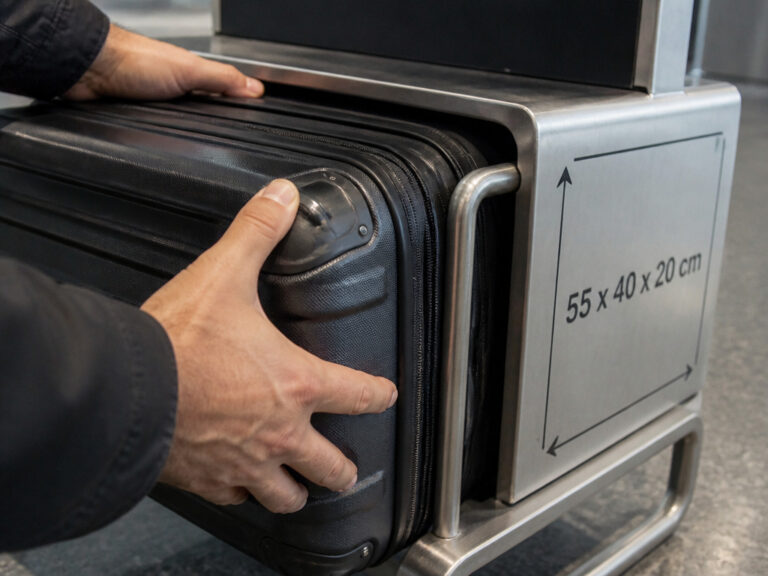
Where this goes sideways: Assuming a soft bag will “squish” into the sizer. Modern gate sizers are metal or rigid plastic. The bag must drop in under its own weight; you cannot apply force. A bulging duffel fails this test every time.
This stricter culture stems from different operational models. The IATA baggage reference manual provides industry guidelines, but budget European carriers like Ryanair and easyJet treat their limits as firm revenue controls. They measure and weigh at the gate because checking an oversized bag there is a profit center.
| Airline Type | Typical Size Limit | Typical Weight Limit | Enforcement Likelihood |
|---|---|---|---|
| US Major (Delta, American) | 22 x 14 x 9 in | Rare | Low, unless bag is visibly oversized |
| US Budget (Frontier, Spirit) | 24 x 16 x 10 in | Yes (e.g., 35 lbs) | High at gate |
| European Budget (Ryanair, easyJet) | 55 x 40 x 20 cm | 10 kg (22 lbs) | Very High at gate |
| Asian/Middle East Full-Service (ANA, Emirates) | 55 x 40 x 20-25 cm | 7-10 kg | High at check-in and gate |
How to Measure Your Bag Correctly (The Gate Agent’s Method)
You measure from the wrong points. Most people measure the bag’s main body, ignoring the wheels and handle. The airline measures from the outermost protruding points when the bag is fully packed. This is the difference between your bag’s “marketing dimensions” and its real-world size.
Follow this sequence: 1. Pack the bag completely as you would for travel. Empty bags collapse; full bags bulge. 2. Retract the handle and extend the wheels to their natural position. 3. Height: Measure from the floor (bottom of wheels) to the highest point of the bag, including the handle if it’s fixed. 4. Width: Measure across the widest point, including any side pockets stuffed with a charger or book. 5. Depth: Measure from the front to the back, accounting for any expansion zippers you’ve used.
The ISO standard for checked baggage (ISO 12604-1:2017) explicitly notes that baggage needs a stable shape and one flat surface for automated handling. While not for carry-ons, the principle applies: a lumpy, overstuffed bag is harder to judge and more likely to be flagged.
I watched a traveler at a Dublin airport argue with a Ryanair agent over a backpack. The bag was within the dimensions on paper, but packed so full it became a sphere. It wouldn’t slide into the metal sizer. The agent’s ruling was final: check it or miss the flight. The lesson is physical, not theoretical.
If your measurements are close, you’re over. Aim for at least a half-inch of clearance in each direction. Use a tape measure, not a ruler. Then, verify the published size requirements on your airline’s official baggage page, not a third-party blog.
Personal Items: The Under-Seat Wild Card

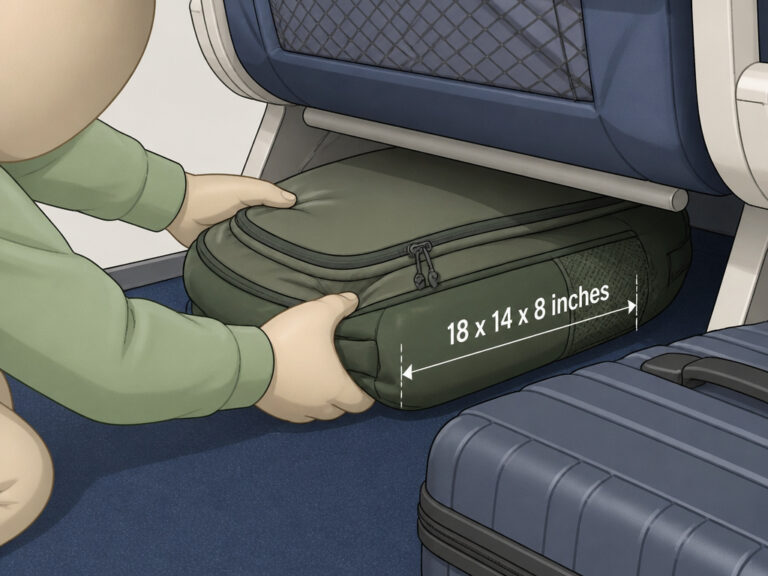
Your personal item is not a second small carry-on. Its official purpose is to fit completely under the seat in front of you without blocking the aisle or your foot space. Dimensions for this are even less standardized than for overhead bags.
- American, Delta, Southwest: Use a “fit under the seat” standard without official dimensions, but a common guideline is 18 x 14 x 8 inches.
- United: Specifies 17 x 10 x 9 inches for its Basic Economy personal item.
- JetBlue: Specifies 17 x 13 x 8 inches.
- International Carriers: Often define it as a small handbag, laptop bag, or item no larger than 40 x 30 x 15 cm.
The critical rule is that the item must be stowed for takeoff and landing. If it protrudes into the aisle, a flight attendant will make you move it, possibly to the overhead bin, which then consumes your carry-on space. A slim backpack or tote is reliable; a bulky duffel is a risk.
Hard-Shell vs. Soft-Side: The Sizer Test

The material of your bag changes your risk profile at the gate.
A hard-shell spinner has fixed dimensions. If it’s marketed as 22x14x9 and you buy it, it will be 22x14x9. It either fits the sizer or it doesn’t. There is no ambiguity. This is the safer choice for strict airlines.
A soft-sided duffel or backpack has variable dimensions. Its acceptable size depends entirely on how you pack it. Pack it square and flat against your back, and it might measure 22x14x9. Pack it round, and the depth can balloon to 11 or 12 inches. This is why two bags with the same listed size can get different rulings at the gate.
The agent uses a metal sizer box. They will ask you to place your bag inside without pushing. If it doesn’t drop in cleanly, it fails. The soft bag’s advantage—its ability to compress—is often nullified by this “no force” rule. Your best defense is to measure your carry-on after it’s fully packed, ensuring it’s not just within the numbers, but within the shape.
What Happens If Your Bag Is Too Big?
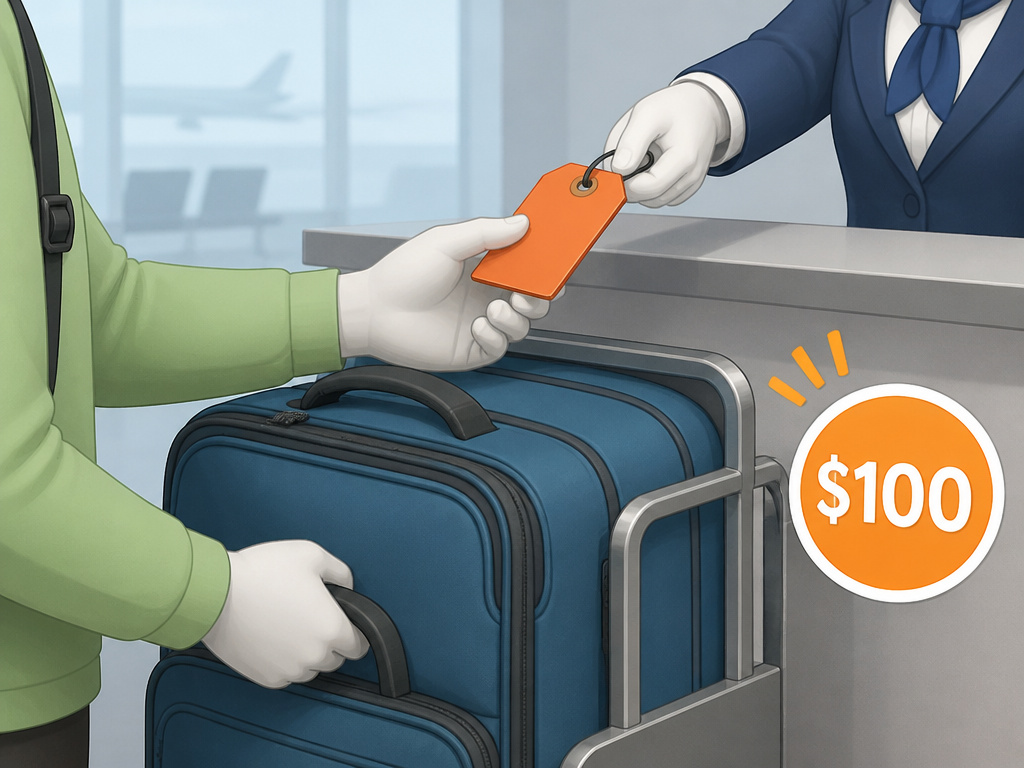
The consequence is a fee. You will be required to check your bag at the gate. This is not the same as checking it at the ticket counter for the standard fee.
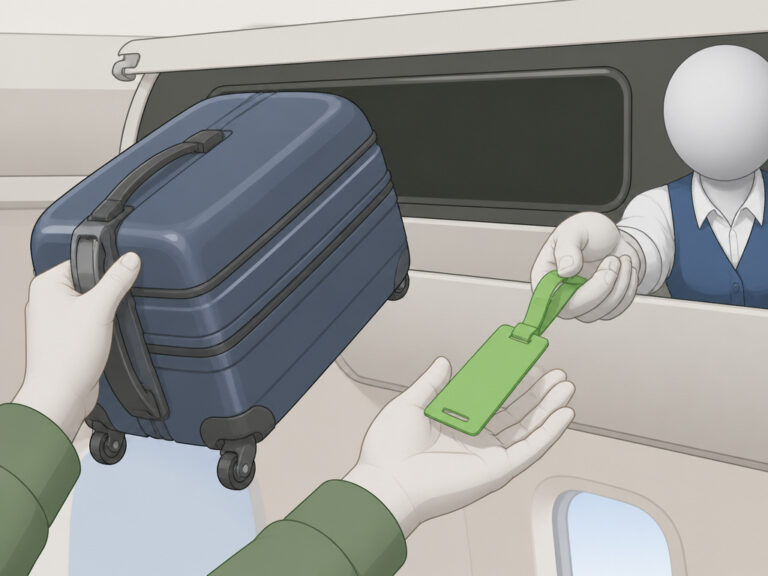
Gate-check fees are punitive, often $60 to $100 or more. They are designed to deter last-minute oversize bags that delay boarding. Furthermore, your bag will be tagged and placed in the aircraft’s hold, meaning you won’t have access to it during the flight and must wait for it at baggage claim at your destination.
On a completely full flight, you may be forced to gate-check your bag for free due to a lack of overhead space. This is a different scenario—you’re not being penalized, but you still lose access to your bag in-flight. To avoid this, board earlier if your fare class allows.
The bottom line: The largest allowed size is a trap. Targeting the most restrictive standard size among the airlines you fly is the only strategy that never fails. For US travel, that’s 22 x 14 x 9 inches. For international, check weight, assume strict enforcement, and measure your packed bag against the carrier’s specific maximum dimensions.
Frequently Asked Questions
What is the largest carry-on size allowed by any airline?
Frontier Airlines and Southwest Airlines currently allow the largest carry-on bags among major carriers at 24 x 16 x 10 inches (61 x 41 x 25 cm). However, this is not a universal “largest size.” Dozens of international airlines, like Air Senegal and Emirates, restrict bags to 21.7 x 15 x 7.9 inches.
Do carry-on dimensions include wheels and handles?
Yes. Every airline’s stated carry-on dimensions include all protruding parts: wheels, handles, side pockets, and anything else that extends the bag’s footprint. You must measure from the very bottom of the wheels to the very top of the extended handle.
Can a 24-inch bag be a carry-on?
Almost never. A 24-inch bag refers to its internal height, usually measured along the spine without wheels. Once you add wheels and a handle, the external height typically exceeds 26 inches. This will surpass the dimensional limit of even the most generous US airlines and will not fit in an overhead bin.
How strict are airlines about carry-on size in 2026?
Enforcement is stricter than pre-2020, particularly by budget airlines (Frontier, Spirit, Ryanair, easyJet) and most international carriers. They use rigid gate sizers and scales consistently. Traditional US majors (Delta, American, United) are still relatively lenient unless your bag is visibly oversized, but this is not a guarantee.
Is there a standard international carry-on size?
No. The International Air Transport Association (IATA) recommends a size of 56 x 45 x 25 cm (22 x 17.7 x 9.8 in), but this is a guideline, not a rule. Individual airlines set their own policies. Always verify the standard dimensions on your ticket carrier’s website.
The Bottom Line
Forget finding one “biggest” size. The real answer is finding the most restrictive size that applies to your travel. For most Americans, that’s the 22 x 14 x 9 inch standard shared by Delta, American, and United. Buy a bag built to that spec, measure it packed, and you’ll never pay a gate-check fee on a domestic trip.
International travel demands more homework. Check your airline’s website for both size and weight limits, and assume they will enforce them. When in doubt, size down. The cost of a slightly smaller bag is always less than the cost and hassle of a surprise $100 fee at the gate. Your carry-on shouldn’t be a gamble. Make it a certainty.