How Much Can a Carry On Bag Weigh: Avoid Fees & Pack Smart
This post contains affiliate links. As an Amazon Associate, we earn from qualifying purchases.
A carry-on bag can weigh anywhere from 5 kg (11 lb) to 10 kg (22 lb), depending on the airline and route. The International Air Transport Association (IATA) cites 5 kg as a common starting point, but major airlines like Lufthansa enforce 8 kg, and ANA and Asiana allow 10 kg. U.S. Carriers like Delta often omit a strict weight limit, focusing instead on a 45 linear-inch (114 cm) size maximum. The real limit is the one your specific airline checks at the gate.
That range is the short answer. The long one is about which number actually matters for your ticket, why airlines pick different battles, and what happens the moment your bag fails the test at the boarding gate.
What follows: the sourced global baseline, the U.S. Regulatory twist that makes weight secondary, a breakdown of four major airline policies, and the packing adjustment that keeps your bag under the radar.
Key Takeaways
- The global baseline is 5–10 kg. IATA notes 5 kg (11 lb) as a common starting point, but full-service airlines in Asia often permit 10 kg (22 lb).
- U.S. Majors often skip published weight limits. Delta, for example, mandates a 45 linear-inch size cap but doesn’t list a weight—though gate agents can still reject overly heavy bags for safety.
- European carriers are strict on weight. Lufthansa’s 8 kg (17.6 lb) limit is actively enforced with integrated scales at gate sizers, especially on busy intra-European routes.
- Exceeding limits means gate-checking. Your bag flies in the hold, often for a fee, and you risk it being mishandled during tight connections.
- Weigh your bag before you leave. Include everything you’ll carry. A 55-liter backpack loaded for a long trip can hit 11 kg before you realize it.
The Global Baseline and the Hard Ceiling
Carry-on weight isn’t a universal number. It’s a band between a general industry suggestion and a legal safety ceiling.
The International Air Transport Association (IATA), which coordinates standards for nearly 300 airlines, provides the reference point. They state that as a general reference, many airlines apply maximum carry-on baggage dimensions of 56 × 45 × 25 cm (22 × 18 × 10 in). On weight, they note some airlines also apply weight limits, typically starting at 5 kg (11 lb).
IATA develops internationally recognized baggage rules and standards to support airlines, airports, ground handling service providers, and regulators in the safe and efficient management of passenger baggage. Baggage allowances and conditions of carriage remain airline specific.
That 5 kg figure is a floor, not a guarantee. Legacy carriers in Asia are more generous. All Nippon Airways (ANA) and Asiana Airlines both set their carry-on weight limit at 10 kg. That includes your main bag and a personal item combined.
The hard ceiling comes from physics and regulation. In the United States, the Federal Aviation Administration (FAA) mandates that all carry-on items must be stowed in an approved location. Their advisory circular, FAA AC 121-29B, details how bags must be secured so they don’t become projectiles during turbulence. Overhead bins have weight limits per compartment, which is why flight attendants will stop you from forcing a monstrous bag in.
The legal rule is 14 CFR § 121.589. It says no certificate holder may allow an airplane to take off or land unless each article of baggage is stowed in a suitable compartment placarded for its maximum weight and providing proper restraint. In plain English: if your bag is too heavy for the bin’s rated restraint, the airline cannot legally let it on board. That’s the regulation that grounds you.
Airline by Airline: Where Weight Actually Matters
Policies split into three camps: weight-focused, size-focused, and combined. Your boarding pass dictates which game you’re playing.
| Airline | Weight Limit | Size Limit (L+W+H) | Primary Enforcement Focus |
|---|---|---|---|
| Lufthansa | 8 kg (17.6 lb) | 55 x 40 x 23 cm | Weight. Uses integrated scale/sizers at gates. |
| ANA / Asiana | 10 kg (22 lb) combined | 115 cm (45 in) | Weight and size. Combined weight for bag + personal item. |
| Delta Air Lines | Not published | 45 linear inches (114 cm) | Size. 45″ linear rule is key; weight can be questioned if bin safety is compromised. |
| IATA Guideline | 5 kg (11 lb) typical start | 56 x 45 x 25 cm | Reference only; not enforced. |
European Strictness: The 8 kg Scale.
Lufthansa is the archetype. Their carry-on baggage page clearly states an 8 kg maximum. Reddit threads from travelers flying out of LAX and Frankfurt confirm gate agents use bag sizers with built-in scales. This is especially common on short-haul European flights where overhead space is the primary bottleneck for on-time departures. They weigh because it’s faster than measuring every bag.
Asian Generosity with a Catch: The 10 kg Combined Limit.
ANA’s rules are precise. You are permitted one carry-on bag and one personal item, with a total combined weight not exceeding 10 kg. This is a common standard for full-service Asian carriers. The critical nuance is the “combined” part. Your laptop bag or purse isn’t free; its weight counts toward your 10 kg allowance. This policy rewards minimalist packing for your personal item.
The American Size-Only Illusion.
Delta’s official carry-on baggage policy highlights the 45 linear-inch rule. They don’t publish a weight. This leads many to believe weight doesn’t matter. It does. The FAA rule still applies. If a gate agent deems your bag too heavy to be safely stowed—or if the flight is full and they need to gate-check bags—yours is first in line. Their contract of carriage always reserves the right to refuse any bag for safety or operational reasons.
The Real-World Failure That Changes Your Packing
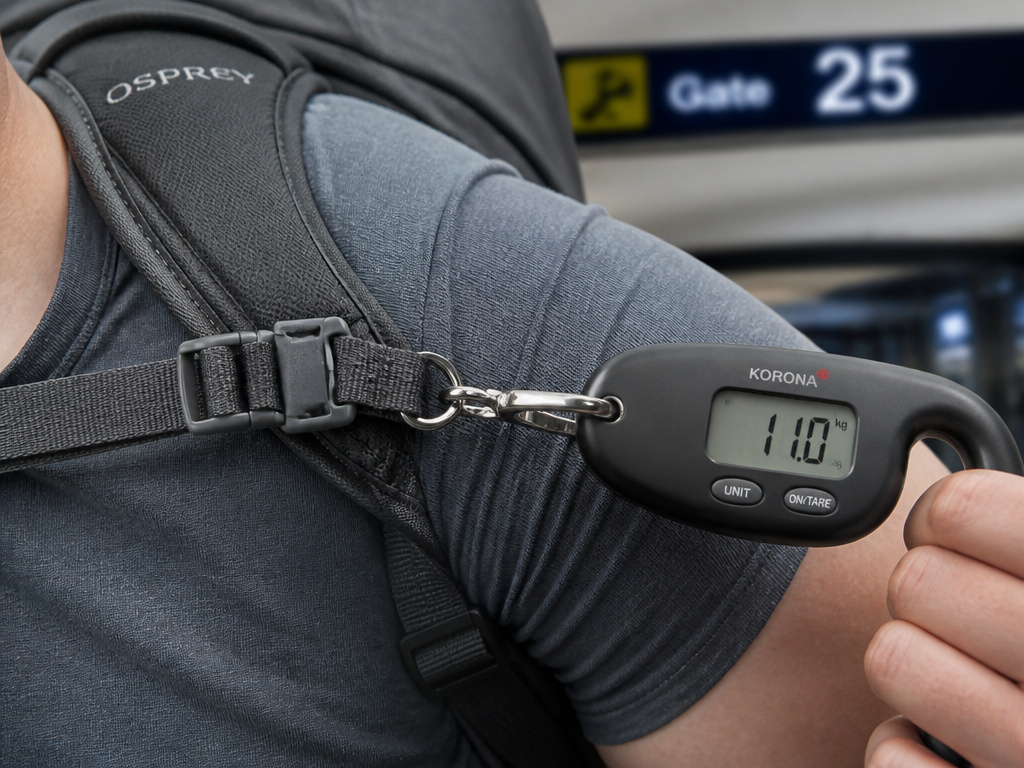
Theory meets a sweaty back and burning shoulders at the airport.
A Reddit user planning a 2-3 month trip to Japan and Southeast Asia chose an Osprey Farpoint 55L travel pack. It’s a popular “one-bag” choice. After a long airport walk, they posted: “My back is sweaty and my traps are on fire… I weighed my pack it’s only 11kg (24lbs)”. They were below ANA’s 10 kg combined limit before adding a personal item. They were already over Lufthansa’s 8 kg limit. The bag felt crushing because its design split weight between two compartments, pulling the center of mass away from the body.
Where this goes sideways: Assuming a backpack is automatically compliant. A 55-liter bag packed full will almost certainly exceed 10 kg. At the gate, that’s a 50 Euro fee to check it, or a frantic repack onto your body.
The lesson isn’t about being a “pussy.” It’s about scale reality. An 11 kg backpack is a significant load. It triggers gate agent scrutiny because it looks heavy. It strains overhead bin hinges. It makes you a target for enforced carry-on weight limits.
Your packing list must fit two constraints: the published weight allowance and the physical reality of carrying it. Weigh your packed bag with a bathroom scale. Subtract your body weight while holding it, then without it. That number must be under your airline’s limit with a buffer for your personal item.
How to Weigh and Measure Your Bag Correctly
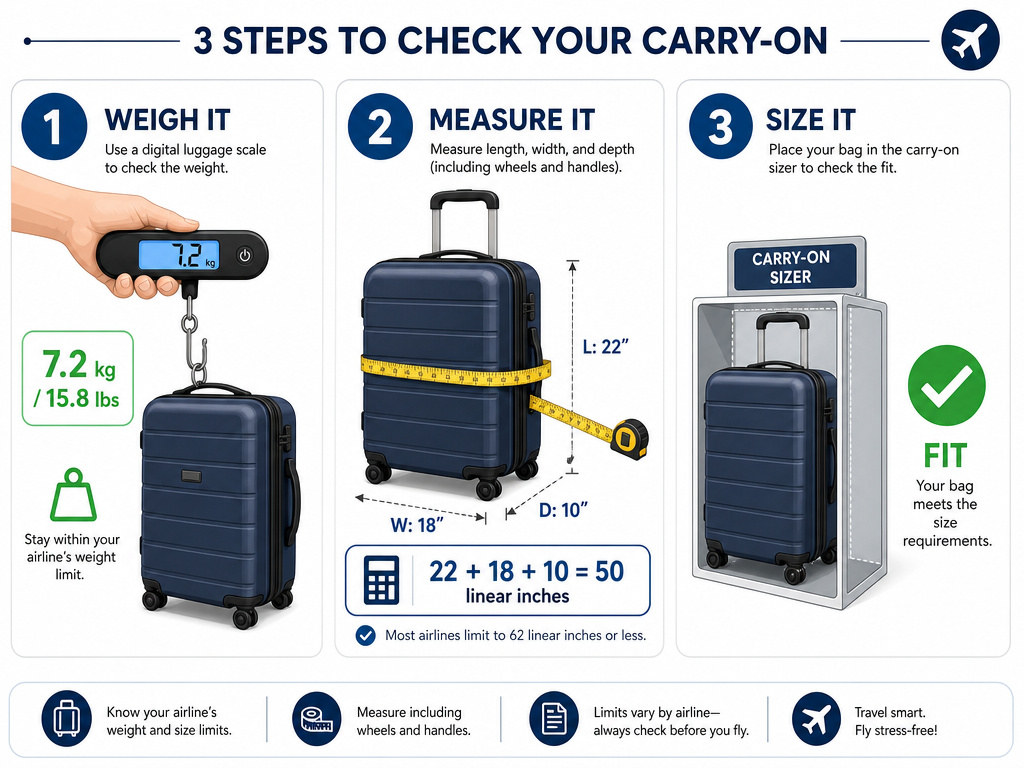
Guessing is how you pay fees. Measuring is how you avoid them.
First, understand your airline’s specific carry-on rules. Is it a combined weight? Do they use linear inches or maximum dimensions? The IATA’s standard carry-on dimensions (22x18x10 in) are a good mold, but your airline’s website is the final word.
- Weigh Everything. Use a digital luggage scale. Hook it to your bag’s carry handle and lift. Pack everything you intend to carry, including your “personal item” if it’s a combined limit. Don’t forget the jacket in the pocket and the book you just bought.
- Measure Linear Inches. Grab a tape measure. Measure the length (from floor to top of handle), width (side to side), and depth (front to back). Add the three numbers. For Delta’s 45 linear-inch rule, your total must be 45 or less. This includes wheels and handles.
- Use the Sizer at Home. Before you leave, check your bag’s carry-on size against a simple box made from chairs or a known-sized suitcase. Does it slide in without force? If you have to shove it, the gate agent will have to shove it, and they won’t.
Common mistake: Measuring an empty bag. Wheels, frames, and fabric add weight. Pack it as you will travel, then measure. The standard carry-on luggage weight you should target is 2-3 kg below your airline’s limit to account for souvenirs.
Keep a printed copy of your airline’s baggage policy on your phone. If an agent challenges you, you can show them the published rule. This won’t always work, but it shifts the burden from “I think it’s okay” to “Here is your company’s policy.”
When Your Bag Is Too Heavy: The Gate-Check Scenario
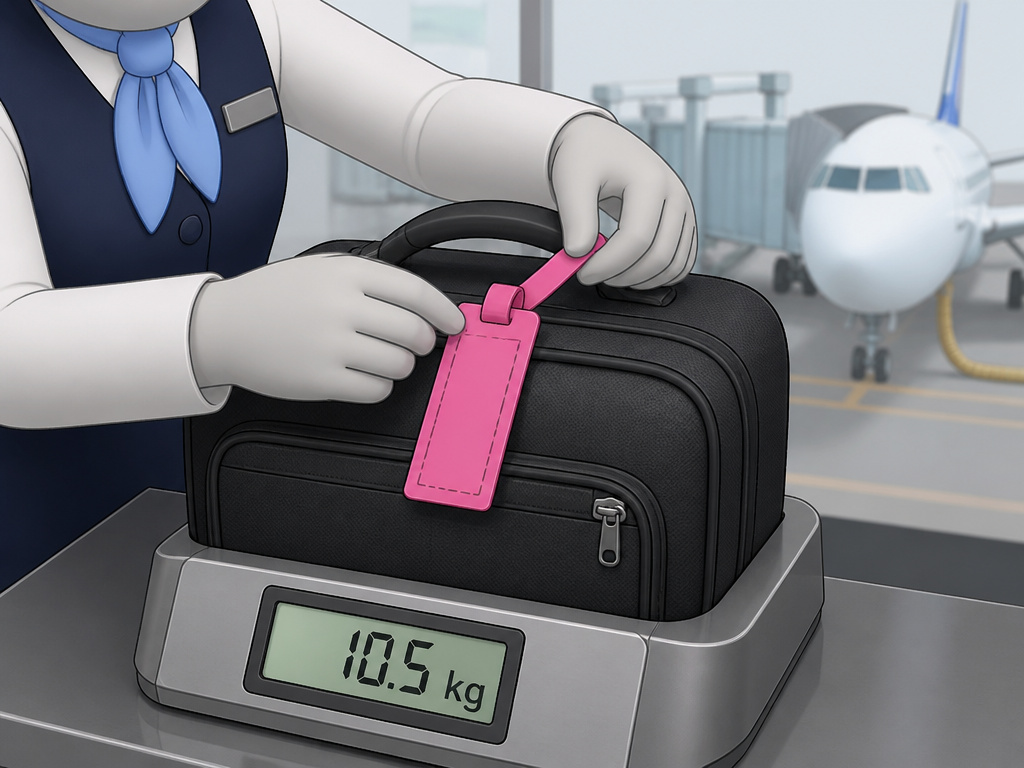
You’re at the gate. The agent points to the scale. Your bag reads 10.5 kg against an 8 kg limit. What now?
The standard procedure is gate-checking. Your bag is tagged with a pink ticket, taken from you at the jet bridge, and loaded into the aircraft’s cargo hold. You collect it at baggage claim, not at the gate.
This costs you three things:
- Time. You must wait at the carousel.
- Control. Your bag is now in the checked baggage system, subject to mishandling.
- Money. Many airlines charge a fee for gate-checking a bag that violates carry-on rules. This fee is often higher than checking it at the ticket counter.
On a completely full flight, even compliant bags may be gate-checked due to lack of space. This is usually free and is about space, not your bag’s fault. The difference is the tag color and the agent’s reason.
If your bag is both oversized and overweight, you may be denied boarding until you check it and pay a fee. This is the worst-case scenario. It’s why knowing the maximum carry-on bag dimensions and weight is a non-negotiable pre-flight task.
Frequently Asked Questions
Do U.S. Domestic flights have weight limits for carry-on?
Most U.S. Airlines like Delta, American, and United do not publish a specific weight limit for carry-on bags. Their focus is on the size limit (typically 45 linear inches). However, they retain the right to refuse any bag that appears too heavy to be safely stowed, per FAA regulations. Always check your airline’s contract of carriage.
What happens if my personal item is too heavy?
If your airline has a combined weight limit (like ANA’s 10 kg), a heavy personal item pushes your total over. The agent will ask you to check one of the bags. If there’s no combined limit, a heavy personal item is rarely weighed unless it’s clearly oversized. The safest approach is to treat all items you carry as part of one weight system.
Can a backpack be too heavy for carry-on?
Yes. A backpack’s weight is not invisible. It must still meet the airline’s carry-on weight allowance. A large travel backpack like the Osprey Farpoint 55L can easily exceed 10 kg when fully packed. The agent will ask you to weigh it if it looks substantial. Backpacks are not exempt from rules.
How strict are airlines about carry-on weight?
Strictness varies by airline, route, and agent. European carriers (Lufthansa, Swiss) are notoriously strict, especially on intra-European flights. Asian carriers (ANA, Asiana) enforce the combined weight limit. U.S. Carriers are generally lenient on weight but rigid on size. The trend is toward stricter enforcement as cabins get fuller.
Is there a standard weight limit for all carry-on luggage?
No. There is no universal standard. The IATA suggests a typical starting point of 5 kg (11 lb), but each airline sets its own policy. You must verify the limit for the airline you are flying, on the specific route you are taking. Policies for checked luggage weight limits are different and usually more generous.
The Bottom Line
Your carry-on’s weight limit is a specific number on your airline’s website, not a rumor. Find it. For most travelers outside the U.S., that number is 8 kg or 10 kg. For U.S. Flyers, the 45 linear-inch rule is king, but an overly heavy bag can still be rejected for safety.
Weigh your packed bag before you walk out the door. If it’s over, pull out the heaviest items—usually shoes, toiletries, or electronics—and wear them or put them in a jacket pocket. Your goal is to walk past the gate agent looking light and compliant. The scale is the judge. Pack like you know it’s there.