What Is the TSA Liquid Limit for Carry-On Bags? A Guide
This post contains affiliate links. As an Amazon Associate, we earn from qualifying purchases.
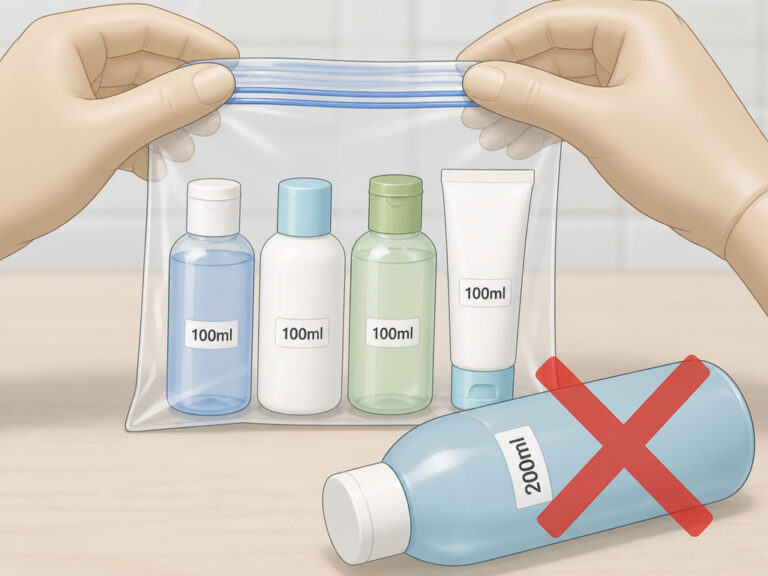
The liquid limit for carry-on luggage is 3.4 ounces (100 milliliters) per container, and all those containers must fit inside a single, clear, quart-sized, resealable plastic bag. You get one bag per passenger. This is the TSA’s 3-1-1 rule.
The rule’s name is a mnemonic, but the numbers hide a specific mechanical reality. A container’s maximum capacity is what the X-ray scanner reads, not how much liquid is actually inside. A six-ounce shampoo bottle that’s three-quarters empty still reads as a six-ounce container to the machine. That’s the point most written guides glance over.
What follows is a breakdown of the three numbers, the real-world exceptions that let you bend them, and the two packing mistakes that guarantee a trip to the bin.
Key Takeaways
- The limit is 3.4 oz (100 ml) per container, not per type of liquid. Ten 3.4 oz bottles of shampoo count as ten items.
- Your quart-sized bag’s dimensions matter internationally. For airlines like ANA, the bag’s length plus width cannot exceed 40 cm.
- Medications, baby food, and breast milk are exempt from the 3-1-1 rule and do not need to go in the plastic bag.
- Duty-free liquids over 3.4 oz are allowed if sealed in a Security Tamper-Evident Bag (STEB) with a receipt dated within 48 hours.
- A container’s labeled capacity is all that matters. A half-full 8 oz bottle is still an 8 oz container and must be checked.
What Exactly Is the 3-1-1 Rule?
The 3-1-1 rule is the TSA’s shorthand for its carry-on liquid restrictions. It breaks into three clear parts, but most people trip on the first number.
3.4 ounces (100 milliliters) per container. This is a hard ceiling on the size of the bottle, not the volume of liquid inside. The rule exists because airport CT scanners and X-ray machines are programmed to identify container shapes and their stated capacities. A large bottle, even if nearly empty, presents the same profile as a full one and requires manual inspection, which slows the line for everyone.
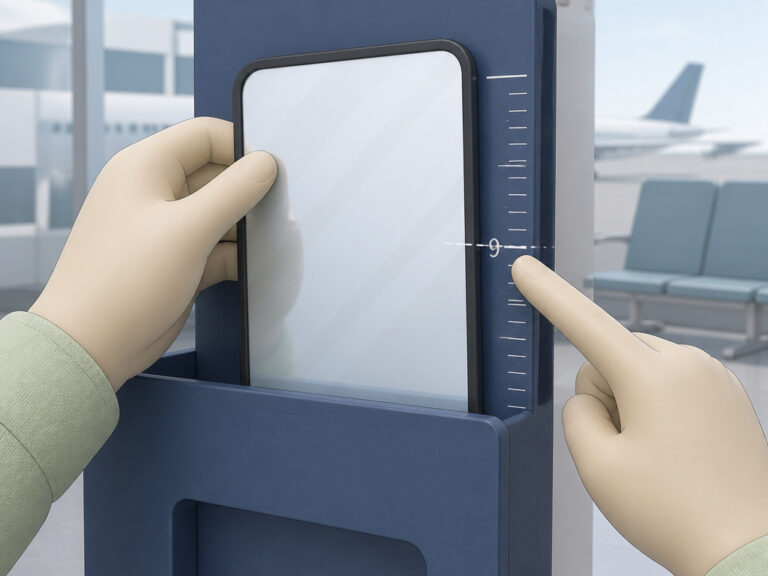
1 quart-sized bag. The bag must be clear plastic and resealable, like a standard Ziploc freezer bag. Its purpose is to consolidate all your small liquids into one easily removable package for screening. The TSA’s official guidance specifies a quart, but some international airlines, such as All Nippon Airways (ANA), define it as a one-liter bag where the combined length and width do not exceed 40 cm.
1 bag per passenger. You don’t get one for your toiletries and another for your snacks. All your travel-sized liquids, aerosols, gels, creams, and pastes must fit into that single quart-sized bag.
TSA liquids rule official page: “You are allowed to bring a quart-sized bag of liquids, aerosols, gels, creams and pastes in your carry-on bag and through the checkpoint. These are limited to travel-sized containers that are 3.4 ounces (100 milliliters) or less per item.”
The rule applies to anything that qualifies as a liquid, aerosol, or gel. Former TSA spokesperson Lisa Farbstein offered a simple test: if you can spill it, spray it, spread it, pump it, or pour it, it’s likely subject to the 3-1-1 rule. This includes shampoo, conditioner, toothpaste, sunscreen, perfume, and even peanut butter.
The Most Common Mistake Is About the Bottle, Not the Bag
People hear “3.4 ounces” and think it’s a limit on the amount of product. It’s not. It’s a limit on the physical container’s maximum capacity. This distinction is the single biggest reason travelers get flagged.
An 8-fluid-ounce bottle of contact lens solution, 90% empty, is still an 8-ounce container. You will be asked to check it or surrender it. The scanner can’t see how much liquid is inside; it sees the container’s size and shape. Security protocols are built around the potential threat a container of that size could pose, not its current contents.
Your packing strategy must start with the bottle label, not your estimated needs. Before you transfer anything, check the fine print on the bottom of every bottle. If it says “NET 5 OZ” or “150 ml,” it’s a no-go for carry-on, regardless of content.
| Container Label | Carry-On Allowed? | Why |
|---|---|---|
| 3.4 fl oz (100 ml) | Yes | Meets the per-container size limit. |
| 4.0 fl oz (118 ml) | No | Exceeds the 3.4 oz limit, even if half-full. |
| 100 ml | Yes | Meets the 100 ml metric limit. |
| 120 ml | No | Exceeds the 100 ml limit. |
The fix is simple but non-negotiable: buy dedicated travel-sized containers that are stamped 3.4 oz or 100 ml. Don’t refill old, larger bottles. That old 6 oz shampoo bottle has to go, into your checked luggage or the trash.
Common mistake: Assuming “partially full” large bottles are okay. They never are. The rule is about container capacity, not current volume.
What Counts as a Liquid? (It’s More Than You Think)
The TSA’s definition is functionally broad. It’s not just about viscosity; it’s about the physical state and how it could be manipulated. This is why some surprising items fall under the rule.
Standard Liquids & Gels:
- Shampoo, conditioner, body wash
- Toothpaste, mouthwash
- Lotions, creams, sunscreen
- Perfume, cologne
- Hair gel, mousse, spray
- Contact lens solution
- Liquid makeup (foundation, concealer)
Food Items Often Missed:
- Peanut butter, jam, honey
- Yogurt, pudding, applesauce
- Maple syrup, salad dressing
- Oils (cooking, essential)
Non-Food Gels:
- Aloe vera gel
- Gel ice packs (unless for medication)
Powders, like loose foundation or protein powder, have their own separate rule if over 12 ounces (350 ml), but they are not subject to the 3-1-1 liquid limits. Solid deodorant, bar soap, and lipstick are also exempt.
When reviewing your what to pack list, apply the “spill-spray-spread” test to each toiletry. If it passes, it needs a 3.4 oz or smaller container and a spot in the quart bag.
Exemptions That Let You Break the 3-1-1 Rule
The rules have built-in flexibility for medical needs and international shopping. These aren’t loopholes; they are documented exceptions with their own procedures.
Medications and Medical Liquids: This includes prescription drugs, over-the-counter medicines, insulin, and gel ice packs required to keep medicine cool. These do not need to fit in the quart-sized bag. You should declare them to the security officer for separate screening.
Infant and Child Nourishments: Formula, breast milk, juice, and baby food in quantities greater than 3.4 oz are allowed when traveling with an infant or toddler. ANA’s policy notes that for departures from the U.S., breast milk may be carried even without an infant present, but it must be presented to inspectors.
Duty-Free Purchases: Liquids over 3.4 oz purchased at an international duty-free shop can be carried on if they are packed in a Security Tamper-Evident Bag (STEB) by the retailer. The bag must be sealed and show no signs of tampering, and you must have the original receipt dated within the last 48 hours. The TSA liquids aerosols gels rule states these items still must be screened and could be denied if they alarm.
Airline-Specific Allowances: Some airlines set their own rules within the international framework. For example, ANA permits hand sanitizer containers up to 350 ml in carry-on luggage, a specific exception to the standard 100 ml limit.
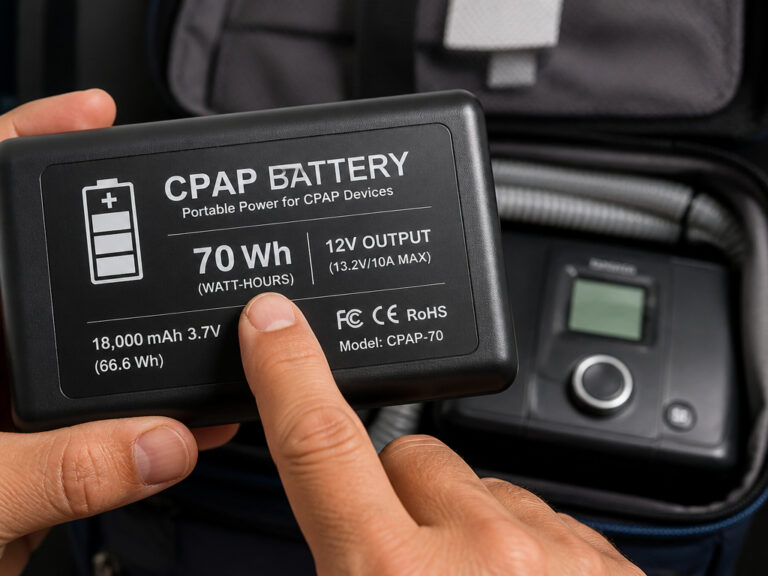
If you’re traveling with exempt items like a CPAP machine or medically necessary liquids, it’s wise to review the specific rules for CPAP machines in carry-on luggage and always have documentation handy.
How to Pack Your Liquids Bag Correctly
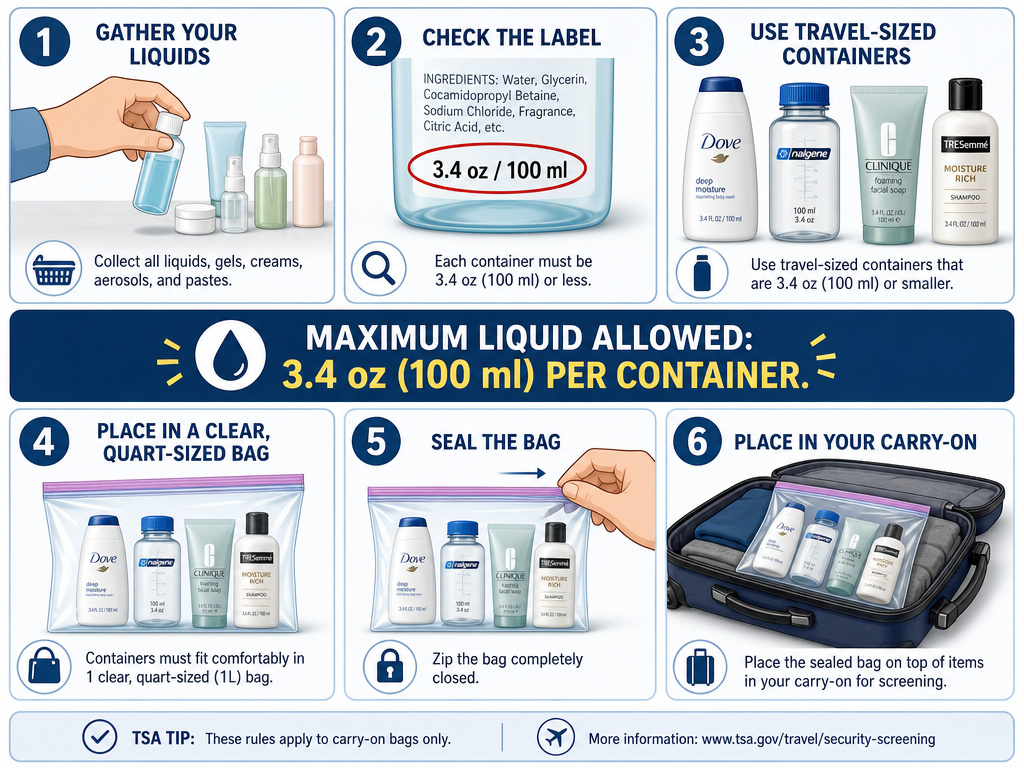
Efficiency at the checkpoint is about preparation, not just compliance. A messy bag invites a hand search.
- Gather Your Bottles. Collect every liquid, gel, and aerosol you need. Check each label for the 3.4 oz/100 ml limit.
- Use a Clear, Quart-Sized Bag. A sturdy, name-brand freezer bag works better than a flimsy sandwich bag. For international travel, ensure it’s approximately 20cm x 20cm or that length + width ≤ 40cm.
- Pack Strategically. Stand bottles upright. Place taller items in the back, shorter ones in front. This creates a clear, scannable layout. For more general tips for packing your carry-on bag, organize from heavy to light.
- Place the Bag on Top. Once packed, put your quart bag at the very top of your carry-on or in an outside pocket. You need to remove it swiftly at security.
- Know Your Screening Lane. In standard lanes, you must take the liquids bag out and place it in a bin. In TSA PreCheck lanes (and often with new CT scanners), you can leave it inside your bag.
Where this goes sideways: Stuffing the bag until the seal strains. An overstuffed bag won’t lie flat in the bin, and the officer may need to open it, slowing you down. Leave a little room.
Your carry-on essentials should include this bag, but remember your packing a carry-on strategy must account for all items allowed in carry-on, not just liquids.
International Liquid Limits: It’s Not Just the TSA
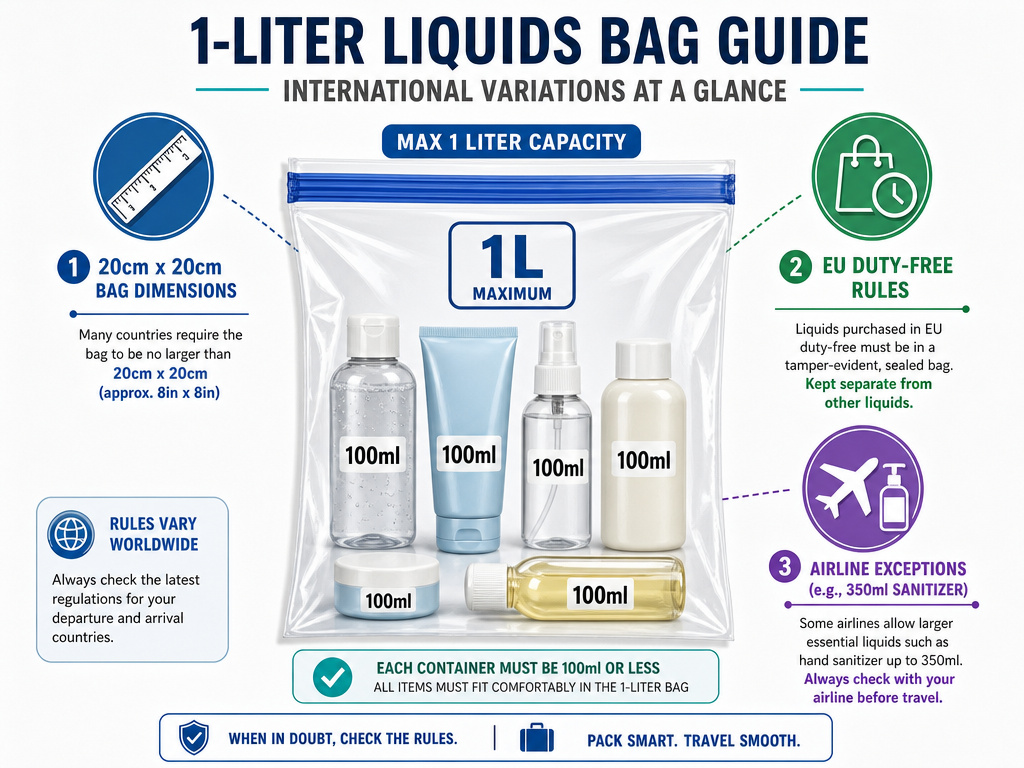
The 3-1-1 rule is a U.S. Implementation of a global standard coordinated by the International Civil Aviation Organization (ICAO). Most countries follow the 100 ml container and 1-liter bag limit, but the specifics can vary.
Key Differences to Watch:
- Bag Dimensions: As with ANA, some countries/airlines specify maximum dimensions (e.g., 20cm x 20cm) rather than just a volume.
- Duty-Free Rules: The 48-hour receipt rule for STEBs is a U.S. Requirement for inbound flights. The European Union has its own regulations for liquids purchased in EU airports.
- Local Exceptions: Always check your airline’s website. An airline like ANA allowing 350 ml hand sanitizer is a perfect example of a carrier-specific exception.
The core principle, small containers in one clear bag, is universal. The variations are in the fine print. When in doubt, default to the strictest interpretation: 100 ml containers in a 1-liter bag with a 20cm x 20cm profile.
Frequently Asked Questions
Can I bring an empty water bottle through security?
Yes. Completely empty bottles of any size are allowed. Fill it at a water fountain once you’re past the checkpoint.
Do my liquids bag items count toward my carry-on weight limit?
Usually, no. The contents of your liquids bag are considered part of your overall carry-on, but most airlines only weigh the main bag at the gate. However, on airlines with strict 10 kg total carry-on limits (like ANA), every ounce counts.
What happens if my duty-free bag is opened?
If the Security Tamper-Evident Bag (STEB) is opened or tampered with, the exemption is void. The liquids inside will be subject to the standard 3.4 oz limit and likely confiscated if they exceed it.
Are electric razor or toothbrush chargers subject to liquid rules?
No. Chargers and electronics are not liquids. However, be aware of separate regulations for batteries in carry-on luggage for any device containing a battery.
Is mascara considered a liquid?
It depends. Liquid mascara is subject to the rule. A completely solid cake mascara is not. If in doubt, put it in the bag.
Can I pack one 7 oz bottle if it’s shared between two people?
No. The limit is per container, not per person. A 7 oz container is prohibited in carry-on regardless of how many people intend to use it.
The Bottom Line
The liquid limit for carry-on luggage hinges on one thing: the printed capacity on your bottles. Master that, and the rest, the quart bag, the exemptions, the international nuances, falls into place.
Pack only containers marked 3.4 oz or 100 ml. Use a sturdy, clear bag. Keep medicines and baby food separate. For everything else, from deodorant rules to power bank policy, the same principle of checking the specific rules applies. Your goal isn’t just to get through security, but to do it without breaking stride.