Is It OK to Carry Power Bank in Hand Luggage | The Rules
This post contains affiliate links. As an Amazon Associate, we earn from qualifying purchases.
Yes, you can carry a power bank in hand luggage, but you must follow three hard rules from the 2026 IATA and ICAO regulations: keep it under 100 Watt-hours (Wh), carry no more than two per person, and never recharge it or use it to charge a device during a flight. All power banks are considered spare batteries and are strictly forbidden in checked baggage under any circumstances.
The 100 Wh limit isn’t new, but the other two rules are. The March 2026 ICAO addendum changed the game by capping everyone at two power banks and explicitly banning their use in the air. This isn’t about convenience anymore; it’s a direct response to documented fire risks from lithium batteries in the cabin.
What follows: a breakdown of the 2026 rules, how to find your power bank’s Wh rating, the exact short-circuit protection method authorities require, and what happens when airlines like Emirates or Singapore Air enforce even stricter policies.
Key Takeaways
- The universal limit is now two power banks per passenger in carry-on luggage, regardless of capacity.
- You are prohibited from recharging a power bank or using it to charge another device during a flight.
- Any power bank placed in checked baggage will be removed by security; it’s a blanket ban.
- You must protect terminals from short circuits by taping them or using the original box.
- Airlines can and do impose stricter rules, like Emirates’ ban on all in-flight power bank use.
The 3 Hard Rules for Carrying a Power Bank
Forget the old, vague advice. The 2026 regulations from the International Civil Aviation Organization (ICAO) and the International Air Transport Association (IATA) are specific. They treat power banks as spare batteries, not personal electronic devices. This classification triggers a strict set of carriage conditions.
Your compliance hinges on three non-negotiable points.
1. Capacity Limit: The 100 Wh Ceiling
The Watt-hour (Wh) rating is the only number that matters. You can carry power banks with a rating of 100 Wh or less without notifying the airline. This covers the vast majority of consumer models. Finding this rating is step one. It’s printed on the power bank itself, often near the model number or output specs. If you only see milliamp-hours (mAh) and voltage (V), calculate it: (mAh / 1000) * V = Wh. A 20,000 mAh bank at 3.7V is 74 Wh.
Power banks with a lithium-ion battery must not exceed a Watt-hour rating of 100 Wh for unrestricted carriage in passenger carry-on baggage. This is a fundamental limit set by both ICAO and IATA dangerous goods regulations.
2. Quantity Limit: Two Per Person, Full Stop
This is the 2026 change that catches most travelers off guard. Previous rules only limited high-capacity spares (100-160 Wh). The new mandate applies to all power banks. No passenger may carry more than two in their carry-on luggage. This limit is now echoed in national directives, like the Malaysian civil aviation safety directive, which instructs airport screeners to enforce the two-device rule.
3. Usage Ban: No Charging, Anytime, Anywhere Onboard
You cannot recharge your power bank during a flight. You also cannot use your power bank to recharge a phone, tablet, or laptop. This rule exists because the charging process generates heat and increases the risk of a thermal event. The IATA power bank guidance for operators is explicit: passengers are “strictly prohibited from recharging power banks during flights.” The aircraft’s seat power outlet is only for personal electronic devices.
Why Checked Baggage Is an Absolute No-Go
This rule has no exceptions. The European aviation safety information bulletin states it plainly: “Spare batteries, including power banks, are forbidden in the checked baggage.”
The reason is physics and access. Checked baggage holds are not pressurized or temperature-controlled in the same way as the cabin. A lithium battery fire starting there could spread undetected for crucial minutes before crew could intervene. In the cabin, a smoke alarm sounds, and a fire extinguisher is seconds away. In the hold, it’s a catastrophe in progress. Packing a power bank in your checked suitcase is a surefire way to have your bag opened and the item confiscated, potentially delaying your luggage.
How to Pack and Protect Your Power Bank
Compliance isn’t just about the numbers. You have a physical responsibility to pack the device so it cannot cause a short circuit. A short circuit occurs when the metal positive and negative terminals connect, completing a circuit and generating intense heat rapidly. This can happen if loose coins, keys, or other metal objects in your bag touch the terminals.
The ICAO Technical Instructions mandate that batteries “must be individually protected so as to prevent short circuits.” Here is the official method, presented in the order of effectiveness:
| Protection Method | How To Do It | Why It Works |
|---|---|---|
| Original Retail Packaging | Keep the power bank in the box it came in. | The packaging is designed to isolate the terminals. |
| Tape Over Terminals | Cover exposed metal terminals with clear adhesive tape. | Creates a physical insulator. Electrical tape is best. |
| Separate Plastic Bag | Place the power bank in its own zip-top bag or protective pouch. | Prevents contact with other metal objects. |
Common mistake: Throwing a loose power bank into a bag pocket with keys and pens. The terminals scrape against a key for three hours of turbulence, and the bag liner melts before anyone smells it.
Do not rely on a silicone case alone. Most cases have openings that leave the charging ports exposed. Tape the ports first, then put it in the case.
Airline-Specific Rules: When Carriers Go Stricter
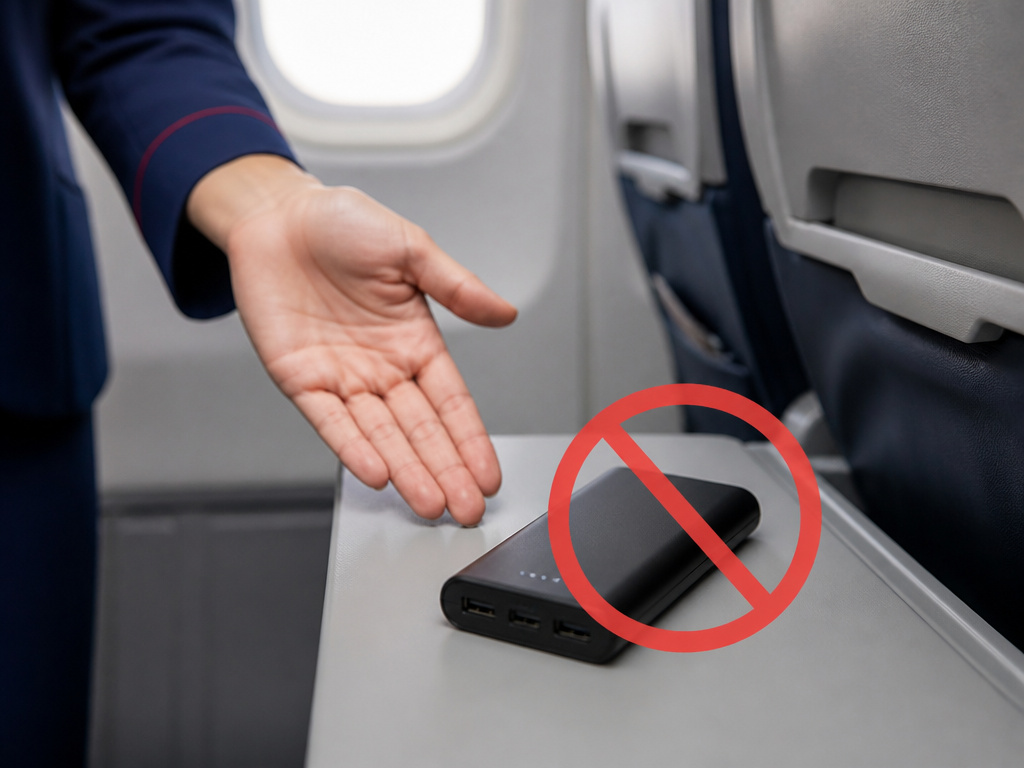
The IATA and ICAO rules are the global baseline. Every airline can impose stricter requirements. You must check your carrier’s policy before you fly. This is not a formality; enforcement varies dramatically.
- Emirates: As of October 2025, Emirates banned the use of power banks onboard entirely. You can carry one under 100 Wh, but you cannot plug it in to charge anything.
- Singapore Airlines, Scoot, Thai Airways: This group has also announced bans on using power banks during flight. The carriage rules (capacity, quantity) remain aligned with ICAO.
- General Carrier Power: Any airline can refuse carriage of a power bank if the Wh rating cannot be verified, if it looks damaged, or if staff deem it unsafe.
The trend is clear. After incidents like the 2024 Air Busan event, airlines are erring on the side of extreme caution. The onboard rule is shifting from “use with care” to “do not use at all.” Assume you cannot use your power bank in the air until proven otherwise by your specific airline’s published policy.
What About Larger Capacity Power Banks (100-160 Wh)?
The rules provide a narrow pathway for larger power banks, typically used for professional camera gear or high-performance laptops. You cannot simply bring them onboard.
- Airline Approval is Mandatory. You must contact the airline before your flight, often at least 48-72 hours in advance. You cannot obtain this approval at the check-in counter.
- The Limit is Still Two. Even with approval, you are limited to a maximum of two spare batteries in this higher capacity range.
- All Other Rules Apply. They must be in carry-on baggage, protected from short circuits, and cannot be used or charged in flight.
The approval process is not guaranteed. Many airlines simply refuse them on certain aircraft or routes due to their specific safety risk assessments. For most travelers, sticking under the 100 Wh limit is the only practical choice.
Frequently Asked Questions
Can I take a 20000mAh power bank on a plane?
Yes, a 20000mAh power bank is almost always allowed. You need to confirm its Watt-hour rating. A standard 20000mAh bank at 3.7V is 74 Wh, which is under the 100 Wh limit. Just ensure you follow the other rules: carry-on only, short-circuit protection, and the two-unit maximum.
What happens if I accidentally put a power bank in my checked luggage?
Security screening will likely detect it. Your bag will be opened, and the power bank will be removed and confiscated. Your bag may be delayed as it goes through this additional screening process. In some jurisdictions, you could face a fine.
Why can’t I use my power bank on the plane?
Charging a lithium battery generates heat. In the unique environment of an aircraft cabin—with vibration, potential pressure changes, and limited firefighting options—this elevated risk is deemed unacceptable by aviation authorities. A thermal runaway event from a charging battery is a severe cabin safety threat.
How do I know if my power bank is under 100 Wh?
Look for the Wh rating on the device label. If you only see mAh and V, use the formula: (mAh / 1000) * V = Wh. Example: (26800 mAh / 1000) * 3.7V = 99.16 Wh.
Can I bring a power bank on an international flight?
Yes, the IATA and ICAO rules are international standards. However, you must also comply with the specific regulations of your departure and arrival countries, as well as your airline. The core rules (carry-on, 100 Wh, two units) are globally consistent.
Before You Go
The rules for power banks are now simpler and stricter. You get two. They must be under 100 Wh each. They live in your carry-on, packed so they can’t short out. You do not plug them in during the flight. This isn’t airline hassle; it’s chemistry and physics dictating the terms. Check your labels, put some tape over the ports, and verify your airline’s stance on use. That routine takes two minutes and beats arguing at the gate while your flight boards without you.