Can You Bring a Backpack on a Plane? Size & Airline Rules
This post contains affiliate links. As an Amazon Associate, we earn from qualifying purchases.
Yes, you can bring a backpack on a plane as a carry-on or personal item, but it must fit the airline’s specific size limits, typically under 22 x 18 x 10 inches for carry-on and under 18 x 14 x 8 inches for a personal item. The critical failure point is depth, not height, with strict budget carriers like Ryanair enforcing a 7.8-inch limit that eliminates most travel packs.
The published numbers are a starting point. The real decision happens at the gate, where an agent’s glance decides if your bag flies free or costs you a fee. Budget airlines run on baggage revenue, so they measure. Major carriers prioritize boarding speed, so they often don’t, unless your pack is obviously a 50-liter monster.
What follows: the exact size limits that matter, the two types of items that will get your bag pulled aside at security, and the one backpack model that consistently beats the system.
Key Takeaways
- Depth is the deal-breaker. Most 40L travel backpacks are 9-10 inches deep, failing Ryanair’s 7.8-inch limit and sitting borderline for United and Delta.
- Budget airlines enforce, major airlines often don’t. Ryanair, Frontier, and Spirit use sizing cages and charge fees at the gate. Delta, United, and American rarely check unless bins are full.
- Lithium-ion batteries over 100 watt-hours need approval. The FAA bans power banks over 160 Wh on passenger aircraft. Damaged or recalled batteries are forbidden entirely.
- The Osprey Daylite Expandable 26+6 is the exception. At 16.9″ tall and 6.3″ deep unexpanded, it fits under-seat on most airlines while offering 26L of space.
- Powders and liquids get extra scrutiny. IATA notes some airports screen powders over 355 ml, and the global 3-1-1 liquids rule (100 ml containers in a 1L bag) always applies.
What Are the Universal Carry-On Size Limits?
The International Air Transport Association (IATA) sets a common baseline: 56 × 45 × 25 cm (22 × 18 × 10 inches), including wheels and handles. Most global and U.S. Major airlines align with this, with weight limits often starting around 5 kg (11 lb). This is the size bin your backpack must squeeze into to qualify as a carry-on.
The IATA standard of 22 x 18 x 10 inches is a volume ceiling, not a guarantee. Individual airlines can and do set stricter limits, especially for the free personal item that fits under the seat in front of you.
Your backpack flies in one of two roles: as your primary carry-on (overhead bin) or as your personal item (under the seat). The personal item limits are smaller, usually around 17 x 13 x 8 inches. If you’re trying to travel with just a backpack to avoid fees, you’re aiming for the personal item category. That’s a much tighter fit.
| Airline Type | Typical Carry-On Limit | Typical Personal Item Limit | Enforcement Style |
|---|---|---|---|
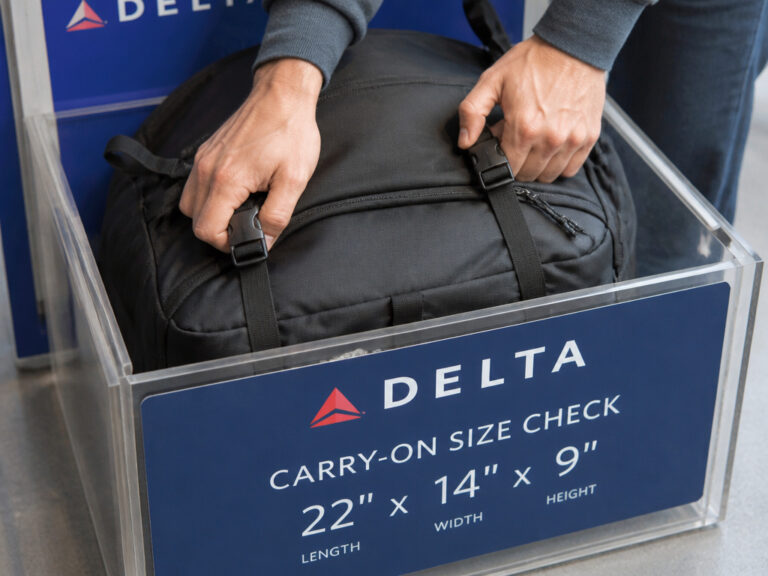
| U.S. Major (Delta, United, American) | 22″ x 14″ x 9″ | 17″ x 13″ x 8″ | Lenient; rarely measures unless bag is obviously oversized. |
| U.S. Budget (Frontier, Spirit) | 22″ x 18″ x 10″ | 18″ x 14″ x 8″ | Very strict; uses sizing cages at gate, high fees for non-compliance. |
| European Budget (Ryanair, Wizz Air) | 21.6″ x 15.7″ x 7.8″ | 15.7″ x 15.7″ x 7.8″ | Extremely strict; rigid metal sizer, fees up to €70 at gate. |
Southwest Airlines is the notable U.S. Exception with a generous 24 x 16 x 10 inch carry-on limit. If you’re flying Southwest, you have more breathing room.
The Depth Problem: Where Backpacks Fail
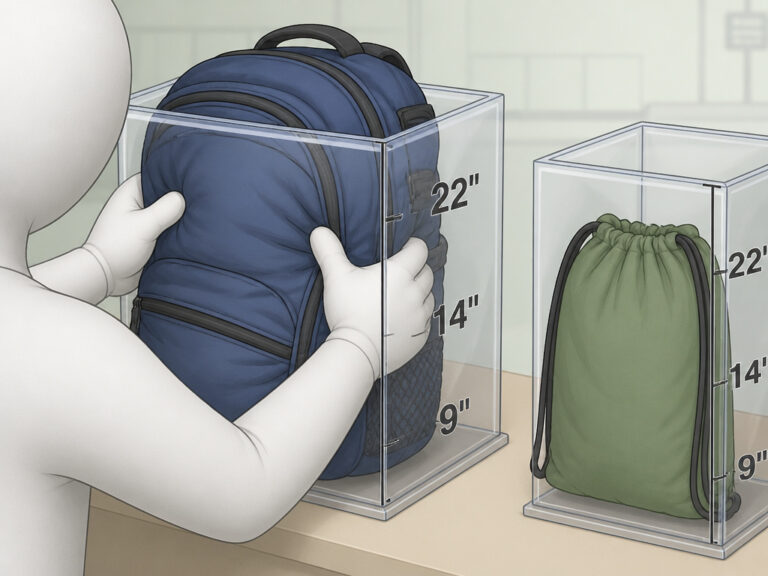
Look at your backpack from the side. The measurement from the front panel (against your back) to the bulkiest part of the packed compartment is the depth. This is the dimension that fails.
Most travel backpacks in the 30-45 liter range are designed for capacity, not compliance. They balloon to 9, 10, even 12 inches deep when fully packed. Ryanair’s ruthless 7.8-inch (19.8 cm) depth limit on both carry-on and personal items was specifically engineered to catch these packs and collect fees.
Common mistake: Choosing a backpack based on its listed “capacity” in liters. A 40L bag can be compliant if it’s tall and slim, or non-compliant if it’s short and deep. Always check the manufacturer’s listed dimensions, not just the volume.
Here’s how popular backpacks measure up on the critical depth dimension:
| Backpack Model | Listed Depth | Fits Ryanair (7.8″)? | Fits United/Delta (9″)? |
|---|---|---|---|
| Osprey Daylite Expandable 26+6 | 6.3 inches | Yes (Unexpanded) | Yes |
| Nomatic 30L Travel Bag | 9 inches | No | Borderline |
| Osprey Farpoint 40 | 9.1 inches | No | Borderline |
| Cotopaxi Allpa 35L | 10 inches | No | No |
| Peak Design Travel Backpack 45L | 9-12 inches | No | Only at minimum 9″ compression |
The Osprey Daylite Expandable 26+6 is the standout here. By keeping its depth to a svelte 6.3 inches when unexpanded, it slides under the seat on most airlines, escaping the overhead bin scramble and the gate agent’s tape measure. It’s a prime example of a carry-on backpack built for the modern budget-travel reality.
What Can and Cannot Go Inside Your Backpack

The TSA and FAA don’t care about your backpack’s brand. They care what’s inside it. Two categories will get your bag pulled for inspection every time: batteries and large quantities of powders or liquids.
Lithium-ion batteries are a cabin-only item. The FAA’s PackSafe rules are non-negotiable. Spare batteries and power banks must stay in your carry-on backpack. The watt-hour (Wh) rating, usually printed on the battery, dictates your freedom: * 0-100 Wh: Allowed (this covers most laptops and power banks). * 101-160 Wh: Requires airline approval, limit of two spares. * Over 160 Wh: Forbidden on passenger aircraft.
Where this goes sideways: Traveling with a damaged or recalled battery. The FAA explicitly forbids any battery or device “likely to create sparks or generate a dangerous evolution of heat” unless the bad cell is removed. That means a swollen laptop battery or a recalled power bank stays home.
Liquids and powders follow the 3-1-1 rule. Containers must be 100 ml (3.4 oz) or less, all fitting inside a single 1-quart clear plastic bag. Exceptions exist for medically necessary liquids like formula or insulin. IATA notes that some airports apply extra screening to powders (like protein powder or instant coffee) in quantities over 355 ml (12 oz).
Sports equipment that can be used as a bludgeon, baseball bats, golf clubs, must be checked. You can, however, bring a life vest with two CO2 cartridges in your backpack as luggage, plus two spares.
Backpack vs. Suitcase: The Hands-Free Advantage

A YouTube traveler’s rant nailed it: “Who’s taking a suitcase over a backpack? You have your hands free… You can just pack more stuff in there.” A suitcase has rigid sides, a handle, and wheels, all taking up packable space a backpack uses for your gear.
For moving through an airport, digging for a boarding pass, holding a coffee, herding kids, a backpack’s harness system is superior. It also conforms to your body, making it easier to squeeze through crowded gates or down narrow airplane aisles. A wheeled suitcase is a blocker you have to drag.
The trade-off is organization. Suitcases have flat, compartmentalized packing. Backpacks are one deep pit. Use packing cubes in a backpack to simulate suitcase organization, and you get the best of both: efficient space use and hands-free mobility.
How to Choose the Right Backpack for Air Travel

You need a bag that matches your most frequent airline’s limits. If you fly Ryanair twice a year, buy for Ryanair. If you’re a Delta loyalist, you have more flexibility.
For budget airline warriors: Your target is the personal item size. Look for bags marketed as “under-seat” or “personal item compliant.” The Osprey Daylite Expandable is the benchmark. Patagonia’s Black Hole Mini MLC 26L is another contender. Ignore any bag with a depth over 8 inches.
For major airline travelers: You can risk a larger pack, but why? A bag that fits under the seat guarantees you a spot for your belongings, even when overhead bins are full. It also lets you board later. A duffel bag on planes can work if it’s soft-sided and you don’t overstuff it, but a backpack’s structure is easier to manage.
The packing test is final. Before you buy, pack the bag as you would for a real trip. Then measure it. Height, width, and most importantly, depth. Does it still fit the limits when fully loaded? If not, it’s the wrong bag.
Navigating Airline-Specific Policies
Airlines publish their rules, but enforcement is the wild card. Know what you’re facing at the gate.
Frontier and Spirit are the U.S. Enforcers. Their backpack policies are revenue drivers. They will place your bag in a metal sizer at the gate. If it doesn’t fit, you’re paying a fee that often exceeds the cost of a checked bag. Don’t test them.
Delta and American are generally lenient. Their Delta backpack policy is more of a guideline unless the flight is full. A 30-liter backpack that’s slightly over will usually pass. A 50-liter mountaineering pack will not.
The “two-bag” trick. Most airlines allow one carry-on and one personal item. If your backpack is your carry-on, you can also bring a small purse or laptop bag. If your backpack is your personal item, that’s all you get. Understanding Delta’s backpack and carry-on policy or Southwest’s rules lets you maximize your luggage without fees.
Frequently Asked Questions
Can I bring a hiking backpack on a plane?
Yes, but it will almost certainly need to be checked. Framed hiking backpacks are long, deep, and have external straps that can snag. Remove any fuel canisters or bear spray (which are always prohibited), and consider putting the pack inside a durable duffel bag for travel to protect it.
Are there backpacks that always fit as a personal item?
No bag is guaranteed, but the Osprey Daylite Expandable 26+6, the Cabin Zero Classic 28L, and the Patagonia Black Hole Mini MLC 26L are consistently reported to fit under-seat on everything from Spirit to Ryanair. Their secret is a depth under 8 inches.
Can I put stickers or pins on my backpack?
Yes, but be prepared for additional screening. The TSA says pins on backpacks can trigger an alarm if they are metal and dense enough. Security may swab your bag or ask to inspect it. It’s allowed, but it might cost you a few minutes.
What if my backpack gets wet or dirty during travel?
Never put a wet backpack in a dryer. The heat can melt adhesives, warp plastic frames, and shrink fabrics. The proper way to dry a backpack is to empty it, wipe it down, and air-dry it completely open, away from direct heat.
Can I bring tools in my backpack?
It depends. Small hand tools (screwdrivers under 7 inches, wrenches) are generally allowed in carry-on by the TSA. Power tools with lithium-ion batteries must be in carry-on, and the battery must be under 100 Wh. Any tool that could be used as a weapon (hammers, saws, drills) must be checked.
The Bottom Line
You can bring a backpack on a plane, but the freedom ends where the airline’s sizer begins. Choose a bag based on the deepest dimension you’ll face. Ryanair’s 7.8 inches is the current global benchmark for strictness. Pack knowing that batteries and large powders are inspection magnets.
For most travelers flying a mix of carriers, a sub-30-liter backpack with a depth under 8 inches is the safest play. It keeps your bag under your control, under the seat, and away from fees. That’s the real goal: getting you and your gear from A to B without surprise costs or last-minute gate-check panic.