Duffel Bags on a Plane: Carry-On and Checked Baggage Rules
This post contains affiliate links. As an Amazon Associate, we earn from qualifying purchases.
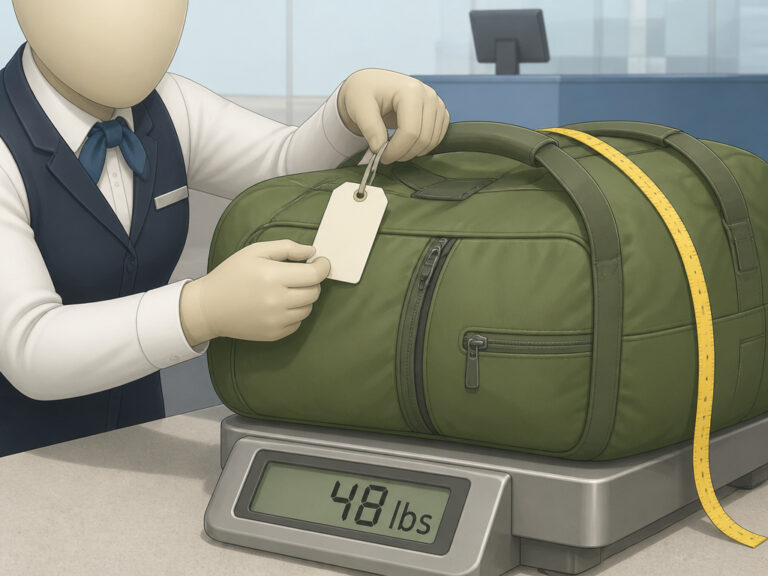
You can bring duffel bags on a plane as carry-on or checked luggage, but the bag must satisfy three FAA-mandated conditions: its dimensions fit the airline’s published size limit, its weight stays under the airline’s threshold, and it can be stowed securely under a seat or in an approved overhead bin. A soft-sided duffel that measures 22” x 14” x 9” when packed will clear every major U.S. Carrier’s sizer, but bringing that same bag onto a Delta Connection flight with 50 seats or less guarantees a gate-check.
The FAA’s rule isn’t a suggestion. It’s the operational standard every U.S. Airline builds its gate procedure around. Section 121.589 of the Federal Aviation Regulations says no airplane can take off unless every article of baggage is stowed in a suitable closet, a cargo compartment, or under a passenger seat. Your duffel bag is just another article of baggage to the crew.
What follows breaks down the FAA’s checklist into the measurements that matter, the one airline exception that overrides all standard sizes, and the packing technique that keeps a soft duffel compliant when a hard-shell suitcase would fail.
Key Takeaways
- The FAA’s carry-on rule (§ 121.589) requires bags to be stowed under a seat, in a closet, or in a cargo bin — overhead racks need approved restraints.
- Always measure your duffel fully packed, including handles and bulging pockets. An empty bag’s dimensions are irrelevant.
- On Delta Connection flights with 50 seats or less, only a personal item is allowed in the cabin; a standard carry-on duffel will be gate-checked.
- Soft-sided duffels can be compressed into a sizer if slightly overstuffed; a hard-sided roller at the same measurement will be rejected.
- Basic economy fares on most major airlines only include a personal item; bringing a full-size duffel to the gate triggers a check-in fee.
The FAA’s 3-Point Carry-On Compliance Checklist
The FAA carry-on baggage regulation (specifically DOT § 121.589) is not about convenience. It’s a safety and operational mandate. Your duffel bag must pass three tests before the crew can close the cabin door.
First, it must fit the airline’s approved carry-on baggage program. This is the size limit you look up online. For Delta, United, American, and Alaska mainline flights, that’s 22” x 14” x 9” (45 linear inches). Spirit Airlines allows a paid carry-on up to 22” x 18” x 10”. These numbers include every external part—wheels, handles, stuffed side pockets.
Common mistake: Measuring the bag empty. A duffel gains an inch in every dimension when fully packed. The sizer box at the gate tests the packed bag, not the manufacturer’s tag.
Second, it must be stowed in one of three approved locations. The FAA lists them in order: a suitable closet, a baggage/cargo compartment, or under a passenger seat. Overhead bins are only approved if they have restraining devices or doors. If your duffel is too big to go under the seat and the overheads are full, it fails this condition.
Third, the stowage must not hinder emergency equipment. A duffel crammed diagonally into an overhead bin that blocks the path to an emergency exit hatch is a violation. Flight attendants will reposition it, and if they can’t, they’ll gate-check it.
| FAA Compliance Point | What It Means for Your Duffel | Consequence of Failure |
|---|---|---|
| Airline Size Limits | Packed dimensions (L+W+H) must be ≤ airline max (e.g., 45″ for Delta). | Bag is rejected at gate; forced to check for a fee. |
| Approved Stowage Location | Must fit under seat or in approved overhead bin with restraints. | Bag is gate-checked if no compliant space is available. |
| No Obstruction | Stowed bag cannot block aisles, exits, or emergency equipment access. | Crew relocates bag; if impossible, bag is checked. |
The gate agent’s metal sizer is the final judge for point one. Your packing strategy decides points two and three.
How to Measure a Duffel Bag for Carry-On (The Right Way)
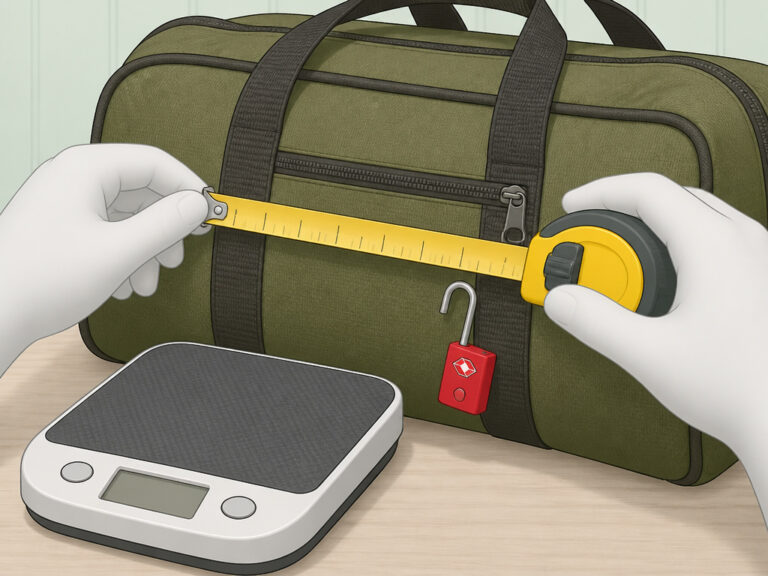
You need a tape measure and your duffel packed exactly as you intend to travel. Lay the bag flat on the floor and gently shape it into its natural, packed position. Do not squash it.
- Measure Length. Find the longest side, typically from end to end. Include any fixed-end handles in this measurement.
- Measure Width. Find the widest point across the bag. Include side pockets that are stuffed.
- Measure Depth/Height. Measure from the bottom to the top of the bag at its thickest point. For a duffel standing upright, this is the height.
The IATA’s general reference for maximum carry-on dimensions is 56 × 45 × 25 cm (22 × 18 × 10 in). The IATA passenger baggage rules set the global baseline, but your specific airline’s policy is the law you must follow.
A soft-sided duffel has a hidden advantage here. A nylon bag that’s a half-inch over in depth can often be compressed into the metal sizer. A hard-shell roller at the same measurement won’t budge. This flexibility is why many frequent fliers prefer a travel duffel bags for tight connections across multiple airlines.
The Delta Connection Exception That Changes Everything
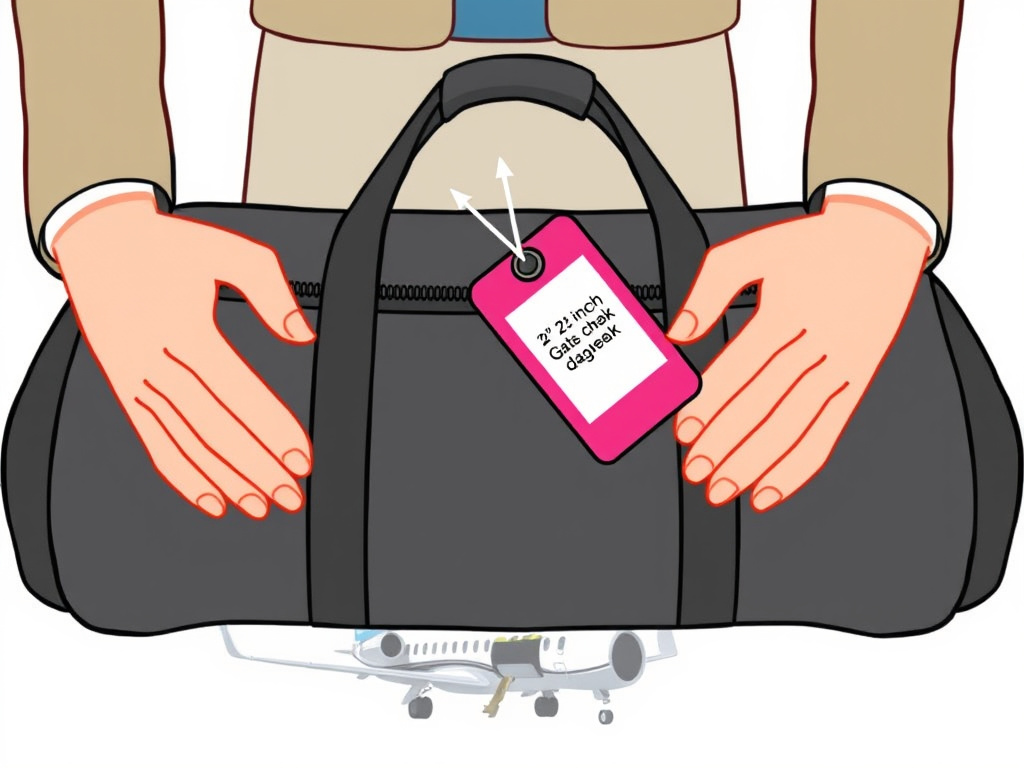 Your duffel can be perfectly sized at 22” x 14” x 9” and still be denied cabin entry. This happens on Delta Connection flights with 50 seats or less.
Delta’s official policy is unambiguous: passengers on these regional jets are only permitted to carry personal items on board due to limited overhead and under-seat space. Larger items, including standard carry-on duffels, will be tagged with a pink gate-claim tag and loaded in the cargo bin.
Where this goes sideways: Bringing a full-size 22″ duffel onto a 50-seat regional jet. The overhead bins on these aircraft are tiny or nonexistent. The gate agent will tag your bag before you board, and you’ll pick it up on the tarmac after landing.
If your itinerary includes a segment on a small plane, your carry-on dimensions become irrelevant for that leg. You have two choices: pack a separate, smaller bag inside your duffel with your in-flight essentials, or be prepared to surrender it at the gate. This rule makes a strong case for having a versatile personal item duffel bags in your arsenal.
Duffel Bag as Carry-On vs. Personal Item vs. Checked Bag
A duffel can serve in any of these three roles. The difference is its size and where you intend to put it.
- Carry-On Duffel: Must fit in the overhead bin. Targets the 22” x 14” x 9” standard. A good carry-on duffel bags in the 35-40 liter range hits this mark.
- Personal Item Duffel: Must fit under the seat in front of you. Targets around 18” x 14” x 8”. This is your laptop bag, large purse, or small weekender.
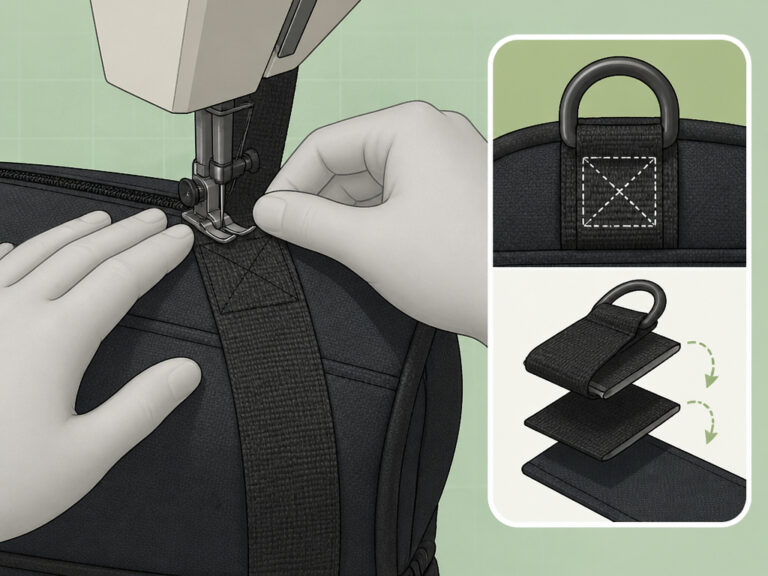
- Checked Duffel: Goes in the aircraft hold. Must survive baggage handling. Focus on durability, not size. A robust checked luggage duffels with reinforced stitching and tough fabric is essential here.
You can combine a personal item duffel with a roller suitcase to maximize what you bring aboard without fees. Just remember that under-seat space shrinks on older aircraft and in exit rows.
Packing a Duffel to Pass Inspection
Packing a duffel is different from packing a suitcase. You’re managing structure, not relying on it.
- Pack the flat side out. A duffel’s depth is the easiest dimension to bust. Place flat items like folded jeans or packing cubes against the side that will face the sizer.
- Use compression, not expansion. Roll your clothes. Use packing cubes to create solid, rectangular blocks inside the bag. The goal is a firm, full duffel that holds its shape.
- Keep TSA items accessible. You must remove liquids and large electronics at security. Pack them on top or in an easy-access pocket.
These moves exploit the soft duffel’s advantage. A properly packed bag from a list of best duffel bags will pass a visual inspection and slide into a sizer, even at the limit.
Airline-Specific Duffel Bag Rules & Weight Limits
While the 22” x 14” x 9” size clears most U.S. Carriers, weight limits and budget airline rules vary sharply. This is where your duffel’s contents matter as much as its shell.
| Airline | Carry-On Size Limit | Weight Limit | Critical Note for Duffels |
|---|---|---|---|
| Delta, United, American, Alaska (Mainline) | 22″ x 14″ x 9″ (45 linear in) | None (domestic) | Soft duffels excel; weight only matters if you can’t lift it into the bin. |
| Spirit Airlines (Paid Carry-On) | 22″ x 18″ x 10″ | 40 lbs | Larger depth allowance helps bulky items, but basic fare includes only a personal item. |
| Frontier Airlines (Paid Carry-On) | 24″ x 16″ x 10″ | 35 lbs | The most generous size, but same basic fare restriction as Spirit. |
| International & Budget Airlines (e.g., Ryanair, EasyJet) | Often 55 x 40 x 20 cm (21.6″ x 15.7″ x 7.8″) | 10 kg (22 lbs) strict | A 40-liter duffel packed with heavy items will exceed this. Weigh it at home. |
International carriers are the wild card. A duffel bags for international flights needs to be lighter and sometimes smaller than its domestic counterpart. Always verify the policy for your specific airline and route.
What You Can and Cannot Pack in Your Duffel
The TSA, not your airline, governs what’s inside your bag. The TSA prohibited items list is absolute. Your duffel’s flexibility doesn’t exempt you.
Always pack in your carry-on duffel:
- Valuables (wallet, jewelry, electronics)
- Essential medication (with prescription)
- A change of clothes
- Travel documents
Never pack in any duffel going on a plane:
- Explosives, flares, fireworks
- Lithium batteries over 100 watt-hours (common in large power tools)
- Most tools over 7 inches in length (saws, hammers, drills)
- Flammable liquids or aerosols (unless in checked baggage under specific rules)
For checked baggage, you have more leeway with tools and liquids, but sharp objects must be sheathed or securely wrapped. A durable checked duffel bags is built for this rougher treatment.
Worth knowing before you start: The TSA’s “3-1-1” rule for liquids applies to carry-ons only. Each liquid container must be 3.4 ounces or less, all fitting in one quart-sized, clear, zip-top bag. This rule does not apply to checked bags.
Frequently Asked Questions
Can a duffel bag be a carry-on and a personal item?
No. You are allowed one carry-on item and one personal item. A single duffel bag cannot count as both. However, a small duffel (meeting personal item dimensions) can be your personal item, and a larger duffel or suitcase can be your carry-on.
Do duffel bags count as carry-on for Spirit?
Yes, but only if you pay for a carry-on bag. Spirit’s free fare includes only a personal item (18” x 14” x 8”). A duffel bag that fits the larger paid carry-on dimensions (22” x 18” x 10”) is allowed if you’ve purchased that option.
What is the best duffel bag for airline travel?
The best bag depends on your primary use. For most domestic carry-on travel, a 40-liter soft-sided duffel like the Patagonia Black Hole 40L is a benchmark. For international trips with strict weight limits, a lighter model like the Osprey Transporter 40 is smarter. Our guide to the best carry-on duffel bags for international travel breaks down the top picks by use case.
How strict are airlines about duffel bag size?
Airlines are strict at the point of enforcement: the gate. If your flight is full and overhead space is scarce, gate agents will use the sizer. A soft duffel slightly overstuffed might be squeezed in, but a visibly overstuffed or rigid bag will be checked. It’s a visual test first, a sizer test second.
Can I bring a large duffel bag as checked luggage?
Absolutely. Checked baggage size limits are much more generous (typically 62 linear inches). The concern shifts from size to durability. A well-made large duffel bags with robust zippers and padded straps will survive the cargo hold better than a flimsy one.
Before You Go
You can bring a duffel bag on a plane. The real question is whether it will fly with you in the cabin or without you in the hold. Match your duffel to the smallest plane on your itinerary—remember the Delta Connection rule. Measure it packed, not empty. And know that a soft side is a strategic advantage at the gate sizer, not a weakness.
For a single domestic trip on a mainline jet, a standard 40-liter duffel is the straightforward answer. For anything involving small regional planes, international budget airlines, or Basic Economy fares, your plan needs a second layer. That’s where a reliable small duffel bags as a personal item becomes your backup plan.