Fitting Stuff in a Duffel Bag: How Much It Can Really Hold
This post contains affiliate links. As an Amazon Associate, we earn from qualifying purchases.
A duffel bag’s capacity is measured in liters (L) or cubic inches, and the amount of stuff you can fit depends directly on that number. Common sizes like 40L, 65L, and 75L hold 3-7 days of clothing, shoes, and gear when packed efficiently, using the bag’s soft sides to compress items and maximize space.
The liter rating is the only spec that matters when you’re trying to estimate fit. Everything else, strap style, pocket count, material, is about convenience, not volume. A 40L bag is a 40L bag, whether it’s from Osprey or a discount brand.
What follows is the translation: what those liter numbers mean in real clothing, how to use a duffel’s flexibility to beat a hard-shell suitcase, and the three packing rules that get you an extra 20% of usable space every time.
Key Takeaways
- Capacity is king. Ignore marketing terms and find the liter (L) or cubic inch (cu. In.) rating on the spec sheet. A 40L duffel bag holds about 2,441 cubic inches.
- Soft sides beat hard shells. A duffel’s flexible fabric lets you compress clothes and wedge items into corners, often fitting more than a same-liter hard suitcase.
- Packing order is non-negotiable. Heavy, dense items (shoes, toiletry kits) go at the bottom, against the back panel. Rolled clothes fill the middle. Light, crushable items go on top.
- Use every dimension. The main compartment’s height, width, and depth are listed for a reason. A tall, narrow 65L bag packs differently than a short, wide 65L bag.
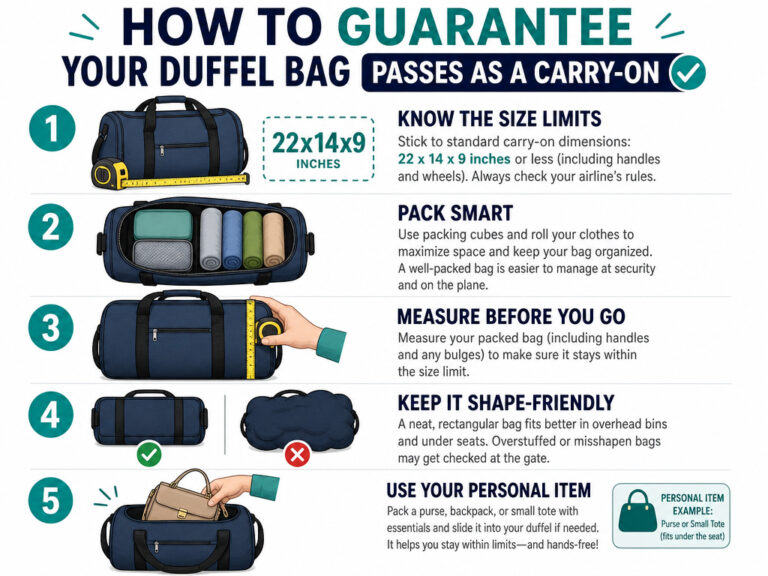
- Check airline limits. Most domestic carriers allow a 22″ x 14″ x 9″ personal item; a stuffed 40L duffel often fits. International carry-on limits are stricter.
The Real Numbers: Duffel Bag Capacity by Liter
Forget vague terms like “large” or “weekender.” The only reliable way to know how much stuff a duffel bag holds is the manufacturer’s stated capacity in liters or cubic inches. This number is calculated from the bag’s internal dimensions. It’s a fixed volume.
The Osprey Arcane WP Duffel 40 holds 2,441 cubic inches (40L). The Arcane WP Duffel 65 holds 3,967 cubic inches (65L). These are not estimates; they are the certified internal volumes printed in the owner’s manual.
Here is how the most common duffel bag sizes translate, using real models as anchors.
| Bag Size (Liters) | Cubic Inches (approx.) | Example Model | Real-World Fit |
|---|---|---|---|
| 40L | 2,400–2,500 | Osprey Arcane WP 40 | 4-5 days of casual clothes, 1 pair shoes, toiletry kit. |
| 55–62L | 3,350–3,800 | Eddie Bauer Large Ripstop (62L) | A full week’s travel for one, including bulkier items like a jacket. |
| 65L | 3,900–4,000 | Osprey Arcane WP 65 | Extended weekend gear for two, or one person’s gear for a 10-day trip with careful packing. |
| 75L+ | 4,500+ | Carhartt Heavy Haul Duffel (75L) | Heavy-duty, multi-purpose hauling for sports, moving, or extended outdoor trips. |
The soft-sided advantage is real. A 40L rolling suitcase might fit a specific packing cube arrangement. That same 40L of volume in a soft duffel can be overstuffed, compressed, and shaped to fit an awkward car trunk or airplane overhead bin. The fabric gives.
Decoding the Spec Sheet: What Dimensions Actually Mean
You found the duffel bag volume. Now look at the three numbers listed as dimensions: Height x Width x Depth (or Length). These are the external measurements of the bag when empty. They tell you if the bag will fit a specific space, like an airline sizer or your car’s trunk.
The Carhartt Heavy Haul Duffel (CTB0000605) measures 11″h x 28.5″w x 12.5″d. That’s a long, relatively low-profile shape. The Nike Brasilia Large Duffel is listed at 28″l x 14″w x 14″h, a more cubic shape with nearly 5,800 cubic inches of capacity.
Common mistake: Assuming width is always the longest side. Manufacturers list dimensions inconsistently. Always check which measurement is which against a product photo.
Internal vs. External Volume
The capacity number (in liters) is the internal space for your stuff. The dimension numbers are the external shell. Thick padding, reinforced bottoms, and structured panels eat into the internal volume. A bag with a 40L rating but 3″ of foam padding on all sides will have a larger external footprint than a simple 40L sack.
This is why comparing duffel bag size by liter is more reliable than comparing by listed dimensions. Two bags with identical 22″ x 14″ x 9″ measurements can have wildly different internal capacities based on their construction.
Packing by Liter Size: A Model-Specific Guide
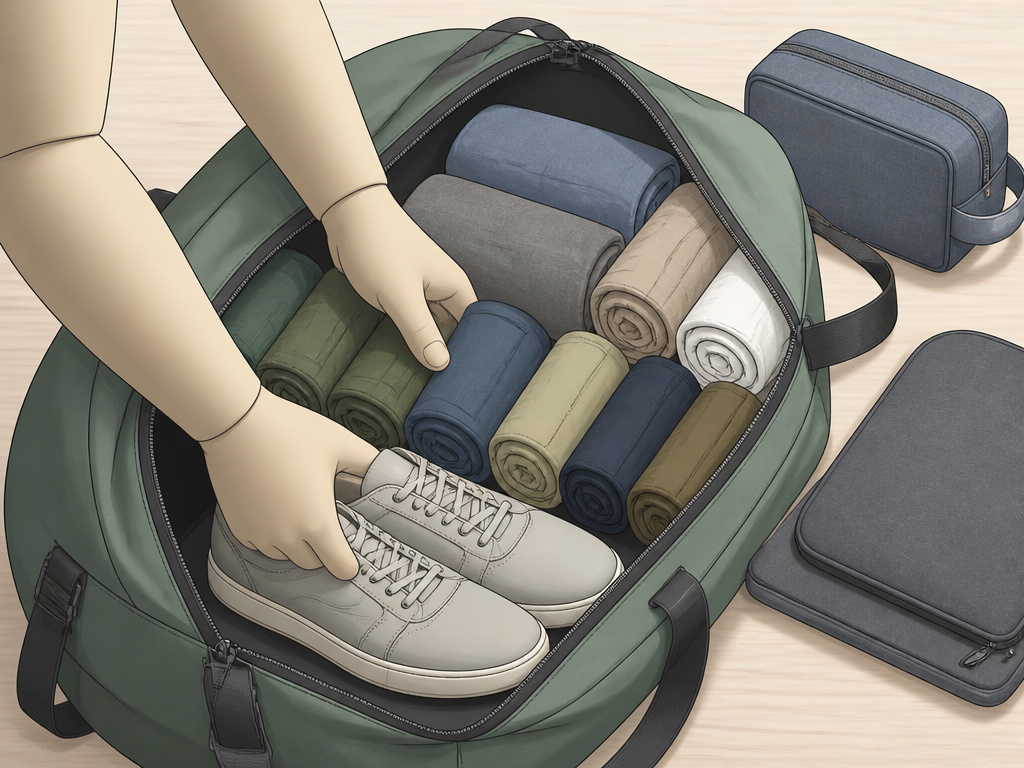
Knowing a bag holds 40L is one thing. Knowing what you can physically put inside it is another. These are not theoretical lists. They are built from the dimensions of the bags in the spec sheets.
What Fits in a 40L Duffel Bag (Osprey Arcane WP 40)
The capacity of a 40L duffel is the sweet spot for carry-on travel and long weekends. The Osprey Arcane WP 40 measures 22″h x 14″w x 8″d. * 5-7 rolled t-shirts or polos. * 2 pairs of long pants (jeans, chinos). * 1 lightweight sweater or hoodie. * 5-7 sets of underwear and socks. * 1 pair of shoes (placed in a shoe bag or at the bottom). * 1 Dopp kit for toiletries. * A thin laptop or tablet in a sleeve.
The 40L limit is shoes. A second pair of sneakers or boots will consume the space for 3-4 shirts. Use the packing a duffel bag rule of heavy-at-the-bottom: shoes first, then rolled pants around them, then shirts.
What Fits in a 65L Duffel Bag (Osprey Arcane WP 65)
A 65-liter duffel bag transitions from “trip” to “expedition.” The Osprey model is 28″h x 14″w x 12″d. This is where the duffel bag’s military origin in hauling gear pays off. * Everything in the 40L list, plus: * 2-3 additional sweaters or a bulky winter coat. * 2-3 extra pairs of pants. * A second pair of shoes. * A packable daypack or tote. * A full-size toiletry bag and a small tech organizer. * Space for souvenirs on the return trip.
Where this goes sideways: Filling a 65L bag to the brim. The weight becomes unmanageable for a single shoulder strap. Use the backpack straps or prepare for a very heavy lift.
What Fits in a 75L+ Duffel (Carhartt Heavy Haul)
At 75L and above, you’re in bulk hauling territory. The Carhartt CTB0000605 is built for tools and work gear, but the principle is the same. * A full bedding set (comforter, sheets, pillow). * Multiple bulkier sports items (helmet, pads, ball). * A complete camp setup for a car camping trip (tent, sleeping bag, pad). * Or, the more practical use: a massively overstuffed 10-14 day travel kit for one person who hates doing laundry.
These large duffel bag uses are about brute-force capacity, not organization. You will need your own packing cubes or stuff sacks.
The Art of Maximizing Space: Soft-Side Strategies
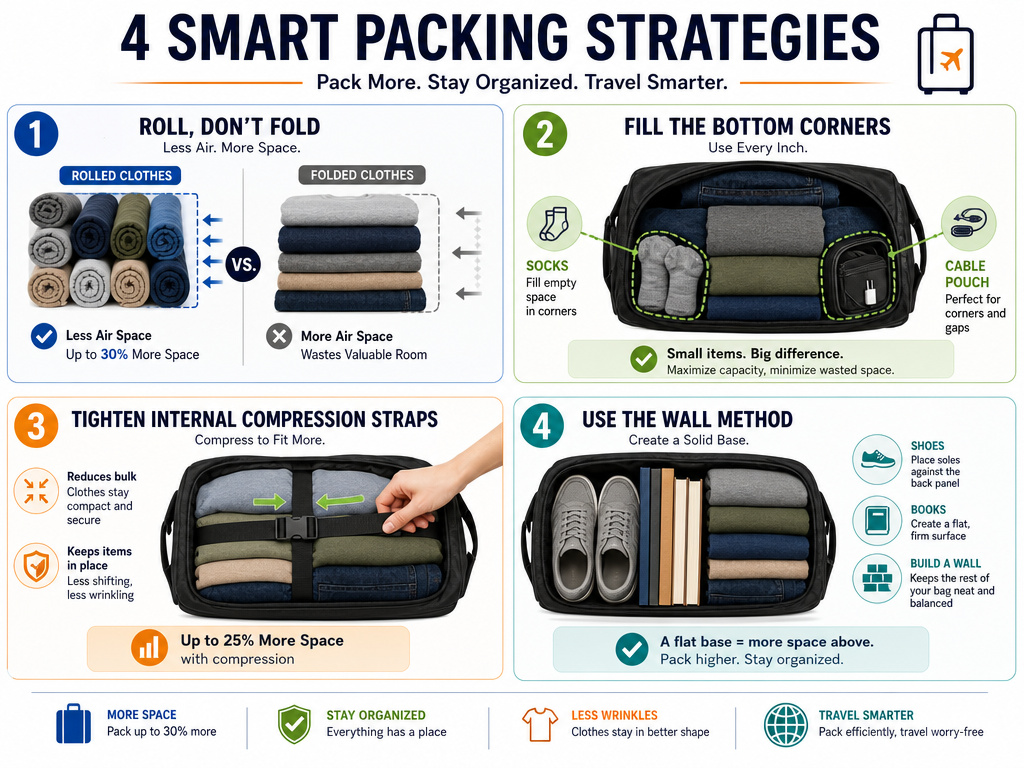
A hard-shell suitcase is a fixed box. A duffel is a flexible container. Your goal is to use that flexibility to exceed the nominal liter rating.
- Roll, Never Fold. Rolling clothes creates tight, dense cylinders that pack together with minimal air gaps. Folded clothes leave soft, uneven voids.
- Fill the Corners First. Place small, dense items (socks, belts, charging cables in a pouch) in the bottom corners of the bag. This creates a flat base for larger items.
- Use Compression. After loading the main compartment, tighten any internal compression straps. On bags like the Osprey Arcane, this pulls the load inward and frees up the zipper path.
- Employ the “Wall” Method. Pack the heaviest, flattest items (shoes, books) against the back panel (the side that will face your back when carried). Build the rest of your gear forward from that wall. This balances weight and protects the bag’s structure.
The zipper test. If you have to fight the zipper closed, you’ve either packed too much or packed inefficiently. Open the bag, rearrange the rolled bundles, and try again. A smooth zip close means you’ve distributed the load evenly.
Duffel Bag vs. Suitcase: The Capacity Illusion
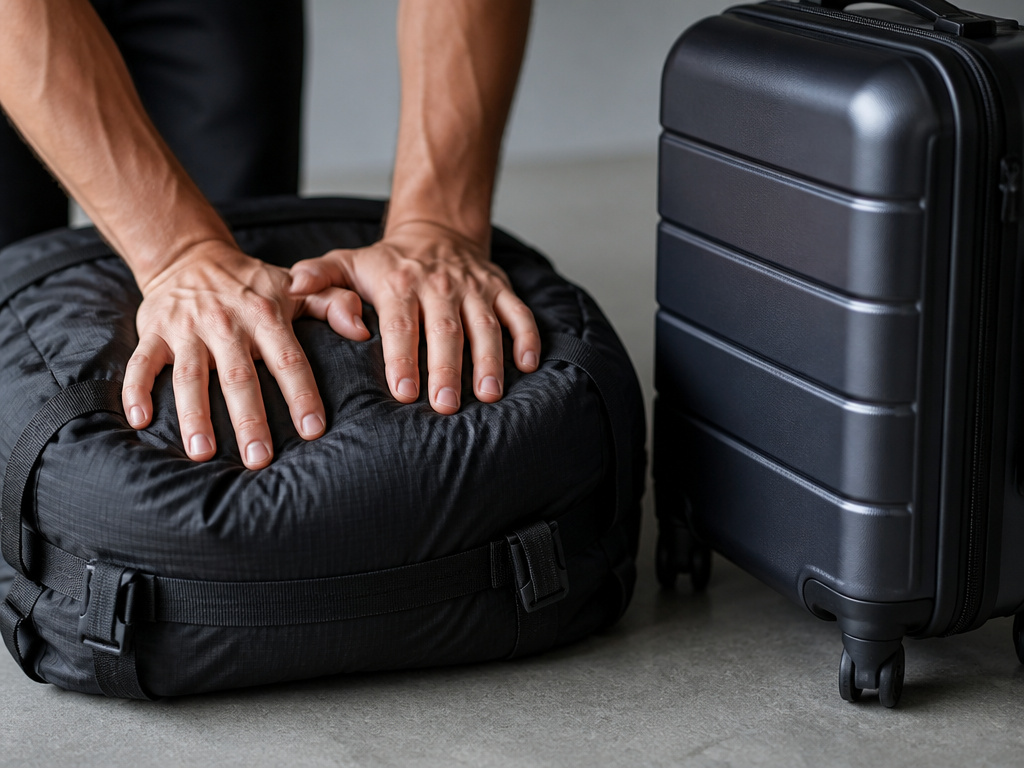
People compare a 40L duffel to a 40L carry-on spinner and declare the suitcase the winner on organization. That’s true. But on raw volume fit, the duffel often wins.
A suitcase’s internal volume is rigid. Its corners are 90-degree hard angles. A duffel’s internal volume is malleable. You can stuff a pair of socks into the curved seam where the side meets the bottom. You can press down on the packed bag to squash air out of down jackets or sweaters.
The part nobody mentions: Airline sizers are designed for rigid suitcases. A fully packed 42L duffel can often be squeezed into a 40L sizer because it compresses under the gentle pressure of the agent’s hand. A hard-shell 42L suitcase will not.
This makes the best travel duffel bags, like those with structured ends but soft bodies, secret weapons for strict carry-on policies. They offer the organization of a suitcase at the gate, with the compression of a soft bag at the sizer.
Frequently Asked Questions
Is a 40L duffel bag carry-on size?
Usually, yes. A 40L duffel bag like the Osprey Arcane WP 40 (22″ x 14″ x 8″) fits within most domestic airline personal item dimensions (typically 22″ x 14″ x 9″). Always check your specific airline’s “sizer” dimensions, as international carry-on limits can be smaller.
How do you calculate duffel bag volume?
Manufacturers calculate duffel bag volume by measuring the internal space in cubic inches (Height x Width x Depth) and converting to liters (1 liter ≈ 61 cubic inches). You can estimate by multiplying the external dimensions and applying a discount for fabric thickness and structure.
What is the most common duffel bag size?
For general travel and gym use, 40L to 65L is the most common range. The 40-liter duffel bag is the standard for a carry-on weekend bag, while 55L to 65L covers week-long trips. Larger sizes (75L+) are for specialized hauling.
Can a duffel bag fit more than a suitcase of the same size?
Frequently, yes. A duffel’s soft sides allow you to compress contents and utilize irregular spaces, often fitting more actual stuff than a rigid suitcase of the same nominal liter capacity. The suitcase wins on organization and protection.
What should I pack first in a duffel bag?
Always pack the heaviest, least compressible items first. Shoes, toiletry kits, and any hard gear go at the bottom, positioned against the back panel of the bag. This creates a stable base and keeps the weight centered for better carry.
The Bottom Line
How much stuff you can fit in a duffel bag comes down to three things: the official liter capacity, your packing technique, and the bag’s soft-sided flexibility. Start with the number, 40L, 65L, 75L, then use rolling and corner-filling to meet it. Remember that a duffel’s superpower is compression, letting you cheat rigid space limits by an inch or two where it counts.
For most travelers, a 40L to 55L bag is the practical maximum for manageable weight and airline compliance. Look for models with clear spec sheets, like the Osprey Arcane series, and ignore any bag that doesn’t list its volume in liters. That’s the real measure of how much your bag can hold.