Duffel Bag as a Carry-On: American Airlines Rules & Tips
This post contains affiliate links. As an Amazon Associate, we earn from qualifying purchases.
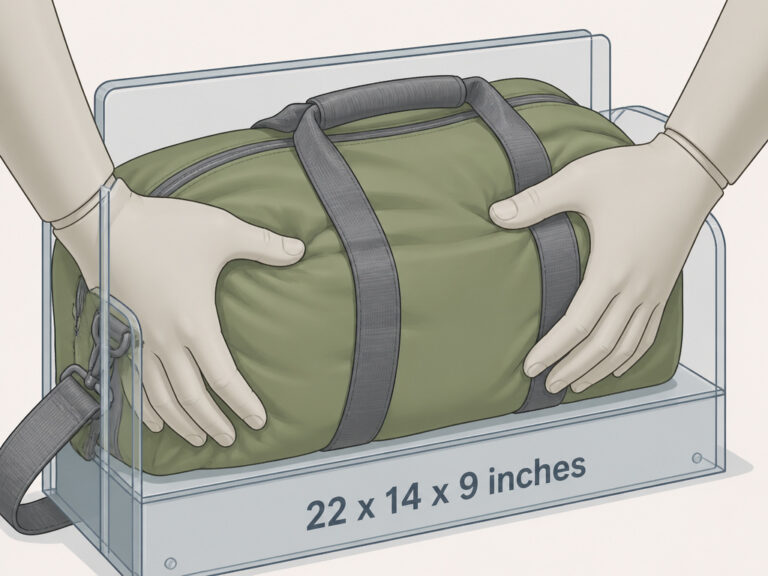
Yes, a duffel bag can be a carry-on on American Airlines. The hard limit is 22 inches long, 14 inches wide, and 9 inches deep, including all handles, wheels, and stuffed pockets. This matches the standard U.S. Domestic carry-on size. Since October 2025, American has removed metal sizers from boarding gates, so gate agents now use visual judgment for borderline bags.
That shift from physical sizers to agent discretion changes the game. Your duffel’s silhouette and how full it looks now matter as much as the tape measure in your closet.
What follows is a breakdown of the official dimensions, the real-world enforcement you’ll face at the gate, and the specific aircraft that will force you to check your bag. We’ll cover how to measure your packed duffel correctly, when to use it as a personal item instead, and the one type of flight where a compliant bag still fails.
Key Takeaways
- American Airlines’ carry-on limit is 22 x 14 x 9 inches, a standard most U.S. Duffels are built to meet.
- Gate agents visually judge bags; a soft, compressible duffel has an advantage over a hard-sided roller.
- Regional jets (CRJ, Embraer) have tiny bins; your full-size duffel will likely be gate-checked for free on these flights.
- The “two-item” rule is strict: one carry-on plus one personal item. A crossbody bag counts as a third item.
- Measure your duffel packed, not empty. External handles and bulging pockets add inches that fail the sizer.
American Airlines Carry-On Size & Duffel Bag Rules
American Airlines permits one carry-on bag and one personal item free of charge on all fares, including Basic Economy. The carry-on must fit in the overhead bin.
The maximum dimensions for a carry-on bag on American Airlines are 22 inches in length, 14 inches in width, and 9 inches in depth (56 x 36 x 23 cm). This measurement includes all external parts: wheels, handles, side pockets, and any compression straps. A soft-sided garment bag is also allowed if its total linear dimensions (length + width + height) do not exceed 51 inches (130 cm).
For a duffel bag, this 22x14x9 spec is the target. Most travel-focused duffels are designed to this carry-on duffel size. The problem isn’t the bag’s listed size. It’s the size it becomes when you pack it.
A duffel marketed as 22 inches long often gains an inch from its padded carry handle. A stuffed water bottle pocket can add another inch of depth. Gate agents are trained to look at the total exterior profile. If your bag looks bloated or rigid, it gets flagged.
Where this goes sideways: Measuring the bag empty. Your packing technique determines compliance. A loosely packed duffel is a floppy sphere that wastes bin space. A tightly packed, block-shaped duffel presents a clean rectangle that fits the mental 22x14x9 box the agent is looking for.
The Personal Item Alternative
If your duffel is smaller, it might qualify as your personal item. That limit is stricter: 18 x 14 x 8 inches. This must fit under the seat in front of you.
Using a duffel as a personal item is a smart move for heavy packers. It lets you bring a full-size carry-on roller and a duffel. Just ensure the duffel is truly small enough to slide under the seat without blocking your footwell. A 30-liter duffel is usually too big; an 18-liter gym bag often works.
How American Airlines Actually Enforces the Rules (The 2026 Shift)
In October 2025, American Airlines removed the metal bag sizers from its boarding gates. They still have them at check-in counters, but the gate agent’s primary tool is now their eyes.
This policy, confirmed through airline memos and travel analyst reports, tells agents to “err on the side of the customer” for borderline bags. The intent was to speed up boarding. The effect is inconsistent enforcement.
| Enforcement Method | Where You’ll See It | What It Means for Your Duffel |
|---|---|---|
| Visual Judgment | Boarding gate | A soft, half-inch overstuffed duffel might pass. A hard-case 22.5″ roller will not. |
| Physical Sizer | Airport lobby, check-in counter | The official test. If it doesn’t drop in smoothly, it’s over. |
| Gate-Check Due to Space | Any full flight | Even a compliant bag gets a pink tag if bins are full. Basic Economy boards last, so risk is high. |
Your duffel’s material is now a feature. Nylon and polyester give. You can often squeeze a soft bag that’s a quarter-inch over into a bin, even if it wouldn’t slide into the metal sizer. This is the hidden advantage duffels have over hard-shell suitcases.
Common mistake: Assuming a crossbody bag or purse doesn’t count. American’s internal memos specifically call out crossbody bags as a third item. If you have a backpack (carry-on), a laptop bag (personal item), and a purse across your chest, you have three items. The agent will ask you to consolidate.
The rule is one carry-on plus one personal item. That’s it. Diaper bags and medical devices are exceptions, but your everyday purse is not.
The Regional Jet Problem: When Your Duffel Can’t Be a Carry-On
Your duffel can meet every carry-on luggage size restriction. It can be soft and compliant. It can still be forced into the cargo hold.
This happens on regional jets operated by American Eagle. These are the smaller 50-76 seat planes (like the CRJ-700 or Embraer 175) that connect smaller cities to hubs.
The overhead bins on these aircraft are significantly smaller. A standard 22-inch roller won’t fit. American knows this. Their procedure is “valet bag” service.
You will hand your duffel to an agent at the jet bridge before walking down the stairs to the tarmac. They tag it with a pink gate-check tag. You pick it up on the tarmac at your destination, not at the main baggage carousel. It’s free, but it’s not in the cabin with you.
If your itinerary includes a regional jet segment, plan for it. Pack your in-flight essentials—medication, laptop, headphones—in a small pouch inside your duffel. When you hand over the duffel, pull the pouch out and carry it on board as your personal item. That way your critical items stay with you.
Duffel Bag vs. Suitcase: Which is Better for American Airlines?
The best bag is the one that fits your packing style and the flight’s realities. Here’s how they compare for American’s specific environment.
| Feature | Duffel Bag | Rolling Suitcase |
|---|---|---|
| Compliance Flexibility | High (soft sides compress) | Low (hard shell is rigid) |
| Packing Efficiency | High (conforms to odd shapes) | Medium (structured cavity) |
| Overhead Bin Fit | Excellent (molds into space) | Good (if exact size) |
| Gate-Check Risk | Lower (due to flexibility) | Higher (if bins are full) |
| Regional Jet Survival | Still gate-checked | Still gate-checked |
A travel duffel bag with a structured base and backpack straps wins for mixed itineraries. It compresses when needed and is easy to carry if you have to sprint through a hub airport. A rolling suitcase is better if you exclusively fly on mainline Airbus or Boeing aircraft with large bins and want maximum organization.
For most travelers, the best carry-on duffels are those from brands like Patagonia, The North Face, or Osprey that are built to the 22x14x9 spec and include thoughtful features like a laptop sleeve and external compression straps.
How to Guarantee Your Duffel Bag Passes as a Carry-On

Follow this sequence. Skip a step, and you risk a $50 gate-check fee.
- Choose the right bag. Buy a duffel marketed as “carry-on compliant” or with dimensions at or under 22x14x9. Don’t guess.
- Pack it firm, not full. Use efficient duffel bag packing techniques like rolling clothes and using packing cubes. The goal is a rectangular block, not a bloated sack.
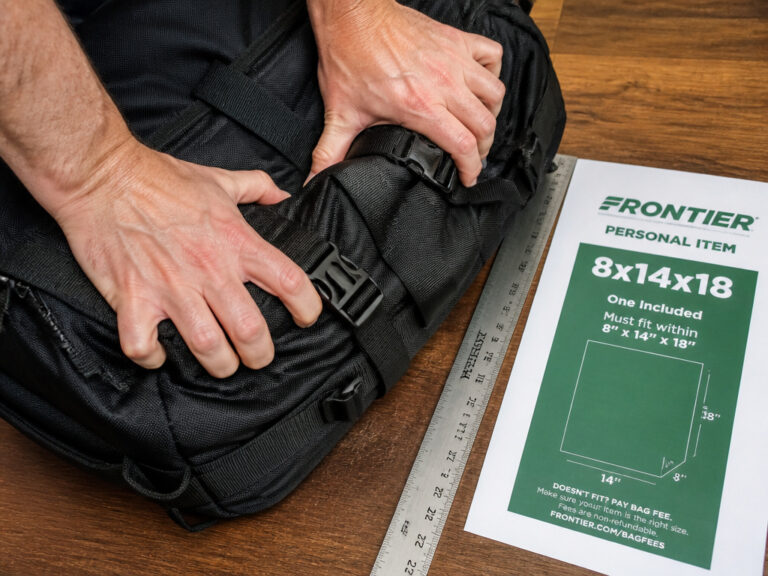
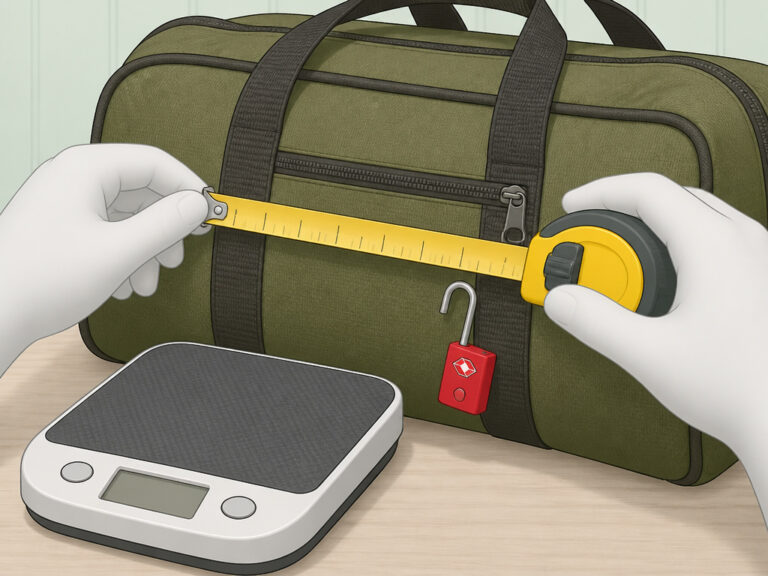
- Measure it packed. Before you leave home, lay your fully packed duffel flat. Use a tape measure on its exterior at the widest points, including handles. Length, width, depth. All three numbers must be at or under the limit.
- Do the “footprint test.” Place your packed duffel on the floor. Look at its silhouette from above. Does it look like a neat rectangle close to 22×14? Or an amorphous blob? Agents make this visual check in two seconds.
- Have a consolidation plan. If you’re bringing a purse, be ready to stuff it into your duffel or personal item backpack before you reach the gate agent. Don’t give them a reason to stop you.
TL;DR: A compliant duffel, packed solid and measured, will pass. A sloppy duffel, even of the same model, will get tagged.
What Happens If Your Duffel Bag is Too Big?
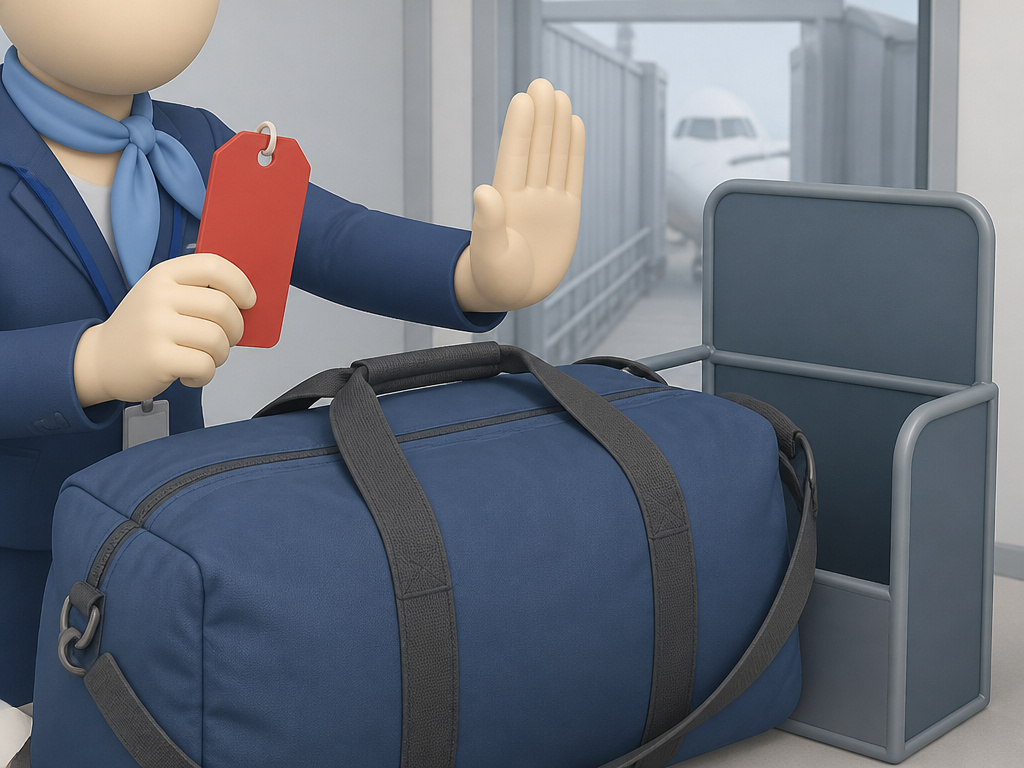
The agent will stop you. The outcome depends on where you are.
- At the check-in counter: You’ll be asked to check the bag. You’ll pay the standard checked bag fee ($35-$50 for your first bag, depending on fare and prepayment) and proceed to security.
- At the boarding gate: This is a gate-check. The agent will tag your bag. You leave it at the jet bridge, and it’s delivered to the baggage claim at your final destination. If the gate-check is due to lack of space (not size), it’s free. If it’s because your bag is oversize, you will be charged the checked bag fee at the gate.
- On a regional jet: It’s a mandatory valet gate-check. It’s free, but you won’t see your bag until you land.
Remove batteries, medications, laptops, and anything fragile before handing over a gate-checked bag. Those bins are not gentle.
Frequently Asked Questions
Does American Airlines weigh carry-on duffel bags?
No. American Airlines does not weigh carry-on bags. They only enforce size dimensions. Checked bags have a strict 50-pound weight limit, but your overhead duffel can be as heavy as you can lift.
Can I bring a duffel bag and a backpack on American Airlines?
Yes, but only if one qualifies as your carry-on and the other as your personal item. For example, a 40-liter duffel in the overhead bin (carry-on) and a 20-liter backpack under the seat (personal item) is perfectly fine. Two full-size duffels are not allowed.
What is the best size duffel bag for American Airlines?
The best size is 22 x 14 x 9 inches or slightly smaller (e.g., 21.5 x 13.5 x 8.5). This gives you a margin for error with handles and packed expansion. Many specific carry-on duffel bag dimensions are designed to this exact spec.
Are duffel bags with wheels allowed as carry-ons?
Yes, but with caution. The wheels and telescoping handle are part of the 22-inch length measurement. A “22-inch wheeled duffel” is often 24 inches with the handle extended. You must retract the handle when measuring, and it must still fit within 22 inches.
Is a 24-inch duffel bag allowed on American Airlines?
No. A 24-inch duffel exceeds the 22-inch length limit. It will not fit in the overhead bin of a mainline aircraft and will certainly not fit on a regional jet. You will be required to check it and pay the applicable fee.
Before You Go
A duffel bag is an excellent, often superior, choice for a carry-on on American Airlines. Its flexibility gives you an edge in the new era of visual enforcement. Just respect the numbers.
Check your bag’s true packed dimensions. Understand that a regional jet flight means a gate-check. And never assume a third small bag is invisible. Stick to the two-item rule.
Pack it tight, measure it right, and your duffel will spend the flight in the bin above you, not in the hold below.