What Size Duffel Bag for Carry On? The 45 Linear Inch Rule
This post contains affiliate links. As an Amazon Associate, we earn from qualifying purchases.
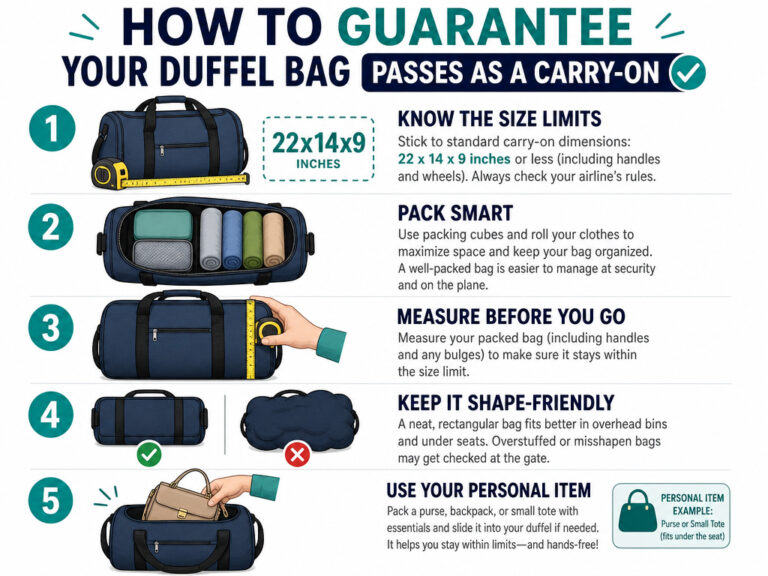
A duffel bag works as a carry-on if its packed dimensions, including handles, straps, and wheels, stay at or under your airline’s limit. For most US carriers, that’s 45 total linear inches (length + width + height) with no single side exceeding 22″ x 14″ x 9″. A soft-sided bag built to 22″ x 14″ x 9″ empty will hold 35-40 liters and clear every major US airline’s sizer when packed square.
That 45-inch total is the number that matters, not the individual dimensions alone. Delta, American, and United all use it. Southwest and Frontier are more generous at 50 linear inches. International carriers often swap inches for weight limits around 7-10 kilograms.
The gate agent’s metal sizer box tests your packed bag, not the tag on the empty duffel. This is where soft-sided nylon or canvas has a hidden edge, it can compress a half-inch to slide in, where a hard-shell roller at the same measurement gets rejected on the spot.
What follows is the measurement logic from the FAA down to the gate agent’s checklist, the one airline exception that changes everything on small planes, and the packing move that keeps a soft duffel compliant when a suitcase would fail.
Key Takeaways
- The universal carry-on size is 45 linear inches (length+width+height), with individual sides not exceeding 22″ x 14″ x 9″. This fits Delta, American, United, and Alaska.
- Always measure your duffel packed, including every strap and stuffed pocket. An empty 21.5″ bag becomes 23.5″ with its handle extended, and that fails the sizer.
- On Delta Connection flights with 50 seats or less, only a personal item is allowed in the cabin. A full-size duffel will be gate-checked regardless of its dimensions.
- A soft-sided duffel can be compressed into a sizer if slightly overstuffed; a hard-sided case at the same measurement will be rejected.
- Overhead bin space is not guaranteed. If the flight is full, your duffel may be gate-checked regardless of its size.
The Universal Carry-On Size Isn’t What You Think
You see 22″ x 14″ x 9″ everywhere. That’s the common shorthand, but it’s incomplete. Airlines like Delta, American, and Air Canada actually use a linear inch system. They add your bag’s length, width, and height to get a single number.
Delta’s carry-on limit is 45 linear inches, per their official baggage page. Their rule states the combined length + width + height must not exceed 45 inches (114 cm), with no single dimension exceeding 22” x 14” x 9”.
This changes how you measure. A duffel that’s 23″ long, 13″ wide, and 9″ tall hits 45 linear inches on the dot (23+13+9=45). It breaks the 22″ rule but still passes Delta’s check. A bag that’s 22″ x 14″ x 10″ also hits 46 linear inches and fails, even though each side seems close.
The 45 linear inch rule is the real ceiling for most domestic travel. It’s a translation of Federal Aviation Administration (FAA) safety regulations that mandate all carry-on items be storable in approved compartments. The FAA carry-on baggage advisory provides the framework airlines use to set their specific inch limits.
The International Air Transport Association (IATA) suggests a common international reference of 56 × 45 × 25 cm (22 × 18 × 10 in). Their IATA passenger baggage rules document notes this is voluntary, and weight limits often start at 5 kg (11 lb) outside the US.
| Airline | Carry-On Dimensions | Linear Inches | Weight Limit (US Domestic) |
|---|---|---|---|
| Delta, American, United, Alaska | 22″ x 14″ x 9″ (max per side) | 45 | Typically not enforced |
| Southwest, Frontier | 24″ x 16″ x 10″ | 50 | 35 lbs (Frontier only) |
| Hawaiian Airlines | 22″ x 14″ x 9″ | 45 | 25 lbs |
| JetBlue | 22″ x 14″ x 9″ | 45 | Not enforced |
| Spirit, Allegiant | 22″ x 18″ x 10″ | 50 | 40 lbs |
Bottom line: Buy or pack your duffel to hit 45 linear inches or less. If you fly Southwest or Frontier often, you can stretch to 50.
How to Measure a Duffel Bag (The Right Way)
Most people measure the empty bag lying flat. That’s wrong. Airlines measure it packed, standing upright, with every external part included.
Common mistake: Measuring the bag empty. A duffel gains an inch in every dimension when fully packed. The sizer box at the gate tests the packed bag, not the manufacturer’s tag.
Gate agents use a metal sizer, usually at the jet bridge. Your bag must drop in smoothly without force. If it doesn’t, it gets a pink gate-claim tag and goes under the plane.
Here is the only measurement method that matches what the gate agent will do.
The 4-Step Packed Measurement Check
- Pack the duffel completely for your trip. Don’t leave space, pack it as you would for the flight.
- Stand it upright on its base. Zip it closed. Make sure all straps are tucked or secured.
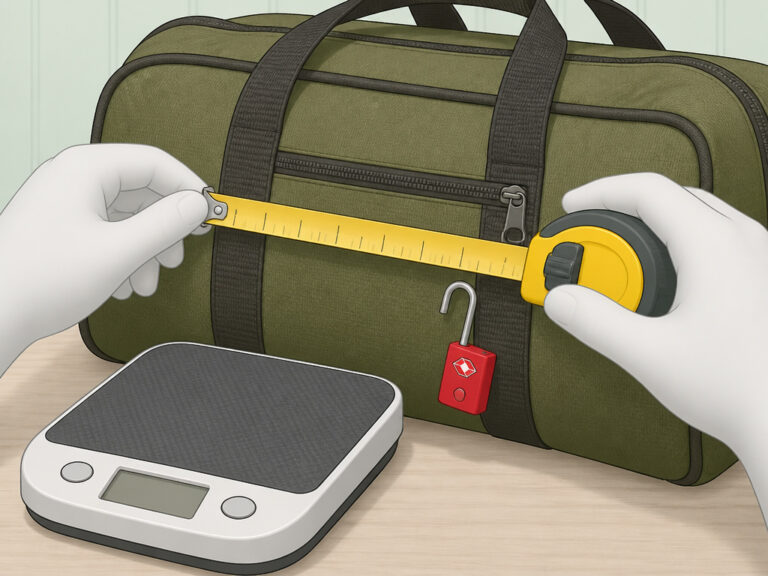
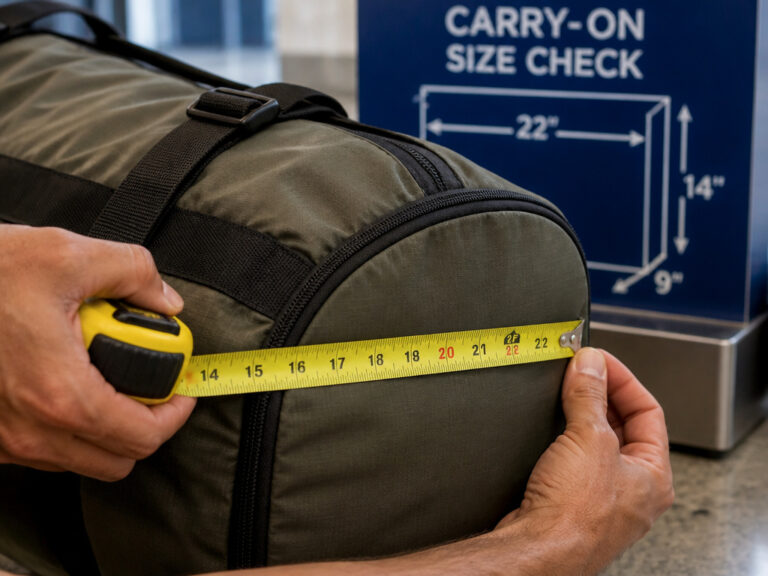
- Use a rigid tape measure. Measure the length (height from floor to top), width (side to side at the widest point), and depth (front to back).
- Add every external bulge. Include extended handles, buckled straps, and stuffed external pockets. If a side pocket has a water bottle in it, that adds to the width.
Now add the three numbers. Is the total 45 or less? Good. Does any single side exceed 22″, 14″, or 9″? Maybe a problem, check your airline’s specific rules.
This process is your best defense against surprise fees. For a detailed walkthrough, our measure carry-on bag guide breaks it down with visuals.
The Soft-Sided Squish Factor
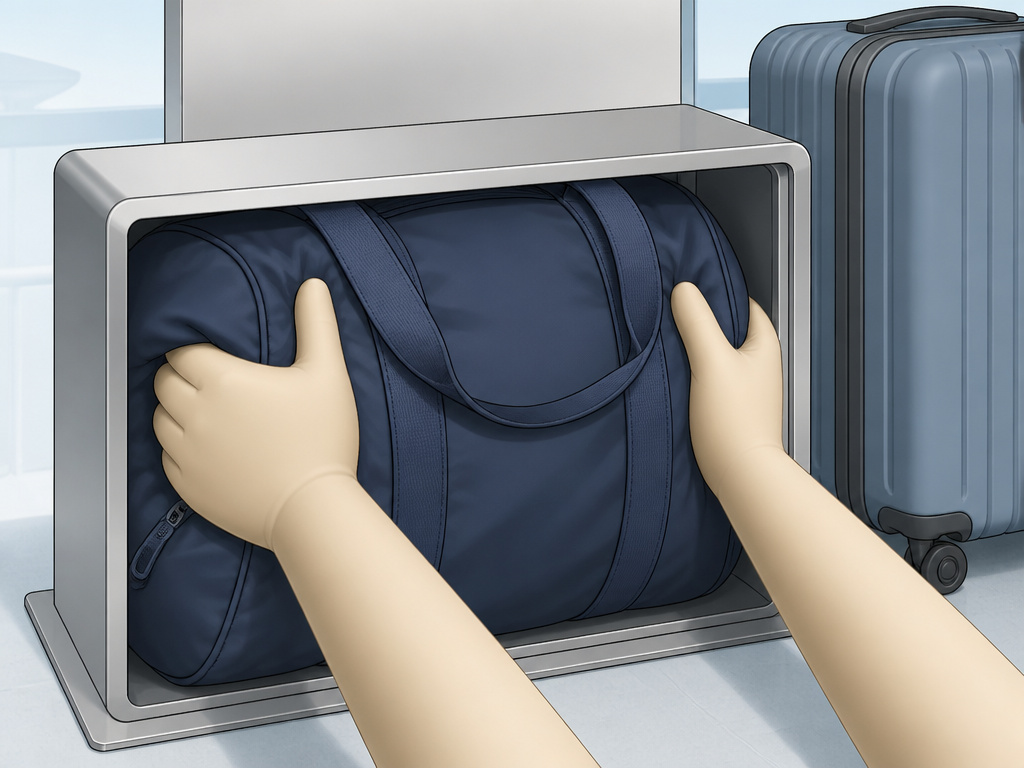
This is the single biggest advantage a duffel has over a hard-shell spinner. Flexibility.
A nylon duffel packed a half-inch over in depth can often be compressed into the metal sizer. You can push on the sides, squeeze the top, or reorient it. A hard-shell roller at the same measurement won’t budge. This flexibility is why many frequent fliers prefer a travel duffel for tight connections on mixed airlines.
But this advantage has a limit. Overstuff the duffel until it’s round like a football, and you’ve lost. The gate agent sees a bag that’s clearly too deep, even if the numbers technically add up. The sizer box is a rigid rectangle.
Where this goes sideways: Bringing a full-size 22″ duffel onto a 50-seat regional jet. The overhead bins on these aircraft are tiny or nonexistent. The gate agent will tag your bag before you board, and you’ll pick it up on the tarmac after landing.
Pack the duffel firm and square, not overstuffed and bulging. Keep the shape as rectangular as possible. This maximizes your chance of sliding through visual inspection and fitting in the overhead bin sideways, which is how flight attendants prefer them.
Duffel Bag as Carry-On vs. Personal Item

Every major U.S. Airline allows one carry-on bag plus one personal item. The definitions matter.
- Carry-On: Goes in the overhead bin. Must meet the size limits we’ve discussed (45 linear inches standard).
- Personal Item: Fits under the seat in front of you. Size is typically around 18″ x 14″ x 8″, but varies. United is strict at 17 x 10 x 9 inches. American says 18 x 14 x 8.
A duffel can be either, depending on its size. A large weekender is a carry-on. A small gym bag might qualify as a personal item. The decision point is the under-seat space.
Some travelers push this boundary. Reddit users report using a 40L Patagonia Black Hole Duffel as a personal item by not stuffing it full and sliding it under the seat. The caveat? You sacrifice legroom.
I have the same experience with my 40L counting as a personal item on flights. I don’t stuff the bag full though. It’s often the only bag I bring, but I actually love having it beneath the seat in front of me because I can prop my legs up on top of it.
If your duffel looks suspect, you’ll be asked to “test fit” it in the sizer. This is the moment of truth. If it doesn’t drop in smoothly, you’ll be gate-checking it. Knowing your airline’s carry-on bag rules is the only way to prepare.
Capacity: What Can You Actually Fit?

A soft-sided duffel bag with dimensions of 22 x 14 x 9 inches typically has a capacity between 35 and 40 liters when packed to its functional limit without external bulging.
That’s enough for: * 5-7 days of casual travel using packing cubes and rolling clothes. * 3-4 days of business travel with a blazer and shoes. * A long weekend with extra space for souvenirs.
A duffel sized to fit under a seat (approximately 18″ x 14″ x 8″) typically holds 20-30 liters. That’s a tight 2-3 day trip for a minimalist packer.
Volume labels are marketing. A “50L duffel” is almost never carry-on compliant unless it’s a sack-shaped bag you underfill. Always trust dimensions over liters.
| Trip Length | Recommended Duffel Size | Approx. Capacity | Fits Under Seat? |
|---|---|---|---|
| Weekend (2-3 days) | 18″ x 14″ x 8″ | 20-30L | Yes (Personal Item) |
| Week (5-7 days) | 22″ x 14″ x 9″ | 35-40L | No (Overhead Bin) |
| Extended (7+ days) | 22″ x 14″ x 9″ (with laundry) | 35-40L | No |
The right carry-on duffel bag size balances capacity with the reality of the sizer box. More space isn’t better if it means checking the bag.
Recommendations: Duffels Built for the Overhead Bin
You need a bag designed around the 45-linear-inch rule, not just a big sack with straps. These three are built to that spec.
For most travelers: Patagonia Black Hole Duffel 40L. It’s 20″ x 10.5″ x 13.5″ empty (44 linear inches). The 1000D recycled nylon face fabric is tough, the water-repellent finish works, and it compresses predictably. It lacks structure, so you must pack it square. This is the default pick for a reason.
If you want wheels: Travelpro Maxlite 5 Duffel 40L. This is a hybrid. It has a retractable handle and inline skate wheels but a soft-sided duffel body measuring 22″ x 14″ x 9″. You get the squish factor with the option to roll it. At under 5 lbs, it’s light for a wheeled bag.
For heavy loads and organization: Eagle Creek Gear Warrior Duffel 40L. It’s built to 22″ x 13″ x 10″ (45 linear inches). The heavy-duty fabric, internal cinch straps, and multiple access panels make it ideal for gear or organized packing. It’s more rectangular than the Patagonia, which helps with bin packing.
Skip duffels over 22 inches in length if you fly major US airlines regularly. The extra few liters aren’t worth the gate-check gamble. Check current reviews on Amazon for the latest versions of these models.
Before You Go
A duffel bag is an excellent carry-on if you respect the numbers. Buy one built to 22″ x 14″ x13 x 9″. Measure it packed, including every strap. Pack it firm and square, not overstuffed and bulging.
For the majority of domestic travel, this approach works. Remember the Delta Connection exception on small planes. And never assume, always double-check your airline’s latest carry-on size limits before you head to the airport. The right duffel, packed right, saves you time, money, and the hassle of the baggage carousel.
Frequently Asked Questions
Is a 24-inch duffel bag too big for carry-on?
Yes, a 24-inch duffel is almost always too big for a standard carry-on. Major US airlines like Delta and American cap length at 22 inches. While Southwest and Frontier allow 24-inch bags, the duffel’s depth and width must still keep it under 50 linear inches total. A 24″ x 16″ x 10″ duffel would hit that limit exactly, leaving no room for handles or overpacking.
Can a 40L duffel bag be a carry-on?
Yes, a 40L duffel can be a carry-on if its dimensions are at or under 22″ x 14″ x 9″ (45 linear inches). Many popular 40L models, like the Patagonia Black Hole, are designed to these exact dimensions. The liter rating is less important than the physical measurements. Always verify the posted dimensions, not just the volume.
Do airlines weigh carry-on duffel bags?
US airlines (Delta, American, United, Southwest) typically do not weigh carry-on duffel bags. The exception is Frontier, which has a 35-pound weight limit. International carriers are far more likely to enforce weight limits, often between 7-10 kg (15-22 lbs). If you’re flying overseas, check your airline’s policy.
What if my duffel bag is slightly too big?
If your duffel is slightly too big, a soft-sided bag might be compressed into the gate sizer. Face the flattest side forward and apply even pressure. If it’s a hard-sided hybrid or simply too large, the gate agent will tag it for plane-side checking, usually for free on domestic flights but with a fee on many budget international carriers.