Carry On Duffel Bag Size Limits: How Big Can It Really Be?
This post contains affiliate links. As an Amazon Associate, we earn from qualifying purchases.
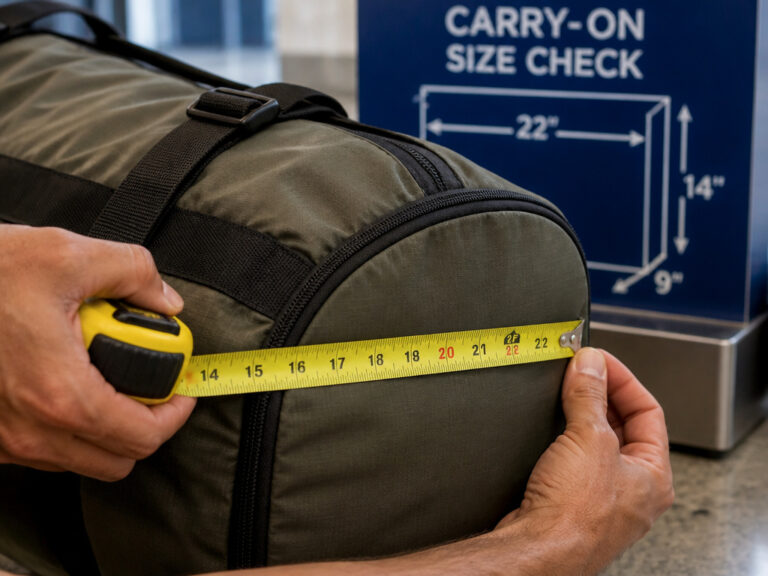
A carry-on duffel bag can be a maximum of 22 x 14 x 9 inches (56 x 36 x 23 cm) for most major US airlines, but that’s the measurement of the bag when fully packed, not its empty shell. The practical sweet spot is a 40–50 liter bag spec’d at 50 x 30 x 25 cm when stuffed, which leaves the 2–4 inch buffer you need to clear gate agents. A 65L duffel marketed as “carry-on compatible” will exceed these limits when loaded and risks fees on stricter airlines like Ryanair.
That packed-versus-empty gap is where airline policies and bag marketing collide. A duffel’s flexibility is its biggest advantage for odd-shaped gear and its biggest risk for an oversize fee at the check-in counter. A bag that measures fine on your floor can balloon when stuffed, turning a legal bag into a problem.
What follows: the non-negotiable linear inch rule, the two capacity tiers that actually work, and how to read a spec sheet so you know what you’re really buying before you board.
Key Takeaways
- The 22 x 14 x 9 inch (56 x 36 x 23 cm) limit applies to your bag’s stuffed dimensions, including all handles and straps. Measure it packed.
- A 40–50 liter duffel is the reliable carry-on size. A 65 liter duffel is a checked bag that will exceed carry-on limits when fully loaded.
- Ryanair’s free cabin bag allowance (40 x 20 x 25 cm) is a hard stop for most structured duffels. Do not assume US compliance translates to Europe.
- Manufacturer dimensions are often for the empty bag. For compliance, you need to know the “load-tested” or packed size, which is rarely listed.
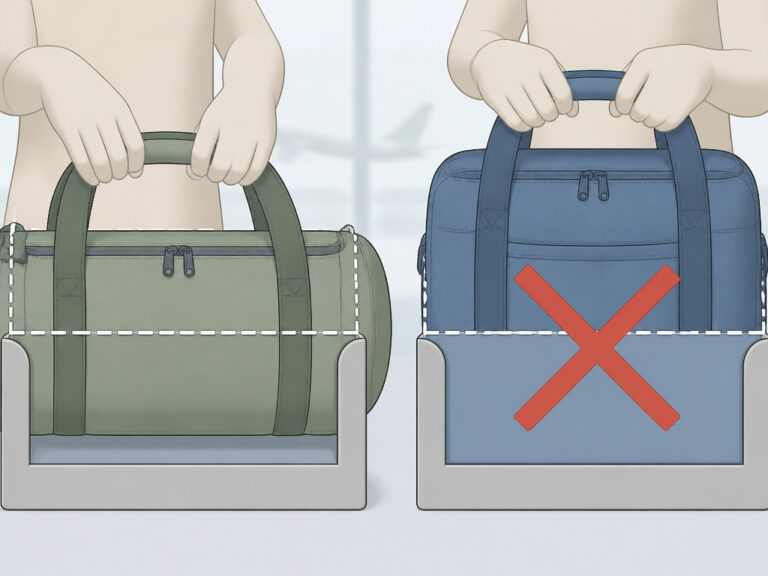
- Soft bags compress; hard shells don’t. That 2–4 inch margin in your bag’s spec is your only buffer against a gate agent’s sizer box.
The 22x14x9 Inch Standard (And Its 2–4 Inch Buffer)
The most widely accepted carry-on size limits across United, American, and Delta is 22 inches long by 14 inches wide by 9 inches deep. In centimeters, that’s 56 x 36 x 23. This is a linear dimension rule, the airline cares about the total outside measurement of the bag you present at the gate.
Common mistake: Measuring an empty duffel laid flat on a table. The fabric will give and bulge when packed, adding 2–4 inches to each dimension. The agent measures the stuffed bag, not the empty shell.
This rule is absolute for hard-shell suitcases. Their external dimensions are fixed. A duffel bag is a different animal. Its soft sides compress, which is why you must spec it conservatively. If you’re buying or comparing bags, design your mental target around 55 x 35 x 22 cm when packed. That 1–2 cm margin on each side is your buffer against a rigid sizer box.
The carry-on size isn’t just about the main compartment. The 22x14x9 measurement includes all handles, wheels, and straps. An external laptop sleeve or a pair of bulky carabiner clips can push you over. This is why understanding the real-world carry-on bag dimensions matters more than the perfect-looking number on a product page.
| Airline Type | Typical Carry-On Limit | Critical Note |
|---|---|---|
| Major US Carriers (United, Delta, American) | 22″ x 14″ x 9″ (56x36x23 cm) | Linear dimensions; often no weight limit. |
| European Budget Airlines (Ryanair, easyJet) | Varies; Ryanair’s free bag is 40x20x25 cm | Significantly stricter; a US carry-on will be too big. |
| Asian Full-Service Carriers (Air China, ANA) | Often 56x36x23 cm | Frequently have a 7-10 kg (15-22 lb) weight cap. |
The gate agent’s sizer box is the final judge. If your bag doesn’t fit, you’re checking it and paying a fee. Your goal is to never let it get to that test.
Why 40 Liters is the Magic Number (And 65 Liters Isn’t)
Capacity in liters tells you how much a bag holds. Linear inches tell you whether it fits. The disconnect between the two is how people get into trouble.
A 40–50 liter duffel bag is the retail sweet spot. At approximately 50 x 30 x 25 cm when moderately packed, it clears US domestic carry-on rules on every major carrier. You can use mid-weight fabric, add reasonable hardware, and still land well within limits. This is the size factories produce more than any other for a reason, it works.
Where this goes sideways: A brand markets a 65L duffel as “carry-on compatible with compression.” I’ve watched this strategy generate consistent customer complaints without exception. When loaded for a trip, a 65L bag will almost always exceed 56 x 36 x 23 cm.
Let’s look at two real bags from the same product line. The specs don’t lie.
| Bag Model | Listed Capacity | Listed Dimensions (Empty) | Real-World Status | | :— | :— | :— | | Osprey Arcane WP Duffel 40 | 40 Liters | 22″ x 14″ x 8″ (55x35x20 cm) | Carry-on compliant. Fits the standard with room to spare when packed. | | Osprey Arcane WP Duffel 65 | 65 Liters | 28″ x 14″ x 12″ (70x36x30 cm) | Checked bag, full stop. The 28-inch length alone exceeds the 22-inch standard. |
The 65-liter bag is a premium checked duffel. Lean into the volume as a feature for road trips or gear hauling, not as a liability. Customers who need 65L already know they’re checking a bag. Positioning it as carry-on compatible creates regulatory exposure and guarantees negative reviews from travelers hit with fees.
For a reliable carry-on duffel, start your search at 40L. The Eagle Creek Cargo Hauler 40L is built to this spec exactly. The WANDRD CARRYALL Duffel 40L is another contender that understands the assignment. These bags are designed with the sizer box in mind.
Measuring Your Duffel: The “Loaded Size” Rule
You cannot trust the manufacturer’s dimensions alone. As an industry guide for brands notes, supplier measurements of an empty bag laid flat are “useless for compliance.” The real metric is the load-tested measurement.
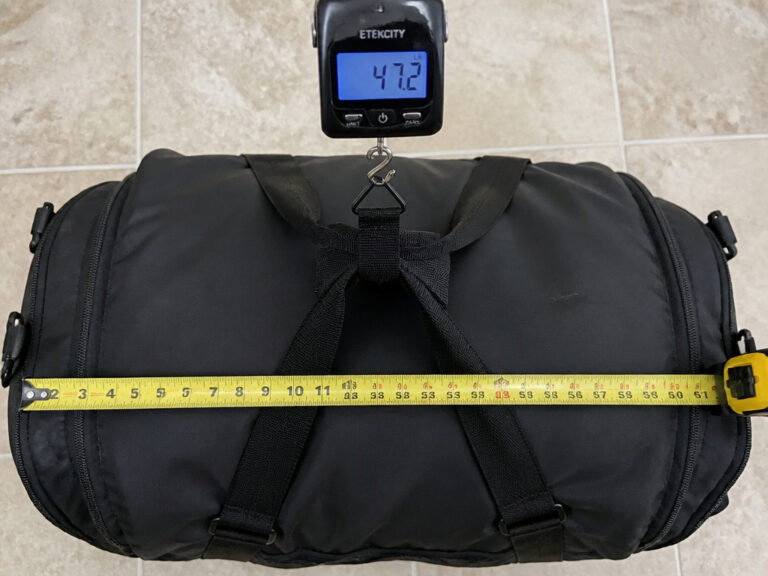
This means you must measure your carry-on after it’s fully packed for a trip. Use a tape measure and get the length, width, and depth at their fullest points, including any bulging pockets. That’s the number that matters.
Here is the correct sequence. Skip a step, and you’re guessing.
- Pack the bag completely as you would for a flight. Include shoes, toiletries, the jacket you’ll stuff in at the last minute.
- Place it on the floor in its natural, packed shape. Don’t squish it.
- Measure length, width, height at the widest points. Follow the carry-on bag measurements rule: include all external protrusions.
- Check the total linear inches (L + W + H). For checked bags, the common limit is 62 linear inches. For carry-ons, you’re checking against the 22x14x9 standard.
This process reveals the truth. A Patagonia Black Hole 60L duffel’s listed dimensions are 25 x 14 x 13 inches (52 linear inches). Pack it tight with a winter jacket and boots, and the width can push to 18 inches. That new total of 57 inches still fits a checked bag limit, but it shows how the margin disappears on a soft bag. For a carry-on duffel, that kind of bulge is a deal-breaker.
The European Budget Airline Trap
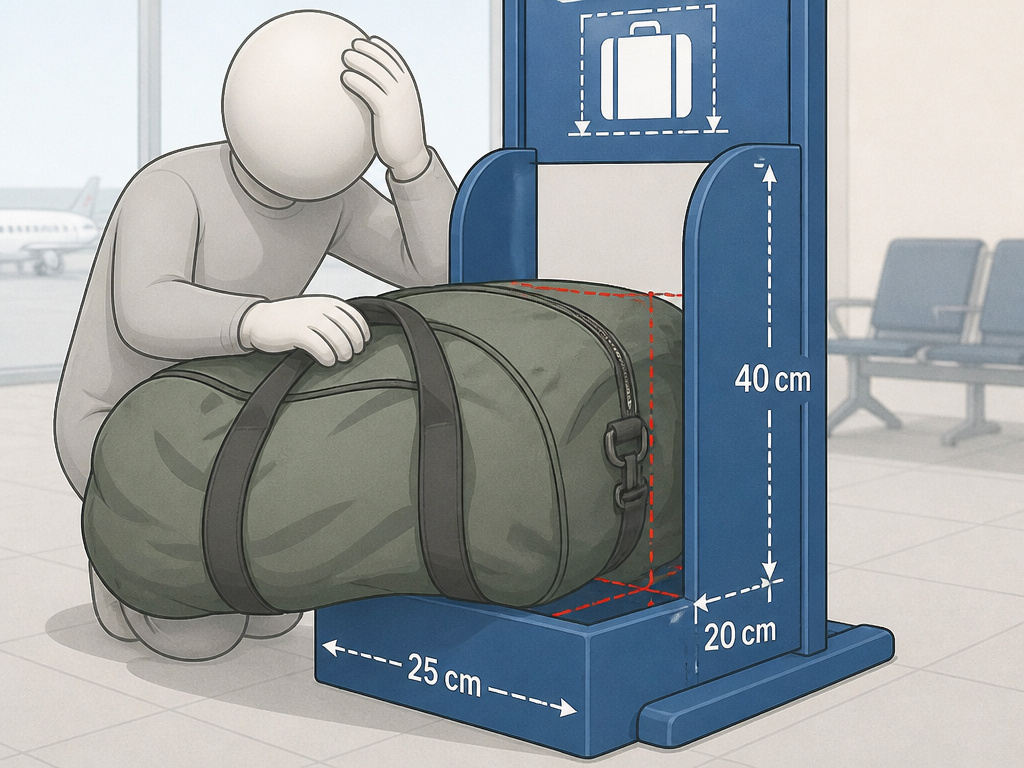
The US standard is one world. European budget airlines operate in another. If your travel includes carriers like Ryanair or easyJet, you must reset your expectations.
Ryanair’s free cabin bag allowance is 40 x 20 x 25 cm (15.7 x 7.9 x 9.8 inches). That 20 cm (8 inch) depth is brutal for any duffel with structure. Most 40L duffels, when packed, will be deeper than 8 inches. This is the landmine that catches US travelers and brands alike.
Easy to miss: A bag labeled “carry-on approved” for the US market is almost never approved for Ryanair’s free cabin bag. You will pay a priority boarding fee to bring it into the cabin, or be forced to check it.
Your strategy here is binary. Either: * Buy a bag specifically designed for this stricter personal item size, like a 27-30L duffel (the Carryx Personal Duffel 27L is built for this), or * Accept that you will pay the extra fee and consider it part of your ticket cost.
Trying to force a standard US carry-on duffel into this smaller space guarantees stress at the gate. Know the rules of the airline you’re actually flying.
Duffel Bag vs. Suitcase: The Flexibility Trade-Off
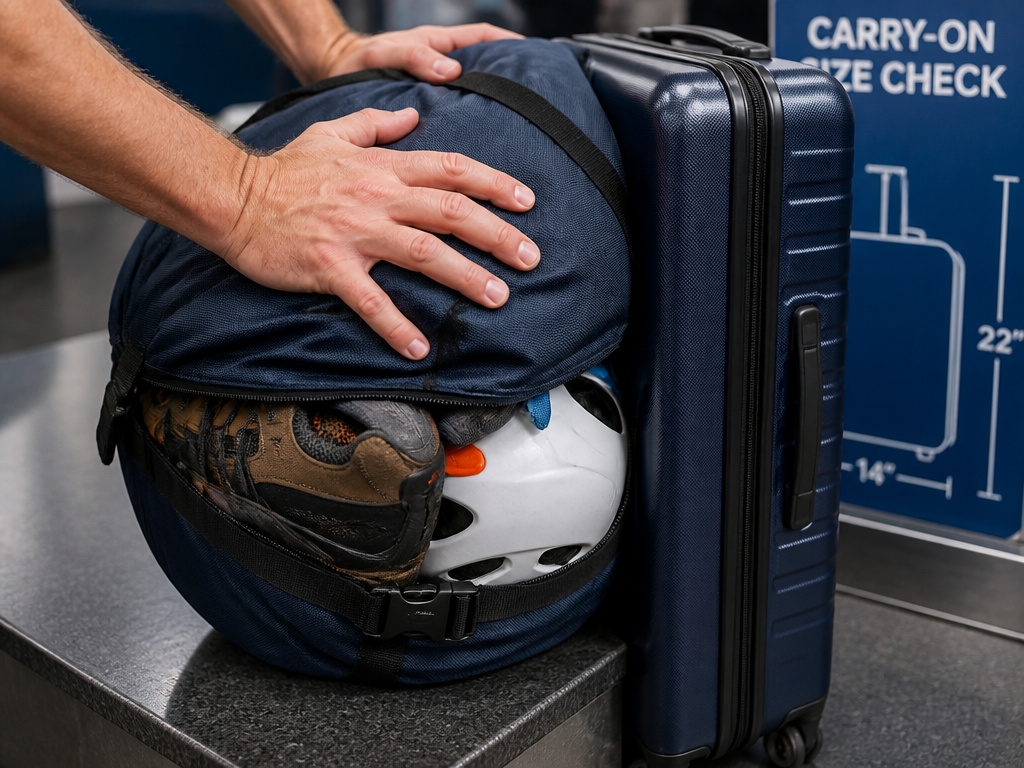
A duffel bag’s soft sides are its superpower and its Achilles’ heel. This is the core trade-off every traveler makes.
The Advantage: Flexibility. A duffel can swallow odd-shaped gear, a climbing helmet, a bulky souvenir, a pair of boots, that would break a hard-shell spinner. It’s also lighter empty, giving you more weight budget for your stuff. For soft, packable items like clothing and jackets, it’s incredibly efficient.
The Disadvantage: Lack of structure. Without internal framing, a duffel offers zero protection for fragile items. It also relies on you to pack it into a compliant shape. Overpack one area, and the bag bulges into a sphere, wasting space in the overhead bin and attracting the gate agent’s eye.
A structured travel duffel, like the Topo Designs Global Travel Bag, excels for packable items. Its flexibility lets you cram in that last souvenir. But checking a duffel full of hiking gear means carrying it a mile through a sprawling airport like DFW. What saved weight in the air costs you in sweat on the ground.
For pure, no-worry carry-on luggage size compliance, a hard-shell suitcase is easier. Its dimensions are fixed. With a duffel, compliance is an active job. You are the structure.
How to Choose: A Simple Decision Framework
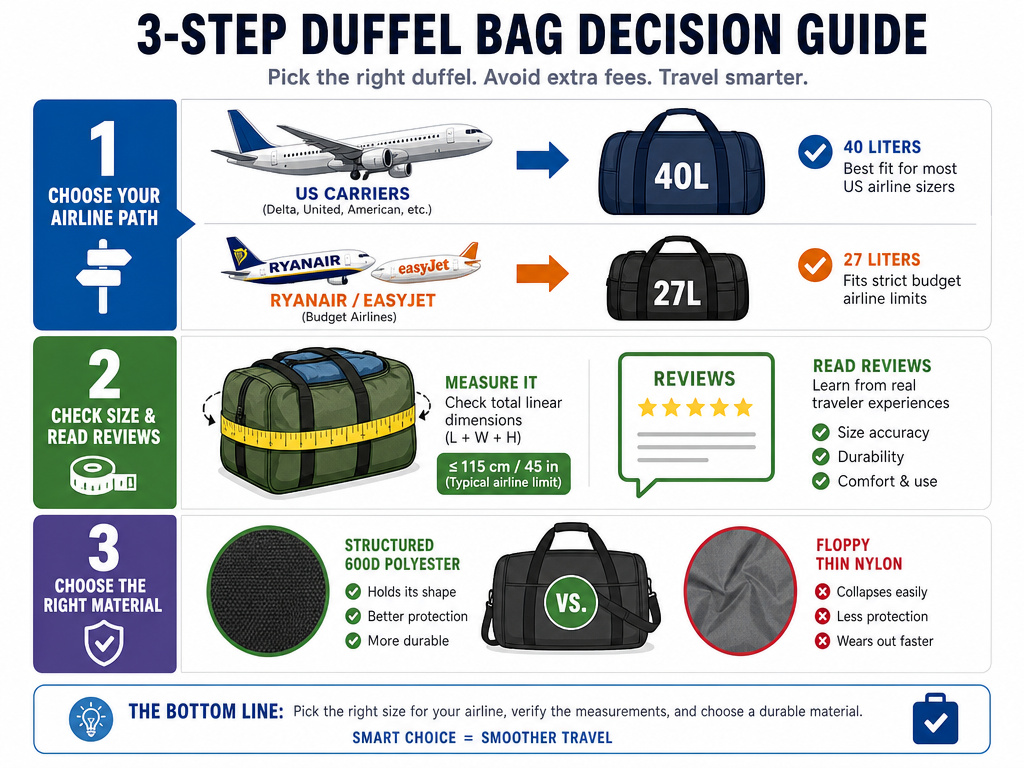
Stop looking at liters first. Start with your travel pattern. This framework cuts through the noise.
First, ask: Who am I flying with most often?
- Mostly US major carriers: Target a true 40-50L duffel. The Osprey Arcane WP Duffel 40 or Eagle Creek Cargo Hauler 40L are benchmarks.
- Frequent Ryanair/easyJet flyer: Target a 27-30L duffel that meets their strict personal item size. The Carryx Personal Duffel 27L is engineered for this.
- A mix of both: Get a compliant 40L duffel for US travel, and accept you’ll pay for priority or check it in Europe. Or, use the 40L as your checked bag and bring a separate small backpack as your personal item.
Second, check the packed dimensions.
If the product page only lists “Dimensions: 22″ x 14″ x 8″,” that’s the empty size. Dig for reviews that say “fits easily in the overhead” or “tight squeeze in the sizer.” That’s your load-tested data.
Third, consider the material.
A 600D polyester duffel with a TPU coating (like the Eagle Creek) will hold its shape better than thin nylon. A more structured bag gives you more predictable carry-on dimensions. A floppy bag is a wild card.
Bottom line: For most people flying US carriers, a 40L duffel from a reputable travel brand is the default answer. It’s the size with the widest margin for error. Size up to 65L only if you are okay checking your bag on every single trip.
Frequently Asked Questions
Is a 65L duffel bag carry-on size?
No. A 65L duffel bag, like the Osprey Transporter 65 or a North Face Base Camp Duffel 65L, will exceed standard 22x14x9 inch carry-on dimensions when fully loaded. These are checked bags. Some brands may call them “carry-on compatible” if under-packed, but at full capacity, they do not comply.
How do I know if my duffel bag is carry-on approved?
You must measure it yourself when fully packed. Check if its length, width, and depth (including bulges) are at or under 22 x 14 x 9 inches (56 x 36 x 23 cm). Then, verify it fits within any weight limit your specific airline has. Manufacturer claims are a starting point, but your packed measurement is the law.
Can a 40L duffel be a personal item?
It depends on the airline. On most US carriers, a personal item must fit under the seat and is typically smaller (around 18x14x8 inches). A packed 40L duffel will be too big. However, some travelers report successfully using a non-bulky 40L duffel as a personal item on flights with lax enforcement. Do not count on this. For a guaranteed personal item duffel, look for bags specifically designed to under-seat dimensions, like a 27-30L model.
What is the biggest carry-on duffel bag?
The biggest duffel that can reliably comply with major US airline rules is a 50-55L bag when carefully packed. However, the 40-45L range is safer and more realistic. The “biggest” bag is not a useful goal, the “most reliably compliant” bag is. Chasing maximum volume is how you end up gate-checking.
Do airlines weigh carry-on duffel bags?
Most major US airlines (Delta, American, United) do not routinely weigh carry-ons. Many international and budget airlines (Air Canada, European budget carriers, Asian airlines) do have and enforce weight limits, often between 7-10 kg (15-22 lbs). Always check your specific airline’s policy before you fly.
Before You Go
The maximum size for a carry-on duffel bag is a fixed box: 22 x 14 x 9 inches. Your job is to find a bag that lives comfortably inside that box when it’s full of your stuff, not when it’s empty on a warehouse shelf.
That means targeting the 40-liter capacity tier, measuring your packed bag religiously, and understanding that a European budget airline’s rules are a different game entirely. The Eagle Creek Cargo Hauler 40L and the Osprey Arcane WP Duffel 40 are two examples that get the formula right, they build in the buffer.
Choose the bag that fits your most common flight, not your dream of maximum volume. Compliance beats capacity every time you’re standing at the gate.