Can a Duffel Bag Be a Carry On? Key Limits & Sizing Guide
This post contains affiliate links. As an Amazon Associate, we earn from qualifying purchases.
Yes, a duffel bag can be a carry-on if its total dimensions stay under your airline’s limit, typically 22 inches long, 14 inches wide, and 9 inches deep, or 45 linear inches combined. The catch is every external part, including handles and stuffed pockets, counts. A soft-sided duffel that measures 21.5 inches empty becomes 23.5 inches with its handle, and that fails the gate sizer on the spot.
That two-inch handle is where most travelers trip. The rule isn’t about the bag’s interior space. It’s about the rigid metal box at the gate. Airlines measure the outside silhouette your bag presents when a crewmember needs to stow it in an overhead bin or under a seat.
What follows is the exact measurement logic from the FAA down to the gate agent’s checklist, the one airline exception that changes the game on small planes, and the packing move that keeps a soft duffel compliant when a hard shell suitcase would fail.
Key Takeaways
- The universal carry-on size is 22″ x 14″ x 9″ (45 linear inches), but always verify with your specific airline. Southwest and Frontier use 24″ x 16″ x 10″.
- Measure your duffel fully packed, including every handle, wheel, and bulging side pocket. An empty measurement is useless.
- On Delta Connection flights with 50 seats or less, only a personal item is allowed in the cabin; a full-size duffel will be gate-checked.
- A soft duffel can be compressed into a sizer if slightly overstuffed; a hard-sided case at the same measurement will be rejected.
- Overhead bin space is not guaranteed. If the flight is full, your duffel may be gate-checked regardless of its size.
The Standard Carry-On Size Explained
Five of the seven largest U.S. Airlines. Delta, American, United, Alaska, and JetBlue, use the same maximum dimensions: 22 inches long, 14 inches wide, and 9 inches deep. This is often expressed as a 45 linear inch total, which is the sum of the length, width, and height.
The International Air Transport Association (IATA) cites 56 × 45 × 25 cm (22 × 18 × 10 in) as a common global reference, but U.S. Carriers typically adopt the slightly narrower 9-inch depth limit for standard overhead bins.
Southwest and Frontier are the common outliers, allowing 24 x 16 x 10 inches. If you build your duffel to the 22 x 14 x 9 standard, it clears every major U.S. Carrier. This size typically holds 35-40 liters when packed properly.
The rule’s origin isn’t arbitrary. It stems from Federal Aviation Administration (FAA) regulations that mandate all carry-on items must be stowed in an approved compartment or under a seat. The FAA carry-on baggage regulation § 121.589 explicitly requires airlines to scan and control the size and amount of baggage carried on board through an approved program. Airlines then translate that safety rule into the specific inch limits that fit their fleet’s bins.
| Airline | Carry-On Dimensions (L x W x D) | Linear Inch Limit | Weight Limit (if enforced) |
|---|---|---|---|
| Delta, American, United, Alaska, JetBlue | 22″ x 14″ x 9″ | 45″ | Usually not |
| Southwest | 24″ x 16″ x 10″ | 50″ | Usually not |
| Frontier | 25″ x 16″ x 10″ | 51″ | 35 lbs |
| Hawaiian Airlines | 22″ x 14″ x 9″ | 45″ | 25 lbs |
The short version: Aim for 22″ x 14″ x 9″. Check Southwest and Frontier directly if flying with them.
How to Measure Your Duffel (The Right Way)
You need a tape measure and your duffel packed exactly as you intend to travel. Lay the bag flat on the floor and gently shape it into its natural, packed position. Do not squash it.
Measure at the widest points for each dimension. For length, include any fixed-end handles. For depth, include side pockets that are stuffed. The wheels and any telescoping handles on a wheeled duffel count fully.
Common mistake: Measuring the bag empty. A duffel gains an inch in every dimension when fully packed. The sizer box at the gate tests the packed bag, not the manufacturer’s tag.
This is where soft-sided duffels have a hidden advantage. A nylon bag that’s a half-inch over in depth can often be compressed into the metal sizer. A hard-shell roller at the same measurement won’t budge. This flexibility is why many frequent fliers prefer a travel duffels for tight connections on mixed airlines.
Your final check is the linear inch math. Add Length + Width + Depth. If the total is 45 or less, you’re likely safe for a standard airline. If you’re at 46 or 47, you’re relying on agent discretion and a soft shell.
The One Airline Exception That Catches Everyone

Delta publishes a clear, often-missed exception. On Delta Connection flights operated with regional jets carrying 50 seats or less, only a personal item is permitted in the cabin.
Where this goes sideways: Bringing a full-size 22″ duffel onto a 50-seat regional jet. The overhead bins on these aircraft are tiny or nonexistent. The gate agent will tag your bag with a pink gate-claim tag before you board, and you’ll pick it up on the tarmac after landing.
If your itinerary includes a segment on a small plane, your carry-on duffel dimensions become irrelevant for that leg. Pack a separate, smaller bag inside your duffel with your in-flight essentials, or be prepared to surrender it at the gate.
Duffel Bag vs. Personal Item: The Critical Difference
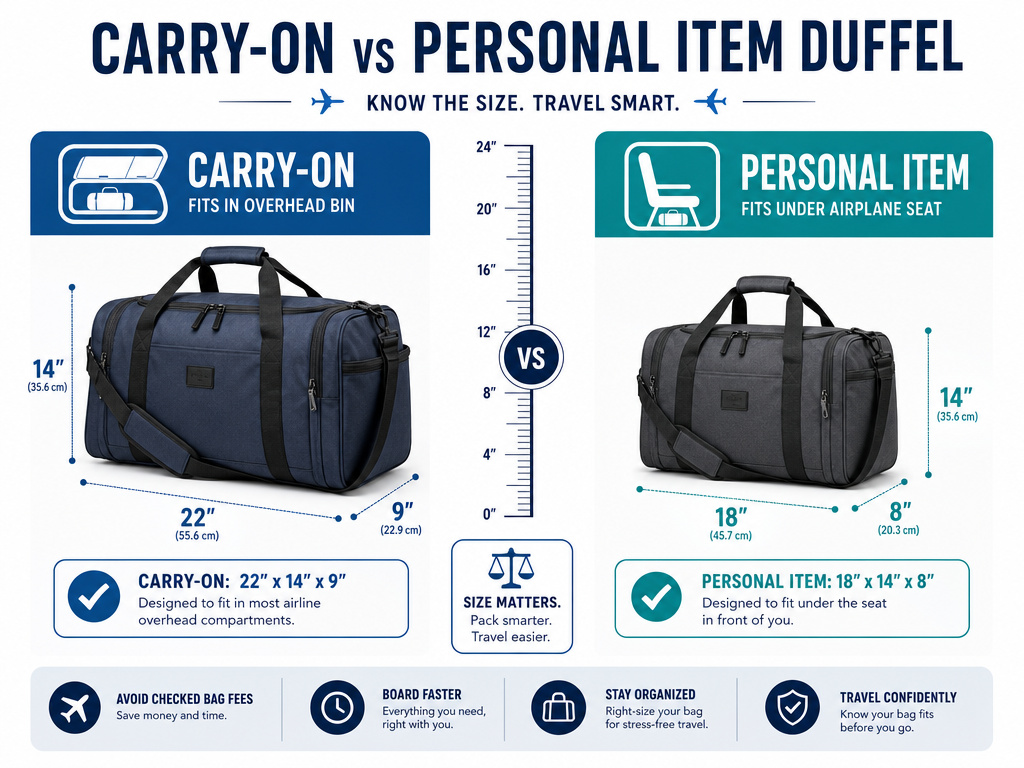
Every major U.S. Airline allows one carry-on bag plus one personal item. The personal item must fit under the seat in front of you. This is not a smaller carry-on. It’s a different category with its own, stricter size limits, typically around 18″ x 14″ x 8″.
A duffel can be either, depending on its size. A large weekender is a carry-on. A small gym bag might qualify as a personal item. The decision point is the under-seat space.
| Bag Type | Typical Size | Stowage Location | Best For |
|---|---|---|---|
| Carry-On Duffel | 22″ x 14″ x 9″ | Overhead bin | Main luggage for a trip |
| Personal Item Duffel | 18″ x 14″ x 8″ | Under seat | Essentials, laptop, quick overnights |
| Gate-Check Risk | Over 45 linear inches | Aircraft hold | Bags that don’t fit the sizer |
If you want to maximize luggage and avoid checked fees, use a duffel as personal item under the seat and a roller in the overhead. Just know that under-seat space shrinks on older aircraft and in exit rows.
3 Packing Moves That Make or Break Your Duffel

Packing a duffel is different from packing a suitcase. You’re managing structure, not relying on it.
First, pack the flat side out. A duffel’s depth is the easiest dimension to bust. Place flat items like folded jeans or packing cubes against the side that will face the sizer. This keeps the profile square.
Second, use compression, not expansion. Roll your clothes. Use packing cubes to create solid, rectangular blocks inside the bag. The goal is a firm, full duffel that holds its shape, not a bloated sack. For a deep dive on this, our guide on duffel packing tips walks through the block-packing method.
Third, leave the external pockets empty or flat. A stuffed water-bottle pocket adds an immediate inch to your depth measurement. Keep those pockets for last-minute, flexible items like a jacket or scarf.
These moves exploit the soft duffel’s advantage. A properly packed best duffels for travel will pass a visual inspection and slide into a sizer, even if it’s at the absolute limit.
What Actually Happens at the Gate?
Enforcement is visual and inconsistent, but it’s tightening. U.S. Agents rarely use a tape measure, but they are trained to spot bags that obviously won’t fit. European and budget carriers are far stricter, using sizer boxes at the gate and charging fees for non-compliance.
The agent’s primary concern is operational speed and safety. A bag that blocks the aisle during boarding delays the flight. A bag that won’t fit in the bin causes a last-minute scramble.
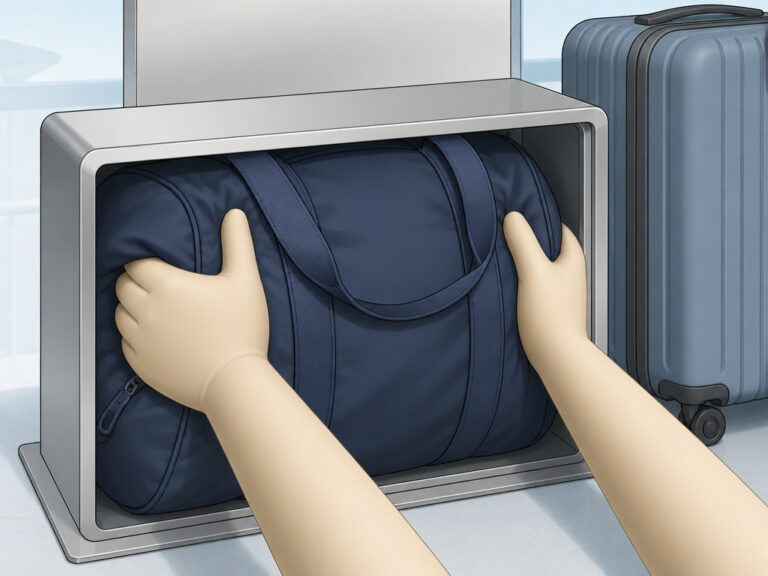
If your duffel looks suspect, you’ll be asked to “test fit” it in the metal sizer at the jet bridge. This is the moment of truth. If it doesn’t drop in smoothly, you’ll be gate-checking it. On a full flight, even compliant bags can be gate-checked if overhead space runs out. This is why your carry-on bag size must work, but it’s no guarantee.
Always keep medications, passports, valuables, and a change of clothes in a small bag you keep with you. Assume your duffel might take a ride in the hold.
Frequently Asked Questions
Can a duffel bag be a carry-on for international flights?
Yes, but international size and weight limits vary more. Many international airlines use the IATA’s 22″ x 18″ x 10″ guideline, but some are stricter. Always check your specific airline’s policy. Weight limits (often 15-22 lbs) are also commonly enforced overseas, which is a major consideration for heavy duffels.
Is a 24-inch duffel bag a carry-on?
24-inch duffel is almost always too long for standard 22-inch limits. It will only work on airlines like Southwest (24″ x 16″ x 10″) or Frontier (25″ x 16″ x 10″). For most other carriers, a 24-inch bag will be flagged and likely gate-checked for a fee.
Do wheels count in carry-on size?
Yes. Wheels, handles, and any other protrusions are included in the airline’s measurement. A bag listed as 22 inches by the manufacturer often measures 23-24 inches with its wheels and handle extended. You must measure the bag as it will be wheeled onto the plane.
What is the 45 linear inch rule?
The 45 linear inch rule is another way airlines express size limits. You add your bag’s length, width, and depth. If the sum is 45 inches or less, the bag is compliant. For example, a bag measuring 22″ + 14″ + 9″ equals 45 linear inches.
Can a duffel bag be too heavy for a carry-on?
Most U.S. Airlines do not weigh carry-ons. Notable exceptions are Frontier (35 lb limit) and Hawaiian Airlines (25 lb limit). For international travel, weight limits are common and strictly enforced. A heavy, overstuffed duffel is a liability on long-haul flights with weight restrictions.
The Bottom Line
A duffel bag is an excellent carry-on if you respect the numbers. Buy one built to 22″ x 14″ x 9″. Measure it packed, including every strap. Pack it firm and square, not overstuffed and bulging.
For the majority of domestic travel, this approach works. Remember the Delta Connection exception on small planes. And never assume, always double-check your airline’s latest size limits before you head to the airport. The right duffel, packed right, saves you time, money, and the hassle of the baggage carousel.