Can a Duffel Bag Be a Personal Item? Key Airline Policies.
This post contains affiliate links. As an Amazon Associate, we earn from qualifying purchases.
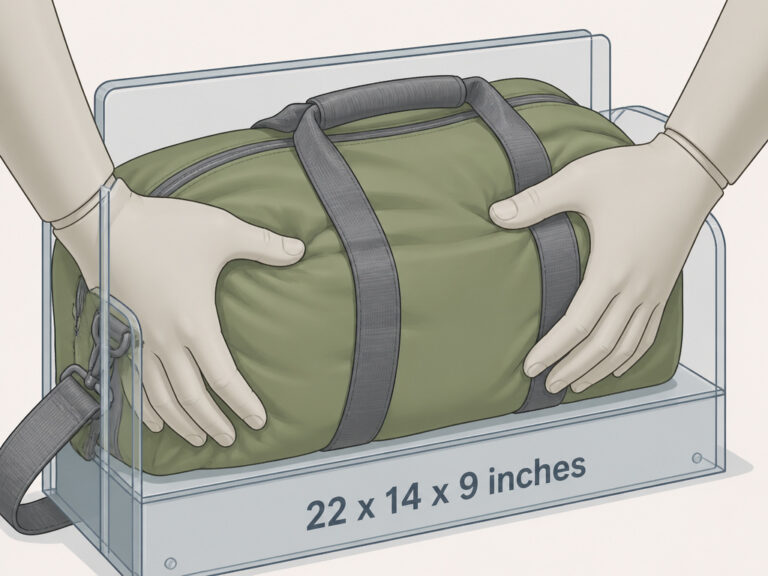
Yes, a duffel bag can be a personal item on most major airlines if it fits completely under the seat in front of you. The universal safe size is 18 x 14 x 8 inches (45 x 35 x 20 cm), a standard used by American, Delta, Frontier, and Spirit. However, United, JetBlue, and Southwest enforce smaller, tighter dimensions that can turn a compliant duffel into a $100 gate-check fee in under a minute.
That 18-inch standard is a starting point, not a guarantee. An airline’s published policy and the gate agent’s sizer are two different documents. The difference between a free personal item and a costly carry-on fee often comes down to three things: your fare class, the specific aircraft seat, and whether your duffel is soft enough to compress.
What follows is a breakdown of the real numbers from seven major U.S. Carriers, the physical limits under airplane seats, and the one style of duffel that actually works across all of them.
Key Takeaways
- The 18 x 14 x 8 inch rule is a mirage for four airlines. United, JetBlue, Southwest, and Alaska all publish personal item dimensions smaller than this “standard,” with United’s 10-inch width being the most restrictive.
- Enforcement is a fare-class game. On Basic Economy tickets (American, Delta, United, JetBlue), you are only allowed a personal item, no overhead bin access. Gate agents on these fares are far more likely to measure.
- A soft-sided, unstructured duffel is your only safe bet. A hard-sided “underseater” or an overpacked duffel will fail a sizer test every time. Flexibility is the feature that matters most.
- Aircraft design is the silent gatekeeper. Newer planes have in-flight entertainment system boxes and power outlets under many seats, reducing clear space by 2-3 inches. A bag that fits under 23A might not slide under 12F.
- Southwest’s policy change altered the math. Since ending its “Bags Fly Free” checked bag policy in May 2025, enforcement of personal item size at busy Southwest hubs has noticeably tightened.
The 18 x 14 x 8-Inch Standard (and the Airlines That Ignore It)
Most online guides point to 18 x 14 x 8 inches as the universal personal item size. That number comes from a common U.S. Carrier specification is a convenient aggregation that misses the critical outliers, but it is not a law.
American Airlines, Delta Air Lines, Frontier, and Spirit all use this exact dimension for their personal item allowance. For these carriers, a duffel bag measuring within that box, including all handles, straps, and bulging pockets, will satisfy the written rule. Delta’s official policy states you may bring “one personal item (purse, briefcase, laptop bag) per passenger,” with the overarching FAA carry-on baggage advisory circular setting the maximum allowable size for any cabin bag.
Where this goes sideways: Assuming 18 x 14 x 8 works for United. United’s personal item limit is 17 x 10 x 9 inches. That 10-inch width is a hard stop for most structured duffels. A bag that is 14 inches wide won’t even enter the sizer.
The airlines that deviate from the “standard” create the real risk. Here’s where the numbers actually land:
| Airline | Personal Item Max Size | Critical Restriction | Free on Basic Economy? |
|---|---|---|---|
| American Airlines | 18″ x 14″ x 8″ | Common standard; least enforced. | Yes (Personal Item Only) |
| Delta Air Lines | 18″ x 14″ x 8″ | Follows FAA max; loosely enforced on standard fares. | Yes (Personal Item Only) |
| United Airlines | 17″ x 10″ x 9″ | The 10″ width fails most duffels. | Yes (Personal Item Only) |
| JetBlue Airways | 17″ x 13″ x 8″ | 1″ shorter & narrower than standard. | Yes (Blue Basic fare) |
| Southwest Airlines | 16.25″ x 13.5″ x 8″ | Shorter length is the trap. | Yes |
| Frontier Airlines | 18″ x 14″ x 8″ | Sizers at every gate. Enforcement is high. | Yes (Personal Item Only) |
| Alaska Airlines | 17″ x 13″ x 6″ | The 6″ depth is the smallest of any major carrier. | Yes |
Your duffel bag’s job is to meet the smallest common denominator, not the average. For U.S. Travel, that means a bag no larger than 16.25 x 13.5 x 6 inches if you want absolute certainty. Very few duffels are built to those specs.
Under-Seat Reality Check: Why Your Duffel Might Not Fit
An airline’s published dimensions describe a theoretical box. The space under an airplane seat is an irregular, obstructed cave. This is the single most common point of failure for duffel bags used as personal items.
Modern narrow-body aircraft like the Boeing 737 MAX and Airbus A321neo are packed with under-seat hardware. The in-flight entertainment system box for the row behind you is often located directly under the middle seat. It can protrude 3-4 inches into the footwell, reducing clear height. Power outlets and floor beam covers further eat into the space.
Common mistake: Packing your duffel to its maximum dimensions. A 14-inch deep bag shoved under a seat with a 3-inch tall metal box in front of it becomes an 11-inch deep bag. It either won’t go in, or it will block your feet and draw the flight attendant’s attention.
The solution is a soft, compressible duffel. A nylon or canvas bag without internal structure can deform around obstructions. A rolling underseater suitcase or a duffel with a rigid frame cannot. This is why a simple carry-on duffel bag made from flexible material has a higher success rate than a piece of luggage built to a specific carry-on size.
The test: Before you fly, check SeatGuru or your airline’s seat map for your specific seat number. Rows marked with a red “under-seat storage limited” icon are typically bulkhead rows or rows immediately behind an exit row. Avoid these if your duffel is full.
The Basic Economy Squeeze: When Your Duffel Is Your Only Bag
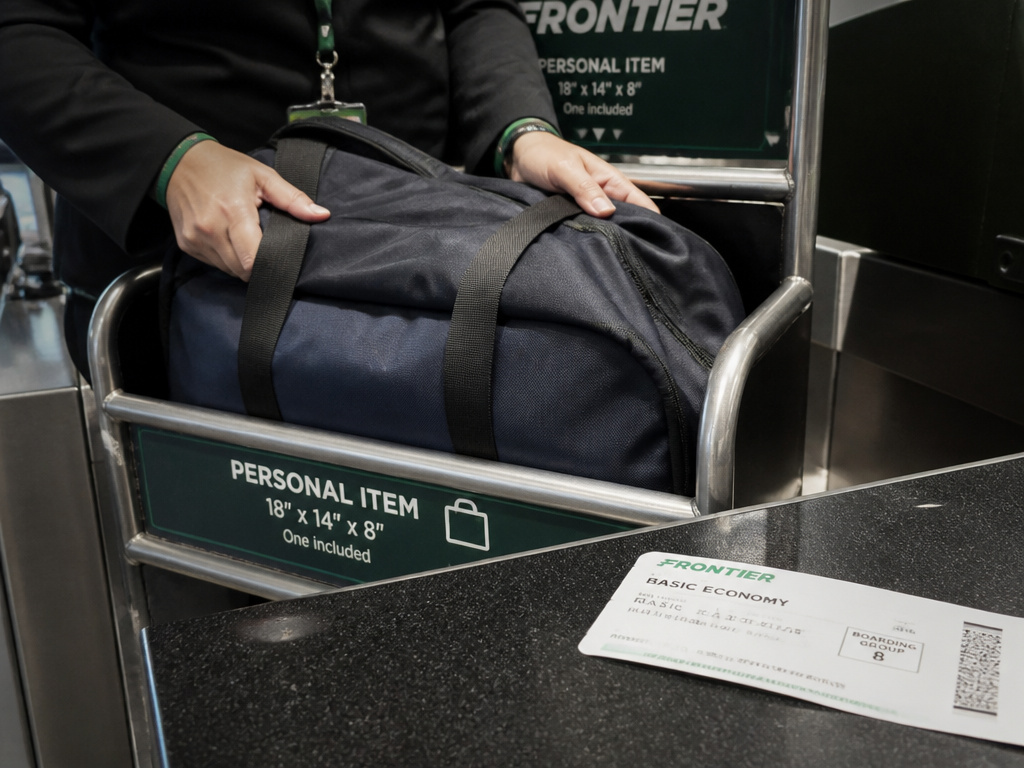
On Basic Economy or equivalent low-fare tickets (American, Delta, United, JetBlue Blue Basic), the rules change fundamentally. You are not allowed a full-sized carry-on for the overhead bin. Your personal item, your duffel bag, is your entire cabin allowance.
This shifts the gate agent’s focus. On a standard fare, a slightly oversized personal item might be overlooked if you also have a compliant overhead bag. On a Basic Economy fare, that oversized duffel is your only bag, and it’s the one item the airline is specifically monetizing. Agents are trained to identify and measure bags on these fares.
Frontier Airlines policy is the clearest example. Their business model relies on bag fees. They have physical sizers at the gate, and agents will ask you to test your bag if it looks close. A duffel that’s a half-inch over on any dimension will cost you.
The packing strategy must also change. You need to fit everything for your trip into that one duffel. This makes internal organization critical. Using packing cubes not only saves space but also keeps your bag looking less bulky and more compliant. Learning efficient duffel bag packing is no longer a nice-to-have skill; it’s the difference between a free bag and a fee.
Duffel vs. Backpack vs. Tote: Which Shape Actually Wins?

A duffel bag is a valid personal item, but is it the best personal item? The answer depends on the airline’s enforcement style and your need for capacity.
| Bag Type | Best For | Risk If Chosen Wrong |
|---|---|---|
| Soft Duffel Bag | Maximizing capacity on airlines with generous dimensions (American, Delta). | Fails on width-restricted airlines (United). Looks bulky, attracting sizer checks on budget carriers. |
| Backpack | Strict airlines (Frontier, United, Spirit). Compresses easily, fits irregular under-seat space. | Lower total capacity. An overpacked hiking backpack can exceed size limits quickly. |
| Tote Bag | Minimalist travel on any airline. Naturally slim profile. | Very limited organization and structure. Uncomfortable to carry when fully loaded. |
For airlines like United with the 10-inch width rule, a standard duffel bag is almost always the wrong choice. A personal item backpacks is better. For Frontier, a soft duffel can work, but it must be underpacked. A tote bag is universally safe but holds the least.
If you want one answer: a 25-30 liter travel backpack is the safest all-around shape. It compresses, it has structure, and it looks like a personal item to a gate agent. A duffel is the high-capacity, higher-risk option.
How to Choose (and Use) a Compliant Duffel Bag

Choosing the right duffel involves matching three specs to your most-flown airline: collapsed dimensions, material flexibility, and lack of external bulk.
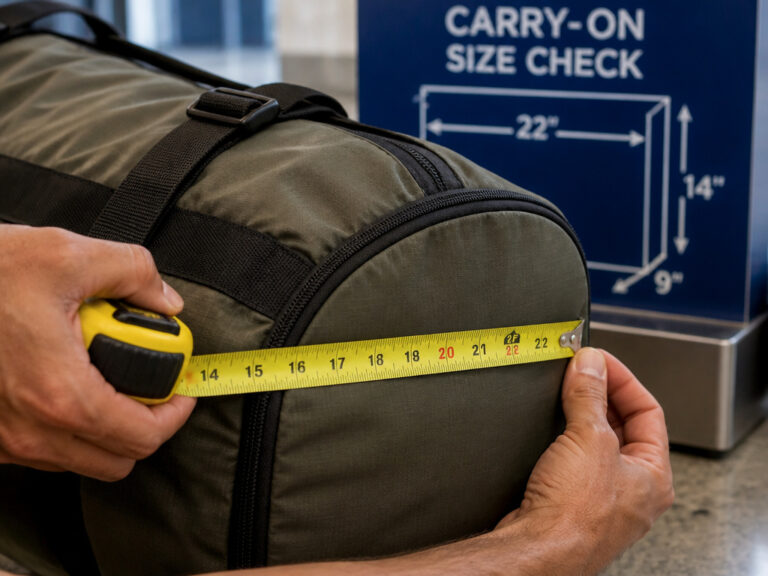
First, measure the bag yourself after packing it for a typical trip. Manufacturer specs are for the empty shell. Your packed bag, with stuffed side pockets and a jacket strapped to the outside, is what the gate agent sees.
Second, prioritize soft-sided, unstructured designs. The Patagonia Black Hole Duffel 30L is a classic example, its lightweight fabric crushes down. Avoid any duffel with a hard bottom panel, rigid ends, or an internal frame. These features turn your bag into a rigid box that will fail a sizer.
Third, be ruthless about external attachments. Looping a pair of shoes or a water bottle on the outside adds inches to your overall dimensions. Those items must go inside.
The part nobody mentions: The color of your bag matters. A bright, distinctive duffel is easier for a gate agent to remember and flag for measurement on a busy jet bridge. A black or grey bag blends into the crowd.
For specific models, the community of one-bag travelers consistently points to a few options as best duffel bags for this purpose. The key is to treat these recommended personal items as a starting point for your own measurement test, not as a guaranteed pass.
Frequently Asked Questions
Does a duffel bag count as a personal item on Southwest?
Yes, a duffel bag counts as a personal item on Southwest if it fits under the seat. Southwest’s limit is 16.25 x 13.5 x 8 inches. This is slightly smaller than the common 18-inch standard, so many medium-sized duffels will be too long. A 40-liter duffel is almost certainly too big; aim for a 30-liter or smaller model.
Can I bring a duffel bag and a backpack?
On most standard fares, you can bring a duffel as your carry-on (overhead) and a backpack as your personal item (under-seat), provided both meet their respective size limits. On Basic Economy fares, you are typically allowed only one item, the personal item. In that case, you must choose one or consolidate.
What if my duffel bag is slightly too big?
If your duffel is slightly too big and you’re at the gate, the agent will likely make you check it. For a Basic Economy passenger, this usually means paying the standard checked bag fee plus a potential gate handling charge ($25-$50). For a standard fare passenger, they may gate-check it for free, but you risk your bag being delayed or lost.
Do wheels on a duffel bag count in the measurement?
Yes. All external components, wheels, handles, straps, count toward the bag’s overall dimensions when placed in the sizer. A wheeled duffel must have its wheels included in the height measurement. This is why wheeled bags are riskier as personal items; they add 1-2 inches of non-compressible bulk.
Are airlines strict about personal item weight?
Most U.S. Airlines do not have a weight limit for personal items. However, some international carriers do enforce a combined weight limit for your carry-on and personal item together. The primary concern for U.S. Carriers is physical size, but an excessively heavy bag may be questioned as a safety issue for stowage.
The Bottom Line
A duffel bag can be a perfect personal item, but it demands more homework than a backpack. You must know your airline’s true dimensions, not the internet’s consensus. You must pack it soft and leave room for compression. And you must accept that on the tightest airlines. United and Frontier, a traditional duffel shape is fighting a losing battle against a 10-inch wide sizer.
For most domestic travel on American or Delta, a soft 18 x 14 x 8 inch duffel will work. For everything else, a 30-liter travel backpack is the simpler, safer choice. The goal is to walk past the gate agent without being seen, rather than to test the rule.