How Big Is a Duffel Bag | The Real Sizing Most Brands Hide
This post contains affiliate links. As an Amazon Associate, we earn from qualifying purchases.
A duffel bag’s size is defined by its length, width, and height, but its true capacity is measured in liters, and the way brands calculate those liters is often misleading. The real answer lives in the difference between marketing math (L×W×H) and the professional ASTM F2153 standard, which can show a 15–25% overstatement. Common carry-on duffels like the Eagle Creek No Matter What 40L run about 22 x 14 x 9 inches, but you must measure every external feature to know if it will pass at the gate.
That gap between listed liters and actual packable space is where travelers get stuck. A bag marketed as “45L” using simple multiplication might hold the same as a competitor’s honestly-rated 35L bag. The problem isn’t the bag. It’s the math brands use to make their product seem bigger on the page.
What follows: the two methods for measuring volume, how to translate dimensions into liters (and back), a chart of real-world duffel sizes from 25L to 120L, and the exact rules for airline carry-on. You’ll learn how to read a spec sheet and spot the numbers that actually matter.
Key Takeaways
- Marketing liters are inflated. Brands often calculate volume by multiplying length, width, and height, which ignores curves and fabric, creating “phantom volume.” The ASTM F2153 standard (using filler balls) gives the true, lower capacity.
- Always measure for airline compliance. Product dimensions often exclude handles, straps, and pockets. Airline sizers measure everything that protrudes. A soft-sided duffel can compress 1-2 inches if not overstuffed, a key advantage over hard luggage.
- Carry-on is about dimensions, not liters. A common limit is 22″ x 14″ x 9″ (56 x 36 x 23 cm), but this varies by airline. A 40L duffel like the Osprey Arcane WP often fits; a 65L bag like its bigger brother will not.
- Shape changes the math. For a cylindrical duffel, use the formula: Volume (L) = π × (Diameter/2)² × Length / 1000. A 30 cm diameter, 55 cm long bag is about 39L.
- Check the manufacturer’s spec sheet. Reliable brands like Eagle Creek and Osprey list both dimensions and liters. Use these as a baseline, then verify the external footprint if flying.
The Two Ways to Measure Volume (And Why One Is a Lie)
You see a number like “40L” on a product page. That should be straightforward. It’s not. There are two competing definitions of what a liter of bag capacity actually means, and the common one benefits the seller, not the buyer.
The first method is the Marketing Math, also called the L×W×H method. You take the bag’s internal length, width, and height in centimeters, multiply them together, and divide by 1000 to convert cubic centimeters to liters. It’s simple, fast, and paints the rosiest possible picture. This method assumes your duffel is a perfect, rigid box with zero fabric thickness, no curves, and no seams. In reality, a duffel’s soft sides bow, its corners are rounded, and its material takes up space. The result is what industry experts call “phantom volume”, air that’s counted on the spec sheet but impossible to fill with gear. This overstatement typically runs 15 to 25 percent.
The professional standard, ASTM F2153, involves filling the bag with standardized polystyrene balls to measure true internal displacement. This is how brands like Patagonia and Osprey verify capacity for their technical gear.
The second method is the Professional Standard: ASTM F2153. This is the metric that matters if you want to know how much your sleeping bag, shoes, and packing cubes will actually fit. The bag is filled with small, uniform polystyrene balls, which settle into every curve and seam. The total volume of the balls is the bag’s true capacity. The number from this test is always lower than the Marketing Math number. When a brand uses this standard, they’re telling you they value honest specs over marketing hype.
| Measurement Method | How It Works | Result | Who Uses It |
|---|---|---|---|
| Marketing Math (L×W×H) | Multiply internal dimensions (cm), divide by 1000. | Inflated, includes “phantom volume.” | Common for generic brands, fast fashion. |
| Pro Estimate (L×W×H × 0.75) | Apply a 0.75 shape factor to the marketing math. | More honest, accounts for curves. | Used by savvy manufacturers for better listings. |
| ASTM F2153 Standard | Fill bag with standardized polystyrene balls. | True, packable capacity. | Patagonia, Osprey, other high-end outdoor brands. |
So when you compare a “50L” bag from a generic brand to a “40L” bag from a brand that follows ASTM, they might hold the same amount. The smaller, honest number is the one you can trust when packing.
How to Measure Your Own Duffel Bag
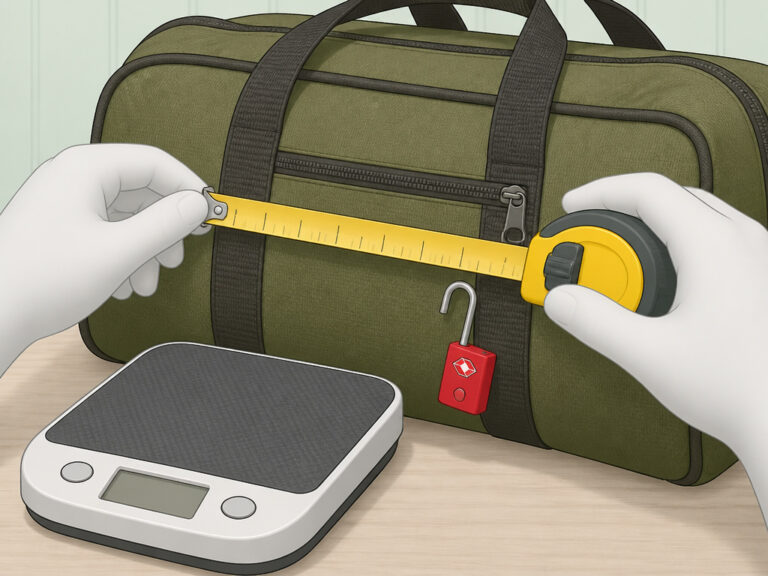
You need a flat surface, a rigid tape measure, and the bag laid out as if it were full. A book or small box inside can help it hold shape without stretching the fabric. 1. Length: Measure from the bottom seam to the top seam along the side. 2. Width: Measure across the bag from one side seam to the other. 3. Height/Depth: Measure from the front of the bag to the back. Round down to the nearest whole centimeter or inch. It’s better for a bag to be slightly bigger in reality than smaller.
Where this goes sideways: Measuring from strap anchors or buckles instead of the bag’s actual body. This small mistake can add inches and make a carry-on bag fail at the gate.
For a cylindrical duffel, the formula changes completely. You need the diameter and the length.
Volume (Liters) = π × (Diameter/2)² × Length / 1000
Example: A cylindrical bag with a 30 cm diameter and 55 cm length has a volume of roughly 38.9 liters.
From Liters to Real-World Dimensions: A Size Chart
Liters tell you capacity. Dimensions tell you if it will fit in an overhead bin, a locker, or your car. Here’s how those liter sizes translate into the physical space a duffel bag occupies, using real product specs.
| Liter Range | Typical Use Case | Example Model & Dimensions | What It Fits (Approx.) |
|---|---|---|---|
| 20L – 30L | Gym, overnight, daily sports. | UA Undeniable 5.0 XS (~17.6″L) | Gym clothes, shoes, toiletries. A tight weekend. |
| 35L – 45L | Weekend trip, carry-on travel. | Eagle Creek No Matter What 40L (21.75″ x 14″ x 9″) | 2-3 outfits, shoes, toiletry bag, jacket. The sweet spot for a carry-on duffel bag. |
| 50L – 65L | Week-long trip, checked luggage, light gear. | Osprey Arcane WP Duffel 65 (28″ x 14″ x 12″) | A week’s clothing, bulkier items. Often too big for overhead bins. |
| 70L – 90L | Extended travel, expedition gear. | OGIO Rage Duffel (62.3L, 24″ x 13″ x 12″) | Heavy gear, multiple packing cubes, long trips. |
| 100L+ | Major expeditions, moving bulk gear. | Carhartt 120L Foundry Duffel (30″ x 19.5″ x 13″) | Sleeping bags, climbing ropes, massive loads. |
The 35L–45L range is the most critical for travelers. This is the carry-on sweet spot. A bag like the Eagle Creek No Matter What 40L is designed to these limits. The Osprey Arcane WP Duffel 40 is another prime example, with its 22 x 14 x 8 inch frame. These dimensions aren’t accidental, they target the common airline maximum.
Notice that a bag’s duffel bag volume in liters doesn’t directly dictate its exterior size. Design, padding, and structure play huge roles. A 40L backpack might be taller and slimmer; a 40L duffel will be shorter and wider. Always check the dimensions.
Airline Carry-On Limits: The Rules That Actually Matter
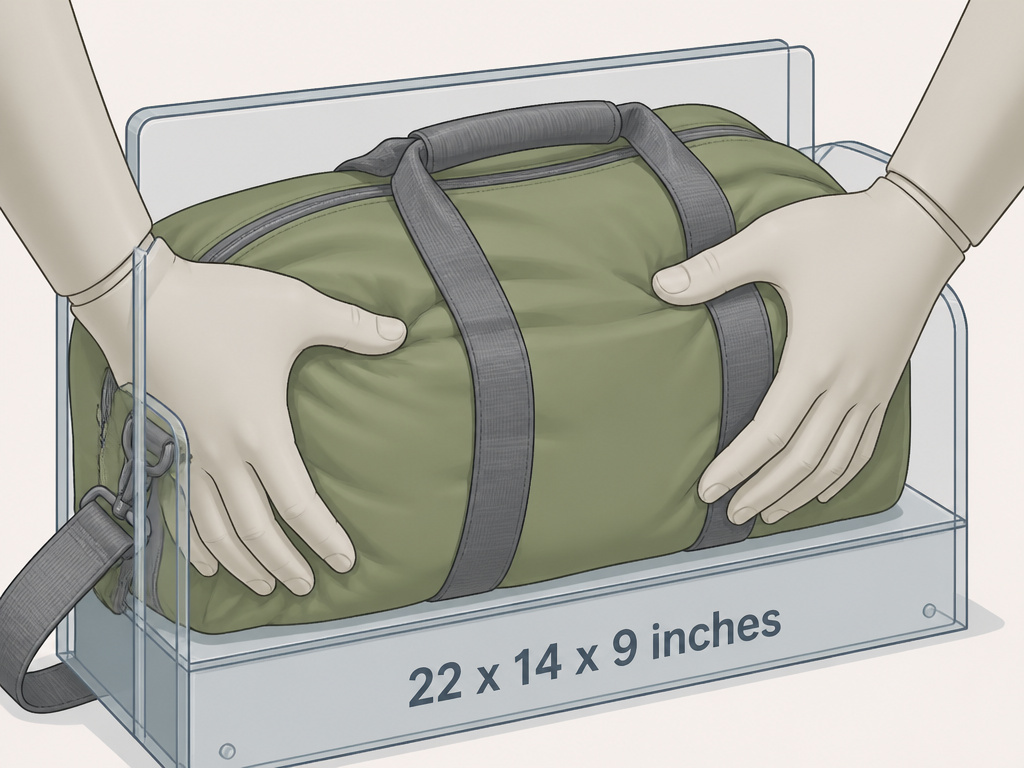
This is the question that brings most people here: will my bag fit on the plane? The answer has nothing to do with liters and everything to do with linear inches. Airlines publish size limits for carry-on bags, usually expressed as length + width + height (total linear inches) or as individual maximums.
The most frequent limit you’ll encounter is 22 x 14 x 9 inches (56 x 36 x 23 cm). This is the standard for many major U.S. Carriers for a overhead bin carry-on. However, budget airlines and international carriers can be stricter. Always, always check your specific airline’s website before you fly.
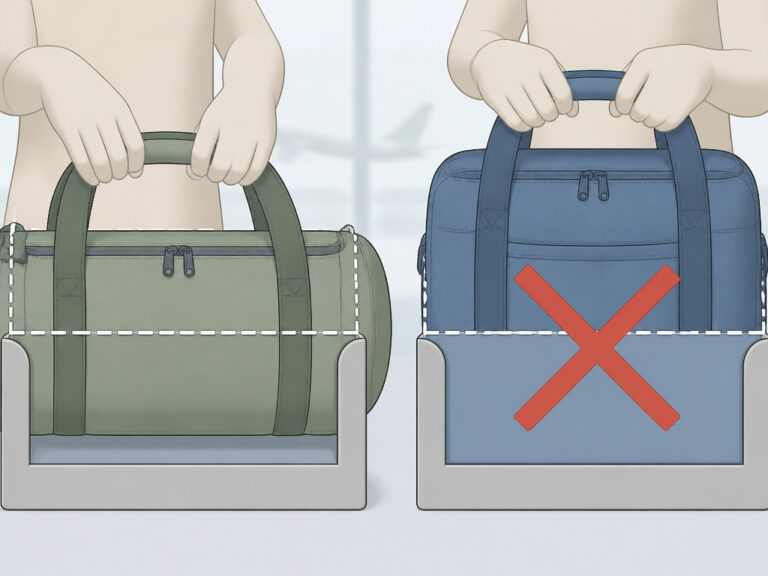
The duffel bag advantage: Soft-sided duffels have a significant edge over hard-shell luggage at the gate. If your duffel is 1–2 inches over the limit but not fully packed, it can compress to fit the sizer frame, something a rigid suitcase cannot do.
The biggest trap is assuming the product’s listed dimensions are the same as its airline compliance dimensions. They are not. Product dimensions often measure just the bag’s body. Airline sizers measure EVERYTHING: handles, straps, wheels, buckles, and any protruding pockets. A carry-on duffel marketed as 22” long might be 24” once you account for the end handles. This is especially crucial for wheeled duffels or bags with rigid shoe compartments.
| Airline (Common Examples) | Carry-On Size Limit (inches) | Carry-On Size Limit (cm) | Notes |
|---|---|---|---|
| Delta, American, United | 22 x 14 x 9 | 56 x 36 x 23 | Standard U.S. Mainline size. |
| Southwest | 24 x 16 x 10 | 61 x 41 x 25 | Slightly more generous. |
| JetBlue | 22 x 14 x 9 | 56 x 36 x 23 | Standard bin size. |
| Spirit, Frontier | 22 x 18 x 10 | 56 x 46 x 25 | Must fit in the sizer; personal item is much smaller. |
| Ryanair | 21.5 x 15.5 x 7.8 | 55 x 40 x 20 | Very strict; includes all handles/wheels. |
If you want to guarantee compliance, your target should be the strictest airline you regularly fly. For many, that means aiming for a bag that is slightly under the 22 x 14 x 9 inch mark when every external feature is included.
How Shape and Style Warp the Measurements
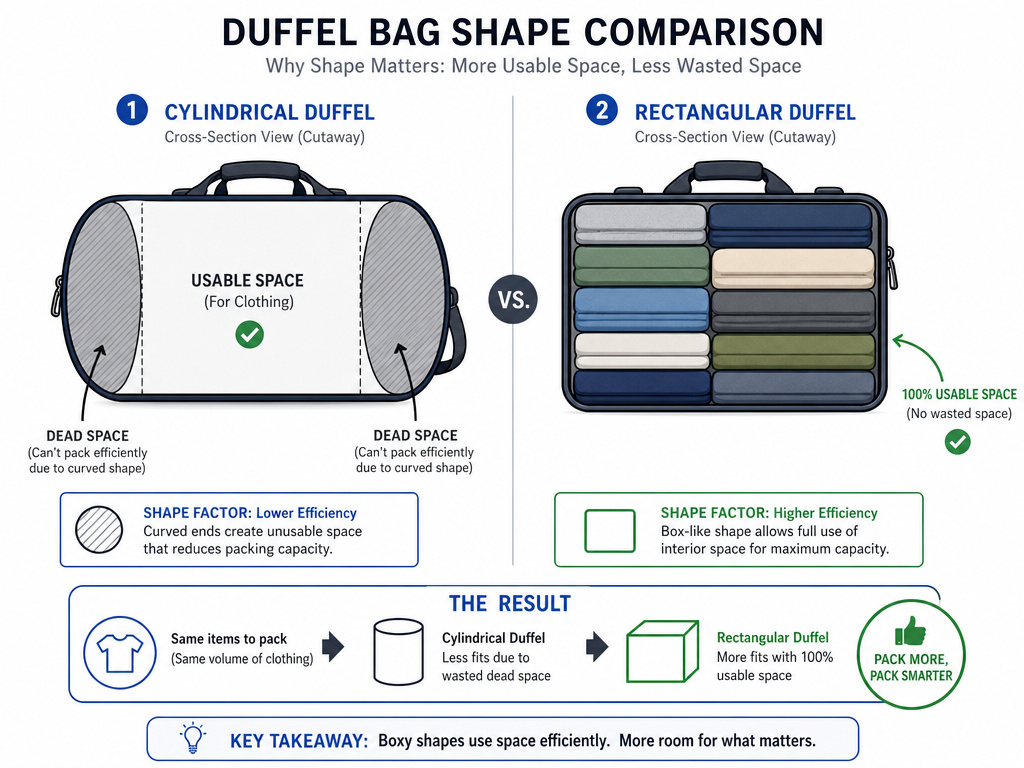
Not all duffels are simple rectangles. The shape of the bag changes how you measure it and how much it can actually hold. This is where the 0.75 shape factor from the pro estimate comes back into play.
A traditional cylindrical duffel, like an old-school hockey bag, has a lot of “dead space” at the ends when packed with rectangular items like folded clothes or boxes. Its calculated volume might be high, but its usable space is lower. A rectangular, box-shaped duffel like the EVERGOODS Transit Duffel uses space more efficiently for organized packing a duffel bag.
Style features also distort dimensions: * Wheeled Duffels: The frame and wheels add permanent length and height. A wheeled duffel’s “length” is almost always the measurement from the ground to the top of the retracted handle. This can add 3-5 inches instantly. * Backpack Duffels: This creates a measurement paradox. When carried as a duffel, the bag’s “length” is horizontal. When worn as a backpack, that dimension becomes the “height.” Airlines measure based on how the bag presents when placed in the sizer, usually upright. You must know which orientation the manufacturer used for their listed dimensions. * Tapered Ends: Many modern duffels taper at the ends for a sleeker look. This reduces the actual packable volume at the top and bottom, further widening the gap between marketing liters and real capacity.
The takeaway? The simpler the shape, the more honest the L×W×H math will be. The more features and curves, the more you should discount the marketed liter size.
Sizing for Your Need: From Gym to Globe-Trotting
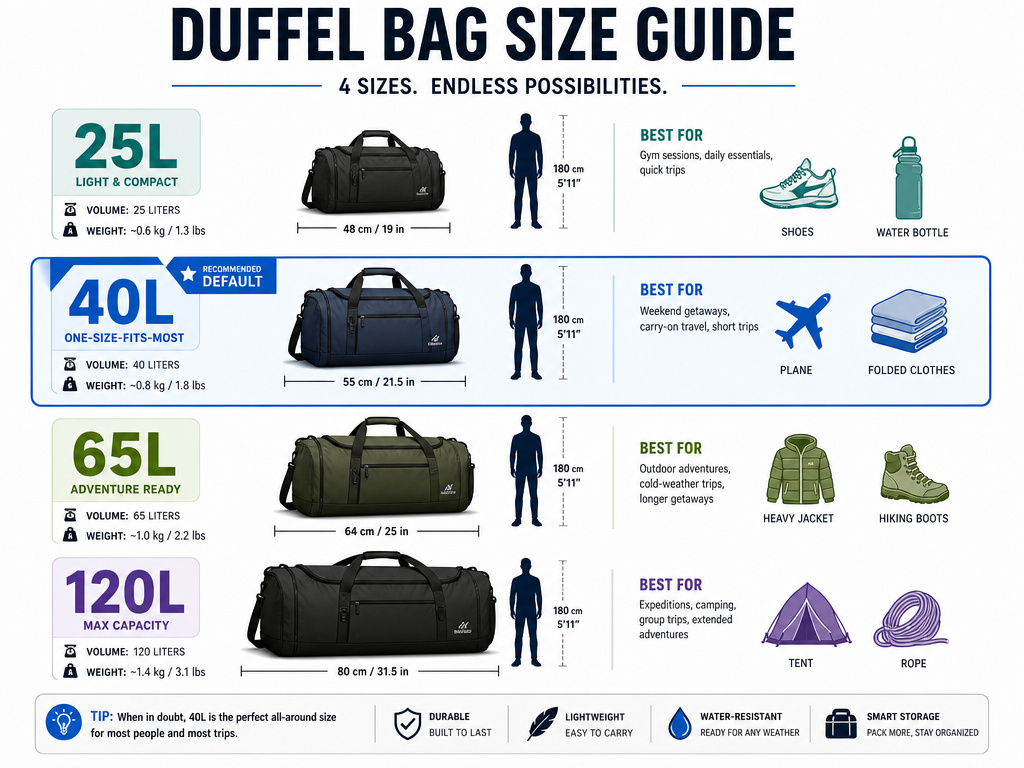
Choosing the right size isn’t about getting the biggest bag. It’s about matching the duffel bag uses you actually have. Here’s how to break it down by scenario.
For the Gym or Sports (20L-30L):
You need a bag that fits in a standard locker, has a separate vented compartment for shoes, and is easy to carry. A 25L bag is ample. The key is organization, not raw volume. Look for a designated shoe pocket and a small compartment for keys, phone, and wallet.
For Weekend Trips (35L-45L):
This is the goldilocks zone. A 40L duffel can hold everything for a 3-4 day trip with careful packing. This is the size that doubles as a duffel as carry-on for most airlines. The Eagle Creek No Matter What 40L or the Osprey Arcane WP 40 are benchmarks here. They’re designed to max out carry-on dimensions while offering solid organization.
For Week-Long Travel or Checked Baggage (50L-65L):
When you need to pack bulkier items like boots, a heavy jacket, or multiple pairs of shoes, step up to a 55L or 65L bag. The Osprey Arcane WP Duffel 65 is a perfect example, it’s built for checked luggage, with a waterproof TPU coating and robust lash points. At this size, weight distribution becomes critical; overpack a 65L duffel and it becomes a back-breaking haul.
For Expedition or Moving Gear (70L+):
These are not for clothes. A 70L to 120L duffel is for gear: camping equipment, climbing ropes, scuba gear, or seasonal clothing storage. The Carhartt 120L Foundry Duffel is a beast meant for brute-force hauling, not nimble travel. At this scale, durability, like the 1200D polyester and abrasion-resistant base, is the primary feature.
So, what’s the one-size-fits-most answer? For the majority of people who want one bag for gym, weekend trips, and air travel, a 40-liter duffel is the default. It’s the intersection of useful capacity and real-world portability.
Frequently Asked Questions
Is a 40L duffel bag carry-on size?
Usually, yes. A well-designed 40L duffel like the Eagle Creek No Matter What or Osprey Arcane WP 40 is built to common carry-on limits of approximately 22 x 14 x 9 inches. However, you must verify the external dimensions including all handles. A soft-sided 40L duffel that’s slightly overstuffed can often compress to fit.
How do you calculate duffel bag volume in liters?
For a rectangular bag, measure the internal length, width, and height in centimeters. Multiply them together (L x W x H) and divide by 1000. This gives you the “marketing” volume. For a more honest estimate, multiply that result by 0.75 to account for curves and fabric. For a cylindrical bag, use the formula: π × (Diameter/2)² × Length / 1000.
What is the difference between a 55L and a 65L duffel bag?
The 10-liter difference is about one full packing cube or a bulky item like a winter jacket or hiking boots. A 55L duffel is typically the maximum for a generous week-long trip. A 65L duffel like the Osprey model crosses into territory where it’s often too big for overhead bins and is better suited as checked luggage or for gear-intensive trips.
Can a duffel bag be too big for carry-on?
Absolutely. Airlines have sizer boxes at the gate. If your bag, including all straps, handles, and pockets, doesn’t fit, you’ll be forced to check it, often with a fee. Bags over 45 liters are at high risk. A 120L duffel bag is strictly checked baggage.
How big is a large duffel bag?
“Large” is subjective. In travel, a large duffel is often 65L-90L, meant for checked baggage. In the work/gym world, a “large” might be 40L-50L. For context, the massive UA Undeniable 5.0 Large is 101L, measuring 29.5 x 14.5 x 14.1 inches, that’s exclusively for checked baggage or moving gear.
The Bottom Line
A duffel bag’s size is a negotiation between marketing, geometry, and airline policy. The number on the tag is a starting point, not a guarantee. Ignore the simple L×W×H liter calculation, it’s a fantasy. Look for brands that reference the ASTM F2153 standard or, at minimum, provide detailed external dimensions.
For travel, your bible is the airline’s carry-on size limit, measured in linear inches, not liters. A 40L duffel is the most reliable traveler because it hits the capacity sweet spot while staying within common gate limits. And never forget the soft-sided advantage: a little give in the fabric can be the difference between sliding your bag into the overhead bin and paying a $75 checked bag fee.
Measure your bag from end to end, including every strap and buckle. That’s the only number the gate agent cares about.