The True Volume of a Duffel Bag vs. The Industry Standard
This post contains affiliate links. As an Amazon Associate, we earn from qualifying purchases.
The volume of a duffel bag is its internal capacity, measured in liters or cubic inches. For a rectangular bag, the industry calculates this by multiplying Length × Width × Height in centimeters and dividing by 1000. This geometric formula is a marketing standard, but it overestimates real usable space by 15–25% because it ignores curves, seams, and fabric. For a cylindrical duffel, the true formula is π × (Radius)² × Length.
That gap between the advertised number and what you can actually pack is where most buyer frustration starts. A bag labeled 50L might hold only 38L of your gear. The difference isn’t a rounding error. It’s the predictable outcome of treating a soft, tapered sack like a rigid box.
What follows is the breakdown of how volume is measured, why the standard method lies, and how to decode any spec sheet. You’ll learn the professional ASTM method, see real numbers from Osprey and Patagonia manuals, and get a table to match liter capacity to real trips.
Key Takeaways
- The standard Length × Width × Height formula treats your duffel like a perfect rectangle, overstating true capacity by 15–25%.
- For a cylindrical or barrel-shaped duffel, the correct volume is π × (Radius)² × Length. Using L×W×H here can cause a 27% overestimate.
- Manufacturer specs like “40L” are geometric volume, not usable space. Internal compression straps, fabric thickness, and curved corners steal room.
- Airline carry-on limits are based on external duffel bag dimensions, not the liter rating. A compressible 40L duffel often fits where a rigid 40L suitcase won’t.
- For trip planning: 20–30L for gym/day use, 30–50L for weekends, 50–75L+ for week-long travel or bulky gear like a karate gi and pads.
The Professional Standard vs. Marketing Math
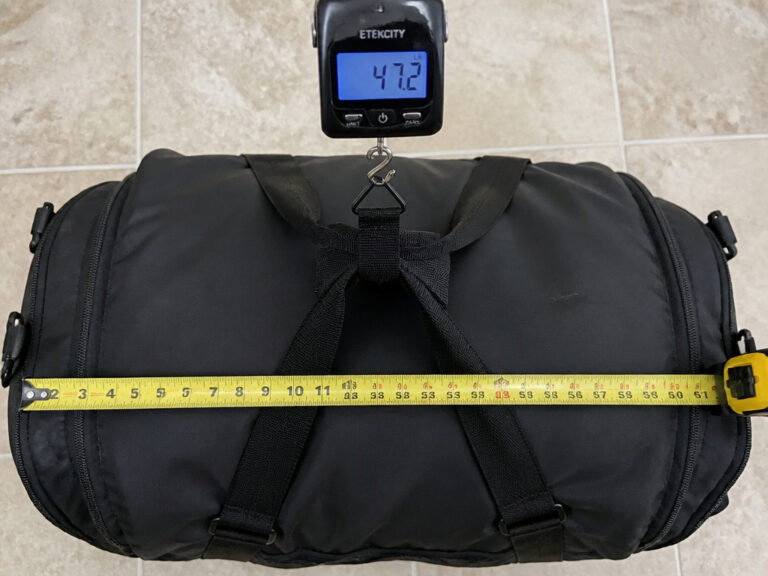
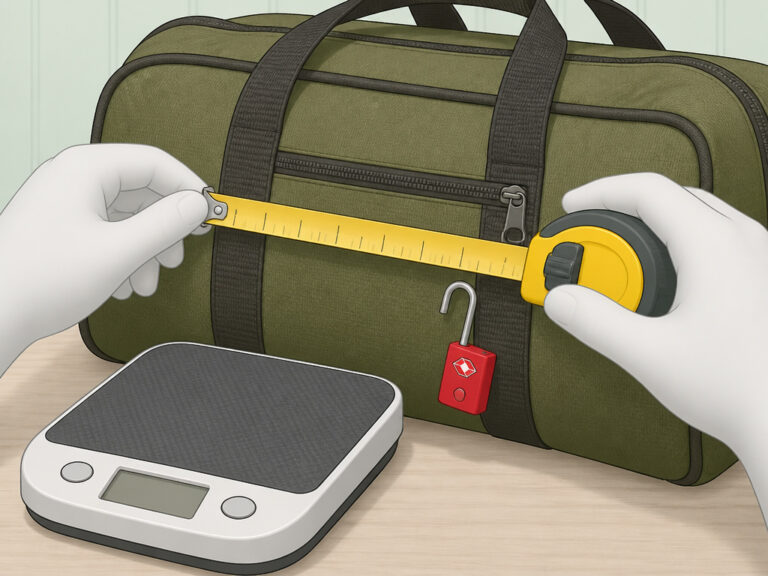
You need a flexible tailor’s tape measure. A rigid metal tape can’t follow a duffel’s curves. The official, professional method for determining true capacity is defined by ASTM F2153, the “Standard Test Method for Measurement of the Volume of a Backpack, Soft-Sided Luggage, or Duffel Bag.”
This standard involves filling the bag with standardized polystyrene balls to measure true internal displacement. It accounts for every curve, seam, and obstructed corner that a simple multiplication ignores. Brands like Patagonia note their Black Hole duffels use this ASTM method for internal capacity.
The geometric volume you see on every product page is different. It’s a simple cube math: Length (cm) × Width (cm) × Height (cm) / 1000. This is fast, consistent, and looks great in a spreadsheet. It’s also wrong.
The problem is fabric. A duffel isn’t a plastic bin. Its sides bow. Its corners are rounded. The base is padded. The zipper track and internal seams eat into the cavity. This creates “phantom volume” in the calculation—space that exists on paper but that you can’t actually fill with a pair of jeans or a packing cube.
Where this goes sideways: Trusting the geometric number for packing. If you buy a 50L duffel expecting it to hold a week’s worth of bulky winter layers, you’ll be forcing the zipper shut on day five. The bag’s true usable capacity is closer to 40L.
How Bag Shape Warps the Numbers
The L×W×H failure is most dramatic with barrel-shaped gym duffels. These are essentially cylinders, but marketers measure them as if they were rectangles.
Let’s say a barrel duffel is 55 cm long, 30 cm wide, and 30 cm tall. The geometric (marketing) volume is (55 × 30 × 30) / 1000 = 49.5L. The actual cylindrical volume is π × (15 cm radius)² × 55 cm / 1000 = 38.9L.
That’s a 27% overstatement. The customer thinks they’re getting a 50L bag. The real capacity is under 40L. This is why a “large” duffel can feel disappointingly small when packed.
| Bag Shape | Correct Volume Formula | Why L×W×H Fails |
|---|---|---|
| Rectangular | (L × W × H) / 1000 | Still overestimates by 15%+ due to fabric, seams, and structure. |
| Cylindrical (Barrel) | π × (Radius)² × Length / 1000 | L×W×H treats cylinder as a box, adding massive phantom volume. |
| Tapered | Complex; requires water-displacement test (ASTM F2153). | Simple multiplication cannot account for the variable cross-section. |
Decoding Manufacturer Spec Sheets
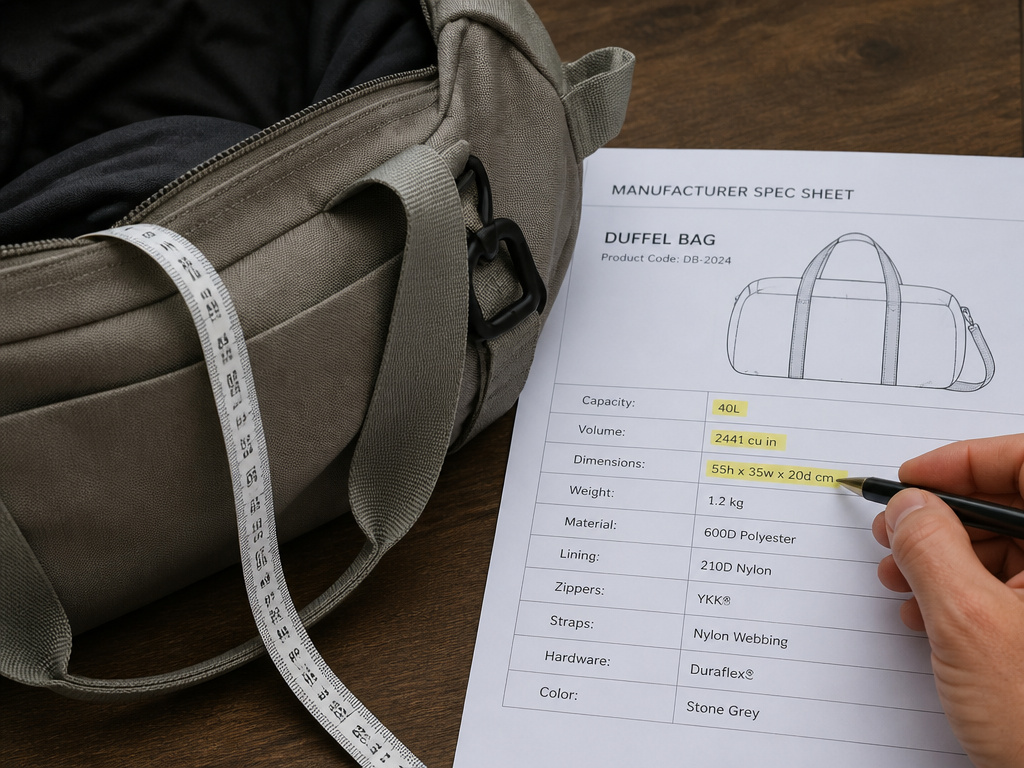
Brands provide the numbers, but they rarely explain them. Here’s how to read a spec sheet like the ones from Osprey and Patagonia in our research.
First, identify which volume they’re listing. Is it “internal volume” or “external dimensions converted to liters”? Look for a note like “Volume is calculated using the industry standard ASTM method,” which Patagonia uses. That’s the good stuff—it’s closer to truth. Most others just give you the geometric math.
Second, look at all three metrics: Liters, Cubic Inches, and Dimensions. They tell a complete story. – Liters: The volume metric used worldwide for comparison. – Cubic Inches: The imperial volume unit (1 liter = ~61 cubic inches). Often used in North American specs. – Dimensions (H x W x D): The external measurements in inches or cm. These decide airline compliance, not the liter count.
Common mistake: Comparing only the liter ratings of a duffel and a hard-sided roller. The duffel’s compressibility means a 40L duffel can fit in a smaller overhead bin than a 40L suitcase. Always check the external dimensions against your airline’s sizer.
Let’s look at real data. The Osprey Arcane WP Duffel 40 specs show 40 liters, 2441 cubic inches, and dimensions of 55h x 35w x 20d cm. The Patagonia Black Hole Duffel 40L lists 2,441 cu in and 19.7″ x 12.5″ x 8.5″. Notice the cubic inches match exactly. That’s the geometric number. Their external dimensions differ slightly due to design, but the underlying volume calculation is the same industry math.
The part nobody mentions: Those dimensions are for the empty bag. A fully packed duffel will bulge, easily adding an inch to each measurement. If you’re cutting it close for a carry-on, add 1-2 inches to the length and 0.5-1 inch to the height when mentally checking it against airline limits.
What Does 40 Liters Actually Hold?
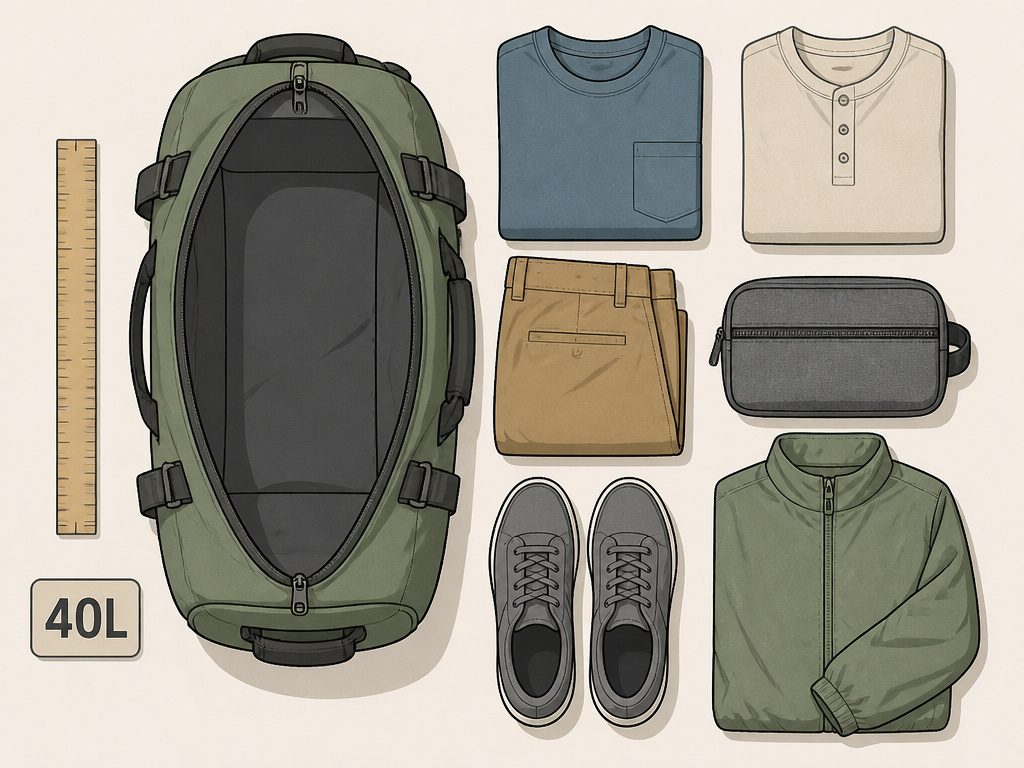
A number without context is useless. Here’s what common capacities translate to in real-world packing.
20–30 Liters (Gym & Day Bag)
This is a compact duffel or a large tote. It holds a change of clothes, shoes, a full toiletry kit, a towel, and a water bottle. It’s perfect for the gym, a day at the pool, or as an under-seat personal item. The OGIO Crunch Duffel at 41L (3,744 cu in) is at the top end of this range, good for gym gear with room to spare.
30–50 Liters (Weekend & Carry-On Standard)
This is the most versatile range. A 40L bag, like the Patagonia Black Hole 40L or Osprey Arcane WP 40, handles a weekend trip: 2-3 outfits, a second pair of shoes, a dopp kit, and a lightweight jacket. Most bags under 45L are carry-on compliant, but you must verify dimensions. This is also the capacity many travelers find ideal for minimizing checked bag fees by using a duffel bag as a personal item.
50–75+ Liters (Extended Travel & Gear Hauling)
This is large duffel territory. A 55-liter duffel bag like the Patagonia Black Hole 55L (3,356 cu in) works for a week-long trip or for carrying bulky, low-weight items. Think winter coats, sleeping bags, or sports gear.
The karate gear problem: A Reddit user in r/ManyBaggers needed a bag for a heavyweight gi, pads, and a water bottle. They found a standard duffel became lopsided and annoying. The solution isn’t just volume—it’s structure. A 40-50L backpack/duffel hybrid with external compression straps and a water bottle pocket solves this. The volume must be paired with the right design.
At the top end, a 120-liter duffel bag is for expedition travel, moving bulky soft goods, or checked luggage on long voyages. It’s unwieldy when full but maximizes capacity for non-fragile items.
How to Verify Volume Before You Buy
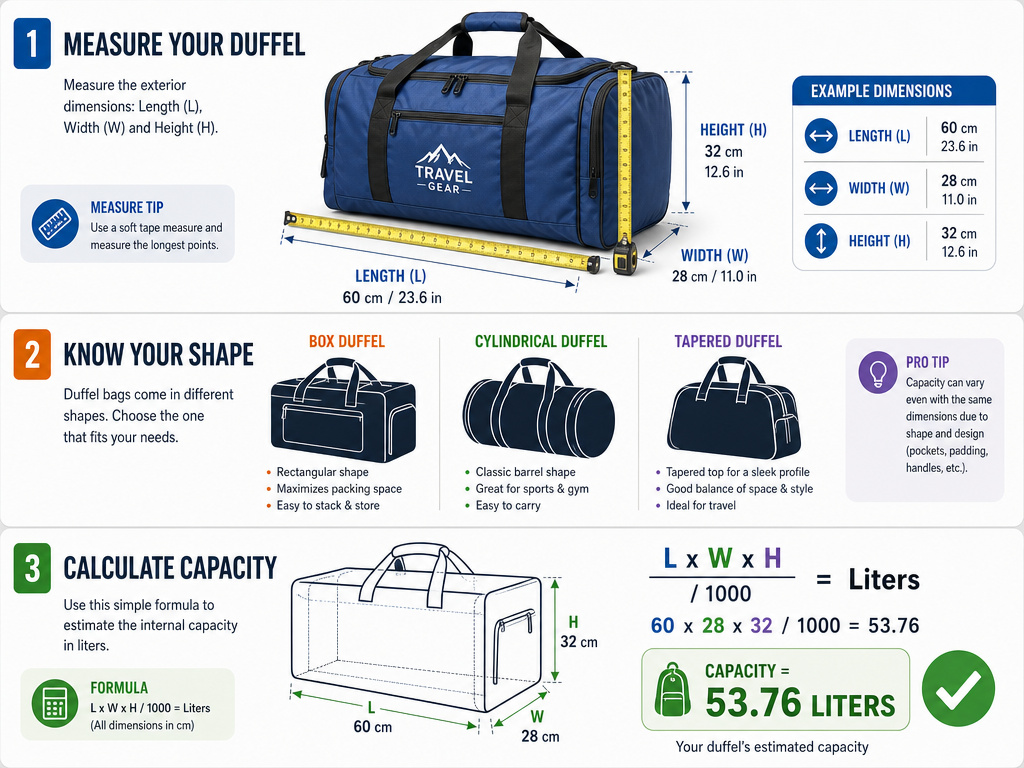
You can’t trust the marketing number alone. Use this three-step check to predict real capacity.
- Find the External Dimensions. If only liters are listed, search for the spec sheet. Get the Height, Width, and Depth in inches or centimeters.
- Assess the Shape. Look at product photos. Is it a rectangular box, a soft sausage, or a tapered barrel? Rectangular shapes will be closer to their geometric claim. Cylindrical shapes will hold far less.
- Do the Reverse Calculation. For a rectangular bag, take the dimensions in cm, multiply L×W×H, and divide by 1000. Does it match the advertised liters? If yes, it’s geometric volume. Now mentally subtract 15-20% for your usable space estimate.
For example, the Eddie Bauer Large Ripstop Duffel (EB901) lists dimensions of 26″L x 13″W x 11″D and a capacity of 62L (3,783.5 cu in). Converting to centimeters (~66 x 33 x 28 cm) and calculating gives (663328)/1000 ≈ 61 liters. The math matches. This is a rectangular design, so its usable capacity will be relatively high—but still less than 62L.
Skip this if: You’re comparing within a single brand’s line. The Osprey Arcane 40L and 65L use the same calculation method. The difference between them is real and consistent. The problem is comparing Osprey’s 40L to a generic Amazon brand’s 40L. Their measurement methods are likely worlds apart.
Volume vs. Dimensions: The Airline Carry-On Test
Airlines don’t care about liters. Their sizers measure external duffel bag dimensions: linear inches (Height + Width + Depth) or maximum individual measurements.
This is where duffels have a hidden advantage: compressibility. A soft-sided 40L duffel can be shoved into a smaller space than a rigid 40L roller. If you’re pushing the limits of a carry-on duffel bag size, a duffel is the more forgiving choice.
The 40-liter duffel bag is the sweet spot for carry-on travel. Models like the ones from Osprey and Patagonia are designed to meet the most common airline limits (around 22″ x 14″ x 9″). When packed firm, they hold a surprising amount. When half-empty, they squash down to fit under the seat.
Easy to miss: The weight of the bag itself. The Osprey Arcane 40L weighs 0.74 kg (1.64 lbs). The Patagonia Black Hole 40L is 2 lb 4.9 oz. That’s a significant difference if you’re facing a strict 7 kg (15.4 lb) carry-on weight limit. Every ounce of bag weight is an ounce less for your belongings.
Frequently Asked Questions
Is a duffel bag’s volume measured inside or outside?
The volume (in liters) refers to internal capacity. However, the standard industry formula calculates it using external dimensions. This is why the number is inflated. The professional ASTM F2153 test measures true internal space by filling the bag.
How do you calculate duffel bag volume in liters?
For a rectangular duffel, use Length (cm) × Width (cm) × Height (cm) / 1000. This gives you the geometric volume used for marketing. For a cylindrical duffel, use π × (Radius in cm)² × Length (cm) / 1000 for a more accurate number. Remember, both methods overestimate usable space.
What is a good duffel bag volume for a 3-day trip?
40 to 50 liter** duffel is the industry benchmark for a weekend trip. This capacity fits three days of clothes, a pair of shoes, and toiletries. A 40-liter duffel bag is typically carry-on compliant, making it the most versatile choice.
Why does my 50L duffel bag feel smaller than my 50L backpack?
Two reasons. First, the duffel’s volume is likely geometric, while a backpack’s volume is often measured more realistically with standardized packing cubes. Second, a backpack’s multiple compartments and compression systems make it easier to organize and utilize every bit of space, whereas a duffel is one big cavity where gear settles inefficiently.
The Bottom Line
The volume of a duffel bag is a starting point, not a guarantee. The number on the tag is a geometric fantasy. Your packing reality is 15-25% less.
Stop comparing liters across brands. Start comparing shapes and dimensions. A rectangular 40L duffel will pack more than a cylindrical 40L duffel. A compressible 40L duffel will fit in more overhead bins than a hard-sided 40L case.
For most people, the 40-50 liter range is the practical maximum. It’s the line between carry-on convenience and checked-bag bulk. If you need more space, you’re often better off with a second bag or a different packing strategy. Choose based on the trip you actually take, not the number a marketer chose.