Personal Item Rules: Can You Use a Tote Bag on Your Flight?
This post contains affiliate links. As an Amazon Associate, we earn from qualifying purchases.
Yes, a tote bag can be a personal item on virtually every airline, but only if it fits completely under the seat in front of you. The specific size limit varies: American, Delta, Spirit, and Frontier use 18 x 14 x 8 inches; United is stricter at 17 x 10 x 9 inches; Alaska allows only 6 inches of depth. A soft, pliable tote that compresses is safer than a stiff, structured one.
That “fits under the seat” clause is operational, not a suggestion. Gate agents carry metal sizers matching those dimensions, and they will use them on any bag that looks suspect. The consequences aren’t minor—on a Basic Economy fare with United or JetBlue, bringing an oversized tote means a gate-check fee plus a surcharge, totaling $65 to $75.
What follows is a breakdown of the exact numbers for 12 major U.S. Carriers, the physical realities of underseat space, and a clear guide to picking a tote that won’t get flagged when your boarding group is called.
Key Takeaways
- The rule is physical, not categorical. A tote is a personal item only if it fits in the sizer and slides under the seat. Structure is the enemy here.
- United’s 10-inch width is a trap. Most standard totes are 12-14 inches wide. A bag sold as “personal item size” often fails United’s sizer.
- Basic Economy fares change everything. On United Basic Economy and JetBlue Blue Basic, a tote is your only cabin bag. There is no overhead bin access.
- Overstuffing turns a compliant bag into a fee. A tote that fits empty will fail if bulging. Pack it, then measure it.
- Soft-sided beats structured every time. Nylon or canvas that conforms to the sizer and molds around seat obstructions is the only safe bet for multi-airline travel.
The One Rule That Beats All Others
Forget what the bag is called. The functional definition of a personal item, echoed in every airline’s contract of carriage and outlined in documents like the FAA carry-on baggage advisory circular, is a bag that stores entirely under the seat in front of the passenger. This isn’t about convenience; it’s a safety and operational mandate for cabin crew.
A personal item must be stowed such that it does not obstruct passenger movement to, from, or across the aisle. The FAA recommends carriers verify proper stowage before closing the aircraft door.
If your tote bag protrudes into the footwell or the aisle, it has failed. This is why dimensions matter, but they’re just a proxy for the real test: the underseat cavity on your specific aircraft.
Common mistake: Assuming your tote will fit because it’s “small.” The underseat space on narrow-body jets like the Airbus A320 is irregular. Metal support bars, in-flight entertainment boxes, and life-vest containers eat into the usable rectangle. A soft tote can mold around these; a structured tote with a rigid base will get stuck.
Airline Personal Item Size Limits (The Numbers That Matter)
Airlines do not agree on a standard. The published limits are your only defense against a gate agent’s judgment call. These numbers include all handles, wheels, and external pockets.
| Airline | Personal Item Size Limit (inches) | Strict Enforcement Notes |
|---|---|---|
| American Airlines | 18 x 14 x 8 | Relaxed at mainline hubs; focuses on Basic Economy compliance. |
| Delta Air Lines | 18 x 14 x 8 (unofficial, per fit) | No published limit, but this is the de facto standard for a “purse or small backpack.” |
| United Airlines | 17 x 10 x 9 | The 10-inch width is aggressively enforced, especially on Basic Economy fares. |
| JetBlue Airways | 17 x 13 x 8 | Gate agents are active on busy routes; Blue Basic fares are scrutinized. |
| Southwest Airlines | 16.25 x 13.5 x 8 | Enforcement tightened after checked bag fees were introduced in 2025. |
| Alaska Airlines | 17 x 13 x 6 | The 6-inch depth restriction is the tightest among legacy carriers. |
| Spirit Airlines | 18 x 14 x 8 | Sizers at most gates; fees are highest when paid at boarding. |
| Frontier Airlines | 18 x 14 x 8 | Most stringent of all; uses sizers consistently and charges steep gate fees. |
The difference between American’s generous 18 x 14 x 8 and United’s narrow 17 x 10 x 9 is the difference between a common tote bag and a specialty laptop bag. Most medium tote bags sold for everyday use clock in around 12 inches wide—they will not squeeze into United’s 10-inch sizer slot.
Where this goes sideways: Buying a bag based on the first airline you’re flying. If your trip involves a United leg, a tote that passes American’s gate will be rejected at United’s, triggering a fee that often exceeds the cost of a compliant bag.
Why Basic Economy Fares Are a Different Game
On a standard economy ticket, your tote is the smaller of two cabin bags. On a Basic Economy fare with United, JetBlue, or similar carriers, your tote is the only cabin bag you are permitted.
- United Basic Economy: No overhead bin access. A rolling suitcase must be checked, incurring the standard bag fee plus a $25 gate-handling surcharge.
- JetBlue Blue Basic: No overhead bin access. A gate-checked carry-on costs $65.
- Spirit & Frontier: These carriers unbundle the carry-on for all fares. Your personal item (tote) is free, but anything destined for the overhead bin costs extra—anywhere from $60 to $100 if paid at the gate.
The financial risk isn’t a checked bag fee. It’s the gate-check penalty atop that fee, applied when you’re steps from the jet bridge with no time to repack.
Tote Bag vs. Backpack: Which Makes a Better Personal Item?
This isn’t about style. It’s about geometry and gate-agent psychology.
A tote bag often has a psychological advantage. It reads as a “purse” or “personal item” to a scanning gate agent, potentially drawing less scrutiny than a backpack that looks like luggage. Its open-top design also makes last-second access to passports or boarding passes easier. However, its single-strap or dual-handle carry concentrates weight on one shoulder or your hand, and it lacks internal structure, which leads to overstuffing.
A backpack distributes weight evenly across both shoulders, a serious advantage for navigating airports. It typically uses the full height allowance of the sizer more efficiently. The trade-off is that a full backpack looks like a second suitcase, inviting measurement on strict carriers like Frontier or Spirit.
The verdict: For a short, direct flight where you need quick access to a few items, a tote is fine. For any trip involving connections, walking long terminals, or carrying a laptop, a personal item backpack is the more functional, if less stealthy, choice.
The Four Airline Size Profiles (And Which Tote Fits)
Not all 18 x 14 x 8 bags are created equal. Airlines cluster into size profiles, and your bag should target the strictest profile on your itinerary.
| Profile | Key Airlines | Ideal Tote Bag Specs | Real-World Fit Notes |
|---|---|---|---|
| Generous | American, Delta, Frontier, Spirit | Up to 18″ L x 14″ W x 8″ D | Most standard market totes fit here. Structure is less risky. |
| Mid-Size | JetBlue, Southwest, Breeze | Up to 17″ L x 13″ W x 8″ D | Needs to compress an inch in width or length. Soft sides are key. |
| Narrow | United, Contour | Max 17″ L x 10″ W x 9″ D | Standard totes fail. Look for slim “laptop tote” styles. |
| Shallow | Alaska, Allegiant | Max 17″ L x 13″ W x 6″-7″ D | Depth is the killer. Avoid puffy materials or boxy bases. |
To clear all four profiles without worry, you need a bag that targets the most restrictive dimensions: around 16 x 10 x 6 inches. That’s not a typical tote; it’s a small, slim pouch. This is why the safest strategy is to pick a soft, pliable tote made of nylon or thin canvas that can be under-packed and compressed to fit the sizer of your most challenging airline.
How to Test Your Tote Before You Fly
Don’t guess. Perform these three checks at home:
- Pack it, then measure it. Use a tape measure. Include the full extension of handles and the bulge of any packed side pockets. This is the number that matters.
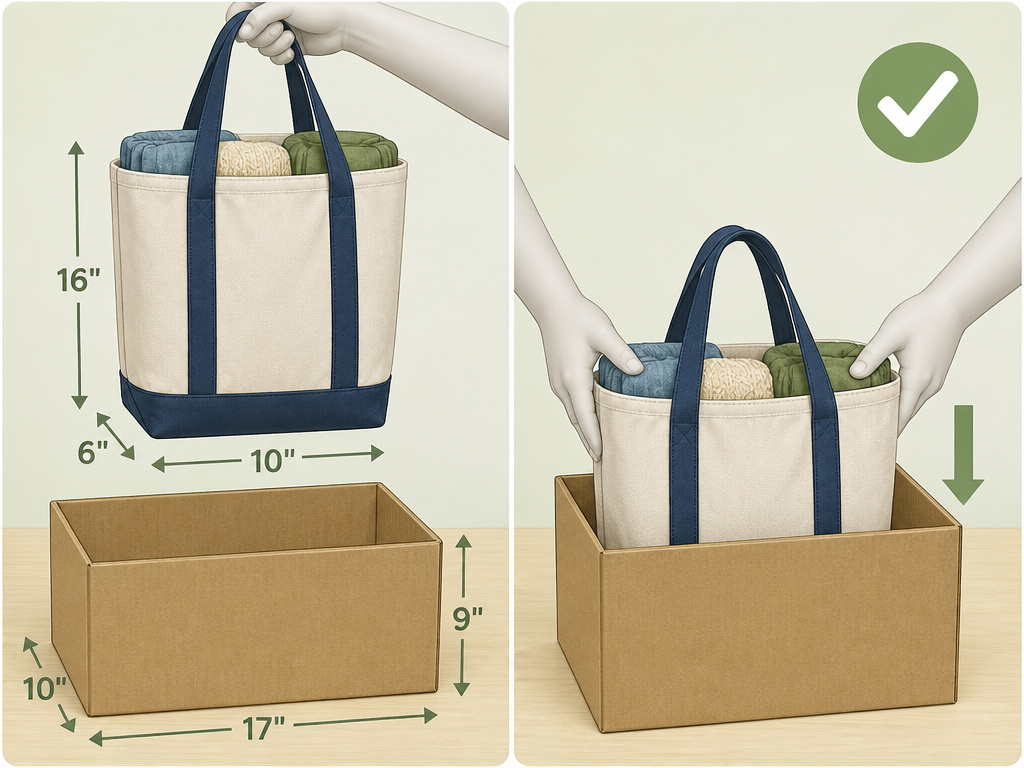
- Perform the “sizer squat.” Construct a mock sizer box using the dimensions of your strictest airline (e.g., 17 x 10 x 9 for United) from cardboard. Your packed tote must drop into this box freely without pushing or compression.
- Do the under-seat test. Slide your packed tote under a dining room chair or a similar low-clearance space. It must fit completely without you forcing it. If it sticks out, it will stick out on the plane.
Easy to miss: The length (longest dimension) on your tote might be its height when carried. The sizer bin is a fixed orientation. You can’t turn a 18-inch-tall tote on its side if the sizer is only 17 inches tall. Know which dimension is which.
Frequently Asked Questions
Does a tote bag count as a personal item or a carry-on?
Tote bag counts as a personal item if, and only if, it fits under the seat in front of you. If it’s too large and must go in the overhead bin, it becomes your carry-on bag. On Basic Economy fares that forbid overhead bags, an oversized tote will incur fees.
Can I bring a tote bag and a backpack on the plane?
Yes, but they will be classified as your personal item and carry-on combination. The tote would need to fit under the seat (personal item), and the backpack would need to fit in the overhead bin (carry-on). On fares that only allow a personal item, you must choose one.
What are the best features to look for in a travel tote bag?
Look for a soft-sided material (nylon, polyester), lightweight construction, a secure zip-top closure (not open-top), and a crossbody strap for hands-free carry. Avoid rigid frames, hard bottoms, and excessive external structure—they reduce compliance.
What if my tote bag is slightly bigger than the personal item size?
If it’s “slightly bigger,” you are at the mercy of the gate agent. Some may let it slide; most on busy flights will not. Budget airlines like Spirit and Frontier will certainly charge you. The safe assumption is that an oversized bag will be rejected, leading to a gate-check fee.
Can I use a weekender bag as a personal item?
It depends entirely on its dimensions. Many weekender bags are too tall or too deep to fit under seats. You must check its packed size against your airline’s personal item limit. A soft, compressible weekender has a better chance than a structured one.
Before You Go
A tote bag is a perfectly legitimate personal item, but legitimacy is earned at the sizer, not at the store. The label doesn’t matter—the measurements do. Before you zip it up, know your airline’s exact dimensions, understand the brutal economics of your fare class, and never assume a soft-looking bag will compress enough if it’s overstuffed.
If you want one answer for U.S. Travel: a soft, unstructured nylon tote from a brand like Longchamp or Baggu, kept half-full, is the most reliable performer across the most airlines. It molds, it compresses, and it doesn’t look like you’re trying to game the system. For anything involving United, however, double-check that width. Ten inches is a lot narrower than it sounds.