Scoliosis From a Tote Bag? How Carrying Affects Your Spine
This post contains affiliate links. As an Amazon Associate, we earn from qualifying purchases.
You cannot get structural scoliosis from wearing a tote bag. Scoliosis is a complex, three-dimensional spinal deformity with strong genetic and developmental origins. However, carrying a heavy, one-shouldered load like a tote bag creates measurable, acute postural shifts, shoulder tilt, trunk lean, spinal flattening, that can lead to muscle strain, discomfort, and may exacerbate pre-existing conditions. The risk isn’t a new curvature; it’s chronic postural stress.
That distinction between cause and contributor is the whole conversation. A bag doesn’t bend bone. It loads muscle and ligament. The body’s response to that load, especially when it’s uneven, is where the real wear happens.
What follows: the specific spinal angles that change under a 15-20% body weight load, the peer-reviewed numbers on shoulder drop and trunk lean, the critical weight threshold that separates annoyance from injury, and how to choose a bag that sidesteps the problem entirely.
Key Takeaways
- Scoliosis is structural; a bag cannot cause it. The real issue is postural stress from asymmetric loading.
- A load of 15-20% of your body weight on one shoulder creates a measurable 8° shoulder tilt and 15 mm forward trunk shift within minutes.
- The 10-15% of body weight rule (from a Polish education regulation) is a practical limit for daily carry to avoid chronic strain.
- Inactive individuals and those in critical growth periods are at higher risk for lasting postural changes from heavy bags. The fix is load management, such as switching shoulders, using a backpack, or choosing a crossbody bag.
The Short Answer: No, But Here’s What Happens
Structural scoliosis, the kind diagnosed by X-ray and monitored by orthopedists, isn’t something you acquire from your accessories. Its etiology is tied to genetics, growth patterns, and neuromuscular factors. A tote bag doesn’t make that list.
Postural effects of symmetrical and asymmetrical loads on the spines of schoolchildren (Scoliosis Journal, 2007) found that an 8 kg (17.6 lb) backpack caused an 18° reduction in lumbar lordosis (the lower spine’s inward curve) and a 19° reduction in kyphosis (the upper spine’s outward curve). The spine flattens under load as a compensatory mechanism.
What a heavy tote bag does cause is a predictable postural deviation. Your body isn’t built to carry significant weight hanging off one side. It compensates. The loaded shoulder hikes up initially, then fatigues and drops. The spine bends laterally away from the load to keep your center of gravity over your feet. Muscles on the opposite side engage in a constant, low-grade tug-of-war.
This is a lean. Holding that lean for an hour a day, every day, for years can lead to problems like scoliosis.You’re asking for a unilateral muscle imbalance, shoulder pain, and a nagging hitch in your gait that feels like a structural problem.
The Mechanics of a One-Sided Load
Forget the bag for a moment. Think about the lever. When you hang weight off one shoulder, you create an off-center force. Your body’s stability systems kick in to counteract it. The research quantifies this in millimeters and degrees.
A 2013 study in Scoliosis used a 3D scanner to measure young adults carrying 15% and 20% of their body weight on one shoulder. The changes were immediate and significant.
| Postural Parameter | Change Under 15-20% Unilateral Load | What It Feels Like |
|---|---|---|
| Shoulder Tilt | ~8°, loaded side lower | One shoulder feels slumped, shirt neckline pulls |
| Lateral Trunk Deviation | ~3 cm away from the load | A constant, subtle lean to the opposite side |
| Forward Trunk Shift | ~15 mm | A feeling of being pitched slightly forward |
| Weight Distribution | ~20% shift to loaded side | More pressure on the foot of the loaded side |
These are measured biomechanical responses published in a peer-reviewed posture analysis.Your body is an adaptive structure. It will deform under load to maintain balance. The problem starts when the load is chronic and the “deformation” becomes your default standing posture.
The lever arm matters. A tote bag with long straps lets the weight swing farther from your body’s midline, increasing the rotational force on your spine. A bag worn higher and tighter reduces this leverage.
The 10-15% Body Weight Rule (And Why It Exists)
Where does the line sit between a minor nuisance and a genuine postural stressor? Regulatory bodies have tried to draw it. The most cited benchmark comes from a Polish Minister of National Education Regulation from August 25, 2009.
The weight of pupils’ schoolbags in early school age and its influence on body posture (BMC Musculoskeletal Disorders, 2017) cites this regulation, which set a maximum schoolbag load for younger pupils at 10–15% of their body mass. The study found only 40.37% of children stayed under this 10% threshold.
This rule exists because the data shows consequences. The same study noted that in inactive children, those not engaged in regular sports, carrying overloaded bags during critical growth periods “greatly increases” the risk of serious postural abnormalities.
Let’s translate that to an adult carrying a tote bag for a laptop. If you weigh 160 lbs, 15% is 24 lbs. A 13-inch laptop, charger, notebook, water bottle, and a few sundries can hit that mark easily. Carry that on one shoulder during your commute, and you’re operating at the established risk threshold for a child’s developing spine. Your adult spine is more resilient, but the physics are identical.
The part nobody mentions: It’s not just the weight. It’s the density. A bag with a durable tote bag fabric like canvas or ballistic nylon has some structure, but if you overstuff it, the load becomes a solid, unyielding block that presses directly on your shoulder joint and scapula. A softer bag allows the weight to conform slightly, distributing pressure a bit better.
Tote Bag vs. Backpack: A Spinal Loading Comparison
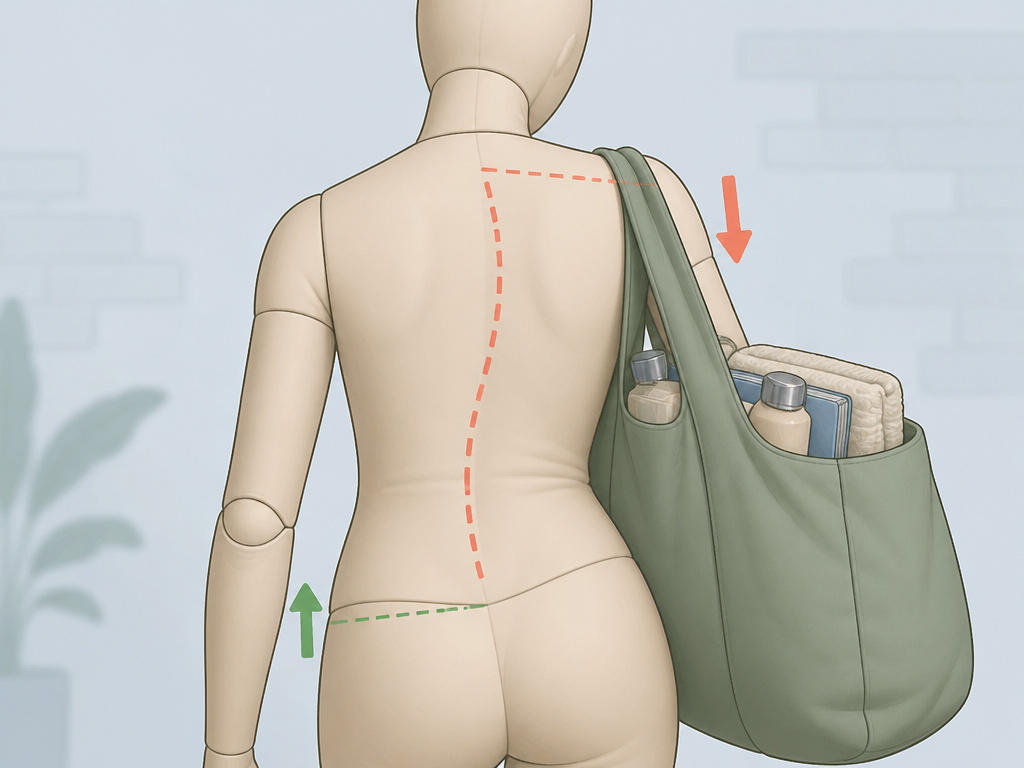
This is the core choice. Both carry stuff. They load your spine in fundamentally different ways.
A properly worn backpack with two straps is a symmetrical load. The weight is centered over your spine, close to your body’s center of mass. The research on schoolchildren shows this also causes postural change, mainly a forward lean and a flattening of the spinal curves, but it’s a balanced, midline adjustment. The muscles on both sides of your spine share the work.
A tote bag is an asymmetrical load. All the force is on one side. The response is a complex, three-part compensation: shoulder drop, lateral bend, and often a contralateral hip hike. It’s biomechanically inefficient. Your body burns more energy just staying upright.
Where this goes sideways: Carrying a heavy tote on the same shoulder every day. Within weeks, the muscles on your loaded side (trapezius, levator scapulae) become overworked and tight. The muscles on the opposite side (latissimus dorsi, quadratus lumborum) become overstretched and weak. This imbalance itself can create a visible postural distortion that looks like a mild scoliosis, a functional scoliosis, but is actually a soft-tissue problem.
The winner for spinal health is obvious: the backpack. But life isn’t that simple. For quick trips, a lighter tote bag on the shoulder is fine. The key is managing the variables: weight, duration, and alternation.
How to Carry a Tote Bag (If You Must)
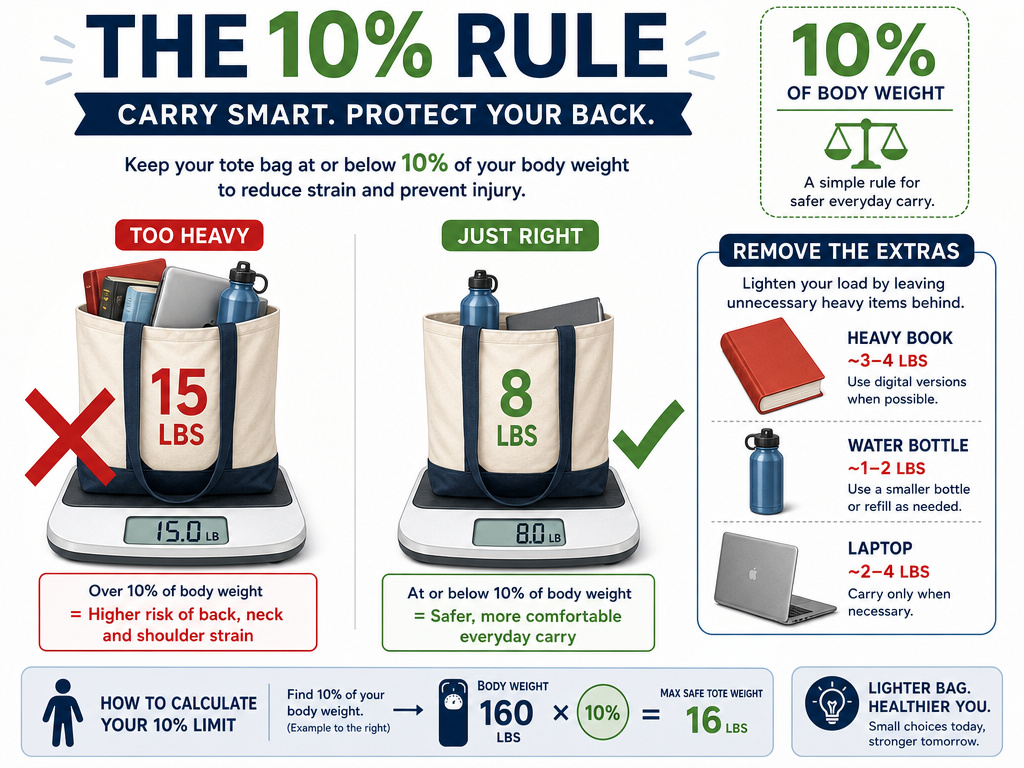
You won’t stop using totes. So use them smarter. The goal is to minimize the duration and magnitude of asymmetric loading.
- Follow the 10% Rule. Before you leave, put your bag on a scale. If it’s over 10% of your body weight, you’re in the high-stress zone. Remove non-essentials. Do you really need that hardcover book today?
- Switch Shoulders Every 10-15 Minutes. This is non-negotiable. Set a timer on your phone if you have to. Alternating sides prevents any one muscle group from locking into a fatigued, shortened state.
- Use the Crook of Your Elbow for Brief Periods. Holding a bag in the bend of your arm changes the lever arm and gives your shoulder a rest. It’s not a long-term solution, it can strain your elbow and bicep, but it’s a useful rotation in your carrying repertoire.
- Choose a Bag with a Wide, Padded Strap. A thin strap cuts into your shoulder, concentrating force on a small area. A wide, padded strap distributes the load across more of your trapezius muscle. This is a primary factor when you choose a tote bag.
- Clean It Out Weekly. Bags collect dead weight: old receipts, expired snacks, charging cables for devices you no longer own. A weekly purge keeps the baseline weight in check and helps with organizing a tote bag.
Consider a crossbody tote as a middle ground. Worn across your torso, it distributes weight between both shoulders and keeps the load centered and stable. It defeats the main purpose of a tote, quick shoulder drop, but for longer carries, it’s the ergonomic choice.
Signs You’re Carrying Too Much
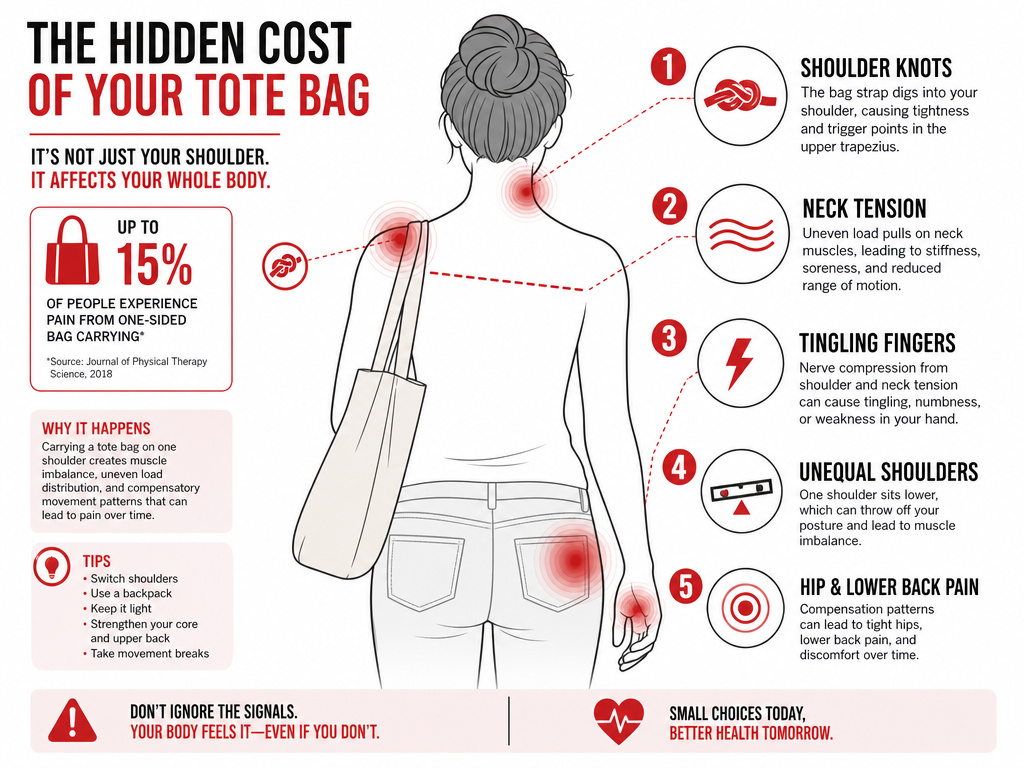
Your body sends signals long before any permanent change sets in. Listen to them.
- Achy, “Knotted” Shoulder: The classic sign of an overtaxed trapezius. The pain will be localized to the shoulder you favor.
- Neck Tightness on the Opposite Side: As your head tilts to compensate for the shoulder drop, the sternocleidomastoid muscle on the opposite side works overtime to keep your eyes level.
- Numbness or Tingling in the Fingers: This can indicate nerve compression in the brachial plexus, often from a strap compressing the area between your neck and shoulder.
- Visible Posture Change in a Mirror: Stand naturally. Does one shoulder appear significantly lower? Does your waistline look tilted?
- Hip Pain on the Side Opposite the Bag: The lateral trunk lean can place uneven stress on the hip joint and gluteal muscles.
If you experience these, the solution is load management. Reduce the weight, change the carrying method, and give the muscles time to recover.Persistent pain warrants a visit to a physical therapist or doctor to rule out underlying issues.
The Bottom Line
A tote bag won’t curve your spine. That’s a medical fact. But it will torque your posture, strain your muscles, and teach your body to stand crooked. The risk isn’t scoliosis; it’s a preventable, chronic musculoskeletal headache dressed up as a convenient accessory.
Respect the 10% weight rule. Switch shoulders relentlessly. And for anything over a few pounds, reach for a backpack. Your shoulders, and your spine, will report the difference within a week.
Frequently Asked Questions
Can a heavy purse cause scoliosis?
No. Like a tote bag, a heavy purse cannot cause the structural bone deformity of scoliosis. It can, however, create identical postural imbalances, muscle strain, and shoulder pain. The smaller strap on many purses often makes the pressure point worse.
Is it better to carry a tote bag on your left or right shoulder?
It’s better to carry it on neither shoulder exclusively. The key is alternation. If you are right-handed, you may naturally favor your left shoulder to keep your right hand free, but you must make a conscious effort to switch to the right shoulder regularly to balance the load.
How can I make my tote bag more ergonomic?
Start with a wide, padded strap. Then, organize the contents so the heaviest items (laptop, book) are placed vertically in the center of the bag, closest to your body. This centers the mass and reduces the swinging, lever-arm effect. Using a bag with more structured tote bag material can also help maintain this organization.
Do children face higher risks from heavy tote bags?
Yes, significantly. Children are in critical periods of spinal growth and postural development (posturogenesis). The early school age bag weight study emphasizes that overloaded bags in inactive children greatly increase the risk of postural abnormalities. For kids, a two-strap backpack is always the better choice.
What does the research say about long-term effects?
Long-term studies on adults specifically using tote bags are limited. The robust research exists for schoolchildren and backpacks, showing a correlation between heavy backpack use and back pain that persists into adulthood. The logical extension is that chronic, asymmetric loading from a tote bag would contribute to long-term unilateral muscle degeneration and joint wear, not structural scoliosis. A 2023 systematic review on schoolbag impact continues to underscore the importance of weight limits for postural health.