How to Crochet a Tote Bag: A Beginner’s Step-by-Step Guide
This post contains affiliate links. As an Amazon Associate, we earn from qualifying purchases.
To crochet a tote bag, you need a sturdy cotton yarn, a 5.0mm or 5.5mm hook, and mastery of three basic stitches: chain, single crochet, and slip stitch. The process builds from an oval base, works up the sides in continuous rounds, and finishes with reinforced handles. A finished, unlined bag takes about six hours.
Most first-time bag makers pick the wrong yarn. They grab a soft, fluffy acrylic because it feels nice. Two weeks later, that bag is a stretched-out sack dragging on the ground, the handles straining under a paperback’s weight. The stitch count was perfect. The tension was even. The yarn choice doomed it from the first chain.
This guide walks through the correct materials and a construction method that actually holds up. We will cover how to pick yarn that fights sag, build a base that lies flat, and attach handles that won’t stretch after one trip to the farmer’s market.
Key Takeaways
- Use 100% cotton or a cotton-blend yarn in a Medium #4 worsted weight. Acrylic and wool stretch too much for a functional bag.
- Work the first round of the sides into the back loop only (BLO). This creates a clean ridge that makes the sides stand up straight from the base.
- Reinforce handles by working them in a denser stitch than the body, like single crochet instead of half double crochet. For heavy loads, crochet over a strand of matching cotton cord.
- Always weave in ends by going back and forth through the wrong side of stitches for at least two inches. A simple knot or a short run will unravel under load.
- Block a cotton tote bag after finishing. Soak it, shape it, and let it dry flat. This evens out stitches and sets the final dimensions permanently.
The Non-Negotiable Kit: Yarn and Hook
Your hook and yarn decide the project’s lifespan before you make the first loop. This isn’t about color. It’s about fiber content and weight.
A proper tote bag yarn is inelastic and strong. That means 100% cotton or a primary-cotton blend. Lily Sugar’n Cream, Paintbox Cotton Aran, or Comfy Cotton Blend are standard picks. Cotton has minimal give. It won’t sag into a hammock shape after you carry a laptop twice. Wool and most acrylics have memory and stretch. They are terrible for bags.
The yarn weight is Medium #4, often called worsted or aran. Thinner yarns make a flimsy fabric. Thicker, bulky yarns work up fast but create a stiff, awkward bag. Stick with #4.
Hook size follows the yarn label. For #4 cotton, that’s usually a 5.0mm (H/8) or 5.5mm (I/9) hook. Go down one hook size from the label’s recommendation for a tighter, stiffer fabric. If the label says 5.5mm, try a 5.0mm. The tighter gauge makes a more durable fabric.
Before you start: Cotton yarn has no give. If you crochet with tight tension, you can develop hand fatigue or pain within thirty minutes. Stretch your hands every twenty minutes. If your stitches become hard to pull through, your hook is too small or your tension is too tight. Switch to the recommended hook size.
The 4-Step Foundation: Crocheting the Oval Base
A flat base is everything. A wobbly base means a tipping bag. We are making an oval, not a rectangle. An oval base distributes weight better and looks more professional.
Start with a foundation chain. The number determines the base length. For a standard bag, chain 21.
Step 1: Single crochet (sc) in the second chain from the hook. Work one sc in each chain across until you reach the last chain. You should have 19 sc.
Step 2: In the last chain, work 3 sc. This is the first end of the oval.
Step 3: Now you are working down the other side of the foundation chain. Work one sc in each chain across. You will have another 19 sc.
Step 4: In the final chain (the same one you started with), work 2 sc. Slip stitch (sl st) to the first sc of the round to join.
Count your stitches. You should have 42 total sc (19 + 3 + 19 + 1? Wait, let me check my own notes). Actually, it’s 19 on the first side, 3 in the end, 19 on the second side, and then 2 in the starting chain to complete the oval. That’s 43 stitches. The exact count matters less than a flat oval. If it cups like a bowl, your increase stitches are too tight. If it ruffles, they’re too loose.
A flat, sturdy base (oval or rectangular) is the structural foundation for a functional tote bag. Working increases at each end with three single crochets prevents the base from curling and allows the finished bag to stand upright when set down.
Here is the stitch count for the first two rounds to keep you on track:
| Round | Total Stitches | Key Action |
|---|---|---|
| Foundation | 43 sc | 3 sc in each end chain to form oval shape. |
| Round 2 | 49 sc | 2 sc in each of the 3 end stitches from Round 1. |
TL;DR: Chain 21, sc around with 3 sc in each end chain to form an oval. The base must lie perfectly flat before moving on.
Building the Sides: The Back-Loop Trick
This is where the bag becomes a bag. The first round of the sides is the most important round you will crochet.
Chain 1. Instead of inserting your hook under both loops of the stitch from the previous round, insert it only under the back loop. Work a single crochet in the back loop only (BLO) of every stitch around. Place a stitch marker in the first stitch of this round.
Working in the back loop creates a distinct ridge. That ridge is not just decorative. It acts like a hinge, allowing the sides to pop up at a 90-degree angle from the base. If you work under both loops, the sides tend to slope inward.
After the BLO round, continue working in continuous rounds. Do not join with a slip stitch at the end of each round. Simply move your stitch marker up to the first stitch of each new round and keep going. This creates a seamless, spiral side with no visible seam line.
How many rounds? For a bag about 12 inches tall, work 15 to 20 rounds of single crochet. Stop every few rounds and lay the work flat. The sides should be straight and even. If they are flaring out, you are adding stitches. If they are bowing in, you are missing stitches.
Common mistake: Not using a stitch marker in continuous rounds — you will lose your place within three rounds, your stitch count will drift, and one side of the bag will be visibly taller than the other.
Crafting Strong, Comfortable Handles

Handles are the load-bearing component. They fail first. A single chain of double crochets looks cute but will stretch into uselessness under a bag of groceries.
You have two good options: a simple reinforced handle or a comfort-grip handle. We will make the simple one first.
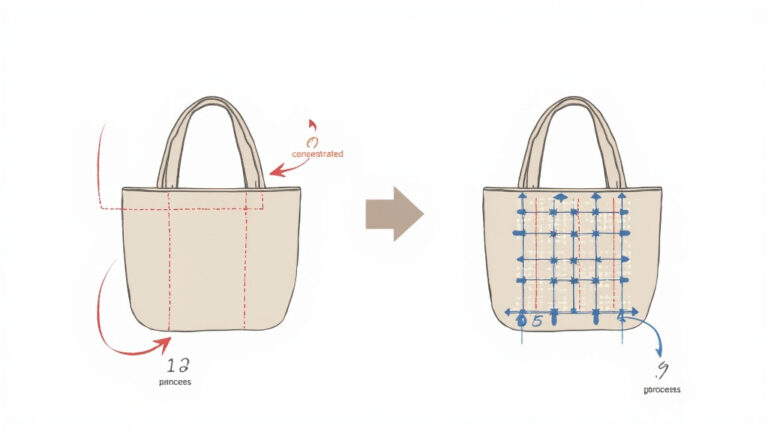
Find the center front of your bag. Count 15 stitches to the left and place a marker. Count 15 stitches to the right of center and place another marker. The space between is where the bag opening will be; you will attach the handle outside these markers.
Step 1: Join yarn with a slip stitch at the first marker. Chain 30. This chain is the foundation for the handle.
Step 2: Skip the 15 stitches across the bag opening. Slip stitch into the 16th stitch (at the second marker).
Step 3: Chain 1, turn your work. Work 30 single crochets into the chain you just made. This creates a dense, non-stretchy handle.
Step 4: Slip stitch into the bag edge to secure. Fasten off. Repeat the entire process on the opposite side of the bag for the second handle.
Why single crochet? It’s the densest, least elastic basic stitch. A handle made of half-double or double crochet will elongate. For a comfort grip, crochet a tube. Make your foundation chain, then work single crochets in a spiral around it for 4-5 rounds before attaching the other end. It takes longer but molds to your hand.
| Handle Type | Best For | Risk If Skipped |
|---|---|---|
| Single Crochet Strip | Light to medium daily loads | Can dig into shoulder with heavy weight. |
| Tubular Single Crochet | Heavy loads, comfort | Adds significant time; can be bulky. |
| Fabric-Wrapped | Maximum durability | Requires sewing skills; adds non-crochet element. |
TL;DR: Attach yarn, chain 30, skip 15 bag stitches, and join. Then fill the chain with 30 single crochets for a strong, simple handle.
The Professional Finish: Weaving, Blocking, and Lining
The last ten percent of the project determines whether it looks handmade or homemade.
Weaving in ends is non-negotiable. Do not just knot and cut. Use a yarn needle. Run the tail through the wrong side of the stitches for at least two inches in one direction, then double back for an inch. This locks the end in place with friction. A knot can come undone. A short tail can pop out.
I once gave a tote as a gift without properly weaving the handle ends. The recipient called a month later with a handle hanging by a thread. The end had worked loose just from the normal swinging motion of carrying. I now spend more time weaving ends than I do crocheting the final round.
Blocking is what gives a cotton bag its final shape. Soak the finished bag in lukewarm water for twenty minutes. Gently press out the water—do not wring. Lay it flat on a towel, shape it into a perfect rectangle, and pin the corners if needed. Let it air dry completely. This process relaxes the fibers, evens out any tension inconsistencies, and sets the size.
Adding a lining is the final upgrade. It hides the inside of your crochet work, adds structure, and creates pockets.
- Turn your bag inside out. Place it on a piece of fabric (cotton quilting fabric works well).
- Trace around the bag, adding a 1/2-inch seam allowance on all sides. Cut two identical pieces.
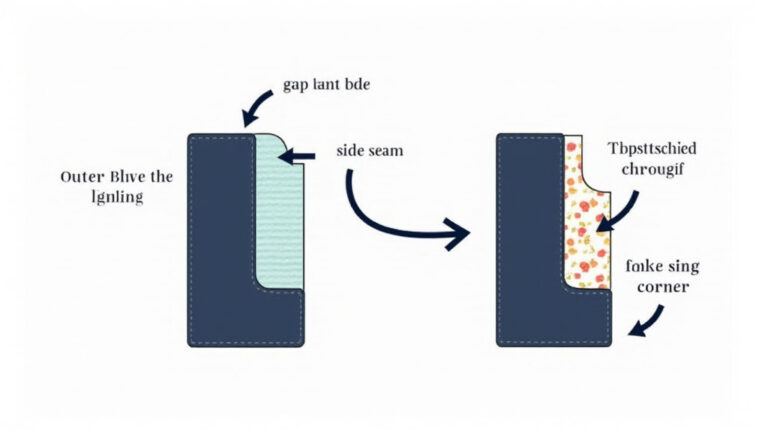
- With right sides together, sew around the sides and bottom. Leave the top open.
- Drop the lining inside the bag. Fold the top raw edge under 1/2 inch and pin it to the top edge of the crochet bag, just below the handles.
- Slip stitch the lining in place by hand with a needle and thread.
The lining transforms the bag. It prevents small items from poking through stitches and makes the interior easy to clean. For a detailed walkthrough, our guide on making a lined tote bag tutorial covers fabric choices and sewing techniques.
Troubleshooting Common Crochet Bag Problems
Your bag is done. It looks… off. Here are the likely fixes.
Problem: The bag won’t stand up. It flops over.
Cause: The base is too small relative to the height, or the yarn is too soft.
Fix: You can’t fix this now. Next time, use a stiffer cotton and make a wider base. For this bag, a lining will add some structure.
Problem: The handles are stretching dramatically.
Cause: The stitch is too loose (like double crochet) or the yarn is acrylic.
Fix: You can reinforce from the outside. With a matching yarn, single crochet a tight round around the entire existing handle. Or, sew a strip of strong webbing to the underside of the crochet handle.
Problem: There’s a visible “step” or seam line on the side.
Cause: You joined rounds with a slip stitch instead of working in a continuous spiral.
Fix: Embrace it as a design element, or next time work in continuous rounds. You can sometimes minimize it by working the first stitch of the new round in a different way, but it’s a fundamental trait of joined rounds.
Problem: The sides are wavy or ruffled.
Cause: You accidentally increased stitches in some rounds.
Fix: Blocking can help smooth minor waving. For severe ruffling, you might have to carefully undo the last few rounds and rework them with the correct stitch count. This is why counting every few rounds is critical.
Understanding these issues helps you plan better next time. For instance, knowing that a basic tote bag needs a wide base prevents the flop. Learning about common tote bag materials helps you avoid stretchy yarn.
Frequently Asked Questions
What is the easiest stitch for a crochet tote bag?
The single crochet (sc) is the easiest and best stitch for a beginner’s tote. It creates a tight, dense fabric with minimal holes. Half-double crochet (hdc) works up faster and is still sturdy, but it has more stretch. Start with single crochet.
How much yarn do I need to crochet a tote bag?
For a medium-sized bag (approx. 12″ tall x 15″ wide) using worsted weight cotton, you will need 300-400 yards. This is typically 1 to 2 skeins of yarn like Lily Sugar’n Cream. Always buy an extra skein if you are unsure—running out mid-project with a dye lot change is frustrating.
Can I use acrylic yarn to crochet a tote bag?
You can, but you shouldn’t for a bag meant to carry weight. Acrylic yarn stretches permanently under load. A full acrylic tote will sag and the handles will elongate after a few uses. If you must use acrylic, hold two strands together to reduce stretch and pair it with a non-stretchy lining.
How do I make my crochet tote bag bigger or smaller?
To make it bigger, increase the starting foundation chain for a longer base, and add more rounds to the sides for more height. To make it smaller, shorten the foundation chain and work fewer rounds. Always make a small gauge swatch first to calculate your stitches per inch; this tote bag dimensions guide explains how to plan final size.
How do I clean a crochet cotton tote bag?
Most cotton totes are hand-wash only. Use cold water and mild detergent, gently swish, then rinse. Press out water in a towel and block to dry flat. Do not machine wash or dry unless the yarn label explicitly says you can. For long-term care, follow general washing a tote bag principles.
Before You Go
Crocheting a tote bag teaches you more than stitches. It teaches construction. You learn how a flat base supports a three-dimensional form, how handle attachment points bear stress, and how fiber choice dictates function.
Your first bag might have a wobbly base or a handle that’s slightly too long. That’s fine. The second one will be square. The third one will be the bag you reach for every day. The real goal isn’t a single perfect tote. It’s understanding the mechanics well enough to customize your next one—maybe adding internal tote bag organization pockets or experimenting with a reversible tote bag design.
Grab a skein of cotton and a hook. Make the oval base. Feel the ridge form on the first round of the sides. Take your time on the handles. The process is straightforward once you know which rules not to break.