Your Guide on How to Make a Durable Tote Bag with Lining
This post contains affiliate links. As an Amazon Associate, we earn from qualifying purchases.
To make a tote bag with lining, you need three things: an outer fabric, a lining fabric, and a planned escape route. Sew the outer bag and lining separately, box the corners for depth, leave a 4-6 inch opening in the lining’s bottom seam, then join them right sides together at the top. Turn the whole assembly right side out through that lining hole, push the lining inside, and close the gap. The structure comes from your fabric and interfacing choices, not the steps.
That last sentence is the whole game. A bag sewn perfectly from quilting cotton will sag under a paperback’s weight. The steps are just the sequence; the materials decide whether you get a grocery hauler or a laundry-day sack.
What follows is the mechanical breakdown most tutorials skip: how to calculate lining size when you’ve cut boxed corners, which interfacing turns limp fabric rigid, and the one forgotten step that anchors the lining so it stops climbing out every time you reach for your keys.
Key Takeaways
- Forget the turning gap once, and your bag is a sealed tube. The Ageberry tutorial author locked a lining inside a bag seven years ago and still remembers the feeling. Leave a 4-6 inch opening in the lining’s bottom seam. It’s your only way back out.
- Interfacing is non-negotiable for structure. Skip it, and your bag flops. For a stand-up tote, use a medium to heavy-weight fusible like Pellon Decor Bond or a sew-in stabilizer like Annies Soft and Stable.
- Calculate lining size based on finished bag depth. For a boxed corner, the Linda Matthews formula is: lining width = bag width + 1 inch; lining length = bag length + (bag depth / 2) + 1/2 inch. Guess wrong, and the lining strains or bunches.
- Anchor the lining corners to the outer bag. After turning the bag right side out, hand-stitch the boxed corners of the lining to the seams of the outer bag. This stops the lining from shifting and ballooning inside.
- Topstitching is a functional finish. A line of stitching 1/8 inch from the top edge after assembly locks the seam allowance flat and gives the bag a professional look. It also prevents the lining from peeking out.
The Fabric & Interfacing That Actually Hold Shape
Most tutorials list “medium-weight cotton” and leave it there. That’s a floppy bag waiting to happen. The fabric’s hand-feel in the store tells you nothing about how it will behave with a gallon of milk inside.
Canvas and denim are the default picks for a reason. Their tight weave and heavier weight provide inherent structure without extra steps. A 10-ounce cotton canvas tote will stand upright on its own. Duck cloth is a slightly lighter cousin that works well for softer totes. For a more polished look, upholstery fabric has the body but can be tricky to sew through multiple layers.
Where this goes sideways: Using quilting cotton alone. A single layer feels sturdy in your hands, but it lacks memory. The bag sides will bow outward under load, and the bottom will sag after a few uses. It needs a companion.
That companion is interfacing. Think of it as the bag’s skeleton. Fusible interfacing is ironed onto the wrong side of your fabric, adding stiffness. The weight determines the effect.
| Interfacing Type | Best For | Feel & Outcome |
|---|---|---|
| Lightweight Fusible | Quilting cotton, lining-only | Adds minimal body, prevents lining from clinging to outer bag. Bag remains soft. |
| Medium (Pellon Decor Bond) | Most cotton, linen, light canvas | The sweet spot. Provides noticeable structure for a stand-up tote without rigidity. |
| Heavyweight Fusible | Canvas, duck cloth, structured totes | Creates a very rigid, boxy shape. Can make sewing thick seams difficult. |
| Sew-in (Annies Soft & Stable) | Bags needing padding (tablet pockets) | Adds cushioned structure without adhesive. Must be basted or pinned before sewing. |
The VickyMyersCreations DIY tote uses Annies Soft and Stable for the outer body and heavyweight fusible for the lining. That combination yields a bag with serious presence. If your machine groans at thick layers, switch to a denim needle and slow down.
Your lining fabric isn’t just for looks. It takes abrasion from everything you carry. A dark-colored quilting cotton or a sturdy broadcloth hides dirt and wears longer than a light, delicate print. The lining is also your chance to add personality that peeks out when the bag is open.
Calculating Your Pieces: No Pattern Required
You don’t need a printed pattern to make a tote bag. You need four measurements: desired finished height, width, depth, and seam allowance. Everything else is simple math.
First, decide on your finished size. A standard grocery tote is about 16 inches tall by 14 inches wide. A smaller everyday bag might be 13 by 15 inches. Write these numbers down.
Now, add seam allowance to get your cut fabric dimensions. The seam allowance is the extra fabric you’ll consume inside the seams. A 1/2-inch allowance is common and forgiving for beginners.
Cutting Formula:
- Outer Fabric (cut 2 pieces): (Finished Width + 1 inch) by (Finished Height + 1 inch)
- Lining Fabric (cut 2 pieces): Use the same formula as the outer fabric unless you are adding boxed corners for depth.
Boxed corners change the game for the lining. The outer bag’s corners get cut and sewn to create a three-dimensional base. If your lining is a simple rectangle, it won’t fill that new space—it will bunch at the bottom.
For bags with boxed corners – width = width of bag plus 1″; length = length of bag, plus depth of bag ÷ 2, plus 1/2″.
This formula from Linda Matthews is the fix. If your finished bag is 14 inches tall with a 4-inch deep boxed corner, your lining length isn’t 14.5 inches. It’s 14 + (4/2) + 0.5 = 16.5 inches. That extra length accommodates the bag’s new depth.
Straps are next. A comfortable over-the-shoulder strap is about 24 inches long before finishing. For hand-carry, 20 inches is ample. Cut strap fabric strips at 4 inches wide. After folding and sewing, they’ll finish to a sturdy 1.5 inches wide.
Proportions in Action:
- Basic Tote (SeeKateSew): Outer pieces: 17″ x 14″. Boxed corner cutouts: 2″. This yields a bag approximately 15″ tall x 13″ wide x 4″ deep.
- Structured Tote (VickyMyersCreations): Outer pieces: 16″ x 12.25″. Finished bag: 15″ tall x 10.5″ wide x 4″ deep.
Write your final cut dimensions on a piece of painter’s tape and stick it to your sewing machine. This prevents mid-project amnesia.
The 6-Step Assembly Sequence (and Where It Breaks)
The process is a logical sandwich. You build the outer shell and the inner lining separately, then join them at the end. Deviating from the order is how you sew a bag shut forever.
Sew the outer bag. Place the two outer pieces right sides together. Pin along both sides and the bottom edge. Sew with your chosen seam allowance (e.g., 1/2 inch). Do NOT sew the top edge. This creates a fabric tube. Repeat this exact process for the lining pieces, but with one critical difference: leave a 4-6 inch gap in the bottom seam. This is your turning gap. Mark it with pins.
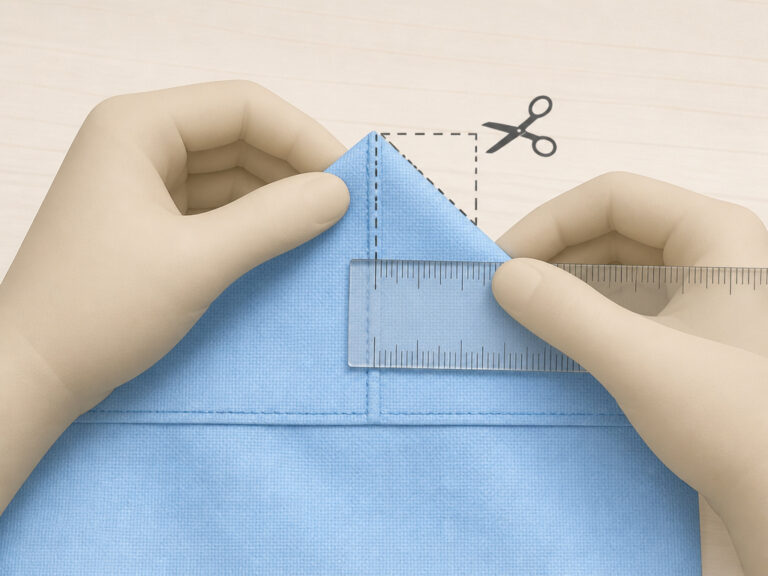
Box the corners. This step creates the bag’s gusset or depth. Flatten one bottom corner of your outer bag tube so the side seam aligns with the bottom seam, forming a point. Measure from that point along the seam the depth you want (e.g., 2 inches) and mark a perpendicular line. Sew across that line. Cut off the corner triangle, leaving a 1/2 inch seam allowance. Repeat for the other corner. Do the same for the lining, including boxing the corners of the lining tube.
The last time I made a tote bag was seven years ago, which is apparently long enough for this critical step to fall out of my brain entirely. So I happily sewed the lining into a perfect, sealed tube and admired my work… right up until I remembered that bags do not turn themselves inside out through sheer determination.
Attach straps. Turn your outer bag right side out. Position your finished straps on the right side of the outer bag, aligning the raw ends with the top edge. Place them 3-4 inches in from each side seam. Baste them in place within the seam allowance. This sandwiches them later.
Join outer and lining. Turn the outer bag wrong side out again. Take your lining (which should still be wrong side out) and slide it over the outer bag. The right sides of the outer fabric and lining should now be facing each other. Match the side seams and align the top edges. The straps are tucked inside the sandwich. Pin generously all the way around the top.
Sew and turn. Sew around the entire top edge with your seam allowance. Trim the seam allowance down to 1/4 inch and clip the curves. Now, reach through the turning gap you left in the lining’s bottom seam. Pull the entire bag through this hole, turning it right side out. Use a blunt tool like a chopstick to push out the corners gently.
Close and finish. Push the lining down into the outer bag. Press the top seam flat. Topstitch 1/8 inch from the edge all the way around—this seals the seam and gives a pro finish. Finally, turn the bag inside out again just enough to access the lining’s turning gap. Fold the raw edges in, pin, and stitch it closed by machine or hand.
Why Your Lining Bunching or Climbing Out (And How to Fix It)
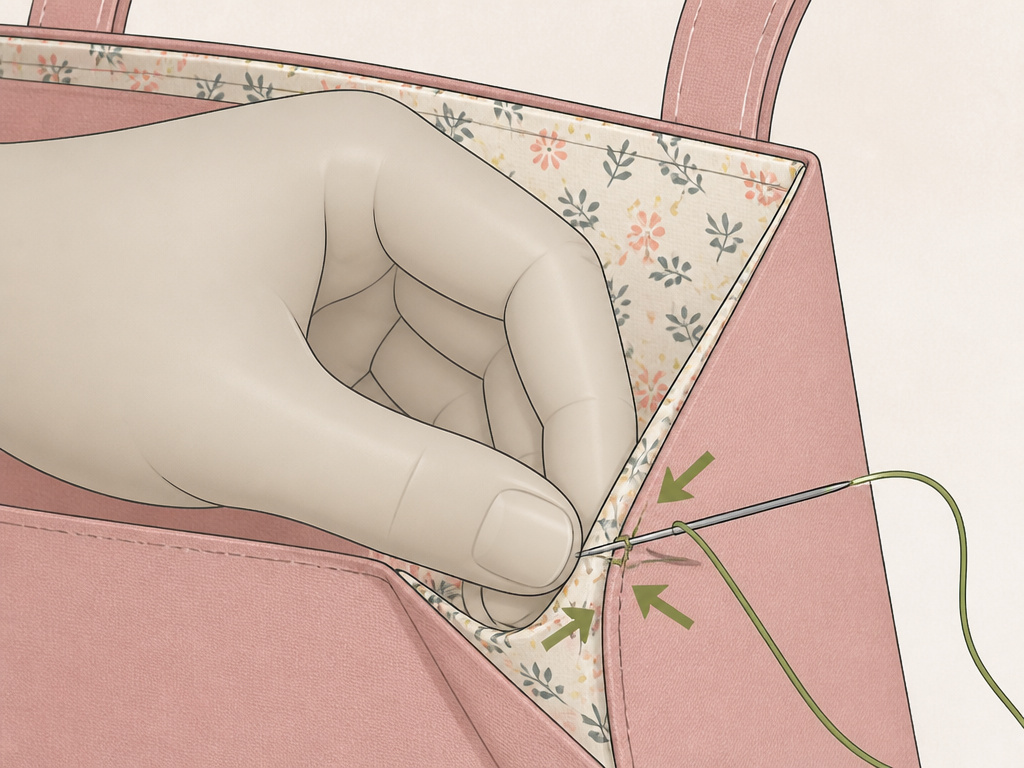
A floating lining is the most common annoyance in a DIY tote. You pull out a notebook, and the lining comes with it, bunching at the top. This happens when the lining is simply dropped in, a free agent inside its shell.
The cause is a size mismatch and a lack of anchors. If the lining is too large, it billows. If it’s too small, it pulls at the seams and distorts the bag’s shape. The Linda Matthews calculation fixes the size.
The anchor is a physical tether. After you’ve turned the bag right side out but before you topstitch, reach inside and feel for the boxed corner seams of the outer bag and the lining.
Both the outer bag and the lining already have boxed corners. By stitching those corners together at the seam allowance, you quietly anchor the lining to the bag. Nothing shifts. Nothing balloons.
Use a hand-sewing needle and thread. Make three or four small, tight stitches to join the lining’s corner seam to the outer bag’s corner seam. Do this for all four corners. This tiny bit of effort is the difference between a bag that feels homemade and one that feels store-bought.
For bags without boxed corners, you can add a single anchor stitch at the center of each side seam, about 2 inches down from the top. This prevents the lining from riding up.
Adding Pockets: The Feature That Makes a Bag Useful
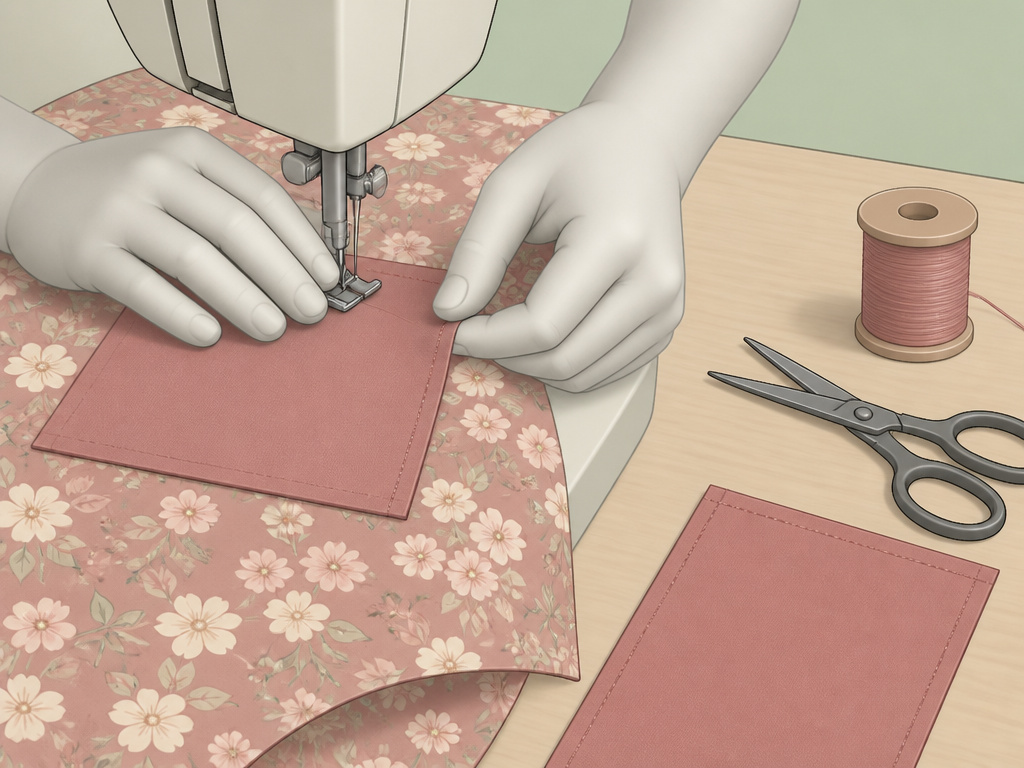
A tote without a pocket is a black hole. You’ll spend minutes digging for your phone at the bottom. Integrating pockets into the lining is straightforward and happens early.
Slip Pockets: Cut a rectangle of lining fabric. A good size is 8 inches wide by 10 inches tall. Fold the top edge down 1/2 inch, press, fold down another 1/2 inch, and stitch to create a clean hem. Fold the entire piece in half right sides together, sew the sides, turn right side out, and press. Position it on the right side of one lining piece, 4-5 inches down from the top edge. Edgestitch the sides and bottom to the lining, reinforcing the top corners with backstitching.
Zippered Pockets: These are more advanced but far more secure. The VickyMyersCreations tutorial uses a method where you cut a window in the lining fabric, attach the zipper from the front, and then construct a pocket bag behind it. If you’re new to zippers, practice on a scrap first. An 8-inch zipper is a manageable length.
Attach all pockets to the lining pieces before you sew the lining pieces together. Once that lining tube is sewn, it’s too late.
Canvas vs. Cotton: Which Fabric Wins for Your Project?
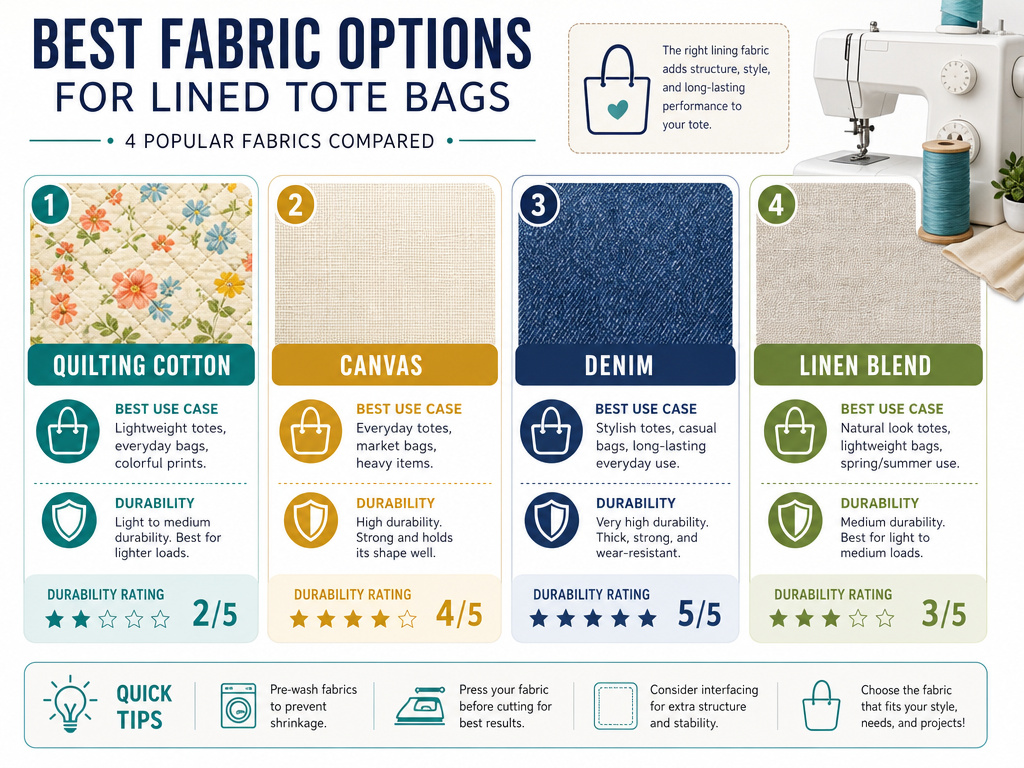
Your fabric choice dictates the bag’s lifespan and its best use. This isn’t an aesthetic preference; it’s a durability rating.
| Fabric | Best Use Case | Structure Needed | Durability |
|---|---|---|---|
| Quilting Cotton | Lightweight everyday bag, gift totes | Medium to heavy interfacing | Moderate. May fade or wear at stress points. |
| Canvas (10oz+) | Grocery bags, library totes, work bags | Light to medium interfacing | High. Withstands heavy, abrasive loads. |
| Denim | Casual, rugged everyday bag | Often needs none | Very High. Breaks in softly over time. |
| Linen Blend | Summer bag, farmer’s market tote | Medium interfacing | Moderate. Wrinkles, develops a soft drape. |
For a first project, a mid-weight cotton canvas is the most forgiving. It’s easier to sew than stiff denim, holds its shape better than quilting cotton, and doesn’t require perfection. A canvas tote bag is the workhorse of the handmade bag world.
If you want to experiment with texture, a quilted tote bag adds padding and visual interest. The quilting process itself adds a layer of stability.
The bottom line: match the fabric to the bag’s job. Don’t make a beach bag from quilting cotton, and don’t make a delicate gift bag from heavy canvas.
Frequently Asked Questions
What is the easiest way to make a tote bag with lining?
The easiest method is the “bag-in-a-bag” technique outlined in this guide. Sew the outer shell and lining as separate tubes, box the corners, then join them at the top. Turning the whole assembly right side out through a gap in the lining is the simplest way to get a clean, fully enclosed finish. For absolute beginners, start with a simple tote bag without a lining to master the basics first.
How much fabric do I need to make a lined tote bag?
For a basic tote measuring roughly 15″ x 14″, you will need about 1/2 yard of outer fabric and 1/2 yard of lining fabric. This allows for two body pieces and straps. Always buy a little extra, especially if your fabric has a directional pattern that requires matching.
Can I make a tote bag without a sewing machine?
You can, but it is labor-intensive. Hand-sewing a tote bag with a strong backstitch is possible, especially with lighter fabrics. However, sewing through multiple layers of canvas and interfacing by hand is challenging. The topstitching and strap attachment also benefit greatly from a machine’s consistent tension. For a true hand-sewn project, consider a basic tote bag without a lining.
What is the purpose of interfacing in a tote bag?
Interfacing adds body, structure, and durability. It prevents the fabric from stretching out of shape, helps the bag maintain its form, and provides a more professional feel. Without interfacing, most woven fabrics will become floppy and sag under weight. It’s the secret to making a homemade bag look store-bought.
How do I fix a lining that is too big for my tote bag?
If the lining is already sewn in and is billowing, you can add anchor stitches. Turn the bag partially inside out to access the interior. At each bottom corner, pinch the excess lining fabric and hand-sew a small dart to take up the slack. Then, secure the lining corners to the outer bag’s seams as described in the anchoring section. For your next project, use the lining calculation formula to cut the correct size.
Can I add a zipper to a lined tote bag?
Yes, but it’s an intermediate step. The most integrated method is to install the zipper in the lining’s top seam before joining the outer bag and lining. Alternatively, you can add a zipper to the top of the finished bag as a separate panel. For a dedicated guide, see our tutorial on adding a zipper to a tote.
Before You Go
Making a lined tote bag boils down to planning the escape route. Cut your pieces with the lining formula in mind. Iron on your interfacing before you sew a single seam. Leave that gap in the lining. Anchor the corners.
The difference between a frustrating project and a satisfying one is often one forgotten step. Now you know which step that is. Your next bag won’t have a floating lining or a floppy base. It’ll be the one you grab every time.
Want to try a different style? A reversible tote bag is a clever next project that teaches you about clean finishes. Or, personalize your creation by learning how to decorate a tote bag with stamps, patches, or embroidery.