How to Know if a Tote Bag is Real: Spot Fakes in 5 Steps
This post contains affiliate links. As an Amazon Associate, we earn from qualifying purchases.
To know if a tote bag is real, you need a nine-point forensic checklist. The process hinges on verifying specific, expensive-to-replicate details: heat stamp typography, material texture, stitching density, hardware engraving, leather quality, lining, zipper construction, shape, and the correct date code or RFID chip. No single detail confirms authenticity; the combination of all nine checkpoints passing is what matters.
This checklist exists because luxury totes are among the most counterfeited items on earth. Modern “superfakes” replicate materials and even fake serial numbers, making a casual glance useless. The game changed in March 2021 for one major brand, turning a standard verification step on its head.
What follows is the same process used by professional authenticators. We’ll break down the measurable details fakes consistently get wrong, from the symmetry of a stamped letter “S” to the exact thread count on a handle. By the end, you’ll know what to photograph and where to look.
Key Takeaways
- Authenticating a luxury tote is a forensic process, not a glance. You must check at least nine specific physical details in combination.
- For Louis Vuitton bags, the rule flipped in March 2021: new bags should have an invisible RFID microchip, not a date code. A date code on a post-March 2021 bag is a definitive sign of a counterfeit.
- Goyard bags use a unique 9-digit serial code (3 letters + 6 numbers). The middle four numbers are the year, and the code must use one of Goyard’s approved three-letter prefixes like “BAE” or “PIR”.
- On a Marc Jacobs “The Tote Bag”, the most reliable check is the underside stitching. Authentic bags have thread that sits flush and neat; fakes have bulky, raised stitching that feels rough.
- For any high-value purchase or resale, a professional photo-based authentication service like Entrupy or Real Authentication is non-negotiable. An authenticated bag can command 20-40% more on the resale market.
The 9-Point Forensic Checklist: How Professionals Authenticate
Forget just looking at the monogram pattern. Modern authentication is about examining the bag’s microscopic DNA, the tiny, costly details counterfeiters miss or get wrong consistently. You need good light, maybe a magnifying glass, and to go point by point.
The first and most telling stop is the interior leather label or heat stamp. On a genuine bag, this is a deep, crisp engraving pressed with industrial precision. The font is balanced. You’re looking for three specific failures in fakes.
The letter “S” is a major technical hurdle. On fakes, the bottom loop is often visibly thicker. A genuine Louis Vuitton “S” is perfectly symmetrical from top to bottom. Next, look at the “i” in “LOUIS”. On an authentic stamp, the dot is a distinct, separate element. If it’s fused to the stem, it’s an immediate red flag. Finally, check for inconsistent font weight. Letters like “V” or “O” should have uniform thickness. Replicas often show one side of a “V” that is thinner, making the text look unstable.
Common mistake: Relying on the monogram alignment alone. Superfakes now replicate pattern placement perfectly. The heat stamp’s typography is a harder, more expensive detail to forge and fails more consistently.
Stitching, Hardware, and Leather: The Devil in the Details
If the heat stamp passes, move to the construction. This is where cheap labor and inferior materials become visible.
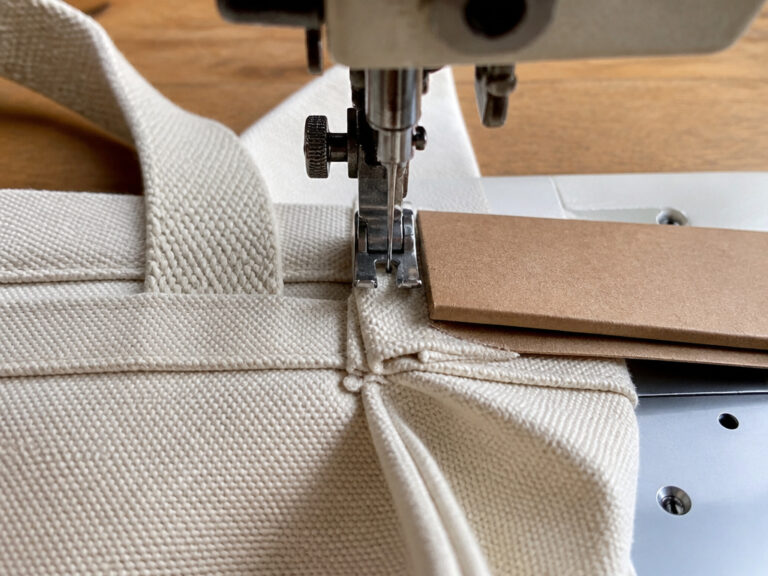
Stitching should be tight, straight, and even. Count the stitches per inch on a handle attachment point. Authentic bags often have a specific, dense stitch count (e.g., 8-10 stitches per inch). Fakes use longer, thinner stitches with visible gaps. The thread should match the bag’s color perfectly and sit flush with the material, not raised.
Hardware should feel substantial, not lightweight or hollow. Zipper pulls, clasps, and feet should have crisp, deep engravings of the brand name, not laser-etched or painted-on lettering that wears off. The zipper itself should glide smoothly; brand-specific models like YKK or Lampo are common in authentic pieces.
Leather tells a vivid story. For brands like Louis Vuitton that use untreated Vachetta leather, the patina is critical. New, pale Vachetta on a supposedly vintage bag is a red flag. Authentic leather develops a rich, honey-colored patina over time. Feel it, it should be supple, not plasticky or stiff.
| Checkpoint | Authentic Sign | Fake Sign |
|---|---|---|
| Stitching | Dense, even, flush threads; specific stitch count. | Long, uneven, loose stitches; thread sits raised. |
| Hardware | Substantial weight; crisp, deep engravings. | Light, hollow feel; shallow or painted engravings. |
| Leather (Vachetta) | Untreated, develops a natural honey patina over time. | Stays pale; feels coated, plasticky, or artificially darkened. |
| Bag Structure | Holds shape; model-specific “pout” or stance. | Collapses inward; distorted, boxy proportions. |
The Louis Vuitton Date Code vs. RFID Transition
This is the single most important timeline in modern luxury authentication. Before March 2021, Louis Vuitton bags had a date code stamped on a leather tab inside a pocket. The format was two letters (factory code) followed by four numbers (week and year of production).
In March 2021, Louis Vuitton switched exclusively to embedded, encrypted RFID microchips. Any Louis Vuitton bag made after this date should not have a date code.
To authenticate a post-March 2021 Louis Vuitton bag, you need an NFC-enabled smartphone. Download a free NFC reader app and hold your phone to the bag’s interior seams. If it detects a chip, that’s correct. The app will not show data, that’s encrypted for LV boutiques only. Crucially, high-end superfakes now include counterfeit RFID chips, so a chip alone proves nothing.
This means for a real Louis Vuitton bag made today, the absence of a date code is correct. Finding one is a definitive sign of a counterfeit. This timeline is a non-negotiable part of any Louis Vuitton tote authentication.
Decoding Goyard: Serial Numbers and Approved Letters

Goyard uses a different system. Authentic Goyard bags are stamped with a 9-digit serial code: three letters followed by six numbers (e.g., BAExxxx21). The middle four numbers (positions 4-7) correspond to the year of manufacture. The first and last numbers correspond to the month.
The code is typically found on the leather strap of the interior pochette, the lip of the lining, or a leather tab inside a pocket. The stamp must be neat, centered, and crisp.
Goyard uses a specific, short list of approved three-letter prefixes. Legitimate codes include “BAE,” “MAE,” “PIR,” “AAS,” “ARO,” “BAL,” “ABA,” “ADM,” “SUT,” “VAE,” and “SAL.” A code starting with an unapproved letter combination is a fake.
The bag’s construction is also a tell. Authentic Goyard Saint Louis totes come in two strict sizes: PM (34x15x28 cm) and GM (40x20x34 cm). They are hand-made and hold a structured, upright shape. A bag that flops over or is a non-standard size is suspect.
The Marc Jacobs Underside Stitching Check
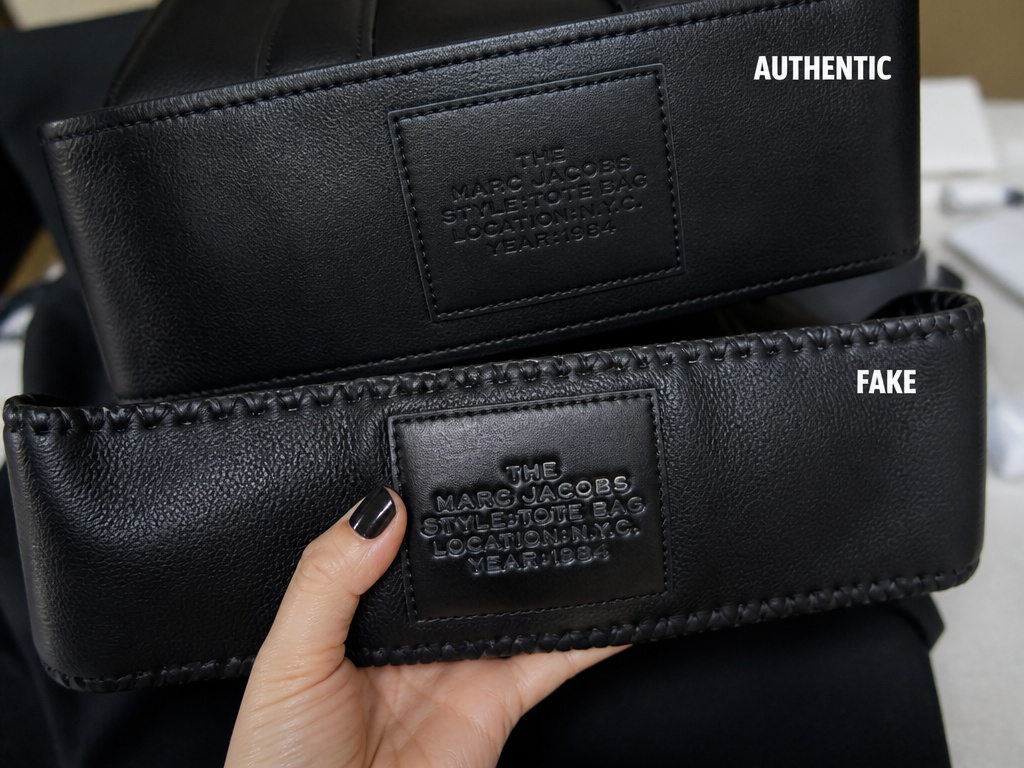
For the popular Marc Jacobs “The Tote Bag,” avoid getting distracted by the bold exterior logo. The most reliable check is on the bottom.
Flip the bag over. Authentic Marc Jacobs totes have stitching where the thread sits flat and tight against the leather, creating a clean seam. On fake versions, the threads are chunkier and sit raised above the surface, making the bottom feel rough to the touch. This is a subtle but consistent fail in replicas.
Also check the rear label. On real bags, the “MARC JACOBS” text is pressed deeply into the leather, it feels engraved. On fakes, the letters look puffy and oversized because they aren’t stamped deep enough, feeling flat or painted on.
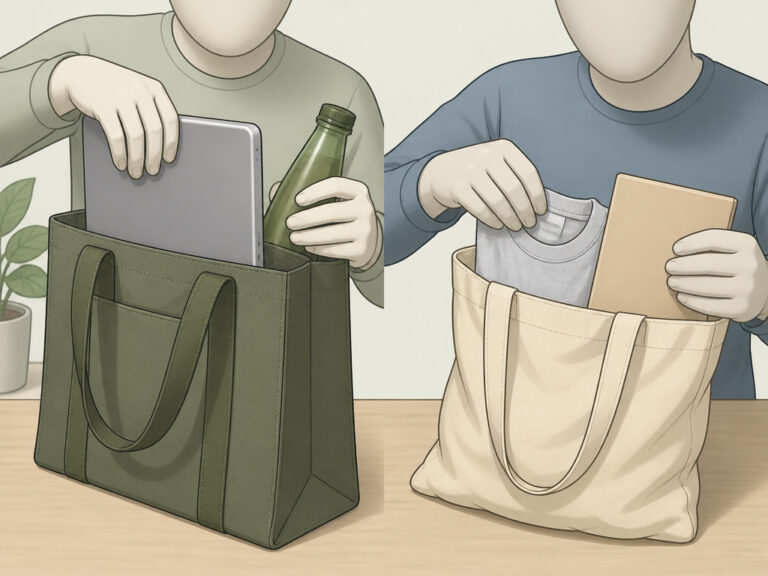
When you’re trying to choose a tote bag for daily use, understanding these construction details helps you assess quality far beyond the brand name. The same scrutiny you’d apply to a canvas tote bag‘s seams applies here, just at a luxury level.
Lining, Zippers, and Shape: The Final Verification Points

The interior lining is model-specific and often a dead giveaway. For example, Louis Vuitton bags in Damier Ebene canvas are lined with a specific red microfibre (Alcantara). A fake might use a cheap red cotton or the wrong color altogether. Feel the lining, it should be high-quality and consistent with the brand’s known materials.
The zipper construction matters. Look at the zipper tape (the fabric part). It should be sturdy, often branded, and the stitching attaching it to the lining should be perfect. The slider should have clean, sharp edges and may feature a branded stamp.
Finally, assess the bag’s shape and proportions. A genuine luxury tote is structured. A Louis Vuitton Neverfull has a slight, structured “pout” at the sides. Cheap replicas often collapse inward or have distorted, boxy proportions. Compare the bag’s silhouette side-by-side with a verified photo from the brand’s website.
These elements, like the right tote bag fabric, are about integrity. A fake compromises on the interior and structure to cut costs, and it shows.
When to Call a Professional Authenticator
You can follow every step and still have doubt. That’s normal. For any high-value purchase, investment, or resale, professional authentication is not an extra step, it’s a requirement.
Services like Entrupy (which uses microscopic imaging AI) or Real Authentication (photo-based human experts) exist for this gray area. For a fee, they provide a definitive verdict and a certificate. This is especially critical for online secondhand purchases from platforms like The RealReal or Vestiaire Collective.
Worth knowing before you start: An authenticated bag can command 20 to 40 percent more on the resale market. The cost of the service is often a fraction of that premium and is essential insurance against a four-figure mistake.
If you’re unsure, the professional route is the only route. The peace of mind and financial protection are worth it. This diligence is similar to understanding proper tote bag care, it’s an investment in longevity and value.
Frequently Asked Questions
What’s the first thing I should check on a tote bag?
Start with the interior brand stamp or heat stamp. Examine the typography closely, look for a symmetrical “S”, a separate dot on the “i”, and uniform font weight. This is a high-difficulty detail for counterfeiters and often fails before you even check the stitching.
Do all real designer bags have a serial number?
No, and the systems vary. Louis Vuitton uses date codes (pre-2021) or RFID chips (post-March 2021). Goyard uses a 9-digit alphanumeric serial code. Other brands may have leather tags, metal plates, or embossed codes. Some contemporary brands have no serial number at all, relying on other construction details for authentication.
Are authenticity cards and dust bags proof a bag is real?
No. These are the easiest items for counterfeiters to replicate. A fake bag almost always comes with a fake card and dust bag. Their presence means nothing; their absence on a pre-owned bag also doesn’t prove it’s fake, as they are often lost.
Can a store clerk authenticate my bag?
Brand boutique clerks are typically prohibited from providing formal authentication opinions for liability reasons. They can tell you about current features but won’t examine your bag and give a yes/no answer. Always use a dedicated, independent professional service.
How much does professional authentication cost?
Fees vary by service and bag value, but typically range from $15 to $50 for a standard photo-based authentication. Entrupy’s device-based service has different pricing tiers. This cost is minimal compared to the price of the bag and the potential loss from buying a fake.
Why is the stitching such a big deal?
Stitching is a direct reflection of manufacturing quality and labor cost. Authentic bags are often hand-stitched or use specialized machines that produce tight, even, consistent stitches. Fakes use lower-grade machines and cheaper thread, resulting in longer, looser, uneven stitches. It’s a physical signature of the factory that made it.
The Bottom Line
Knowing if a tote bag is real requires moving past the logo and into the forensics. Match the heat stamp typography, count the stitches, feel the leather, and know the brand’s specific serial system, especially the March 2021 RFID rule for Louis Vuitton.
Use the nine-point checklist. If any point fails, walk away. For any serious purchase, budget for a professional authentication certificate, it’s the only way to be sure. Your eye can learn the details, but for real money, get the paper.
Frequently Asked Questions
What is the most common mistake people make when trying to spot a fake tote bag?
The biggest error is relying on a single, obvious feature like the logo pattern from a distance. Modern superfakes replicate these broad visuals convincingly. Authenticity is determined by a combination of minute, manufacturing-specific details that are expensive and technically difficult for counterfeit operations to perfect consistently.
Why can’t I just rely on the serial number or date code to verify authenticity?
Counterfeiters often copy valid serial numbers and stamp them onto fake bags. For some brands, the format and placement of these codes are critical. Notably, a major brand changed its system in 2021, so a bag featuring an outdated code type is an instant fake, proving that codes alone are not reliable without cross-referencing other checkpoints.
Are there any quick physical tests I can perform on a tote bag?
While no single test is definitive, examining the quality of the stitching and hardware offers fast clues. Run your fingers along the stitching; authentic bags have even, flush, and dense stitching. Check zipper pulls and metal fixtures for precise, deep engraving and a substantial weight, as fakes often use lighter, poorly finished metals.
How important is professional authentication for a pre-owned luxury tote?
It is crucial, especially for high-value transactions. A professional service uses microscopic analysis and databases of known counterfeit traits that are beyond a casual inspection. An authenticated bag carries verified proof of legitimacy, which significantly protects your investment and enhances its resale value compared to an unverified item.