How Do You Know if a Louis Vuitton Bag Is Real? Spot Fakes
This post contains affiliate links. As an Amazon Associate, we earn from qualifying purchases.
You authenticate a Louis Vuitton bag by matching three things: the correct era-appropriate identifier (date code pre-2021, NFC chip post-2021), the physical craftsmanship (canvas alignment, stitching, leather, hardware), and the story the bag tells (does the factory code match the “Made in” stamp, does the production date precede the model’s launch?). A valid chip scan or a correctly formatted date code is strong evidence, but neither is proof alone. The most definitive red flag is a bag claimed to be from 2022 or later with neither a scannable chip nor a visible date code.
That chip-or-code distinction is the whole framework. Louis Vuitton didn’t just swap one sticker for another; they moved from a human-readable stamp to a machine-readable encrypted tag. The date code was always a production marker, easily copied. The NFC chip is part of the brand’s Connected Products initiative, designed for supply chain control. It hands verification power to the brand’s internal database and, indirectly, to your smartphone.
What follows: the exact steps to scan a chip on any phone, how to decode a date code without getting tripped up by the 2007 format change, and the five physical details that separate a real bag from a superfake even when the digital check passes. By the end, you’ll be able to look at any listing or hold any bag and run a ten-minute verification that catches 95 percent of fakes.
Key Takeaways
- Scan the NFC chip on post-2021 bags by holding the top of your unlocked iPhone near the interior leather tab; a banner with a
louisvuitton.comURL confirms the chip is registered. - A date code is just a production marker, not proof of authenticity. Counterfeiters copy correct codes, so you must verify the format matches the bag’s claimed era and that the factory letters align with the “Made in” stamp.
- The single strongest red flag is a bag claimed to be from 2022 or later with neither a functioning chip nor a visible date code. This warrants immediate professional authentication.
- Physical examination beats any code or chip. Check for mirrored monogram alignment at seams, slightly slanted hand-stitching, untreated vachetta leather that develops a honey patina, and heavy, precisely engraved hardware.
- For any transaction above a few hundred dollars, pair your own checks with a certificate from a professional service like Entrupy or Real Authentication. The cost is a fraction of the risk.
The Identifier Shift: Date Code vs. NFC Chip
Louis Vuitton phased out visible date codes and began embedding NFC microchips around March 2021. This wasn’t a minor label change. It moved authentication from a visual inspection anyone could attempt to a digital handshake that, while not perfect, is much harder for mass-market counterfeiters to spoof reliably.
The old system used a heat-stamped code inside the bag. The new system uses a passive RFID tag sewn into the lining. Your job is to know which system your bag should have and how to read it.
Where this goes sideways: Applying 2023 rules to a 2018 bag. A pre-2021 bag with no date code is suspicious. A post-2021 bag with a date code is equally suspicious. The year 2021 itself is ambiguous—some bags have both, some have one, some have the other.
The NFC Chip Era (2021–Present)
If your bag is new or claimed to be from 2022 onward, it should have a chip. The chip is a tiny, grain-of-rice-sized module embedded between layers of the interior leather or lining. You can’t see it, but you can often feel a slight rigidity in the leather tab where the date code used to sit.
| Bag Model | Typical Chip Location |
|---|---|
| Speedy (all sizes) | Leather tab near the interior zip pocket |
| Neverfull (MM/GM) | Inside the lining of the interior pocket, right-hand panel |
| Alma (BB/PM/MM) | Leather tab inside the interior slip pocket |
| Pochette Métis | Interior leather tab, left side of main compartment |
| Onthego (MM/GM) | Interior lining panel near the zip pocket |
The chip’s data is a unique URL registered in Louis Vuitton’s database at manufacture. When scanned with an NFC reader (your phone), it redirects to the official product page for that exact bag. This is the closest thing to a public verification tool LV offers.
What the chip verifies: That the bag contains an NFC tag registered in LV’s database for the stated model and production facility.
What it doesn’t verify: That the physical bag surrounding the chip is genuine. A sophisticated operation could transplant a chip from a real bag into a fake one.
The Date Code Era (1982–Early 2021)
For bags made before the transition, the date code is your starting point. It’s a combination of two letters (factory code) and four numbers (production date) stamped on a leather tab or directly onto the lining.
The critical twist is that the format changed in 2007. Most online decoders get this wrong, which leads to false accusations.
| Era | Format | How to Decode | Example |
|---|---|---|---|
| 1990–2006 | Two letters + four digits | 1st & 3rd digits = month, 2nd & 4th digits = year | TH1024: TH factory (France), month 12 (1 & 2), year 2004 (0 & 4) = Dec 2004 |
| 2007–Early 2021 | Two letters + four digits | 1st & 3rd digits = week of year, 2nd & 4th digits = year | FL3089: FL factory (France), week 38 (3 & 8), year 2009 (0 & 9) = Week 38, 2009 |
Applying the week-based formula to a pre-2007 bag will give you a nonsense date. Always check the model’s introduction year first—a Neverfull with a 2005 date code is impossible, as the model launched in 2007.
How to Scan the Louis Vuitton NFC Chip on iPhone
You don’t need a special app. Modern iPhones have background NFC reading enabled by default.
- Unlock your iPhone. The screen must be on and unlocked.
- Position the top edge of the phone (where the antenna is) within 1–2 cm of the chip area inside the bag. Hold it steady for 2–3 seconds.
- A notification banner will appear at the top of the screen showing a URL starting with
louisvuitton.com. - Tap the banner. It should open Safari to the exact product page for your bag’s model and colorway.
If nothing happens, try shifting the phone slightly. The chip’s antenna alignment matters. As a fallback, you can use the NFC Tag Reader shortcut in Control Center (add it via Settings > Control Center).
The part nobody mentions: The chip can be permanently damaged. NFC chips demagnetize when exposed to strong magnets, MRI machines, or heat above 85°C (185°F). A non-responsive chip on a modern bag isn’t an automatic fail, but it shifts the burden of proof entirely to the physical inspection.
Scanning on Android and Using the LV App
On Android, the process varies by manufacturer. Go to Settings > Connected Devices > NFC and ensure it’s on. You’ll likely need a free app like NFC Tools by wakdev. Open the app, tap “Read,” and hold the center-back of your phone near the chip.
The official Louis Vuitton app offers the most direct verification. Its built-in scanner connects to LV’s database and displays a structured product card with model name, colorway, and production country. This is the method that most closely mirrors what a boutique staff member would see.
What a Genuine Scan Result Looks Like (And What Doesn’t)
A successful scan produces a notification with a louisvuitton.com URL. Tapping it opens the specific product page—correct model, correct color, correct “Made in” country.
Red flags:
- No scan response on a post-2021 bag (after checking antenna placement).
- The scan opens a generic LV homepage, not a product page. (Rare, but can happen with very early 2021 chips.)
- The product page doesn’t match the bag in your hand (a Speedy page for a Neverfull).
- The URL domain is anything other than
louisvuitton.comor a recognized regional subdomain (uk.louisvuitton.com,fr.louisvuitton.com).
The Physical Authentication Checklist
Chips can be transplanted. Date codes are copied. The bag itself, however, is exponentially harder to replicate perfectly. This is where you spend your time after the digital check.
Focus on these four areas in order. You need a loupe or a phone camera with a strong macro mode.
1. Monogram Canvas & Pattern Alignment
The coated canvas should feel thick and slightly pebbled, never plasticky or thin. The monogram pattern is symmetrical and, on most models, mirrors perfectly at seams.
On a Speedy, the pattern on the front panel will align with the pattern on the back panel where they meet at the side seams. The famous LV flowers and quatrefoils will be cut and matched with intention. Sloppy cuts where a pattern element is haphazardly severed are a classic tell of cheaper fakes.
2. Stitching
Authentic Louis Vuitton bags are hand-stitched. This results in a slight, consistent slant to each stitch. Machine stitching on fakes is often perfectly straight and uniform.
Look at the tension, too. Stitches should be even and tight, with no loose threads or varying stitch lengths. The thread color is a specific mustard yellow for vachetta leather and matches the canvas tone for other areas.
3. Vachetta Leather
This is the untreated, natural cowhide leather used on handles, straps, and trims. It starts a pale, creamy beige and darkens naturally with exposure to light and oils from hands to a rich honey patina.
This is a huge stumbling block for counterfeiters. * Fake leather often stays pale or develops an orangey, unnatural tint. * Some fakes use pre-treated, artificially patina’d leather that looks dirty and uneven. * Feel it. Real vachetta is supple and smooth, not stiff, waxy, or plastic-like.
4. Hardware
Zippers, clasps, and rivets should feel substantial and heavy. Engravings are clean, deep, and precise.
- Zippers: Usually YKK or Lampo. The pull should glide smoothly. The “LV” logo on the pull is sharply engraved, not painted or stamped shallowly.
- Strap rings and clasps: The engravings are crisp. The gold or silver tone is consistent and not overly brash or cheap-looking. On modern bags, hardware often has a slightly brushed, antique finish.
- Magnetism: Most authentic LV hardware is brass and is not magnetic. Use a fridge magnet as a quick test; if it sticks strongly, it’s likely plated base metal.
What Scan Failures and Warning Signs Mean

Not every odd result is a condemnation. Here’s how to interpret common hiccups.
| Symptom | Possible Cause | Next Step |
|---|---|---|
| No scan response on a post-2021 bag | Damaged chip, wrong scan area, or counterfeit | Perform a thorough physical inspection. Check for a date code (shouldn’t be there). If physicals are questionable, seek professional authentication. |
| Scan opens generic LV homepage | Very early 2021 chip not fully linked in database | Investigate further. Does the bag have a date code too (plausible for 2021)? How do the physical markers look? |
| URL doesn’t match bag model | Swapped chip or recycled counterfeit chip | Strong red flag. The chip and bag are mismatched. Assume counterfeit unless proven otherwise by deep physical authentication. |
| No chip, no date code on post-2021 bag | Major red flag | Stop. The likelihood this is authentic is extremely low. Walk away or demand professional authentication before any payment. |
| Date code format wrong for era | Counterfeit or decoding error | Double-check the format rules (month/week confusion). If genuinely wrong, it’s a significant concern. |
Common mistake: Relying on the chip’s manufacturer code. Low-level reader apps show a code like “04” (NXP Semiconductors) or “16” (EM Microelectronic). This only tells you who made the blank chip hardware, which anyone can buy. It proves nothing about the bag’s authenticity. Don’t decide based on this number.
The Date Code for Pre-2021 LV Bags
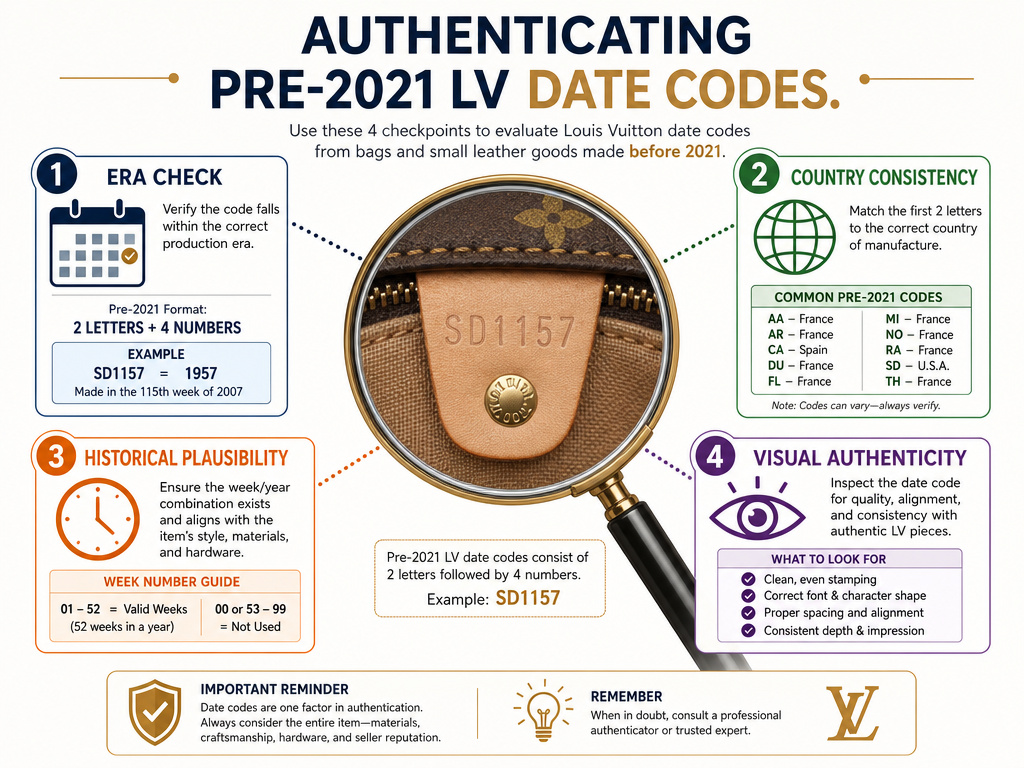
For vintage or pre-owned bags, the date code is your entry point. Remember, it’s a production marker, not a serial number.
First, find it. Check interior leather tabs, the edges of pockets, or directly on the fabric lining. On very old bags, codes can fade.
Once you have the code, run through this checklist: 1. Era Check: Does the format match the bag’s claimed age? (Use the table in section 2). 2. Country Consistency: Do the factory letters match the “Made in…” stamp? (e.g., “CA” codes with “Made in Spain”). 3. Historical Plausibility: Does the production date precede the model’s launch? (A Neverfull can’t have a 2005 code). 4. Visual Authenticity: Is the stamp fine, subtle, and slightly uneven? Overly deep, perfect, or bold stamps are suspect.
When to Call in a Professional
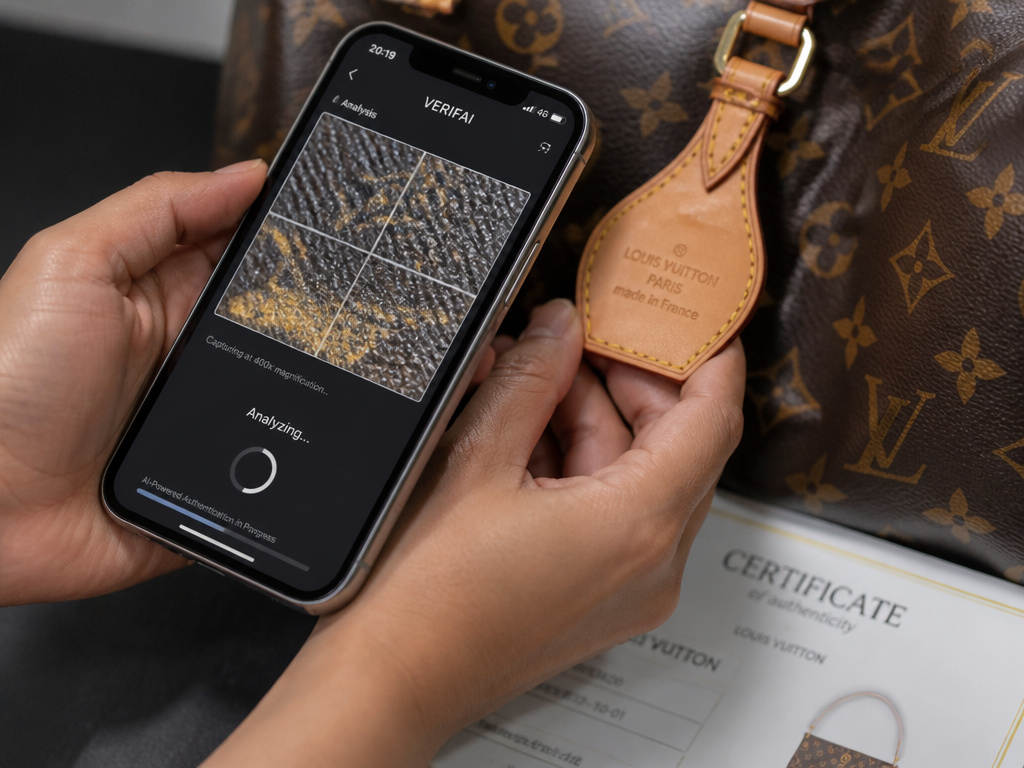
You can catch most fakes with the chip scan and physical checklist. For high-value transactions, or when your own checks yield ambiguous results, professional authentication is a non-negotiable investment.
Services like Entrupy (uses microscopic imaging and AI) and Real Authentication (human experts via photo submission) provide legally valid certificates. For a bag worth thousands, a $30-$50 authentication fee is trivial insurance.
This is especially true for online resale platforms. A seller’s refusal to allow or provide a recent third-party certificate is, in itself, a red flag.
Frequently Asked Questions
Do all Louis Vuitton bags have a serial number?
No. Louis Vuitton does not use unique serial numbers. They use date codes (pre-2021) or NFC chips (post-2021) that identify production batches, not individual bags.
Can I authenticate a Louis Vuitton with the receipt?
No. Receipts are easily forged or resold. Authentication must be based on the physical and technical characteristics of the bag itself. A receipt is supporting evidence at best.
My 2022 bag has no date code. Is it fake?
This is normal. Louis Vuitton replaced date codes with NFC chips. The absence of a visible date code on a 2022 or later bag is expected. You should, however, be able to scan a chip.
What if my bag is from 2021 and has both a chip and a date code?
This is also normal. 2021 was a transition year. Bags from this period might have both, one, or the other. The presence of both is not a concern if they both check out.
Can a fake bag have a working NFC chip?
Technically, yes. A counterfeiter can buy a generic NFC chip and program it to redirect to a fake website that mimics a Louis Vuitton page. This is why you must verify the URL domain is louisvuitton.com and pair the scan with a physical inspection.
Before You Go
Authenticating a Louis Vuitton bag is a process of triangulation. No single point proves anything. You need the identifier (chip or code), the physical craftsmanship, and the historical story to all align.
For a bag made after 2021, scan the chip first. If it redirects to the correct louisvuitton.com product page, you have strong positive evidence. Then, put on your loupe and check the stitching, leather, and hardware.
For a pre-2021 bag, decode the date code, verify its format and consistency, and then subject the bag to the same physical scrutiny.
The single most reliable rule is also the simplest: a bag claimed to be from 2022 or later with neither a scannable chip nor a date code is almost certainly counterfeit. That one observation saves you from the vast majority of modern scams.
When in doubt, or when the money is significant, pay for a professional opinion. The confidence is worth the fee.