How to Tell if a LV Bag Is Real | The Chip & Code Check
This post contains affiliate links. As an Amazon Associate, we earn from qualifying purchases.
To tell if a Louis Vuitton bag is real, you must cross-check three layers: the internal identifier (NFC chip for post-2021 bags, date code for older ones), the physical construction (canvas alignment, stitching, hardware), and the provenance. A valid chip scan or logically correct date code is only one piece of evidence—high-end fakes replicate these. The absence of both a chip and a date code on a bag claimed to be from 2022 or later is a major red flag.
The shift from visible date codes to embedded NFC chips in 2021 changed the verification game. It moved the first check from your eyes to your phone, but it didn’t make authentication easier. It made the physical examination around that digital check more critical.
What follows is the full 2026 field guide. We’ll walk through scanning the chip, decoding the old date codes, and spotting the construction flaws even the best replicas struggle to hide. By the end, you’ll know exactly where to press your phone, what the numbers mean, and which stitch pattern to measure.
Key Takeaways
- Louis Vuitton replaced visible date codes with embedded NFC chips starting in March 2021. A bag from 2022 or later with a physical date code is almost certainly fake.
- Scanning the NFC chip with your phone should open a specific product page on louisvuitton.com. A generic homepage or a mismatched product is a warning sign.
- The chip’s manufacturer code (04 for NXP, 16 for EM Microelectronic) tells you nothing about the bag’s authenticity—it only identifies the blank chip hardware.
- For pre-2021 bags, the date code’s factory letters must match the country in the “Made in” stamp. A “Made in France” stamp with a factory code for Spain (CA) is a confirmed fake.
- A valid chip or date code is not proof. It must be paired with a physical check of the canvas print alignment, stitching tightness, and hardware finish.
The Modern Check: How to Scan the NFC Chip
If your bag was made in 2021 or later, the first step happens on your smartphone. Louis Vuitton embedded Near Field Communication (NFC) chips in place of the old leather-tab date codes. This isn’t a “scan to verify” feature for you—it’s part of LV’s supply-chain and digital passport system. But you can use it.
A successful NFC chip scan on a genuine bag produces a notification with a louisvuitton.com URL. Tapping it opens the exact product page for that bag’s model, color, and hardware. The chip itself is a passive tag the size of a grain of rice, embedded invisibly in the interior leather.
You won’t see the chip. On most bags, you can feel a slight, rigid rectangle in the interior leather tab where the date code used to sit. For a Speedy, that’s the small tab near the inner zip pocket. For a Neverfull, check inside the interior pocket lining on the right-hand panel.
How to Scan the Modern LV NFC Chip
The method depends on your phone. The goal is to get the chip to communicate.
On iPhone (7 and later):
- Unlock your phone. NFC reading won’t work on a locked screen.
- Hold the top edge of your iPhone (where the antenna is) within 1-2 cm of the leather tab area.
- Hold it steady for 2-3 seconds. A notification banner with a louisvuitton.com link should appear at the top of your screen.
- Tap the banner. It should open Safari to the correct product page.
On Android (2018 and later):
- Enable NFC in your settings (Settings > Connected Devices > Connection Preferences > NFC).
- Download a free reader app like NFC Tools (by wakdev).
- Open the app, tap “Read,” and hold the back center of your phone near the chip area.
- The app will show the chip’s data, including the LV product URL.
Using the Official Louis Vuitton App:
This is the most direct method. The app’s built-in scanner connects to LV’s database and displays a product card with details like model name and production country.
| Scan Result | What It Means | Next Action |
|---|---|---|
| Opens correct LV product page | Strong positive indicator. Chip is registered. | Proceed to physical authentication. |
| No scan response | Bag may be pre-2021 (check for date code), or chip is damaged/dead. | Look for a date code. If neither exists on a post-2021 bag, be wary. |
| Opens generic LV homepage | Chip may be unlinked (rare on recent bags) or fake. | Investigate further; do not rely on chip alone. |
| Opens incorrect product page | Chip was likely swapped from another bag. | Major red flag. Seek professional authentication. |
Where this goes sideways: Relying solely on a chip scan. The chip is a small, passive component. A sophisticated counterfeiter can transplant a genuine chip into a fake bag. The scan would be valid, but the bag would not be. The scan confirms the chip, not the canvas surrounding it.
The Legacy Check: Decoding Pre-2021 Date Codes
For bags made before 2021, authentication starts with finding and deciphering the date code. This alphanumeric code was never a serial number. It tells you the factory location and the date of manufacture.
Common mistake: Treating a valid date code as proof of authenticity. High-quality “superfakes” replicate the code logic perfectly. A correct code is a prerequisite, not a verdict.
The code is typically embossed on a small leather tab inside the bag. Check along interior seams, inside pockets, or on the fabric lining behind a pocket flap. On a vintage Speedy, it might be stamped directly onto the interior canvas.
Date Code Format Through the Decades
The format changed several times. Getting the era right is your first filter.
| Era | Format | How to Read It | Example |
|---|---|---|---|
| 1982–mid 1980s | 3-4 digits | Factory code not used. | 823 = 23rd week of 1988? (Ambiguous) |
| Mid 1980s–1989 | 2 letters + 3-4 digits | First 2 letters = factory. Numbers = month & year. | TH8901 = Jan 1989, France. |
| 1990–2006 | 2 letters + 4 digits | Letters = factory. 1st & 3rd digits = month. 2nd & 4th = year. | AR1002 = Oct 2002, France. |
| 2007–March 2021 | 2 letters + 4 digits | Letters = factory. 1st & 2nd digits = week. 3rd & 4th = year. | DU2154 = 21st week of 2014, France. |
The factory code is your most powerful cross-check. It must align with the “Made in” stamp found elsewhere on the bag (usually on a leather tag near the top).
- AR, BO, DU, LP, MB, MI, NO, RA, RI, SD, SL, SN, SP, SR, TH, VI = France
- BC, CE, FI, FO, MA, RE, TD = Italy
- CA, LB, LM, LO = Spain
- FC, FH, LA, OS, SD = USA
The part nobody mentions: A mismatch here is a confirmed fake, full stop. If the stamp says “Made in France” but the date code starts with CA (Spain), the bag is counterfeit. This is a frequent error in mid-tier replicas.
The Physical Inspection: Details Fakes Can’t Perfect
This is where you move from data to detective work. Counterfeit operations excel at copying one thing at scale. They struggle with the consistent, minute perfection of industrial craftsmanship.
Canvas & Print Alignment:
The coated canvas is thick and has a distinct pebbled texture. The famous LV monogram and flower pattern should be symmetrical and never cut off awkwardly at seams. On a genuine Neverfull, the pattern will align perfectly across the side seams. On a fake, it’s often misaligned or uses a blurrier, thinner print.
Stitching:
Louis Vuitton uses a specific waxed linen thread that is durable and slightly glossy. Stitches are impeccably even, with a consistent number per inch (usually 5-6 stitches per cm on leather trim). Look for back-stitching at the end of a seam for reinforcement. Fakes often use cheaper, thinner polyester thread with uneven tension or sloppy back-stitches.
Hardware:
Zippers should be smooth, often by YKK or Lampo, and will be engraved with “Louis Vuitton” in crisp, clean lettering. The brass tone is usually a muted, warm gold that is not overly shiny or brassy. Fake hardware tends to be lighter, more reflective, and the engraving can be shallow or fuzzy.
Leather Trim (Vachetta):
New, untreated vachetta leather is a pale, creamy beige. It darkens naturally to a honey patina over time. The patina should be even. Fake vachetta often has an orange or artificial-looking tint, or feels plasticky rather than like supple, raw leather.
| Component | Genuine Marker | Fake Giveaway |
|---|---|---|
| Canvas | Thick, pebbled texture; crisp, deep-colored print. | Thin, plasticky feel; blurry or faded print. |
| Stitching | 5-6 even, waxed stitches per cm; perfect back-stitches. | Uneven, loose, or too many stitches; cheap thread. |
| Zipper Pull | Engraving is deep and crisp; metal has substantial weight. | Shallow, blurred engraving; lightweight, jingly metal. |
| Vachetta Leather | Ages to a rich, even honey brown; smells like natural leather. | Ages to a blotchy orange; may have a chemical smell. |
Easy to miss: The interior heat stamp. The font for “Louis Vuitton” and “Made in France” is very specific. On a fake, the ‘O’s may be too perfect circles (genuine are slightly oval), and the ‘S’s may be too narrow. Compare it to a verified stamp online.
When to Get a Professional Authentication
For any bag over a couple thousand dollars, or if your own inspection leaves any doubt, professional authentication is a smart investment. It costs between $25 and $40 and provides a certificate that boosts resale value.
Entrupy is the industry standard for businesses. It uses AI and microscopic imaging to analyze materials at a level impossible with the naked eye, claiming over 99% accuracy. For individual buyers, services like Real Authentication or Authenticate First have experts review your photos and issue a verdict within a few days.
You should get a professional opinion if: * The chip scans but something feels “off” physically. * The bag is from the ambiguous 2021 transition period and has neither a clear chip nor date code. * You’re buying secondhand from a private seller without a platform guarantee. * The price seems too good to be true.
A professional detailed Louis Vuitton authentication guide goes deeper than any single article can. Their physical details of a real Louis Vuitton checklist includes dozens of micro-details, from the exact shape of the fleur-de-lis to the glue used on the lining.
The Date Code for Pre-2021 LV Bags
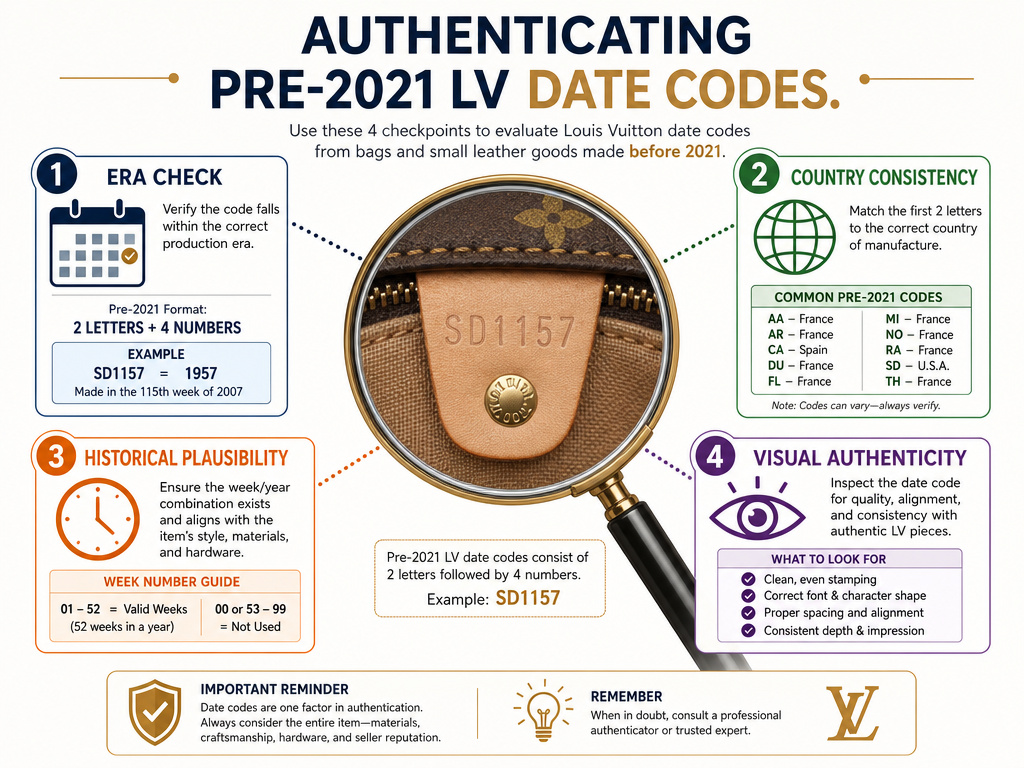
Let’s solidify the date code system, as it’s the backbone of authenticating Louis Vuitton vintage pieces. The code is a two-part cipher: location and time.
Factory Codes Matter Most
Memorize this short list: AR, SD, FL. Those are all French factories. If you see a code like “CA2148” on a bag stamped “Made in France,” you have a problem. CA is Spain. Authentic bags do not have conflicting location data.
The Timeline Trap
The most common date code error on modern fakes is a timeline violation. Louis Vuitton stopped using physical date codes around March-April 2021. Therefore, a bag presented as a 2023 model with a date code embossed on a leather tab is an instant replica. It shouldn’t have one at all.
If your date code’s format doesn’t match its claimed era, the bag is fake. A 1990s bag should not have a 4-digit week/year code (that format started in 2007). A 2022 bag should not have a date code, period.
This logic check is why understanding date codes is still vital, even in the chip era. It’s the fastest way to eliminate low-to-mid-tier counterfeits before you ever examine a stitch.
Frequently Asked Questions
Do all Louis Vuitton bags have a chip now?
No. The NFC chip rollout applies to core handbag lines (Speedy, Neverfull, Alma, etc.). Some small leather goods, accessories, and special collections may still use date codes or have neither identifier. If a mainline bag from 2022 or later has no chip and no date code, that requires investigation.
Can a fake bag have a working NFC chip?
Technically, yes. Standard NFC chips cost pennies and can be programmed with any URL, including one that mimics a Louis Vuitton page. A valid-looking scan is not a substitute for physical inspection, especially on high-value items. This is why the authentic tote bag verification process for any designer, from Gucci to Coach, always combines digital checks with hands-on scrutiny.
What does the “Made in” stamp mean?
It indicates the country where the bag was assembled, not necessarily where all materials originated. Louis Vuitton has workshops in France, Italy, Spain, and the United States. The stamp must be consistent with the factory code in the date code.
My bag has a chip, but the scan doesn’t work. Is it fake?
Not necessarily. First, ensure you’re scanning correctly (unlocked iPhone top edge, Android center-back). If there’s truly no response, the chip could be damaged (exposure to strong magnets or extreme heat can kill it). For a post-2021 bag with a dead chip and no date code, professional authentication is the only path to certainty.
How much does professional authentication cost?
Services charge between $25 and $40 per item for a photo-based review by an expert. For high-volume verification like pawn shops use, AI-based services like Entrupy cost less per item but require a subscription.
Before You Go
Authenticating a Louis Vuitton bag is a process of elimination. Start with the identifier—scan the chip or decode the date code and check for factory stamp alignment. That filters out the sloppy fakes.
Then move to the physical evidence. Feel the canvas, count the stitches, examine the hardware engraving. This catches the better replicas.
Finally, know when to call in the pros. For any high-stakes purchase, a $30 professional opinion is cheap insurance. It gives you a certificate that not only confirms authenticity but also solidifies the bag’s value, whether it’s a classic tote bag or a practical duffel bag you plan on packing a duffel for years of use.
The goal isn’t just to spot a fake. It’s to confirm the real thing with enough confidence to enjoy it.