Master How to Choose a Sleeping Bag With Our Expert Tips
This post contains affiliate links. As an Amazon Associate, we earn from qualifying purchases.
To choose a sleeping bag, match three things: your coldest expected temperature (using the ISO 23537-1:2022 lower limit rating if you’re a warm sleeper, the comfort rating if you’re cold), the insulation type (down for dry performance, synthetic for wet), and your sleeping pad’s R-value. A bag rated to 20°F needs a pad rated R-4 or higher to perform as labeled.
That last point is the one every quick-guide skips. The ISO test that gives you those tidy numbers assumes you’re sleeping on a pad with an R-value of 5.38. Most pads are thinner. If your pad is R-2, your 20°F bag becomes a 35°F bag overnight, and you’ll wake up shivering long before dawn. The rating is a controlled comparison, not a personal thermostat.
What follows is the breakdown most people need but never get: how to read an ISO tag without being misled, the real difference between a 600-fill and an 850-fill down bag, and the one shape that ruins side sleepers. By the end, you’ll be able to spot the marketing fluff and buy the bag that actually works for your nights outside.
Key Takeaways
- The ISO 23537 “extreme” rating is for survival only, not for choosing a bag. Marketing that highlights it is a red flag.
- Your sleeping pad’s R-value is half the warmth equation. A bag’s rating is void without the right pad underneath it.
- Down lasts decades but dies when wet. Synthetic is bulky but shrugs off moisture. Your local climate picks for you.
- A mummy bag is 15% warmer than a semi-rectangular one, but it can make a side sleeper miserable.
- Brands like Western Mountaineering and Big Agnes set their own ratings. Their 20°F is often warmer than an ISO-tested 20°F.
The ISO 23537 Rating (and What It Actually Means)
You see three numbers on the tag: comfort, limit, extreme. Most shoppers fixate on the biggest, boldest number, which is usually the limit. That’s the first mistake. The ISO 23537-1:2022 test, which replaced the older EN 13537 standard in 2017, uses a heated manikin wearing long underwear, a hat, and lying on a sleeping pad with an R-value of 5.38. It measures heat loss in a perfectly still, dry, windless chamber.
The “extreme” rating should not be used to choose a bag. It describes conditions involving severe cold stress and is not a promise of safe or comfortable sleep.
That’s the technical snippet. It means the “extreme” number is when hypothermia risk begins, not when you’ll be cozy. A bag marketed on its extreme rating is telling you it’s for emergencies, not for camping.
The comfort and lower limit ratings are useful. Which one you use depends on your sleep physiology, not your gender, despite marketing labels. If you sleep cold, plan around the comfort rating. If you sleep warm, the lower limit is your target. For a bag like the Sea to Summit Spark rated to 15°F lower limit, its comfort rating is 29°F. That’s a 14-degree spread that decides whether you sleep through the night or not.
Where this goes sideways: Assuming the ISO rating translates directly to the forecast. Your real-world warmth is a guess. Fatigue, hydration, ground temperature, and a damp tent change everything. The rating is a comparison tool, not a guarantee. Use it to compare two bags, not to predict your night.
Down vs. Synthetic Insulation: The 20-Year Choice
This isn’t about warmth. A 20°F synthetic bag and a 20°F down bag are rated for the same temperature. The difference is weight, pack size, durability, and what happens when they get wet.
| Insulation Type | Best For | Fails When | Lifespan |
|---|---|---|---|
| Down | Dry climates, weight savings | Soaked (clumps, loses all loft) | Decades |
| Synthetic | Wet climates, budget trips | Repeated compression (loses loft faster) | 5-10 years |
Down is lighter and packs smaller because of fill power. Fill power measures loft, not warmth. Higher fill power (800+) means less down is needed to achieve a given loft, saving weight. It does not mean a 600-fill 20°F bag is colder than an 850-fill 20°F bag; it means the 850-fill bag likely weighs less and stuffs smaller for the same rating.
Synthetic insulation, like Primaloft or Thermolite, traps warmth even when damp. It’s also non-allergenic and cheaper upfront. The trade-off is bulk and longevity. Synthetic fibers break down with compression over time. A down bag properly cared for will outlive your backpack.
Common mistake: Choosing down for a rainy coastal backpacking trip because it’s “higher quality.” A soaked down bag is a dangerous liability. A synthetic bag will still insulate, giving you time to manage the situation.
Your local weather and trip style make this call. For three-season backpacking in the Rockies, down is the default. For paddle trips in the Pacific Northwest, synthetic is the only sane choice.
Shape and Fit: Why Your Sleeping Position Vetoes the Mummy
Sleeping bag shape is a thermal efficiency trade-off. A snug mummy bag minimizes air space your body must heat. A roomier semi-rectangular or barrel bag gives you space to move. Your sleeping position decides which trade-off you can live with.
A side sleeper in a tight mummy bag will compress insulation at the knees and hips. That creates cold spots exactly where you need warmth. The “figure-four” side position common among women is particularly poorly served by a standard narrow mummy.
Do you actually sleep on your back or your side? Test a bag in the store by lying down in your normal position. If your knees press firmly against the side, that spot will be cold at 3 a.m. Women’s-specific bags, like those from Sea to Summit, are cut wider from hip to knee for this reason. A unisex mummy is a recipe for a miserable night if you’re a dedicated side sleeper.
Quilts are the ultralight end of this spectrum. They eliminate back insulation entirely, relying on your sleeping pad. They work extremely well for back sleepers on insulated pads but demand good packing a duffel bag skills to control drafts around the shoulders.
The Sleep System: Your Bag Is Only Half the Equation
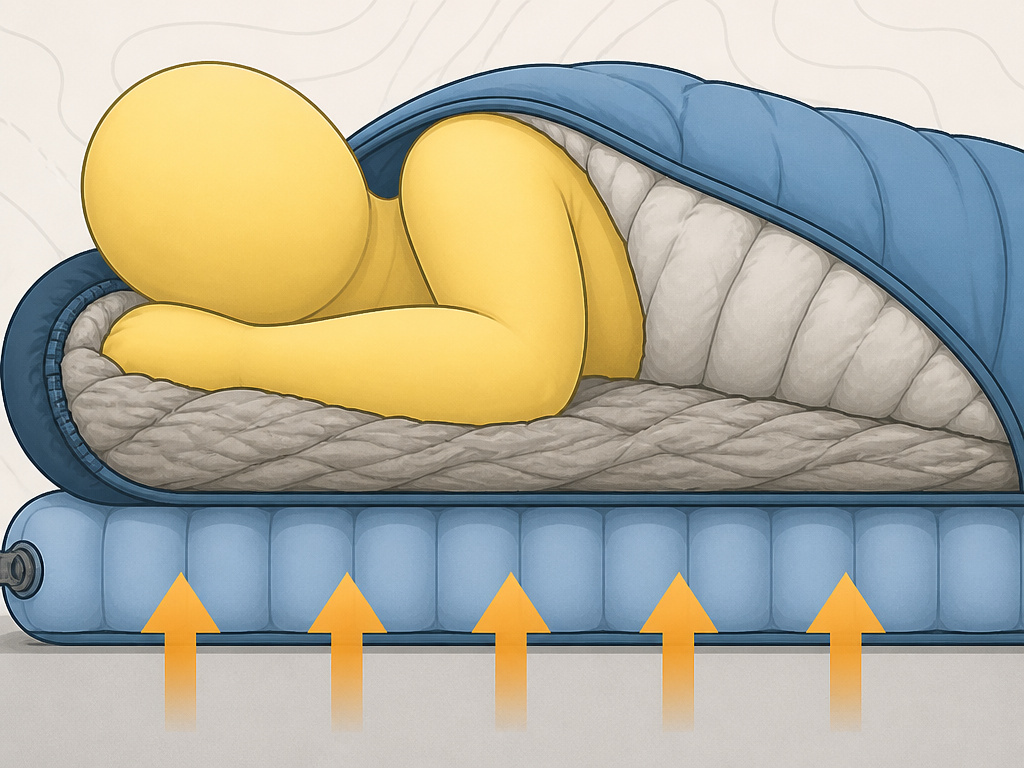
A sleeping bag’s insulation is crushed underneath you. All the loft is on top and the sides. The pad provides virtually all the insulation between you and the ground. Ignoring this is why people with a $400 bag still get cold.
The ISO test uses a pad with an R-value of 5.38. Most three-season backpacking pads are R-3 to R-4.5. If your pad is under-insulated, your bag cannot hit its rating. REI’s sleep system guidance makes this concrete: for conditions near a bag’s lower limit, pair it with a pad in the R-4 to R-5.4 range.
| Expected Night Low | Pad R-Value Range | Bag Rating Needed |
|---|---|---|
| 50°F (10°C) | Under 2 | 30°F or lower |
| 32°F (0°C) | 2 – 3.9 | 20°F or lower |
| 20°F (-7°C) | 4 – 5.4 | 15°F or lower |
| 0°F (-18°C) | 5.5+ | 0°F or lower |
If you are cold mainly through your back and hips, a better pad fixes it. A warmer bag won’t.
This system thinking extends to your clothing and a bag liner. A sleeping bag’s rating assumes you’re wearing long underwear. Adding a fleece layer and a hat can extend a bag’s range by 5-10 degrees. A washing a sleeping bag reminder is key here: body oils and dirt degrade insulation loft over time, so a liner also protects your investment.
Features That Matter (and Ones That Don’t)
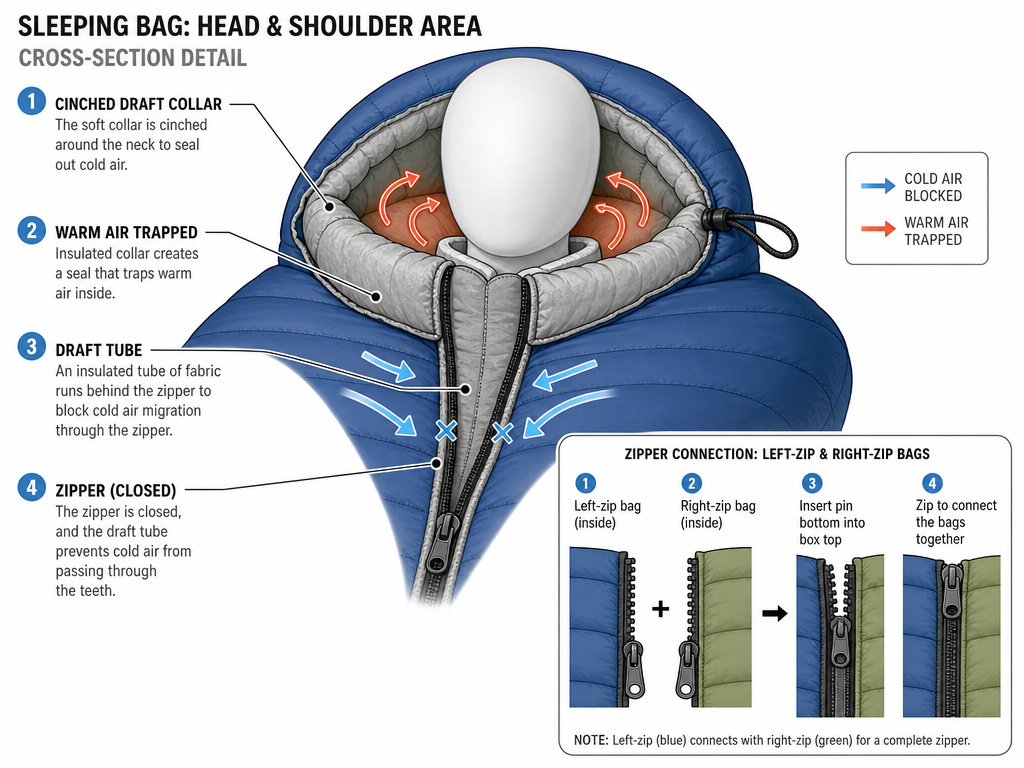
A draft tube behind the zipper is non-negotiable. It’s a sleeve of insulation that blocks cold air rushing in through the teeth. A draft collar around the neck is equally critical; it’s a baffle you snug up to trap warm air.
A stash pocket for earplugs or a phone is nice. A pillow sleeve is a gimmick if you already use an inflatable pillow. Every feature adds weight and cost. Prioritize the ones that directly combat heat loss.
The part nobody mentions: Left-zip and right-zip bags can zip together if they’re from compatible brands. This is a feature for couples, but it only works if you plan the purchase together. Check compatibility before buying two bags hoping to combine them.
Hood design separates serious bags from casual ones. A good hood cinches tightly around your face with a single pull, leaving only a small breathing hole. A sloppy hood lets heat pour out all night.
Brands That Play by Their Own Rules

Not every reputable brand uses ISO testing. Western Mountaineering, Big Agnes, and Feathered Friends are famous for setting their own conservative ratings. A Western Mountaineering bag rated for 20°F is often noticeably warmer than an ISO-tested 20°F bag. This is a point of pride and a point of confusion.
When shopping these brands, you must rely on community experience and detailed reviews, not the number on the tag. The SleepingBags.org selection guide is a good starting point for understanding these nuances. Their ratings are a different language.
This also applies to children’s bags. ISO 23537-1:2022 explicitly excludes them. Kids’ bag ratings are even more of a guess. Always err on the side of a warmer bag for a child and pair it with an appropriate pad.
Before You Buy: The 5-Minute Store Test
You can’t test temperature in a store. You can test fit and feel. Here’s what to do.
- Wear your base layers. Bring the long underwear you’d sleep in.
- Get in your position. Side sleepers, get on the floor on your side. See where the bag pulls tight.
- Check hood and collar. Cinch them down. Do they seal without gaping?
- Zip and unzip. Is the zipper smooth? Does it snag the draft tube?
- Check the footbox. Can you wiggle your toes without compressing the insulation?
If the bag fails any of these comfort checks, keep looking. A bag that doesn’t fit won’t keep you warm, no matter its rating. This test also helps you understand the packed size—can you realistically fit it in your duffel bag as carry-on along with your other gear?
Frequently Asked Questions
What temperature sleeping bag do I need for summer camping?
For summer camping in most regions, a bag rated between 30°F and 40°F (comfort rating) is sufficient. If you’re a warm sleeper or in a hot climate, a 50°F bag or even a lightweight quilt might be better. Always check historical nighttime lows for your location, not just daytime highs.
Is a down or synthetic sleeping bag better for beginners?
Synthetic sleeping bag is often better for beginners. It’s more forgiving, retains warmth when damp, is easier to care for, and is less expensive. The down sleeping bag maintenance learning curve is steeper.
How much should I spend on a sleeping bag?
Spend based on expected use. For occasional car camping, a $100-150 synthetic bag is fine. For frequent three-season backpacking, plan on $200-350 for a quality down bag that will last a decade. Ultra-light specialized gear exceeds $500.
Can I wash my sleeping bag?
Yes, but carefully. Follow the manufacturer’s instructions precisely. Use a front-loading washer without an agitator, a technical cleaner like Nikwax Down Wash, and dry on low heat with tennis balls to break up clumps. Improper cleaning a sleeping bag is a leading cause of premature loft loss.
What is the difference between a mummy and a rectangular sleeping bag?
Mummy bag is tapered from shoulders to feet for maximum warmth-to-weight efficiency. A rectangular bag is like a blanket with a zipper, offering more room to move but less thermal efficiency. Rectangular bags are generally too heavy and bulky for backpacking.
The Bottom Line
Skip the marketing and start with the ISO rating’s lower limit or comfort number, matched to how you sleep. Let your local climate choose your insulation: down for dry, synthetic for wet. Let your sleeping position veto the shape. And never, ever forget that your sleeping pad carries half the load. The right bag isn’t the warmest one you can buy. It’s the one that fits your body, your trip, and the rest of your sleeping bag wash routine. Get those four things right, and the cold won’t find you.