Real vs Fake Gucci Bag: How to Tell by Serial Number Check
This post contains affiliate links. As an Amazon Associate, we earn from qualifying purchases.
To tell if a Gucci bag is real, you must cross-reference multiple details. Check the interior leather tag for a crisp, heat-stamped serial number, modern bags have two rows totaling 10-13 digits. Feel the hardware for substantial weight, inspect stitching for consistent 6-7 stitches per centimeter, and verify any QR code or NFC tag using the official Gucci app. No single detail proves authenticity, but a combination of correct construction, materials, and codes does.
Most authentication guides treat the serial number like a fingerprint. It’s not. A correct-looking number is just one data point in a story written by leather, thread, and metal. Forgers copy real serial numbers directly from genuine bags, so a tag that passes a quick glance can still be attached to a fake.
What follows is a systematic walkthrough of the checkpoints professional authenticators use. We’ll cover the serial number tag’s evolution, the new NFC technology, and the model-specific details on the most-faked styles like the Dionysus and the Bamboo 1947. By the end, you’ll know which details to pressure-test and where most counterfeits finally crack.
Key Takeaways
- A genuine Gucci serial number is heat-stamped, not printed, on the back of an interior leather tag. The font features serifs, small decorative strokes on digits like “2,” “3,” and “5.”
- Authentic hardware has a substantial, solid feel. Zippers glide smoothly, and engravings are crisp and deep, never light or shiny.
- Stitching density is remarkably consistent at about 6-7 stitches per centimeter across the entire bag, with thread color that matches the material.
- The official Gucci NFC tag, found on selected newer items, only works with the Gucci app. A QR code that scans to a website is a guaranteed fake.
- The absence of a “Controllato” card does not mean a bag is fake, but its presence requires verification, one digit on the genuine card always has a distinctive notch.
The Serial Number Tag is Your First Stop
Look inside the bag, typically along a seam or inside a pocket. You should find a small, rectangular leather tag stitched neatly into the lining. The leather should feel supple, with clean, finished edges. A tag glued on top of the lining is an immediate red flag.
The serial number is stamped on the back of this tag. It is always heat-stamped, leaving a slight impression in the leather. Printed or inkjet numbers are signs of a counterfeit.
Common mistake: Treating the serial number as a unique ID. Gucci serial numbers are not unique. The same number can appear on multiple bags of the same style from the same production batch. A correct number alone proves nothing.
How to Read a Gucci Serial Number Tag
Modern Gucci bags (post-2000s) use a format of two rows, totaling 10 to 13 digits. The top row is the 6-digit style code. The bottom row is the supplier or factory code, which can be 4 to 6 digits long.
For example, you might see:
449661
525040
The style code (449661) identifies the bag’s model. You can cross-reference this number online, but be cautious, forgers use real codes from real bags. If you search the code and a completely different style like a wallet appears, that’s a definitive red flag.
The serial number on a Gucci bag does not indicate the year of manufacture. Unlike Louis Vuitton date codes, these numbers tell you the model and the workshop, not the production date. This is a critical distinction that changes how you use the information.
Older vintage pieces have more variable formats, sometimes using dots, dashes, or a single line. This variability is why context is king. A detail correct for a 2024 Marmont bag would be wrong on a piece from the 1990s.
Modern Tags: QR Codes and NFC “Controllato” Cards
Gucci’s anti-counterfeiting tags have evolved. Understanding these new features is essential for authenticating bags made from 2016 onward.
QR Code Tags (2016–2021): A small black fabric tag was sewn into the side seam. Here is the crucial rule: an authentic Gucci QR code is designed not to scan with your phone’s standard camera. If you scan it and it takes you to a website, the bag is fake. The genuine system was for internal inventory only.
NFC “Controllato” Cards (2021–Present): Newer items may include a card with an embedded NFC chip and the word “Controllato” (Italian for “checked”). This is a quality-control card, not a warranty.
To verify it, you must use the official Gucci app. Download the app, go to the “My Gucci” section, and select “Gucci Tag.” Hold your smartphone’s back to the card or the bag’s designated NFC spot. A genuine chip will pull up product information in the app. A fake might do nothing or, worse, open a browser.
Where this goes sideways: Assuming a missing card condemns a bag. Many authentic pieces, especially on the pre-owned market, circulate without their Controllato card. Its absence is not a definitive authenticity test, but its presence requires verification through the app.
| Tag Type | Time Period | How to Verify | Red Flag |
|---|---|---|---|
| QR Code | 2016 – 2021 | Should NOT scan publicly | Scans to a website |
| NFC Controllato Card | 2021 – Present | Use official Gucci App | Doesn’t work in app; works in browser |
| Leather Serial Tag | 1970 – Present | Heat-stamped, serif font | Printed ink, missing serifs |
Hardware Should Have Weight

Pick up the bag. Authentic Gucci hardware has a reassuring, solid density. Zipper pulls, clasps, and D-rings should feel substantial in your hand, not hollow or lightweight. This heft comes from better metals and thicker casting.
Zippers should glide smoothly without catching. High-end models often use YKK or Lampo zippers, and many feature engraved “GUCCI” branding. The engraving should be crisp, deep, and precise. Look for the signature font details: the letters “U” and “I” have small, trumpet-like flares at the ends of their strokes.
Counterfeit hardware often feels light and looks overly shiny or “gold.” That brassy, perfect shine is a common tell. Real Gucci hardware has a richer, more subdued luster.
On bags with the GG monogram hardware, the overlapping Gs should be sharply defined where they intersect. On fakes, this area often looks blurred or soft. The GG logo itself should also be proportionate; on replicas, the loops are frequently stretched or misshapen.
Stitching Tells a Story

Gucci’s stitching standards are exceptionally high, but this is one of the most misunderstood checkpoints. It’s not just about “neat” stitching.
The key is consistency. Authentic Gucci products have approximately 6 to 7 stitches per centimeter. This density should be uniform everywhere, the main seam, a pocket edge, the strap attachment. Grab a ruler and check.
The thread color should also match the material it’s sewn into. On a black leather bag, the stitching is black. On brown canvas, it’s brown. A visible mismatch is a red flag. Furthermore, the stitches should lie flat and even, with no loose threads poking out. While a single stray thread isn’t a death sentence, combined with other questionable details, it points to lower-quality construction.
Easy to miss: Stitching on the interior lining. Don’t just check the exterior. The inside seams should show the same consistent density and neat finishes. Counterfeiters often cut corners where they think you won’t look.
Materials and Canvas Alignment
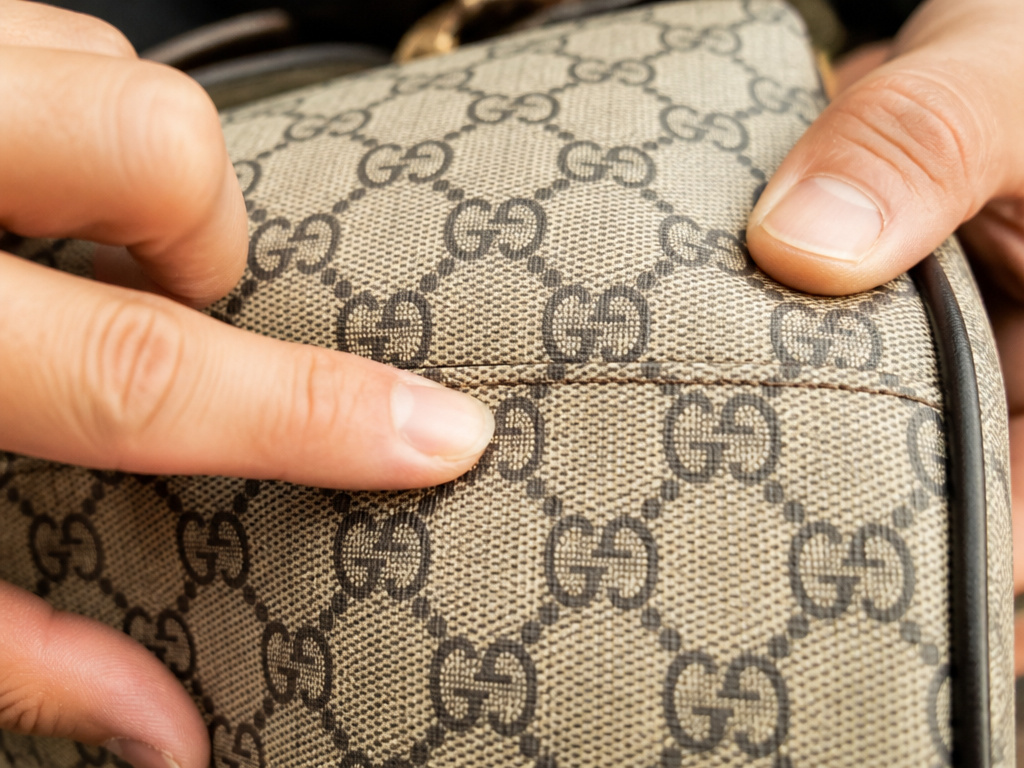
Feel the material. Genuine Gucci leather is soft, supple, and smells like high-quality leather, not plastic or chemicals. Canvas bags, like those in the GG Supreme monogram, have a specific, durable texture, not too smooth or plasticky.
For monogram canvas, pattern alignment is a major giveaway. Gucci artisans carefully match the interlocking GG pattern across seams. On the front of a bag, the pattern should be centered and symmetrical. Where two panels meet, the Gs should line up. On counterfeits, the pattern is often off-center, cut awkwardly at seams, or mismatched entirely.
The color of the monogram is another clue. Authentic canvas has a distinct, warm hue. Fakes can look too yellow, too green, or too flat. Compare the bag in question to verified reference photos from the Gucci website or trusted resellers.
Model-Specific Tells on Popular Styles
Some Gucci bags have unique features that are especially hard for counterfeiters to replicate perfectly.
Gucci Dionysus: The iconic tiger-head closure is the focus. On a genuine bag, the tiger head is heavy, with intricate texturing and sharp, detailed features. The eyes, stripes, and snout are clearly defined. Fake versions feel lightweight and have blurred, flattened facial details. The sliding closure mechanism should also operate with a smooth, substantial feel.
Gucci Bamboo 1947: The handle is made from real bamboo. Look for natural characteristics: heat marks from the shaping process, subtle irregularities in the grain, and organic color variation. Fakes often use painted plastic or resin, which looks too uniform, too glossy, and lacks the natural node structure of real bamboo.
GG Marmont: The matelassé chevron pattern should be plush and evenly quilted, with the GG logo sitting squarely in the center of the back flap. On counterfeits, the quilting can look deflated or uneven, and the logo may be off-center or poorly engraved.
Frequently Asked Questions
Do all Gucci bags have a serial number?
Nearly all Gucci bags produced from 1970 onward have a serial number. Some very early vintage pieces may not, but for any modern or pre-owned bag you’re likely to encounter, you should expect to find one. Its absence on a bag that looks new is a significant warning sign.
Can I authenticate a Gucci bag online by the serial number?
Not definitively. You can search the style code to see if the model matches, but since serial numbers are copied by counterfeiters, a matching code does not guarantee authenticity. Online verification requires high-resolution photos of multiple details (serial tag, hardware, stitching, logos) for a professional authenticator to assess.
What does “Controllato” mean on the Gucci card?
“Controllato” is Italian for “checked” or “controlled.” The card indicates the bag passed Gucci’s internal quality control inspection. It is not a warranty card or a certificate of authenticity. Its presence is a good sign, but it must be verified via the NFC chip in the Gucci app for newer items.
Are Gucci bags made in Italy?
Authentic Gucci bags should have “Made in Italy” heat-stamped on the interior leather tag, alongside the Gucci logo. Some smaller leather goods or specific product lines may be made in other European countries, but this is always clearly stated. A bag with no country of origin label is suspicious.
How much should I worry about stitching?
Stitching is a valuable clue when combined with other factors. Perfectly neat stitching can be faked, but the consistent 6-7 stitches per centimeter density and perfect color matching are harder to replicate at scale. Use stitching as one of several cross-referenced points, not a single deciding factor.
The Bottom Line
Authenticating a Gucci bag is a process of elimination. Start with the serial number tag, but don’t stop there. Heft the hardware. Count the stitches. Feel the leather. Check the pattern alignment.
Remember, counterfeiters are good at copying one or two details. They struggle to replicate the entire package of quality materials, precise craftsmanship, and evolving security features like the NFC tag. When in doubt, especially for a significant investment, seek a professional authentication service or stick to purchasing from Gucci directly, authorized retailers, or pre-owned platforms with ironclad authentication guarantees. Your confidence is worth the extra step.