Can a Tote Bag Be a Carry On? A Guide to Airline Allowances
This post contains affiliate links. As an Amazon Associate, we earn from qualifying purchases.
Yes, a tote bag can be a carry-on if it fits within the airline’s overhead bin size limit, typically 22″ x 14″ x 9″ for most U.S. Carriers, and you can lift it into the bin yourself. However, on Delta Connection flights with 50 seats or less, a tote cannot be your carry-on; you are only permitted a personal item that fits under the seat. The bag’s style is irrelevant; airlines only care about its packed external dimensions.
That “Delta Connection” clause is the hinge. It means your perfectly-sized tote is useless overhead on a regional jet, and you’ll be gate-checking it for free. The policy exists because those small planes have virtually no overhead space. Assistive devices like wheelchairs are exempt, but your weekend bag is not.
What follows: the real size numbers from Delta and ANA, the difference between “carry-on” and “personal item” on a boarding pass, and how to pack a tote so it actually fits the sizer box at a Frontier gate. We’ll also name the totes that work and the one common mistake that triggers a $75 gate-check fee every time.
Key Takeaways
- On Delta Connection flights (50 seats or less), your tote cannot be a carry-on, only a personal item that fits under-seat is allowed.
- The standard 22″ x 14″ x 9″ carry-on size is a linear-inch measurement (length+width+height); your tote’s handles and bulging pockets count toward this total.
- Budget airlines Spirit and Frontier use a rigid 18″ x 14″ x 8″ sizer for free personal items; a tote larger than that must be a paid carry-on.
- All Nippon Airways (ANA) enforces a strict 10 kg (22 lb) combined weight limit for your carry-on and personal item together.
- An expanded tote, with its expansion zipper open, is the first bag a gate agent will pull for measurement and a fee.
The 22″ x 14″ x 9″ Standard That Isn’t Universal
Most U.S. Airlines publish a maximum carry-on size of 22 inches by 14 inches by 9 inches. Delta, American, and United all use this figure. But that’s not a simple box. It’s a linear-inch limit, you add the bag’s length, width, and height. The total cannot exceed 45 inches.
Delta’s carry-on limit is 45 linear inches, per their official policy. This means a bag measuring 22″ x 14″ x 9″ (which sums to 45″) is at the absolute ceiling. Handles, wheels, and any external pocket that protrudes must be included in this measurement.
A floppy tote bag with tall, non-collapsible handles is the classic fail. If the bag is 20″ tall but the handles add another 3 inches, your total height is 23 inches. That alone pushes you over the 45-inch linear limit on a 22″ x 14″ x 9″ bag. You must measure your tote packed, as you’ll fly with it, not empty.
International airlines often use slightly different dimensions. All Nippon Airways (ANA), for example, allows a carry-on with each side not exceeding 55 cm x 40 cm x 25 cm (about 21.7″ x 15.7″ x 9.8″). Their real differentiator is a 10 kg (22 lb) combined weight rule for your carry-on and personal item together. A heavy leather tote plus a laptop bag can hit that limit faster than you think.
| Airline | Carry-On Size Limit | Key Restriction |
|---|---|---|
| Delta Air Lines | 45 linear inches (22″ x 14″ x 9″ typical) | Includes handles & wheels; not allowed on 50-seat Connection flights. |
| All Nippon Airways (ANA) | 55 x 40 x 25 cm (21.7″ x 15.7″ x 9.8″) | 10 kg combined weight for carry-on + personal item. |
| Spirit / Frontier | Paid carry-on option (~22″ x 18″ x 10″) | Free personal item must fit 18″ x 14″ x 8″ sizer. |
| British Airways | 56 x 45 x 25 cm (22″ x 17.7″ x 9.8″) | Weight limit varies by cabin class (typically 23kg). |
The takeaway: “22 x 14 x 9” is a starting point, not a guarantee. Always verify your specific airline’s published policy in linear inches or centimeters.
Delta Connection Flights: The Carry-On Ban Nobody Reads
If your itinerary includes a regional jet operated as a Delta Connection flight with 50 seats or less, the rules change completely. Your tote bag cannot be your carry-on.
Delta’s policy is explicit: on those small aircraft, only a personal item that fits under the seat is permitted in the cabin. Any bag intended for the overhead bin, including a compliant tote, will be gate-checked free of charge. You’ll get a pink Gate Claim tag, and your bag will be returned plane-side at your destination.
Common mistake: Assuming a “carry-on” fare includes overhead space on every plane. On a 50-seat CRJ, it doesn’t. Your tote must be planned as an under-seat personal item from the start.
This rule exists for physical space, not revenue. The overhead bins on those aircraft are tiny, often reserved for crew bags and assistive devices. The exception proves the rule: if you’re traveling with an infant-in-arms or a pet in the cabin, you get an extra allowance. Your weekend tote doesn’t qualify.
The fix is simple. Before you pack, check your flight number. If it’s a Delta Connection service, plan to squeeze everything into a bag that fits under the seat in front of you. That tote you were counting on for the overhead? It’s checked baggage now.
Tote as Personal Item: The Sizer Box Test
When a tote bag serves as your personal item, it must fit under the seat. Airlines enforce this with sizer boxes at the gate. The most famous is the Spirit and Frontier box: 18 inches by 14 inches by 8 inches. Your bag must slide in without force.
This is a hard volume limit. A soft tote might seem forgiving, but if it’s overstuffed and bulging, it won’t compress enough to fit. Gate agents don’t negotiate with a bulging bag.
Where this goes sideways: Using a tote with an open expansion gusset. An expanded bag is an immediate flag for agents. It will be measured, and if it doesn’t fit the sizer, you’re paying a gate-check fee, $35-$65 on major carriers, $75-$100 on budget lines.
Other airlines have similar, though sometimes unspoken, limits. JetBlue’s personal item size is 17″ x 13″ x 8″. United’s is 17″ x 10″ x 9″. The under-seat space on newer aircraft is often smaller than on older models, so even a bag that fit last year might not fit today.
How to guarantee your tote passes:
- Measure it packed, with everything you’ll carry.
- Ensure the height measurement includes the handles lying flat.
- Do not overfill it, the top should be level, not domed.
- Never travel with expansion zippers open.
Follow these four steps and your tote will clear the sizer. Skip them and you’re gambling with your wallet.
Packing a Tote to Actually Fit Under the Seat

Packing a tote as a personal item is a stacking game, not a stuffing contest. The goal is a flat, rectangular profile that slides under the seat easily. Start with the stiffest item, usually a laptop, against the back panel. This creates a solid base.
Next, layer folded clothes or a packing cube on top of the laptop. Place your quart-sized liquids bag in a front pocket or right at the top. You need to grab that in one motion at security. Heavier items go at the bottom, closer to your body, to improve the bag’s balance when you carry it.
I prefer a tote with a trolley sleeve for this reason. Slide it over your rolling suitcase handle and you can navigate the terminal hands-free. Gate agents also see a tidy, controlled bag, not a loose, swinging mess.
The final, critical step is the pre-flight squeeze test. At home, pack the tote as you will for the flight. Place it under a chair or table that has roughly 8 inches of clearance. If you have to push, shove, or sit on it to make it fit, it’s too full. Remove an item. That item is the difference between a free bag and a fee.
Tote vs. Backpack for Personal Item Duty
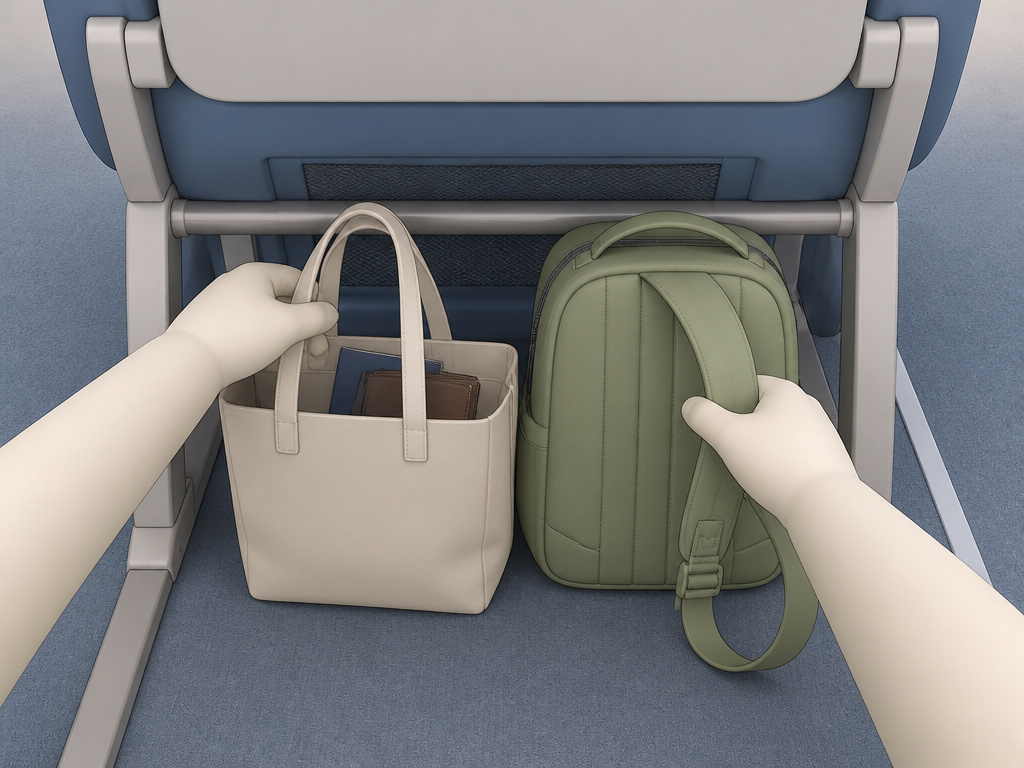
Both fit under the seat. The difference is how they carry weight and grant access. A tote hangs from one shoulder, giving you instant one-handed access to your wallet, passport, or headphones. It reads as more polished in business or casual settings.
A backpack distributes weight across both shoulders. That matters if you’re carrying a 15-pound load across a large airport or during a tight connection. The trade-off is access, you must take it off to get anything out.
The verdict: Choose a tote for short-haul flights, business trips, or any journey where you’ll be opening the bag frequently. Choose a backpack for long terminal walks, heavy gear (like a camera or toddler supplies), or budget-airline trips where the personal item is your only luggage. Many frequent fliers use a hybrid: a packable tote inside their backpack for the return trip with souvenirs.
The One Tote That Works as a Carry-On (And Two That Don’t)
You need structure. A floppy canvas sack will fail the overhead bin test because it won’t hold its shape when lifted. A structured tote with reinforced sides and a flat base will.
The Away The Bigger Carry-On is the benchmark for a reason. Its hard-shell construction guarantees it meets the 22″ x 14″ x 9″ dimensions exactly, every time. It’s a carry-on first, but its streamlined shape makes it a viable, if expensive, option.
For a soft-sided winner, the Travelpro Maxlite 5 is lightweight and designed to airline specs. It’s soft enough to compress slightly if needed but holds its shape under a gate agent’s glance. The Briggs & Riley Baseline expandable tote is the business traveler’s pick, it’s built to a lifetime guarantee and fits international size rules.
Two styles to avoid: oversized canvas market totes (they’re never 22″ tall but they’re always too deep) and any tote with external buckles or straps that dangle. Those straps catch on bin doors and annoy everyone behind you.
Frequently Asked Questions
Can I hold a tote bag and a carry-on suitcase?
Yes, that’s the standard allowance: one carry-on for the overhead bin and one personal item (your tote) for under the seat. Just ensure your tote fits the airline’s personal item size rules. Some basic economy fares, like United’s, only include the personal item, so your tote would be your only bag.
Do airlines weigh carry-on totes?
Most U.S. Airlines (Delta, American, United) do not weigh carry-ons. International carriers often do. ANA, for example, enforces a 10 kg (22 lb) combined weight limit for your carry-on and personal item. A heavy leather tote plus a laptop can push you over.
What if my tote is slightly too big for the sizer?
If it doesn’t fit the rigid sizer box at the gate, the agent will tag it as a carry-on. If you haven’t paid for a carry-on (on Spirit/Frontier), you’ll be charged a gate-check fee, typically $75-$100. On other airlines, they may gate-check it for free if overhead space is full, but there’s no guarantee.
Is a tote bag a personal item or a carry-on?
It can be either, depending on its size and your ticket. If it fits under the seat, it’s a personal item. If it’s designed for the overhead bin and you have a carry-on allowance, it’s a carry-on. The bag itself doesn’t decide; the airline’s size police do.
Can I use a tote as a carry-on for international flights?
Yes, but international size limits differ. Many European and Asian airlines use a 55 x 40 x 20 cm (21.6″ x 15.7″ x 7.8″) limit, which is slightly smaller than the U.S. Standard. Always check your specific airline’s requirements in centimeters before you fly.
Before You Go
A tote bag can be a carry-on, but only if you treat it like one. That means measuring its packed dimensions, including handles, and ensuring it doesn’t exceed your airline’s linear-inch limit. Remember the Delta Connection rule, on those small planes, your tote is a personal item or it’s checked.
For most domestic trips on major carriers, a structured tote like the Travelpro Maxlite 5 is a safe bet. For budget airlines, size it down to fit the 18″ x 14″ x 8″ personal item sizer. And never, ever fly with the expansion zipper open. That single mistake is the fastest way to turn a free bag into a hundred-dollar lesson.