How to Start a Tote Bag Business: The Key Supplier Detail
This post contains affiliate links. As an Amazon Associate, we earn from qualifying purchases.
To start a tote bag business, match your product to a concrete use case and lock in quality control specs before you order. The market is growing at 4.6% annually, but failure comes from vague supplier agreements, not from a lack of buyers. Define tolerances for stitching, print placement, and material weight, or your first production run will be unsellable.
Most guides tell you to find a supplier and get samples. They skip the part where a perfect sample hides a factory’s willingness to cut corners on a 500-piece order. Your business isn’t sunk by a bad design. It’s sunk by accepting a 20% lighter canvas or misaligned stitching because you never wrote down the acceptable margin of error.
What follows: the three business models, the exact quality standard factories use (and hope you don’t know), a supplier vetting script, and the legal guardrails that keep a defective batch from ending your venture before it starts.
Key Takeaways
- Success depends on matching your tote bag to a specific, functional use case—corporate gifting, DTC commuting, or retail lifestyle. A generic “cute tote” drowns in ad costs.
- Lock in the AQL 2.5 quality standard in your supplier contract. This defines acceptable defect rates and gives you a legal basis for rejecting subpar shipments.
- Vet suppliers by asking for production references of similar bags, not just glossy photos. A factory that can’t show past work in your fabric and construction type will learn on your dime.
- Budget for product liability insurance ($400-$700/year) from day one. A broken strap causing a customer’s injury is a lawsuit, not a refund.
- A private label tote is a retail product with packaging and branding; a promotional tote is just a bag with a logo. Confusing them wrecks your cost structure and customer expectations.
Pick Your Path: POD, Private Label, or Handmade
Your first decision isn’t about design. It’s about how much control you need over cost, quality, and timeline. Each path has a different failure point.
Print-on-demand (POD) services like Printful or CustomCat are the easiest entry. You upload a design, they print it on a stock bag, and they handle fulfillment. Your startup cash can be under $500. The trade-off is thin margins, limited material choices, and zero control over the final product’s feel. A customer’s complaint about cheap-feeling fabric is a complaint you can’t fix.
Private label manufacturing is for building a brand. You work with a factory like Ecoicolortote or Optima Bags to create a fully custom product—your material, dimensions, hardware, and branding. Minimum order quantities (MOQ) start around 500 pieces per style, with startup costs from $1,500 to $5,000. The lead time is 8–12 weeks. This path fails when you skip the “golden sample” approval step or neglect to define production tolerances.
The handmade route, often seen on communities like r/smallbusinessindia, is for artists and craftspeople. Each bag is unique, commanding a higher price point (₹550-₹749 in the examples). The scale is limited by your time, and the business challenge shifts from production to marketing and efficient sales channels. As one Reddit user advised a hand-painting business, “Make the user journey as easy as possible, direct click to purchase.”
| Business Model | Best For | Key Risk If Quality is Vague |
|---|---|---|
| Print-on-Demand (POD) | Testing designs, ultra-low risk start, niche digital marketers. | Customer receives a bag with blurred print or poor fabric; you bear the refund cost and brand damage. |
| Private Label Manufacturing | Building a branded DTC or retail business, controlling every spec. | Production run deviates from sample (lighter material, wrong color); you’re stuck with unsellable inventory. |
| Handmade / Craft | Artists, unique goods, community-based sales, high-perceived value. | Inconsistent output, inability to scale, burnout from handling all production and marketing. |
Find Your Niche Before You Sketch
A tote bag is a tool. You must know the job it’s hired for. The Zion Market Research report notes the global market is growing, but that’s useless if you’re selling a flimsy event tote to someone who needs a sturdy laptop commuter bag.
Corporate clients need bags that are branding vehicles. They prioritize exact color matching (Pantone codes), on-time delivery for events, and unit cost. A DTC customer buying a “work tote for laptops” needs a padded sleeve, a sturdy base, and a comfortable strap that won’t dig during a commute. A retail lifestyle brand needs packaging, hangtags, and a material hand-feel that justifies a $50 price tag.
Where this goes sideways: Using event-bag specifications for a DTC commuter bag. The result is a flood of reviews calling it “flimsy” and “cheap-feeling.” The bags are returned, and your customer acquisition cost swallows any profit.
Conduct real demand validation. Don’t just ask people if they like your design. Ask, “What specific feature would make a tote bag perfect for your daily use?” Search for terms like “conference tote bag bulk” to see consistent B2B demand. If you see endless competition for “cute tote bag,” your differentiation must be razor-sharp.
The AQL 2.5 Standard Your Supplier Won’t Mention
This is the non-negotiable. Acceptable Quality Limit (AQL) 2.5 is the industry standard for pre-shipment inspection. If you don’t specify it, your factory will use its own, much looser standard.
Your supplier contract must include a clause referencing AQL 2.5. It breaks defects into three classes with strict limits. This isn’t bureaucratic box-ticking—it’s your only objective defense against a bad batch.
Critical Defects (0% allowed): Torn seams, broken zippers, wrong material or color, missing or upside-down logo. Any critical defect in your shipment is grounds for full rejection. Major Defects (<2.5% allowed): Loose threads, uneven stitching, color variation from the approved sample, print quality below standard. Minor Defects (<4.0% allowed): Minor packaging flaws, slight measurement variation (e.g., bag height of 16″ ± 0.25″).
Imagine a customer unboxing a bag where the logo is printed 3mm off-center. On paper, it’s minor. To the customer, it screams “poor quality.” The AQL standard lets you catch that in inspection, not in a review.
How to Vet a Supplier Beyond the Sample
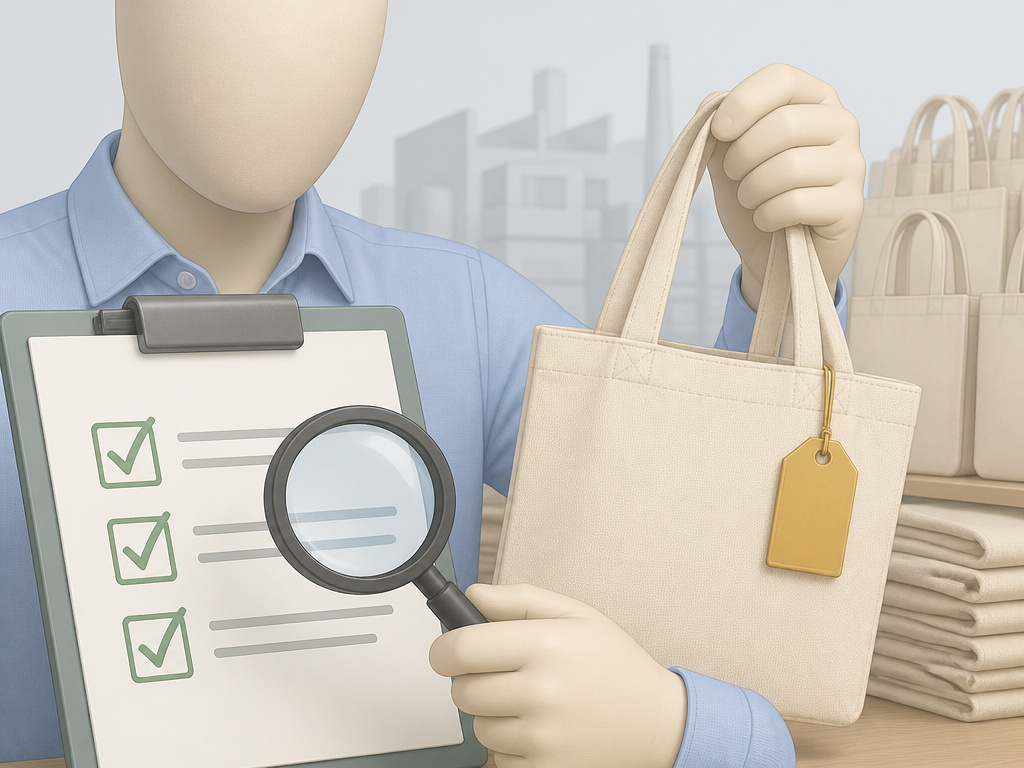 A perfect sample is a marketing tool. It proves a factory can make one good bag when they’re focused on you. Your job is to prove they can make 500 identical good bags while also working for ten other clients.
First, ask for comparable production references. Don’t accept “we make all kinds of bags.” Say, “Show me 2-3 tote bags you’ve produced in the last six months that are similar in material, printing method, and structure to what I need.” A factory that can’t provide this is either inexperienced or hiding inconsistent work.
Second, get specific on timelines and delays. A standard canvas tote takes 8-12 weeks. Add 1-2 weeks for custom hardware or quilting. Add 2-3 more weeks if you need Amazon FBA prep. Put these dates in the contract, with clear penalties for missing them.
Third, discuss the golden sample. This is the one bag you approve, sign off on, and keep as the physical benchmark for the entire production run. The factory must agree that the bulk order will match this sample in every measurable aspect. No surprises.
Design, Tech Packs, and Realistic Costs
 Your design needs to be translated into a language factories understand: the Tech Pack. This is a detailed document with technical drawings, material specs (e.g., 10oz cotton canvas), stitch types, hardware details, print artwork files, and all measurements.
Services like Optima Bags offer Tech Pack creation starting around $360. It’s worth the investment. A vague design leads to factory interpretation, and their interpretation will always be the cheapest, fastest method for them.
Your cost structure has layers beyond the bag itself. For a private label order, budget for: * Unit Cost: The price per bag from the factory. * Freight & Import Duties: Shipping a pallet from overseas. * Packaging: Polybags, hangtags, barcode stickers. * FBA/Prep Fees: If selling on Amazon. * Product Liability Insurance: A $1 million policy typically costs $400-$700 annually.
Leaving out any of these is how a “$5 per bag” cost becomes a “$15 landed cost” that kills your margin.
Legal and Operational Setup
 Treat this as a real business from the first sale. The operational boring stuff is what allows the creative fun stuff to thrive.
Form an LLC. It separates your personal assets from your business liabilities. Cost varies by state ($50-$200). If a customer has an issue, they sue the LLC, not you personally.
Get a general liability insurance policy that includes product liability coverage. This protects you if a defective bag strap breaks and someone’s laptop is damaged, or worse, someone is injured. It’s not optional for a physical goods business.
Set up a separate business bank account. It makes accounting clear and professional. Use accounting software like QuickBooks from the start to track every expense related to your tote bag business.
Launch, Market, and Scale
Your launch strategy depends on your path. A POD business lives on social media ads and Etsy SEO. A private label brand needs a professional website, email marketing, and perhaps wholesale outreach.
For DTC, focus on the specific use case you chose. Market your “gym-to-office tote” to fitness and professional communities. Content marketing showing the versatile uses of tote bags in real life builds trust. Consider the key considerations for a tote bag when writing product descriptions to answer buyer questions before they ask.
For B2B, network with event planners and corporate procurement officers. Your pitch is about branding, volume discounts, and reliable delivery.
Scaling means ordering more inventory, which increases risk. Your quality control processes must scale too. Consider hiring a third-party inspection service for future large orders to verify the factory’s own QC report.
Frequently Asked Questions
How much money do I need to start a tote bag business?
It ranges from about $100 for a print-on-demand test to $1,500-$5,000 for a small private label production run. The largest upfront cost is usually the inventory itself. Don’t forget to budget for sampling, legal setup (LLC), and product liability insurance.
What is the biggest mistake new tote bag businesses make?
They focus on design and marketing but outsource quality control to the factory by not defining specs. They get a great sample, then receive a production run with lighter fabric, sloppy stitching, or off-center prints. This results in unsellable stock, lost cash, and a six-month setback.
How do I find a reliable manufacturer?
Start with supplier directories like Alibaba, but vet deeply. Ask for references of similar past work. Request a detailed quote that breaks down material costs. Insist on a golden sample you approve before production. Finally, mandate the AQL 2.5 inspection standard in your contract. For smaller batches, domestic manufacturers or tote bag sewing specialists might be more manageable.
What are the best materials for durable tote bags?
For durability and a classic look, canvas tote bags are the standard. Heavier weight cotton canvas (10oz or more) holds shape well. For eco-conscious brands, rPET (recycled polyester) is a strong, water-resistant option. The best fabric for tote bags balances durability, cost, and the desired aesthetic for your niche.
Can I sell tote bags on Amazon?
Yes, but it’s a competitive channel. You’ll need to understand Amazon FBA requirements, including polybagging and labeling. Your product must be retail-ready, with professional packaging. Ensure your tote bag material and construction can withstand Amazon’s shipping and handling, as returns for perceived quality issues are common.
The Bottom Line
Starting a tote bag business is a logistics and quality control project disguised as a creative endeavor. Your design gets the first look, but your supplier agreement gets the last word. Define every tolerance, from stitch length to color variance, before a single bulk bag is cut. The AQL 2.5 standard is your contract’s most important line. Use it.
Choose your model based on the control you need, and validate that real people will buy your bag for a specific job. Then build the operational backbone—LLC, insurance, bank account—that lets the business survive its first mistake. The market is growing, but it only rewards those who treat their tote as a serious product, not just a pretty accessory.