How to Ship a Suitcase: A Step-by-Step Packing Guide (51 chars)
This post contains affiliate links. As an Amazon Associate, we earn from qualifying purchases.
You ship a suitcase by choosing a carrier that accepts luggage, packing it to prevent internal damage, protecting the exterior with stretch wrap, and securing it without locks for customs. The process hinges on three things: carrier-specific size and weight limits, proper internal packing, and external protection that doesn’t impede inspection.
Most shipping advice treats all carriers the same. They aren’t. A rule from one major carrier is absolute: if the zipper isn’t completely fastened, they won’t accept it. That’s not a suggestion, it’s a rejection at the counter. Another rule contradicts common travel sense: never lock your luggage for shipping, not even with TSA locks. Customs officers will cut them off.
What follows is the difference between general tips and carrier-enforced procedure. We’ll cover the Kuroneko Yamato size limits that include wheels in the measurement, the ExpediShip warning on locks, and the manufacturer manual that voids your warranty if you use the suitcase commercially. By the end, you’ll know which steps are flexible and which are non-negotiable.
Key Takeaways
- Never lock a shipped suitcase with a standard or TSA lock; customs authorities will cut them open. Use heavy-duty zip ties instead.
- Fully fasten every zipper. Carriers like Kuroneko Yamato explicitly reject luggage with unfastened zippers.
- Understand volumetric weight. For large, lightweight suitcases, shipping cost is based on size, not actual weight, which can multiply the price.
- Wrap the exterior in industrial stretch film to protect against scuffs, dirt, and moisture during handling.
- Remove all old airline tags and loose straps to prevent the suitcase from getting caught in automated sorting systems.
The One Mistake That Gets Your Suitcase Rejected
You can pack perfectly and still fail at the counter. The most common, immediate rejection reason is an unfastened zipper, not weight or size.
Carriers handle thousands of parcels daily on automated conveyor belts. An open zipper is a guaranteed snag point. When a zipper tag or loose fabric catches, the entire belt can jam. The suitcase itself can tear. For this reason, carriers have a zero-tolerance policy.
Where this goes sideways: An unfastened zipper. The Kuroneko Yamato FAQ states plainly: “If the zipper of your suitcase is not completely fastened, we cannot accept it.” Your shipment is dead on arrival.
The fix is simple, but it’s a final check you must not skip. Run your hand along every zipper track. Ensure the sliders are at the end of their run and the two sides are fully meshed. If your suitcase has a combination lock, engage it, not to secure the contents from theft, but to physically lock the zipper sliders in place so they cannot slide open during transit. This mechanical lock is different from the security lock you’ll avoid later.
This rule extends to any loose strap, dangling luggage tag, or retractable handle that isn’t fully secured. The industrial shipping environment is a network of fast-moving rollers, chutes, and sorting arms, unlike an airport baggage claim. Anything that can catch, will.
Locking vs. Securing: The Customs Problem Nobody Explains
Here is the single biggest contradiction between flying with a suitcase and shipping one. When you fly, you might use a TSA-approved lock. When you ship, you must never use any lock at all.
Customs authorities in the destination country have the legal right to inspect any international shipment. If your suitcase is selected and it’s locked, they do not have a master key. They have bolt cutters. According to shipping service ExpediShip, officers will “cut, break, or force open the locks and zippers,” which can permanently ruin the case. The carrier assumes no liability for this damage.
So how do you secure a suitcase you can’t lock?
The professional workaround is heavy-duty zip ties. Thread a zip tie through the zipper pull holes and tighten it. It prevents casual opening during transit but can be snipped in two seconds by a customs officer with the right tools. After inspection, they can replace it with a new tie. Your suitcase remains intact.
This approach aligns with the official IATA dangerous goods regulations, which govern what can enter a country by air. The regulations focus on contents, not containers, but the inspection principle is the same: authorities need access. Providing it without destruction is your job.
Suitcase or Box? The Carrier Rules on Packaging
You have two paths: ship the suitcase as-is, or put it inside a cardboard box. The right choice depends on your carrier’s rules and the level of protection you need.
Some carriers, like Kuroneko Yamato, will accept a standalone suitcase but have a specific caveat. If it’s not boxed and exceeds their “size 160” dimension limit, they will still ship it but charge you as if it were size 160, as long as it’s under 30kg. This is a potential loophole for a slightly oversized case, but it’s not a guarantee with all carriers.
Putting the suitcase inside a box is the safer, more universally accepted method. It provides superior protection against impacts, moisture, and dirt. The box also presents a flat, uniform surface for labels, unlike the curved, handled surface of a suitcase.
| Packaging Method | Best For | Key Risk If Skipped |
|---|---|---|
| Suitcase Only | Carriers that explicitly accept luggage (e.g., Kuroneko Yamato), quick domestic shipments. | Direct scuffing, torn handles/wheels, label damage on textured surfaces. |
| Cardboard Box | All carriers, international shipments, high-value contents, maximum protection. | Box must be significantly larger than suitcase to allow for internal cushioning (bubble wrap, foam). |
The golden rule for boxing: the outer box must be at least 6 inches larger in every dimension than the suitcase. This space is for cushioning material like bubble wrap or packing peanuts. A suitcase rattling inside a tight box offers no protection at all.
The 5-Step Packing Checklist (Inside the Suitcase)
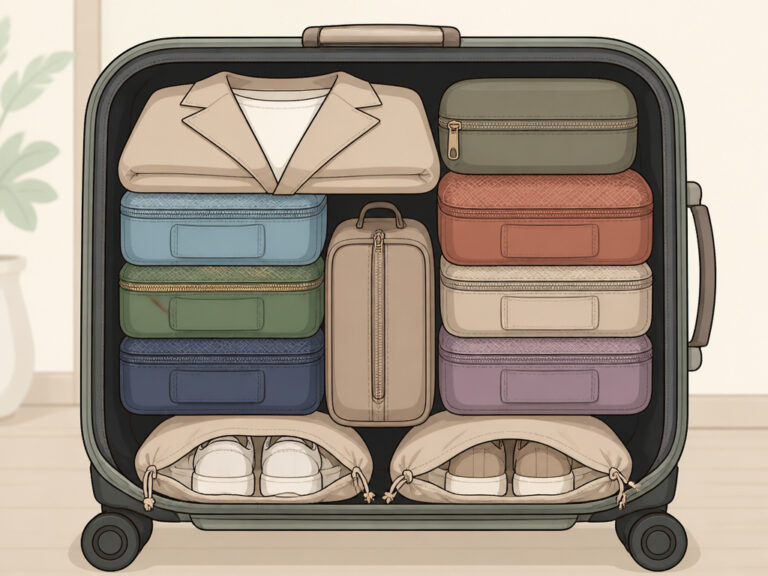
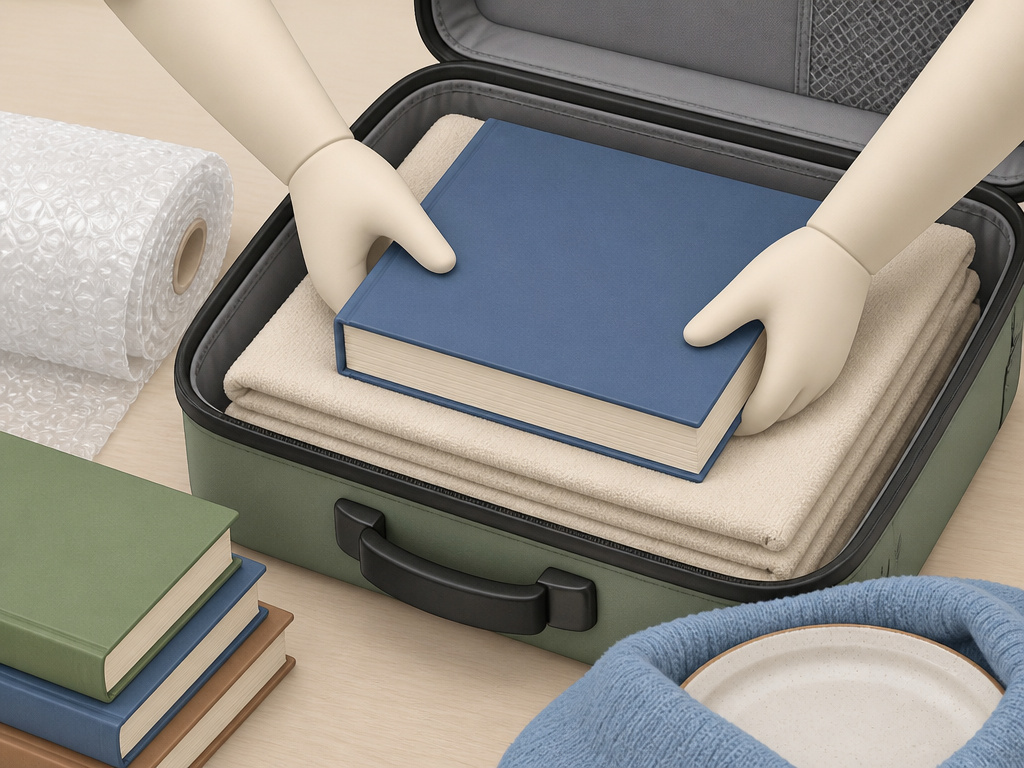 Packing for shipping is different from packing for travel. The goal shifts from accessibility to immobility and impact resistance. Your clothes are no longer just items; they are padding.
- Start with a Layer of Bottom Padding. Place a folded blanket, towels, or bubble wrap at the very bottom of the suitcase. This absorbs the initial shock when the case is set down hard.
- Load Heavy, Flat Items First. Books, dense electronics, shoes, these go in next, centered and flat. They form a stable, low center of gravity.
- Wrap Every Fragile Item Individually. Use clothing as your primary buffer. Wrap plates, frames, or ceramics in sweaters and t-shirts. For electronics, use proper foam or bubble wrap if available.
- Fill Every Cubic Inch of Void. Crumple packing paper, socks, or soft goods into every gap. When you shake the suitcase, nothing should move or make a sound. This prevents items from hammering against each other for thousands of miles.
- Bag All Liquids and Toiletries. Place any liquids, even sealed ones, inside a ziplock bag, then wrap that bag in a towel. Air pressure changes in plane cargo holds can force seals to leak.
Following a meticulous guide to packing a suitcase for shipping turns your belongings into a single, solid unit. It’s the difference between a vase arriving intact or as a bag of dust.
Protecting the Exterior: More Than Just a Wrap
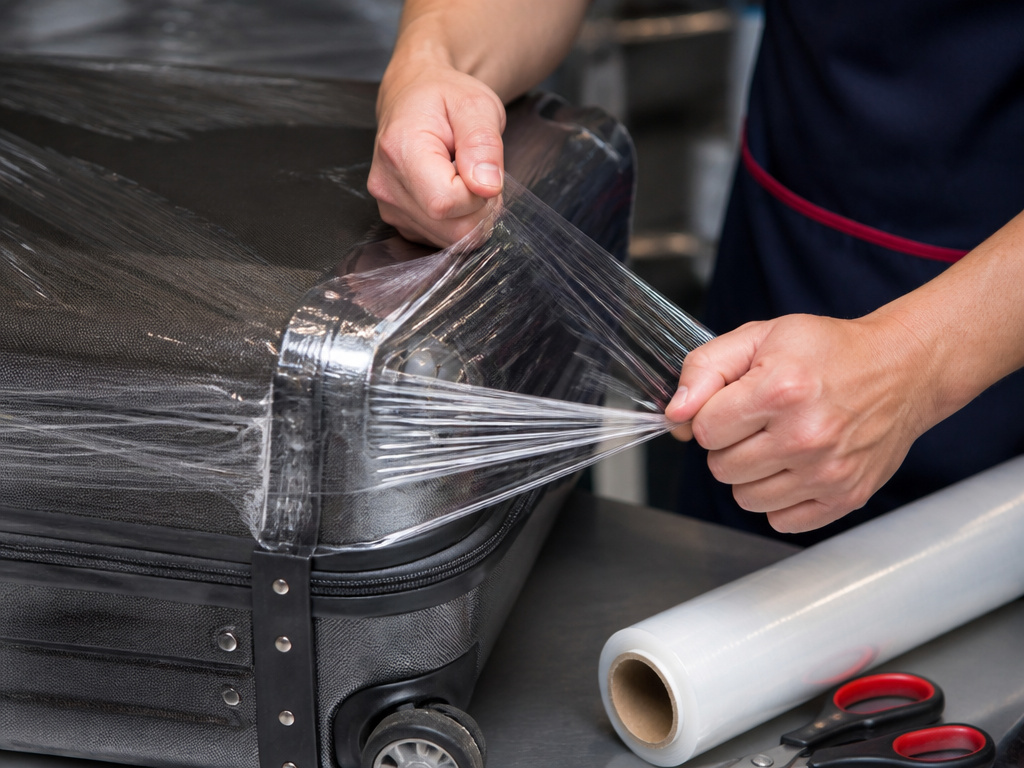 A suitcase’s exterior is designed for airport trollies and car trunks, not for sliding down metal chutes or being stacked under pallets. The corners, wheels, and handles are vulnerability points.
The standard is industrial stretch film. This clear plastic wrap is wound tightly around the entire case, typically 5-10 layers thick. It does three jobs: * Contains the suitcase if a zipper fails or a seam splits. * Protects the shell from scuffs, dirt, and water. * Secures loose parts like retracted handles and straps.
After wrapping, address the label. Print at least two copies of the shipping label. Place one inside a clear plastic document sleeve and secure it to the most visible, flat surface of the suitcase or box with heavy-duty packing tape. Tape over the entire sleeve, sealing it against the elements. Put the second copy inside the suitcase, on top of the contents, as a backup.
Finally, remove any visual confusion. Take a knife and cut off every old airline luggage tag, destination sticker, or barcode from previous trips. A single stray barcode can misdirect your suitcase in an automated facility.
Understanding Size, Weight, and “Volumetric” Price Traps
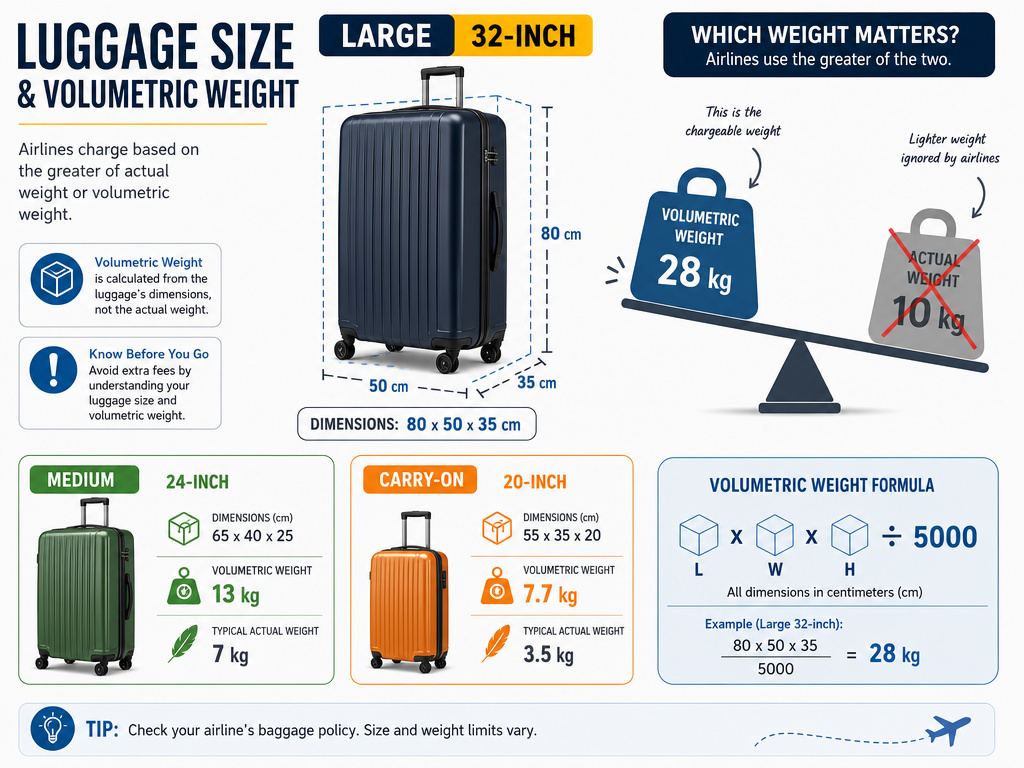 You know your suitcase’s weight. The carrier cares about two weights: actual and volumetric.
Actual weight is what your scale shows. Volumetric weight is a calculation that turns size into a “weight equivalent” for pricing. The formula is typically (Length x Width x Height) / 166 (for inches) or / 5000 (for centimeters). Carriers charge whichever weight is greater.
This is where shipping a large, lightweight suitcase becomes expensive. An empty or half-full 32-inch suitcase might only weigh 10kg. But its volumetric weight could be 25kg. You pay for 25kg.
| Suitcase Size | Example Dimensions (cm) | Volumetric Weight (kg) | What It Means |
|---|---|---|---|
| Large (32″) | 80 x 50 x 35 | 28.0 | Even if empty, you pay for a 28kg shipment. |
| Medium (26″) | 65 x 45 x 30 | 17.6 | A better efficiency ratio for dense items. |
| Carry-on (22″) | 55 x 40 x 23 | 10.1 | Rarely triggers volumetric pricing. |
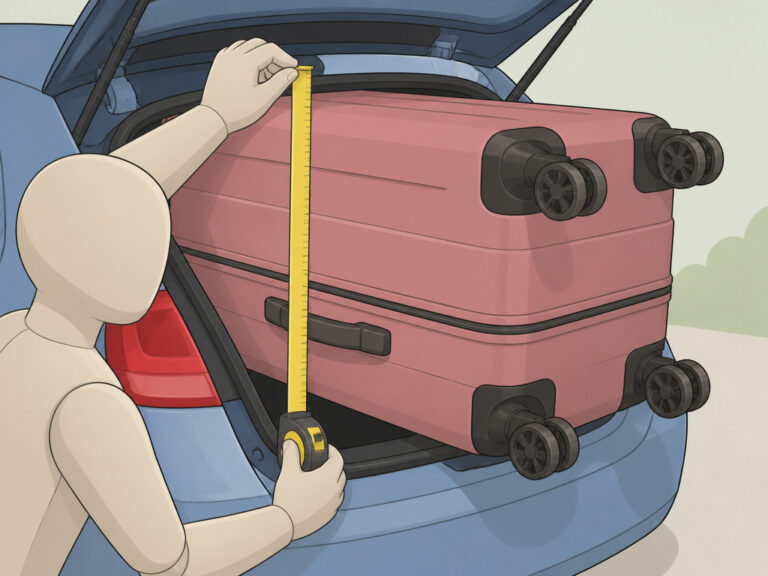
Always check the carrier’s specific size limit. For example, Kuroneko Yamato’s maximum is 200cm total (length + width + height), and they include the wheels in that measurement. A standard 28-inch suitcase with wheels can easily hit 75+45+30 = 150cm. You have 50cm of leeway, but you must measure.
The takeaway: if you’re shipping a large suitcase, fill it with dense, heavy items (like books or clothing) to make the actual weight exceed the volumetric weight. Otherwise, you’re paying for air.
The Manufacturer’s Fine Print: What Voids Your Warranty
That suitcase manual isn’t just for the lock combination. It contains legally binding terms about how you can use the product. Ignoring them can void your warranty and any insurance claim.
Most suitcase warranties, like the 3-year coverage cited in the sit-connect.com manual, are explicitly for private use only. The manual states: “This product was exclusively designed for private use and is not suitable for commercial use.” If you are a business shipping products to customers inside this suitcase, or using it repeatedly for commercial logistics, the manufacturer’s warranty is null.
Furthermore, manuals specify a maximum filling weight. One model lists a max of 30kg. Exceeding this risks the internal frame buckling under stress in a shipping environment far rougher than an airport, not just the handle breaking. If the suitcase fails and you were over weight, the warranty claim will be denied.
Before you ship, find your suitcase’s manual online. Check its rated weight capacity and its intended-use clause. This is a non-negotiable spec, as critical as the carrier’s own limits.
Frequently Asked Questions
Can I ship a suitcase internationally?
Yes, you can ship a suitcase internationally via cargo carriers, international postal services, or specialized luggage shipping companies. The process is stricter than domestic shipping, requiring detailed customs paperwork (a commercial invoice), compliance with the destination country’s import rules, and strict adherence to prohibitions on items like batteries, aerosols, and plants outlined in the IATA dangerous goods regulations.
How much does it cost to ship a suitcase?
Shipping cost is determined by the carrier’s rates, the destination, the speed of service, and the greater of the actual weight or volumetric weight. A large, lightweight suitcase shipped internationally can cost several hundred dollars due to volumetric pricing. Domestic shipping is often cheaper, but prices vary widely.
What is the cheapest way to ship a suitcase?
The cheapest way is often via ground services (like postal service or freight carriers for domestic shipments) and by maximizing weight efficiency to avoid volumetric pricing. Putting a suitcase inside a cardboard box you already have is cheaper than buying a specialty “luggage box.” Comparing rates from multiple carriers is essential.
Can I ship a suitcase via USPS?
Yes, the US Postal Service will ship a suitcase if it is securely packaged inside a cardboard box and meets their size and weight limits. You cannot simply stick a label on a naked suitcase and hand it to USPS. It must be boxed. They also have specific restrictions on international contents.
Do I need insurance when shipping a suitcase?
Yes, you should always declare the full value and purchase shipping insurance. Standard carrier liability for lost or damaged shipments is often very low (e.g., $100). If your suitcase contains $1500 worth of belongings, you need separate insurance coverage. Document the contents with photos before sealing the case.
The Bottom Line
Shipping a suitcase succeeds or fails on specifics. It’s not just packing; it’s matching your actions to the carrier’s literal rules. Measure including the wheels. Fasten every zipper completely. Replace locks with zip ties. Wrap the exterior like you’re protecting it from a storm.
The process is mechanical, not magical. Follow the limits in the manual, the regulations from IATA, and the blunt advice from carriers who see broken luggage every day. Your goal is to have the suitcase arrive looking like it never left your house, not just to get it there. That takes layers, of padding, film, and attention to the fine print everyone else skips.