How Big Is a 50L Backpack | The Carry-On Trap That Costs $75
This post contains affiliate links. As an Amazon Associate, we earn from qualifying purchases.
A 50L backpack is a 50-liter container, but its physical size varies wildly by model, from 28″ tall to over 33″ tall, and a “carry-on compatible” label only guarantees empty volume, not that it will fit an airline sizer when packed. The critical measurement isn’t liters; it’s the linear inches (height + width + depth) and your torso length.
That gap between marketing and reality is where checked bag fees live. A pack can be technically 50 liters yet stretch several inches beyond a 22″ x 14″ x 9″ sizer when its frame is curved or its fabric bulges.
What follows: the real dimensions of six top models, the one field test that proves “carry-on compatible” is a gamble, and how to match a pack’s specs to your body and your trip length.
Key Takeaways
- Litres measure capacity, not physical size. A 50L pack can be tall and skinny or short and deep. Always check the manufacturer’s dimensions in inches or centimeters.
- “Carry-on compatible” is not a guarantee. This label often refers to the empty pack’s volume. A fully loaded 50L backpack will almost always exceed standard airline linear-inch limits (usually 45 inches total).
- Torso length, not your height, decides fit. Your pack’s harness must match the distance from your iliac crest (top of your hip bone) to your C7 vertebra (the bony bump at the base of your neck).
- Weekend trips (1-3 nights) are the 50L backpack’s sweet spot. This capacity is ideal for efficient packers with modern, compressible gear. For longer trips or bulkier items, you’ll likely need more space.
- Weight distribution matters more than total capacity. A well-designed 50L pack with a proper hipbelt can carry 30lbs comfortably. A poorly fitted 70L pack will hurt with 20lbs.
The 50L Backpack vs. The Carry-On Sizer (A Real-World Test)
You see “carry-on compatible” printed on a tag. You think you’re safe. Then you’re at the gate, facing a metal box and a line of impatient travelers.
Where this goes sideways: Assuming a “carry-on compatible” label on a 50L pack is a guarantee. It usually means the pack meets the volume of a carry-on when empty and uncompressed, not the linear inch dimensions when full.
The incident with the Granite Gear Perimeter 50 proves the point. Its listed dimensions were 28″ x 13″ x 11″. That’s 52 linear inches, already over the typical 45-inch limit. At the gate, the agent made the owner test it. It slid into the sizer, barely, when compressed with a knee. On the return flight, packed tighter with souvenirs, it wouldn’t budge. That was a $75 checked bag fee.
The lesson isn’t about that specific pack. It’s about physics. A backpack is a soft container. Its frame and fabric give, but only to a point. Fill every liter, and the pack will reach, and often exceed, its stated dimensions. Curved frames designed for ergonomics add extra inches. A mesh back panel that provides ventilation also creates a bulge.
Do you actually know your airline’s linear inch limit? Most are 22″ x 14″ x 9″. That’s 45 inches total. Very few 50L packs, when fully loaded, will sum to less than that. The Osprey Atmos AG 50 in size S/M is 31.89″ H x 14.96″ W x 12.2″ D. Do the math: 31.89 + 14.96 + 12.2 = 59.05 linear inches. It’s not even close.
If avoiding a checked bag is critical, you have two paths. First, look for packs specifically designed for travel, not backpacking, they tend to be boxier and sized to the inch. Second, never fill a 50L backpack to capacity if you plan to carry it on. Use the compression straps aggressively and leave 10-15% of the main compartment empty.
The Three Numbers That Actually Matter
Forget the big number on the tag for a second. Three other specs will determine if a 50L backpack works for you: its dimensions, its torso size range, and its recommended load range.
A pack’s dimensions tell you if it will fit in an overhead bin. Its torso range tells you if it will fit on your back. Its load range tells you if it will remain comfortable when filled.
Let’s look at real data. The following table compares how different brands interpret “50 liters” physically. Notice the staggering difference in height between the ultralight Gossamer Gear and the full-featured Osprey.
| Model & Size | Volume (L) | Dimensions (H x W x D) | Key Design Note |
|---|---|---|---|
| Osprey Atmos AG 50 (S/M) | 50 L | 31.89″ x 14.96″ x 12.2″ | Anti-Gravity mesh backpanel adds height & bulge. |
| Exped Lightning 50 (S/M) | 50 L | 27.6″ x 13.8″ x 9.8″ | Sleek, top-loading tube; most sizer-friendly shape here. |
| Rab Muon 50L | 50 L | 29.5″ x 13.8″ x 11.8″ (approx) | Recycled nylon, simple panel load; a middle-ground height. |
| Gossamer Gear Gorilla 50 (Medium) | 50 L (32L main + extension) | 24″ x 11″ x 4.7″ (main body) | Ultralight; relies on extension collar for full volume, so height varies. |
| Granite Gear Perimeter 50 (Regular) | 50 L | 28″ x 13″ x 11″ (reported) | “Carry-on compatible” claim failed the real-world sizer test. |
| Deuter Aircontact Ultra 50+5 | 50+5 L | 29.9″ x 11″ x 9.8″ (approx) | Ventilated back system; depth can expand with the “+5” extension. |
Torso length is non-negotiable. This is the single most important factor for comfort and weight transfer. You measure from your iliac crest to your C7 vertebra. The Osprey Stratos 50 fits a range of torso lengths via an adjustable harness, detailed in its manual. The Granite Gear Perimeter 50 offers a regular (18″-21″) and long (21″-25″) fit. Picking the wrong size means the hipbelt won’t sit on your hips, and the shoulder straps will choke you or hang loose.
Recommended load range is your safety cue. The Osprey Stratos 50 is rated for 25-40 lbs. The Deuter Aircontact Ultra 50+5 suggests 12-15 kg (26-33 lbs). Exceed these limits, and the frame may flex, the stitching may strain, and your shoulders will bear the weight your hips should be carrying. A 50L pack is not a sherpa’s load hauler; it’s a day-and-a-half to four-day pack for disciplined packers.
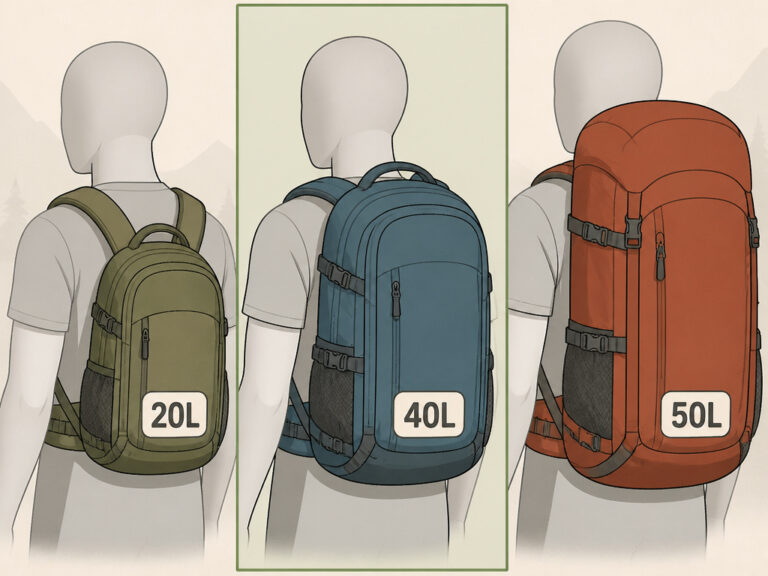
How a 50L Backpack Compares to Other Sizes (30L, 40L, 60L)
Where does 50 liters sit in the lineup? It’s the crossover point between minimalist travel and serious backpacking. To see the difference, you need to compare it to the packs on either side.
A 30-liter backpack is a large daypack or a very sparse overnight bag. It’s what you take on a day hike with a jacket, lunch, and a first-aid kit. You can force a weekend into it, but only if your sleeping bag is the size of a football and you wear the same clothes for three days.
The jump to a 40L backpack is significant. It’s the true weekend warrior size. You can fit a compact sleeping bag, a pad, a small tent, a stove, and food for two nights. It’s also the upper limit for comfortable carry-on travel. Many 40L packs are designed specifically to hit 22″ x 14″ x 9″.
The 50L backpack is the next logical step. It adds room for a warmer sleeping bag, a bulkier tent, more food, or extra layers for variable weather. It’s the most popular size for 3-5 night summer trips, according to REI’s expert advice. This is the “multiday” category.
Move up to 60-70 liters, and you’re entering extended trip or winter gear territory. You need that space for a four-season tent, a thicker sleeping bag, more fuel, and heavier clothing. The trade-off is weight and bulk. A 50L pack forces efficiency; a 70L pack invites overpacking.
The bottom line: If you’re debating between a 40L and a 50L pack, choose the 40L if carry-on compliance is your top priority. Choose the 50L if you need the flexibility for longer trips or bulkier gear, and you’re willing to check it or pack it lightly for flights.
What Can You Actually Fit Inside 50 Liters?

Volume is an abstract concept until you try to stuff a puffy jacket next to a water bladder. Let’s make it concrete.
A 50L backpack typically has a main compartment, a sleeping bag compartment at the bottom, a front shove-it pocket, and two side pockets. The main compartment might hold 35-40 of those liters. Here’s what that space can realistically contain for a 3-season, 3-night trip:
- A compact 3-season sleeping bag (stuffs to about 8L).
- An inflatable sleeping pad (rolls to 2L).
- A lightweight 2-person tent (around16L, including poles).
- A simple cook kit with fuel canister (3L).
- Food for four days (highly variable, but roughly 10L).
- A water filter and 1L bottle (2L).
- A basic first-aid kit, headlamp, and toiletries (3L).
- Clothing: one worn outfit, one spare, rain jacket, puffy, extra socks/underwear (12L compressed).
That’s 56 liters, and we haven’t counted the pack itself or any luxury items. This is why compression sacks and strategic packing are mandatory. You must crush the soft items (clothing, sleeping bag) to make room for the hard ones (food, cookware).
Common mistake: Packing for a “just in case” scenario. Every extra pair of socks, every backup gadget, fills space that could be left empty for food or for compressing the load. A 50L pack rewards ruthless editing.
The internal architecture changes what you can fit. A pack with a dedicated hydration reservoir sleeve (like the Osprey Stratos) saves you from sacrificing a water bottle pocket. A floating top lid provides a quick-access spot for snacks and sunscreen. Those side pockets? If they’re stretchy mesh, you can stash a wet rain jacket there without soaking everything else.
Choosing the Right 50L Backpack: Frame, Fit, and Features

Not all 50L backpacks are built for the same job. The right one for a thru-hiker is wrong for a mountaineer. Your choice hinges on three F’s: Frame, Fit, and Features.
Frame type dictates how the load rides. An internal frame pack, like the Osprey Atmos AG 50, hugs your body and moves with you on uneven trails. An external frame pack (rarer now) keeps the load further from your back, offering superior ventilation but less stability on scrambles. A frameless pack, or one with a removable frame like the Gossamer Gear Gorilla 50, saves weight but transfers the load directly to your shoulders, fine under 25 lbs, miserable over 30.
Fit is a two-part process. First, match the pack’s torso range to your measurement. Second, dial in the harness on your body. This means adjusting the load lifter straps so they pull the top of the pack inward at a 45-degree angle, and tightening the hipbelt so the lumbar pad cups the curve of your lower back. Shoulder straps should rest comfortably without gaping or digging in. Many packs, like the Deuter Aircontact Ultra 50+5, use a Clip & Loop system for fine-tuning back length.
Features should solve your specific problems. Use this table to match your primary activity to the must-have specs.
| Primary Use Case | Prioritize These Features | A Model to Look At | Feature Why-Layer |
|---|---|---|---|
| Airplane Carry-On Travel | Linear dimensions ≤ 45″, boxy shape, suitcase-style opening. | Travel-specific packs (e.g., Matador Globerider 45) | A boxy shape maximizes sizer compliance; a clamshell opening lets you pack like a suitcase. |
| 3-Season Backpacking | Good hipbelt, ventilated back panel, trekking pole attachments, raincover. | Osprey Atmos AG 50, Deuter Aircontact Ultra 50+5 | The hipbelt carries 80% of the weight; ventilation prevents sweat buildup; attachments keep essentials accessible. |
| Ultralight Hiking | Minimal weight, removable frame/lid, large external stretch pocket. | Gossamer Gear Gorilla 50, Exped Lightning 50 | Every ounce saved reduces fatigue; removable parts let you shed weight as consumables (food, water) are used. |
| Ski Touring / Mountaineering | Ice axe loops, reinforced crampon patch, A-frame ski carry, streamlined profile. | Deuter Guide 42+6 SL, Gregory Alpinisto 50 | Tool attachments secure sharp gear safely; a narrow profile prevents snagging and improves balance on technical terrain. |
For most people heading into the woods for a few nights, the default pick is an internal-frame pack with a solid hipbelt and some ventilation. The Osprey Atmos AG 50 is a benchmark for a reason, its Anti-Gravity mesh is a game-changer for sweaty backs. If you value weight savings over every feature, the Exped Lightning 50 at just over 2.5 lbs is worth the step up in price.
How to Measure Your Torso for a Perfect Fit

You can’t guess this. You need a flexible tape measure and a friend.
- Find your iliac crest. Stand up straight and place your hands on your hips. Feel for the top of your hip bones. This is the baseline.
- Find your C7 vertebra. Tilt your head forward. The most prominent bone sticking out at the base of your neck is the C7. This is the top line.
- Have your friend measure. They should follow the contour of your spine from the iliac crest to the C7 vertebra. Don’t pull the tape tight; just let it follow the curve. That number is your torso length.
Now, compare that number to the pack’s size chart. If you measure 19 inches, and the pack’s Regular size fits 18″-21″, you’re in the middle, perfect. If you’re 21.5 inches, you need the Long size. Do not size up or down to make it work. A pack that’s too long will ride low and hit your tailbone. A pack that’s too short will put the hipbelt on your ribs.
The part nobody mentions: Your torso length can change slightly throughout the day as your spine compresses. Measure in the afternoon, not first thing in the morning, for the most accurate, trail-ready number.
Once you have the pack, load it with 20-30 lbs of gear (use towels, books, water bottles). Put it on. Tighten the hipbelt first, securing it snugly over your hip bones. Then, tighten the shoulder straps just enough to pull the harness onto your shoulders without taking weight off the hips. Finally, cinch the load lifter straps until they form that 45-degree angle. The pack should feel like an extension of your body, not a separate weight pulling you backward.
Frequently Asked Questions
Is a 50L backpack a carry-on?
It depends entirely on the specific backpack’s dimensions and the airline’s rules. While many 50L backpacks are marketed as “carry-on compatible,” their stated linear dimensions (height + width + depth) often exceed the standard 45-inch total limit when fully packed. Always check the manufacturer’s listed dimensions and compare them to your airline’s sizer size before relying on it as a carry-on.
How many days can you pack in a 50L backpack?
For an efficient packer using modern, compressible gear, a 50L backpack is ideal for 1 to 4-night trips in 3-season conditions. It can stretch to a week if you are ultralight or have opportunities to resupply food. For longer trips, colder weather, or bulkier gear, a 60L or 70L pack is a safer choice.
What is the difference between a 50L and 60L backpack?
The primary difference is 10 liters of capacity, which translates to room for extra food, a warmer sleeping bag, or bulkier clothing. Physically, a 60L pack is often 2-4 inches taller and may have a deeper main compartment. This extra space provides flexibility for longer trips but also tempts overpacking and adds weight to the pack itself.
Can a 50L backpack be used for hiking?
Absolutely. A 50L backpack is one of the most popular sizes for multi-day hiking and backpacking. It provides enough space for shelter, sleep system, cookware, food, and layers without being overwhelmingly large. Look for models with dedicated hiking features like trekking pole attachments, a ventilated back panel, and a robust hipbelt, such as the Osprey Atmos AG 50 or the Deuter Aircontact Ultra 50+5.
How do you know if a 50L backpack is too big for you?
Backpack is too big if you cannot properly fit the harness to your torso length, leaving the hipbelt sitting on your ribs or the shoulder straps dangling. It is also too big if you consistently fill less than 2/3 of its capacity, as the empty space will cause the load to shift and destabilize you. If you never use the extra volume, you’re carrying unnecessary pack weight.
Is a 50L backpack good for airline travel?
50L backpack can be used for airline travel, but it is best checked as luggage. While you can carry a backpack on a plane, a full 50L pack will likely need to be checked as a backpack. To use it as a personal item backpack, you must pack it lightly and use compression straps to minimize its bulk.
The Bottom Line
A 50L backpack is not a single size. It’s a category where the Osprey Atmos AG 50 stands over 31 inches tall and the Gossamer Gear Gorilla 50 starts under 24. The number on the tag promises space; the dimensions on the spec sheet predict fights with overhead bins.
Your job is to match the physical object to your body and your trip. Measure your torso. Compare linear inches to airline limits. Be brutally honest about how much you actually need to carry. For weekend warriors and summer hikers, a 50L pack is the perfect bridge, capable enough for the trail, manageable enough for the travel to and from. Just don’t bet $75 that it’ll fit in the sizer.