Standard Carry On Luggage Size Explained for All Airlines
This post contains affiliate links. As an Amazon Associate, we earn from qualifying purchases.
The standard carry on luggage size for most major U.S. Airlines is 22 inches long, 14 inches wide, and 9 inches deep. That’s the “case” or “interior” dimension, not counting wheels and handles. If a bag’s overall dimensions, wheels and handles included, exceed that, it likely won’t fit in the sizer bin at the gate.
That distinction between case and overall size is where trips get complicated. A bag marketed as a 21-inch carry-on might measure 23 inches when you include its spinner wheels. You need to know which number the manufacturer is giving you.
What follows is a breakdown of the two measurement systems, a comparison of five real bags against the standard, and the one feature that can turn a compliant bag into gate-checked luggage in ten seconds.
Key Takeaways
- The 22″ x 14″ x 9″ carry-on size is a case dimension for U.S. Airlines like Delta, American, and United. Always check if a bag’s listed size includes wheels and handles.
- Linear inches (length + width + depth) is the real limit for many airlines, especially international ones. The common ceiling is 45 linear inches.
- Expandable zippers add 1-2 inches of depth. Using them can push your bag over the size limit, turning a legal carry-on into one you must check.
- Weight limits are separate and stricter on international and budget carriers. A bag that fits the sizer can still be rejected if it’s over 15-22 pounds.
- Soft-sided bags often compress to fit a tight sizer, while hard-shell cases offer no give. Choose based on the airlines you fly most.
The 22x14x9 Inch Standard (And Why It’s a Trap)
That trio of numbers, 22, 14, 9, is the U.S. Domestic benchmark. Delta, American, United, and Southwest all publish some variation of it. But here’s the catch: airlines measure with an external sizer bin at the gate. That bin accounts for every protruding part.
Where this goes sideways: Manufacturers often list the smaller “case” dimensions on their spec sheets. The Travelpro Maxlite 5 states its case is 21 x 14 x 9 inches. Its overall dimensions, including wheels and handles, are 23 x 14.5 x 9 inches. That extra 2 inches in length is the difference between sliding it into the bin and forcing you to check it.
You must verify which set of numbers you’re reading. Look for phrases like “overall dimensions (includes wheels and handles)” or “exterior measurements.” If you only see one number, assume it’s the larger, overall size.
How Airlines Actually Enforce Carry On Size Limits
Enforcement is inconsistent but follows a pattern. On a packed flight, gate agents are more likely to pull out the sizer. Budget airlines like Spirit and Frontier are notorious for measuring and weighing every bag. Full-service carriers are more lenient on lightly booked routes, but they always reserve the right to check.
The sizer bin itself is the final judge. Its internal dimensions are usually exactly the airline’s stated maximum carry-on size limit. If your bag doesn’t slide in with a gentle push, it fails.
Linear Inches: The International Carry On Rule
Many international airlines and some U.S. Carriers use a “linear inch” formula instead of three separate dimensions. You add the length, width, and depth together. The most common maximum carry-on luggage size by this method is 45 linear inches (22+14+9 = 45).
| Airline Type | Common Linear Inch Limit | Example Carriers |
|---|---|---|
| Major U.S. Domestic | 45 linear inches | Delta, American, United |
| International & Budget | 45 linear inches | British Airways, Lufthansa, Air Canada |
| Strict Budget & Regional | 42-44 linear inches | Spirit, Frontier, some regional jets |
This system benefits bags with unconventional proportions. A bag measuring 20 x 15 x 10 inches also equals 45 linear inches. It’s taller and deeper but shorter, which might fit a different packing style.
Case Dimensions vs. Overall Dimensions: A Real Bag Comparison
This is where marketing meets reality. Let’s look at five popular bags and their two sets of numbers. The “Overall” is what the airline sizer sees.
| Bag Model | Listed “Case” Dimensions (L x W x D) | Overall Dimensions (Incl. Wheels/Handles) | Does It Fit the 22x14x9 Standard? |
|---|---|---|---|
| Travelpro Maxlite 5 | 21″ x 14″ x 9″ | 23″ x 14.5″ x 9″ | No. Exceeds length and width. |
| Away The Carry-On | 21.7″ x 14.4″ x 9″ (exterior) | 21.7″ x 14.4″ x 9″ (includes wheels) | Yes. Away uses overall dimensions. |
| Briggs & Riley Baseline Medium | 21.5″ x 15.5″ x 9″ | Not specified; likely ~23.5″ L with wheels | No. Width is over. Briggs & Riley states it’s too large for carry-on. |
| Travelpro Crew Classic | 20.5″ x 13.75″ x 9″ | 23″ x 14.5″ x 9.5″ | No. Exceeds in all three dimensions when expanded. |
| Delsey Paris Carrousel | 20.25″ x 13.5″ x 10″ | 22″ x 14.75″ x 10.5″ | No. Depth is over when expanded. |
Notice a pattern? Only the Away The Carry-On lists its exterior dimensions upfront and stays within the 22x14x9 frame. The others either exceed it in overall size or have a width/depth that pushes past the limit. This isn’t a mistake, it’s manufacturers designing to the absolute edge of the sizer, knowing a soft-sided bag can be squeezed.
The Expandable Loophole
An expandable zipper adds packing space but also risk. Both Travelpro models and the Delsey Carrousel warn that the fully expanded carry-on luggage size “may not meet airline restrictions.” That extra 2 inches of depth is the difference between 45 and 47 linear inches.
Common mistake: Packing with the expander zipped open for the outbound flight. If the gate is busy, you will be forced to check it. Use the expansion only for the return trip, after you’ve cleared the departing gate.
How to Measure Your Own Bag Correctly
 Don’t trust the tag. Grab a tape measure.
- Measure Length: Place your bag upright on its wheels. Measure from the floor to the top of the retracted handle (fully extended if it’s a fixed handle).
- Measure Width: Measure across the bag at its widest point, side handle to side handle.
- Measure Depth: Include any external pockets, compression straps, or expansion zippers that bulge out.
Now add the three numbers. Is the total under 45? If so, you’re likely within the maximum dimensions for most airlines. This simple carry-on measurement guide beats guessing every time.
Worth knowing before you start: The sizer bin has rounded internal corners. If your bag is a rigid box, it might not fit even if the numbers match. A slightly soft-sided bag with rounded edges often fits where a hard-shell of the same dimensions jams.
Weight Limits: The Second Hurdle
 Size is only half the battle. Weight is the other, especially outside the U.S.
- Major U.S. Carriers: Often no strict weight limit for carry-ons, but they can impose one if the bag appears too heavy to lift overhead safely (typically around 40 lbs).
- International & Budget Airlines: Enforce strict limits, commonly 15-22 pounds (7-10 kg). They will weigh your bag at check-in and the gate.
Weigh your packed bag at home. A lightweight frame like the Travelpro Maxlite 5 (5.4 lbs) gives you more packing weight allowance than a heavier Away The Carry-On (7.5 lbs).
Hard-Side vs. Soft-Side: A Compression Advantage
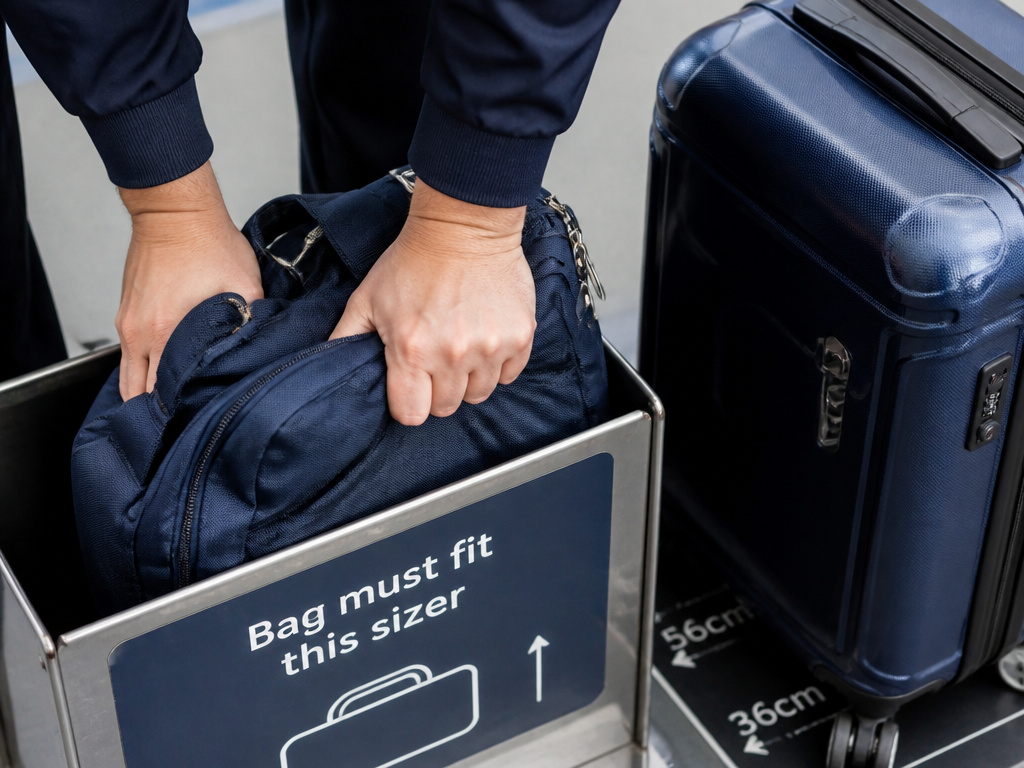 This choice directly impacts your acceptable carry-on size.
A soft-sided bag made of nylon or polyester can be compressed by an inch or two to fit a tight sizer. The Travelpro Crew Classic is built for this, crew members know how to shove it in. A polycarbonate hard-shell like the Away or Delsey offers zero give. If it’s 22.1 inches tall, it’s not fitting.
For strict airlines, soft-sided is the safer bet. For durability and organization, hard-sided wins.
The One Bag That Fits (Almost) Everywhere
If you need a single answer: get a soft-sided, non-expandable spinner with published overall dimensions at or under 21.5″ x 13.5″ x 9″. This leaves a half-inch margin of error on every side for sizer bins and overzealous agents.
The Travelpro Maxlite 5 is a strong contender if you never use its expander. The Away The Carry-On is a reliable hard-shell option because its stated size is the true size. For maximum flexibility, the Briggs & Riley Baseline series is superb quality but too large for strict international carriers, it’s a dedicated U.S. Domestic bag.
Bottom line: Buy the bag for your most common route, not your dream itinerary. A bag that’s slightly too big will be a problem on every third flight.
Frequently Asked Questions
What happens if my carry-on is slightly too big?
The gate agent can force you to check it at the gate, usually for a fee higher than checking it earlier. On a full flight, they are more likely to be strict. A soft-sided bag might be given a pass if you can compress it into the sizer.
Do personal item dimensions count towards carry on size?
No. Your personal item (backpack, purse, laptop bag) has its own, smaller size limit, typically around 18 x 14 x 8 inches. It must fit under the seat in front of you. Your carry-on must fit in the overhead bin.
Is the 22x14x9 size a guarantee for all flights?
No. It’s the standard for most large U.S. Airlines. Always check your specific airline’s website before you fly. Regional jets use smaller bins, and many international airlines use the 45 linear inch rule, which can translate to different dimensions.
How can I find my airline’s exact carry-on policy?
Go to the airline’s website and search “baggage” or “carry-on.” Do not rely on third-party travel sites, as policies change. The airline’s own “Baggage Info” page is the only source for the current airline carry-on size limits.
Are wheeled bags measured with the wheels?
Yes. Always. The sizer bin is a box. Wheels and handles are part of the bag that must fit inside that box. This is the most common reason a “22-inch” bag fails.
Before You Go
The standard carry-on luggage size is a starting point, not a guarantee. Your bag’s true test is the airline’s sizer bin, which measures overall dimensions. Before you buy, ignore the marketed “inch” size and find the “overall dimensions including wheels” on the spec sheet. If you frequently fly budget or international airlines, choose a bag that leaves a one-inch margin on all sides. And never, ever rely on an expandable zipper on your outbound flight. That extra space is for souvenirs on the way home, not for getting past the gate agent.