What Is a Faraday Bag | Signal Blocking Explained
This post contains affiliate links. As an Amazon Associate, we earn from qualifying purchases.
A Faraday bag is a portable, flexible shield that uses conductive materials like nickel-copper fabric to block all incoming and outgoing wireless signals, cellular, Wi-Fi, Bluetooth, GPS, and RFID. It creates a continuous conductive enclosure, redirecting electromagnetic waves around the contents inside. The bag’s effectiveness, measured in decibels (dB) of attenuation, hinges on its material, layer count, and most critically, the integrity of its seams and closure.
That 70 dB or 102 dB number on a spec sheet isn’t marketing fluff. It’s a quantifiable measure of how much signal power the bag stops, and it traces directly to the bag’s physical construction. A single layer of nickel-copper ripstop might hit 70 dB; a premium bag with six conductive layers and a magnetic seal can exceed 100 dB, enough to silence a 5G signal. The difference between a bag that works and one that fails often comes down to a millimeter-wide gap at a seam or a worn Velcro strip.
What follows: a breakdown of the physics, the materials that matter, the three closure types that decide success, and the specific failure modes that render a bag useless within months. You’ll also learn how to test any bag you own and why a cheap Amazon special is worse than no bag at all.
Key Takeaways
- Faraday bags work by creating a continuous conductive shield; any gap at a seam or closure becomes a “slot antenna” that leaks signal.
- Attenuation values (dB) are the only objective performance metric; look for published figures tied to specific frequency bands (e.g., 90 dB at 2.4 GHz).
- Roll-top and magnetic closures are reliable; standard Velcro fails above 3 GHz, making it useless against modern Wi-Fi and 5G.
- Bags have a finite service life, repeated folding, pocket carry, or a single puncture in the conductive mesh can create a leak.
- Always test a new bag by calling a sealed phone; many budget products, especially those marketed for “EMP protection,” are documented scams.
How a Faraday Bag Works: The Physics
A Faraday bag is a portable version of a Faraday cage, a principle demonstrated by Michael Faraday in the 19th century. The core idea is that a continuous conductive enclosure redistributes an external electromagnetic field around its exterior, leaving the interior electrically neutral. In practice, this means radio waves, the carriers for cell service, Wi-Fi, GPS, and Bluetooth, cannot penetrate the shield to reach a device inside. Likewise, signals generated by the device cannot escape.
A Faraday bag’s shielding effectiveness is quantified as attenuation, measured in decibels (dB). This number represents how much the bag reduces signal strength. For example, 70 dB of attenuation means the signal power inside the bag is one ten-millionth of the power outside. Each 10 dB increment represents a tenfold reduction in signal power.
The conductive layer is typically a woven fabric embedded with metallic fibers, such as nickel-coated copper or silver-coated nylon. When a radio wave hits this material, the free electrons in the metal move rapidly, generating an opposing electromagnetic field that cancels the incoming wave. This is not a filter that lets some frequencies through; it’s a blanket barrier against a broad spectrum. The effectiveness depends entirely on the shield being complete. A pinhole, a seam sewn with standard thread, or a loosely sealed closure acts as an antenna, funneling signal directly through the gap.
Why-layer: The decibel scale is logarithmic, not linear. A bag rated for 80 dB isn’t just “a bit better” than one rated for 70 dB; it’s ten times more effective at blocking signal power. This is why a few extra layers of conductive material or a superior closure can mean the difference between a phone staying silent and it ringing inside the bag.
Faraday Bag Materials & Construction
Not all conductive fabrics are equal, and the bag’s construction is where most cheap products fail. The material dictates baseline performance, but the seams and closure decide real-world reliability.
Nickel-copper ripstop is the industry standard for a reason. The nickel coating prevents copper corrosion, and the ripstop weave adds durability. This material provides consistent attenuation, around 70 dB for a single layer, across a wide range of temperatures and humidity. It’s the workhorse fabric in most legitimate bags designed for forensics or privacy.
Silver-coated textiles offer higher conductivity, which can push attenuation to 90–95 dB. They are more expensive and are often reserved for military or high-end forensic applications. However, silver can tarnish over time, which may marginally reduce performance if the coating degrades.
The real Achilles’ heel is the seam. If a bag is sewn with standard polyester thread, that stitch line creates a break in the conductive layer. To a radio wave, this break looks like a slot antenna, a perfect channel for signals to leak in and out.
Where this goes sideways: A bag is only as protective as its worst seam. Quality manufacturers use conductive thread or thermo-welding to fuse layers, maintaining the continuous shield. A bag without a described seam-sealing method is suspect.
Layering is the other key. Multiple conductive layers separated by insulating material improve attenuation by dealing with signal reflection and absorption at each interface. Faradaybags.cz’s 6+6 layer construction, tested at the Bundeswehr University in Germany, is an example, achieving up to 102 dB attenuation and compliance with MIL-STD-285 and ASTM D-4935-2010 standards.
| Material / Feature | Typical Attenuation | Best For | Failure Point |
|---|---|---|---|
| Single-layer nickel-copper | ~70 dB | General privacy, blocking cell signals | Seams, closure gaps |
| Multi-layer nickel-copper (e.g., 3+ layers) | 80-95 dB | Forensic use, securing key fobs | Material fatigue from folding |
| Silver-coated textile | 90-95+ dB | High-security, military applications | Tarnishing over very long periods |
| Conductive thread / welded seams | Maintains shield integrity | Any reliable bag | N/A – this is the solution |
| Standard stitched seams | Creates signal leak | Budget bags | Immediate |
Closure Types: The Critical Seal
The opening of a Faraday bag is its largest inherent gap. The closure system’s job is to eliminate that gap, creating a long, tortuous path that signals cannot navigate. The choice here has a direct, measurable impact on performance, especially at higher frequencies.
Roll-top closures are the most reliable. You fold the conductive fabric over itself multiple times, creating a long, indirect channel. This design is inherently resistant to leakage because there’s no mechanical seal to wear out. It’s common on bags designed for evidence handling where absolute certainty is required.
Magnetic closures, like those on Faradaybags.cz Generation M models, offer a strong seal with clear feedback, you feel the “click.” The magnetic strip creates continuous conductive contact along the opening. They are excellent for daily use and are less prone to user error than Velcro.
Velcro (hook-and-loop) closures are the most common and the most problematic. Standard single-fold Velcro creates a straight-line gap. While it may block lower frequencies (under 3 GHz), it leaks significantly at 5G and modern Wi-Fi bands. A high-performance, multi-fold Velcro variant can mitigate this, but it’s still a wear item. The hooks and loops will degrade with repeated use, eventually compromising the seal.
Common mistake: Assuming a Velcro-sealed bag is “good enough.” If your threat model includes Wi-Fi or 5G tracking, which most modern location services use, a standard Velcro closure is a known point of failure.
| Closure Type | Attenuation Integrity | Ease of Use | Durability Concern |
|---|---|---|---|
| Roll-top | Excellent (no direct path) | Slower, two-handed | Fabric wear at fold points |
| Magnetic | Very Good (continuous contact) | Fast, tactile feedback | Magnet strength over time |
| Standard Velcro | Poor above 3 GHz | Fast, one-handed | Hook/loop wear, collects lint |
| Multi-fold Velcro | Good (with design) | Moderate | Same as standard, but slower to fail |
When Do You Actually Need a Faraday Bag?
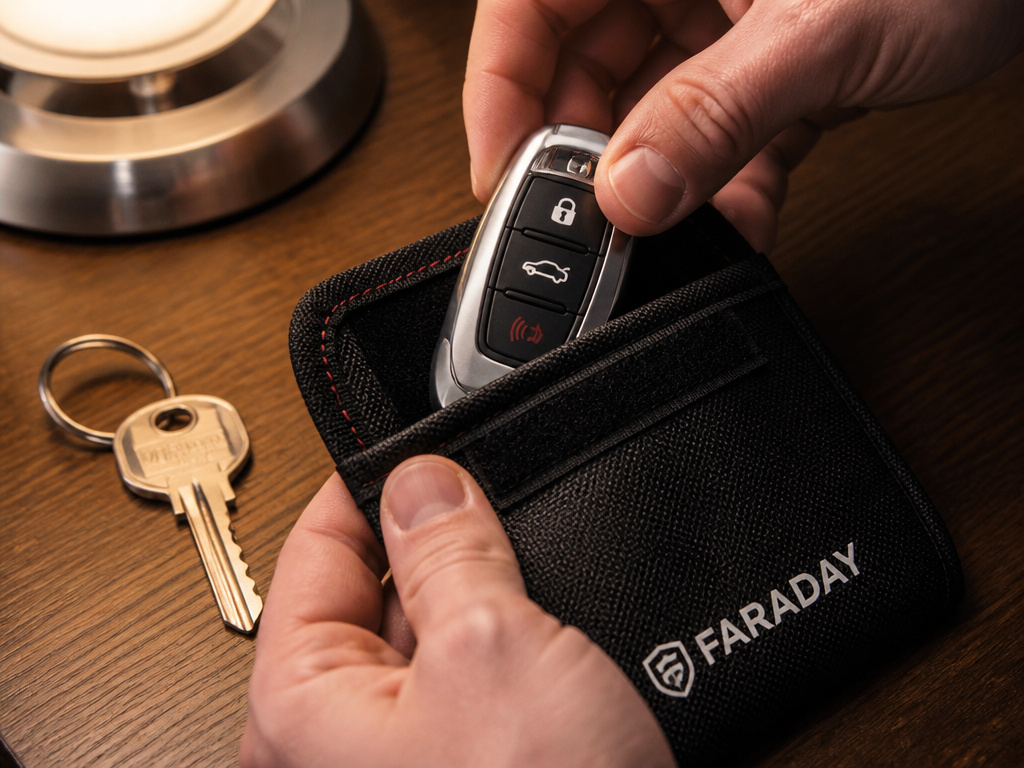
A Faraday bag isn’t everyday carry for most people. It’s a tool for specific scenarios where software-based solutions like airplane mode are either untrustworthy or insufficient. Its value lies in providing absolute, physical signal isolation.
Preventing car key relay attacks is a prime example. Thieves use amplifiers to extend the signal from your key fob inside your home to your car outside. A Faraday bag (or a dedicated Faraday box) blocks that signal completely. Storing your fobs in one overnight is a proven, physical countermeasure.
Travel and border crossings present another use case. While you can turn your phone off, modern iPhones continue to broadcast a low-power Bluetooth beacon for up to 24 hours for Find My purposes. A Faraday bag guarantees the device is silent. It also prevents remote wiping or tracking if your device is seized or inspected.
Forensic and legal security is the professional standard. Law enforcement and investigators use Faraday bags to isolate seized devices, preventing remote data alteration or destruction. The SWGDE mobile device guidance explicitly recommends this practice.
Privacy at sensitive gatherings is a consideration for journalists, activists, or anyone attending a protest. Cell-site simulators (Stingrays) can log all nearby devices. A phone in a Faraday bag is invisible to these devices, breaking the location data trail that can be used for identification later.
Testing & Failure Modes: Don’t Trust, Verify
The Reddit community is full of stories about Amazon-bought Faraday bags that fail basic tests. One user placed an 8-watt two-way radio inside a sealed bag, only to have it receive a transmission loud and clear. This is the norm for unscrupulous products, particularly those marketed with vague “EMP protection” claims.
How to test your bag:
- Place a powered-on phone inside.
- Seal the bag completely, following the manufacturer’s method (roll, snap, press Velcro firmly).
- From another phone, call the sealed device.
- If it rings, vibrates, or shows any sign of connection, the bag has failed. It’s not blocking signals.
A phone left on inside a working bag will drain its battery in under three hours because the modem increases its power output, searching fruitlessly for a network. This is actually a good sign, it means the bag is working.
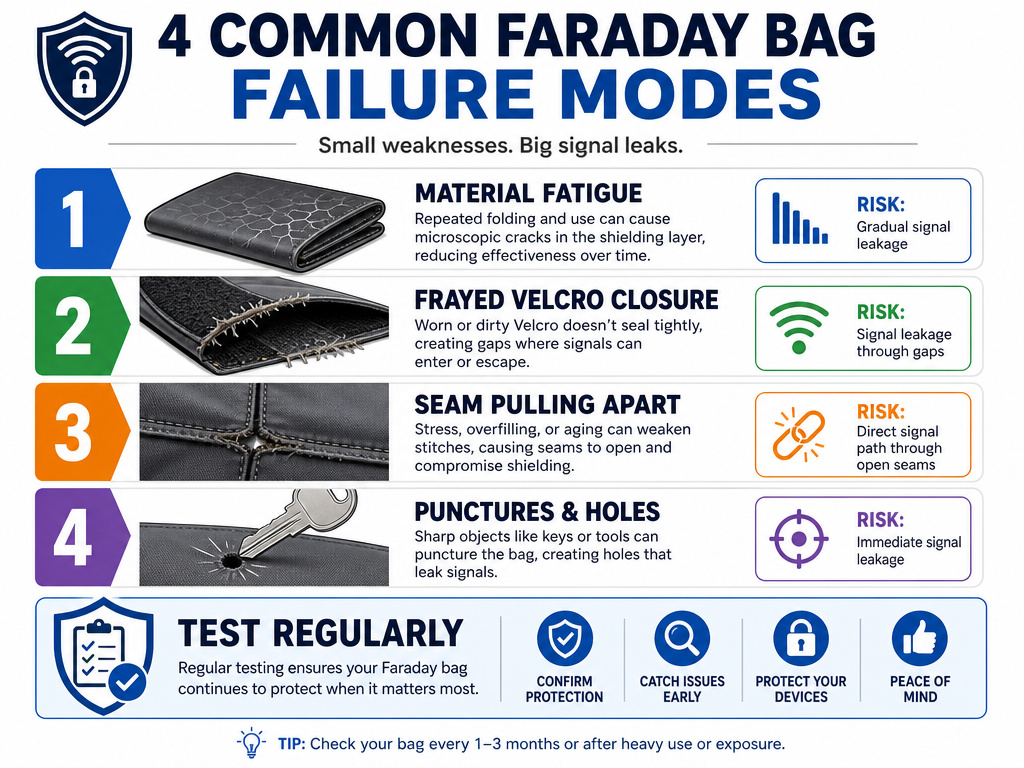
Faraday bags have a service life. They are not permanent fixtures. Here are the specific ways they degrade:
- Material fatigue: Repeated folding and bending, especially from carrying a small pouch in a pants pocket, can break the fine metal threads in the fabric. This creates micro-tears that leak signal.
- Closure wear: Velcro loses its grab, magnets can weaken, and roll-top fabric can crease permanently.
- Seam failure: Stitched seams can unravel. Thermo-welded seams can delaminate.
- Punctures: A sharp object can pierce the conductive mesh. A hole larger than the wavelength of the target signal (a few centimeters for cellular) renders the bag useless.
You should re-test your bag every few months, or anytime you suspect it’s been damaged. A bag that passes today might fail in six months.
Recommended Faraday Bags & What to Avoid
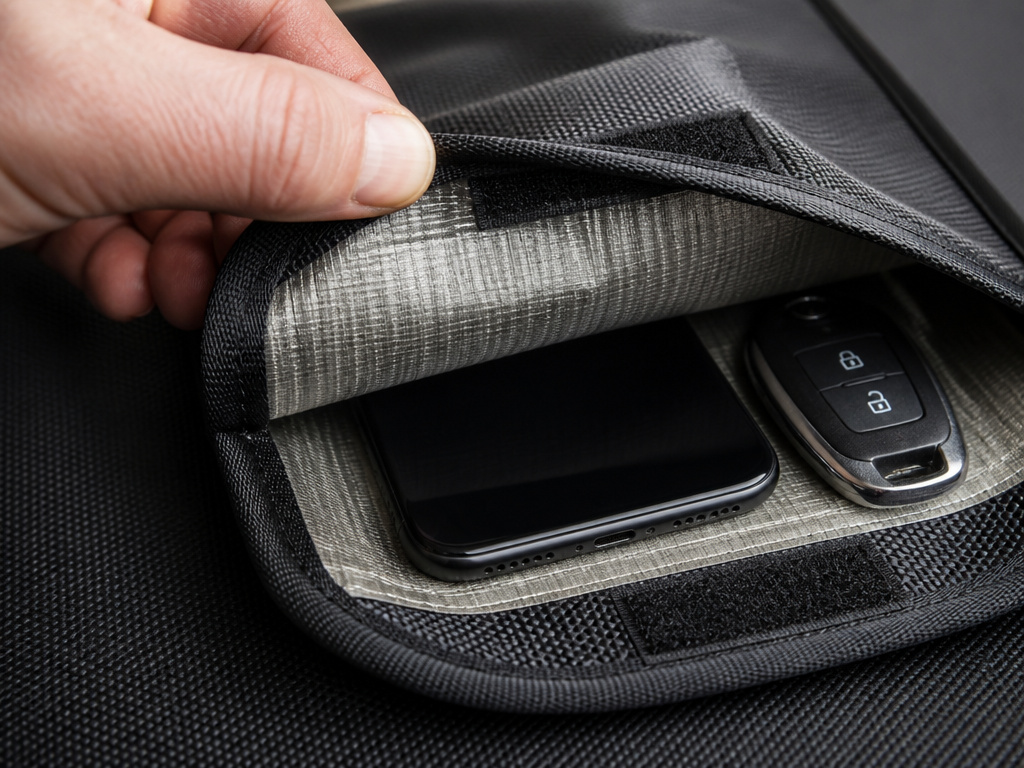
Based on community verification and manufacturer transparency, a few brands stand out. You want a bag that publishes its attenuation values at specific frequencies and details its construction.
Mission Darkness bags are frequently cited on Reddit as verified working. Users report consistent success with their phone-sized pouches and laptop sleeves. They provide attenuation charts, which is a positive sign.
Faradaybags.cz offers transparent specs, citing tested attenuation up to 102 dB and compliance with recognized standards like IEEE-Standard 299-2006. Their Generational model guide explains the trade-offs between their Velcro and magnetic closures.
Silent Pocket is another brand often mentioned in professional and forensic contexts. Their products are used by law enforcement, which is a strong indicator of real-world reliability.
What to avoid: Any product sold primarily with “EMP,” “prepper,” or “survivalist” marketing that does not provide third-party test results or specific decibel attenuation figures. Be deeply skeptical of no-name Amazon listings with generic stock photos. The Reddit consensus is clear: the market for these bags is flooded with scams.
Your choice ultimately depends on your threat model. For blocking key fob relays, a small, well-made pouch is sufficient. For securing a phone against all modern cellular and Wi-Fi tracking, you need a bag rated for high attenuation across a broad frequency range, preferably with a roll-top or magnetic seal.
Frequently Asked Questions
Can’t I just use airplane mode instead of a Faraday bag?
No. Airplane mode is a software instruction that can be bypassed or incomplete. For instance, iPhones 11 and later continue to broadcast a Bluetooth location beacon for up to 24 hours even when powered off completely. A Faraday bag provides a physical, hardware-level barrier that is impossible for software to override.
Will a Faraday bag damage my phone or affect my service?
No. The bag passively blocks radio waves; it does not emit any signal or interfere with the device’s electronics. Your service is temporarily interrupted and resumes normally within 10–20 seconds after removing the device from the bag.
How long will a Faraday bag last?
There’s no fixed timeline, as it depends on use. With careful handling, avoiding sharp objects, not storing it in a tight pocket, and sealing it gently, a quality bag should remain effective for years. However, you should test it periodically, as performance degrades with physical wear, not time.
Can I charge my device inside a Faraday bag?
Generally, no. Running a charging cable into the bag creates a gap in the seal, acting as an antenna and defeating the shielding. Some bags have a special conductive passthrough port designed for this, but they are specialized products. For standard bags, you must remove the device to charge it.
Are Faraday bags waterproof?
The outer shell of many bags is water-resistant or weatherproof, but the primary shielding layer is not designed for submersion. Sustained water exposure can lead to corrosion of the metal fibers or mold growth. Check the specific care instructions for your model.
Do I need a different bag for my phone, keys, and laptop?
Yes, size and fit matter. A bag that’s too large for your phone allows the device to slide around, potentially pressing against the seam or closure in a way that creates a leak. A bag that’s too small for a laptop will strain the seams and material. Get a bag sized specifically for your device.
The Bottom Line
A Faraday bag is a simple tool built on complex physics. Its job is to create a perfect conductive seal around your device, a task that depends entirely on the quality of its materials, seams, and closure. Look for published attenuation numbers (80 dB or higher is a good target) and a reliable closure system, magnetic or roll-top over standard Velcro.
Test every bag you buy immediately. The call test is free and takes thirty seconds. It separates proven products from the abundant scams. Remember that even a good bag wears out; treat it as a piece of gear with a finite service life, not a permanent solution.
For most people concerned with key fob relay attacks or basic travel privacy, a single, well-reviewed pouch from a brand like Mission Darkness is a solid choice. For high-stakes scenarios where absolute signal certainty is required, forensics, sensitive meetings, or protection against advanced tracking, invest in a multi-layer, standard-compliant bag from a manufacturer like Faradaybags.cz that documents its testing.