What to Pack in a Go Bag: The Crucial 4-Litre Water Rule
This post contains affiliate links. As an Amazon Associate, we earn from qualifying purchases.
What to pack in a go bag is a 72-hour supply of water (4 litres per person minimum), non-perishable food, a first-aid kit, critical documents, light, communication tools, and personal hygiene items—all stored in a sturdy, portable backpack you can grab in seconds.
That 4-litre water figure isn’t a guess. It’s the official minimum from British Columbia’s PreparedBC program, calculated for drinking and basic sanitation. Most generic lists say “water” and leave you underprepared for a real 72-hour wait.
What follows is the breakdown of that official list, the one item most pre-made kits forget, and the three places you need a bag ready before you ever think about evacuating.
Key Takeaways
- Water is the non-negotiable math. Plan for 4 litres per person per day as a baseline. In hot climates or for active individuals, that need can double.
- Skip the all-in-one pre-made kits. They consistently skimp on water, include useless gadgets, and lack personal medications.
- Build three bags: one for home, one for your vehicle, and one for your workplace. Disasters don’t wait for you to be in the right place.
- Food replacement is annual. Mark your calendar to swap non-perishables every year; they lose nutritional value and taste.
- Your bag is a backpack, not a bin. If you can’t carry it comfortably while running, it’s not a go bag.
The Core 72-Hour Go Bag Checklist
Forget vague categories. This is the item-by-item list that meets government-sourced specifications.
Water: Store a minimum of 4 litres (just over 1 gallon) per person. This covers 2 litres for drinking and 2 litres for sanitation over 72 hours, as per British Columbia’s PreparedBC guidelines. For hot environments or high exertion, plan for 8 litres.
Food: Pack a 3-day supply of non-perishable food per person. Focus on calories that require no cooking, minimal water, and no refrigeration. Think protein bars, canned tuna with pull-tabs, peanut butter, and dried fruit.
Your food choices must pass the no-utensils, no-can-opener, no-stove test. If it fails any of these, it doesn’t belong in your go bag. A manual can opener is a tool for your home kit, not a burden for your evacuation sprint.
The full breakdown:
| Category | Specific Items | Why It’s Non-Negotiable |
|---|---|---|
| Water & Food | 4L water/person, high-calorie bars, ready-to-eat cans | Dehydration and low energy cripple decision-making within 24 hours. |
| First Aid & Health | Adhesive bandages, gauze, antiseptic wipes, pain relievers, personal medications | A standard kit treats cuts. Your personal prescriptions treat you. |
| Tools & Light | Multi-tool, waterproof flashlight (with extra batteries), whistle, N95 masks | A dead light is a brick. Tools adapt shelter; a whistle signals rescuers when yelling fails. |
| Documents & Comfort | Copies of ID, insurance, passports in a waterproof sleeve, emergency cash, spare socks | Proof of identity speeds aid. Dry socks prevent blisters that can immobilize you. |
Where most pre-made kits fail: they include a cheap flashlight with batteries pre-installed that leak within a year, a flimsy poncho, and a generic first-aid kit with no space for your heart medication or epi-pen. You build a go bag to fill those gaps.
Water and Food: Getting the Quantities Right
The “one gallon per day” rule is a FEMA standard. The Canadian translation is four litres per person per day. This isn’t trivia—mixing up imperial and metric measurements leaves you short by almost a litre a day.
The math is simple, but the consequences are physical. Two litres for drinking is the bare minimum to prevent dehydration headaches and confusion. The other two litres are for brushing teeth, cleaning a wound, or mixing with powdered milk for a child. Skip the sanitation allotment, and infection risk climbs by the second day.
Common mistake: Storing water in used milk jugs or glass bottles. Milk jugs degrade and leak; glass is dangerously heavy and fragile. Use only food-grade plastic bottles designed for liquids, like clean soda bottles or dedicated water containers.
Food is about shelf life and morale. You need calories, but you also need something you’ll actually eat under stress. – Rotate every 12 months. Mark a recurring calendar event. Old food isn’t just unappetizing; it loses nutritional value. – The protein bar test. Buy a few different kinds now and try them. If you hate the taste on a calm Tuesday, you’ll despise it during an emergency. Find one you can tolerate. – Special diets are not optional. Gluten-free, diabetic-friendly, or toddler purees must be packed and rotated with the same discipline.
The FEMA Family Disaster Supplies Kit PDF underscores this: non-perishable food must require “no refrigeration, preparation, or cooking, and little to no water.” That eliminates anything needing a camp stove or a mixing bowl.
The First Aid Kit You Actually Need
A store-bought adhesive bandage kit is a starting point. Your real first-aid kit is built on top of it with the items a plastic box never includes.
First, add a seven-day supply of every prescription medication for each person in your household. Pharmacies will be closed or inaccessible. This is the single most overlooked item in personal preparedness.
Next, upgrade the basics:
- Tourniquet & Hemostatic Gauze: For severe bleeding. A pressure bandage from a generic kit won’t stop arterial bleeding.
- Blister Treatment: Moleskin or specialized blister pads. Walking any distance in evacuation shoes can create debilitating blisters.
- Burn Gel: A water-based gel for minor burns is more effective and sterile than butter or ointments.
Your first-aid knowledge is part of the kit. Taking a basic Stop the Bleed or wilderness first aid course transforms these items from supplies into tools. Packing a tourniquet you don’t know how to apply is worse than not packing one at all.
Tools, Light, and Communication
 This category separates a survival bag from a inconvenience bag. Every item must have multiple uses or solve a problem nothing else can.
Light:
- A headlamp is superior to a flashlight. It keeps your hands free to carry things, set up shelter, or administer first aid.
- Rule: For every battery-powered device, pack one set of spare batteries sealed in their original packaging. Pre-installed batteries corrode.
Communication:
- A hand-crank or battery-powered NOAA weather radio is your link to official instructions when cell networks fail.
- A physical list of emergency contact numbers written on waterproof paper. Your phone’s battery will die.
- A whistle carries farther than your voice and takes less energy. Three short blasts is the universal distress signal.
The multi-tool is your kit’s workhorse. Ensure it includes pliers, a knife, a screwdriver, and a can opener. The cheap ones snap. A Leatherman or Victorinox Swiss Tool is an investment that pays off long before any disaster.
Personal Documents and Comfort Items
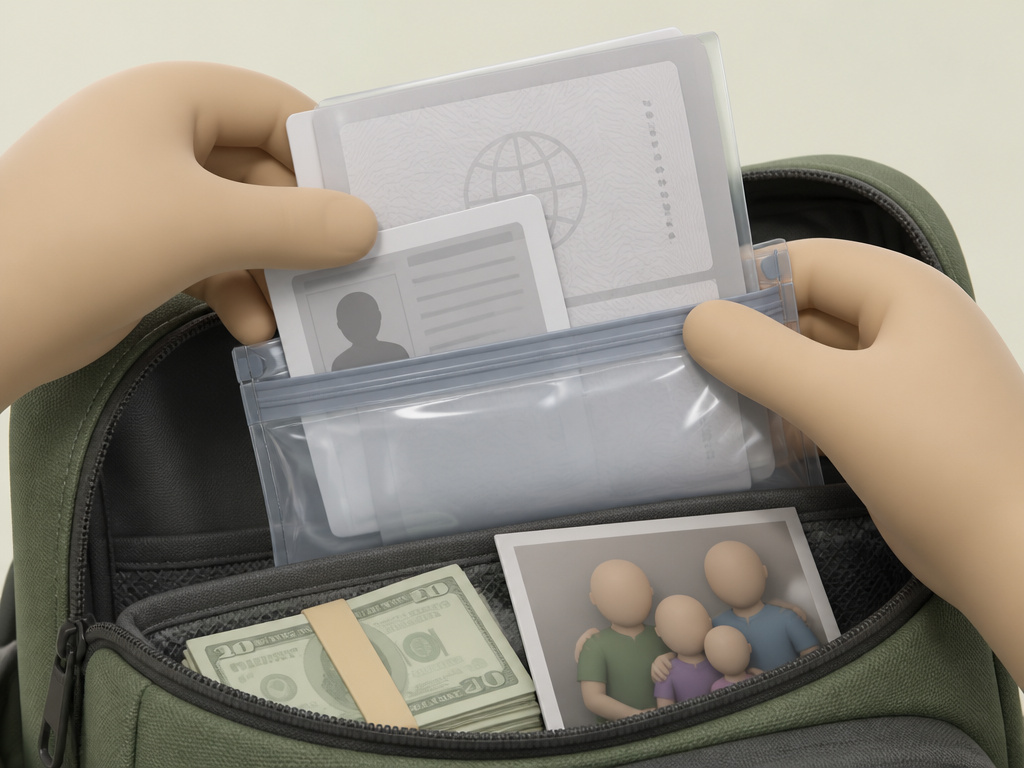 Your identification and financial tools are as critical as water. Without them, accessing services, proving ownership, or receiving aid becomes a bureaucratic wall.
What most people get wrong: Storing original documents in the bag. You need photocopies or scanned copies stored in a waterproof sleeve. Keep originals in a separate, secure location like a fireproof home safe.
Document checklist:
- Photocopies of driver’s licenses, passports, and birth certificates.
- Copies of insurance policies (home, auto, health).
- A small amount of emergency cash in small denominations. ATMs and credit card networks go down.
- A list of important account numbers and phone numbers.
Comfort items are not luxuries. They are psychological stabilizers. A spare pair of broken-in shoes, a warm beanie, a compact blanket, and a photograph of your family can ground you during chaos. For children, include a familiar stuffed animal or a small coloring book. Fear is manageable; utter detachment is dangerous.
Choosing the Right Bag and Packing It
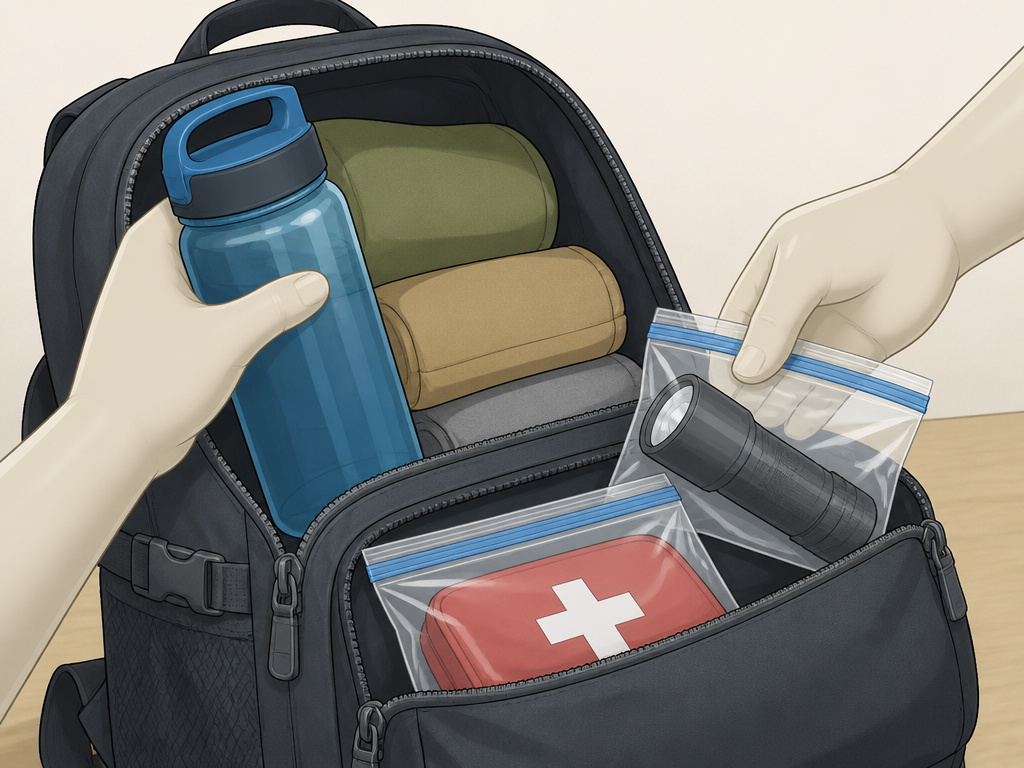 The container dictates what you can carry. A plastic tote is for a home “stay kit.” A go bag must be a backpack.
Backpack criteria:
- Internal frame or sturdy padding. It must hold its shape when half-empty and distribute weight.
- Water-resistant material. A soaked bag doubles in weight and ruins electronics.
- Multiple compartments. You need to organize for quick access, not dump everything into one cavity.
Packing order matters. Heavy items like water go in the middle, close to your back. Frequently needed items (flashlight, snacks) go in top or side pockets. Use packing cubes or large ziplock bags to group categories: “Food,” “Health,” “Tools.” This keeps things dry and findable in the dark.
The process of how to pack a bag for evacuation mirrors travel packing but with a critical difference: every gram is justified by survival, not convenience. A duffel bag can work if it has backpack straps, but a dedicated hiking backpack is superior for long-distance comfort.
Where to Store Your Go Bag (Hint: Not Just One Place)
A single bag stored in the basement is useless if the disaster strikes while you’re at work or stuck in traffic.
The three-bag strategy is non-negotiable:
- Home: Stored by your primary exit (front door closet, under the bed). Not in the remote attic or buried in the garage.
- Vehicle: Secured in the trunk. This is for accidents, breakdowns in severe weather, or being unable to return home.
- Workplace: In a desk drawer or locker. Earthquakes, fires, or lockdowns can trap you at the office for hours or days.
The Berkeley disaster go-bag guide explicitly recommends this multi-location approach. Your workplace bag can be a slimmed-down version focused on warmth, water, food, and walking shoes to get you home.
Go Bag vs. Home Emergency Kit
A go bag is a subset of a larger home emergency kit. They are not the same thing.
| Aspect | Go Bag (72-Hour) | Home Kit (14-Day) |
|---|---|---|
| Purpose | Immediate evacuation and survival for 3 days away from home. | Sheltering in place for up to two weeks with no utilities or outside aid. |
| Container | Portable backpack you can carry while moving quickly. | Large plastic bins or duffels stored in a garage, basement, or closet. |
| Key Differences | Minimalist, high-energy food, one water bottle filter, walking shoes. | Bulk water (3+ gallons/person), cooking equipment, camp toilet, extensive tools, comfort items for a prolonged stay. |
Your home kit is where you store the bulk water, the camp stove, the extra blankets, and the spare tech organizers for keeping backup power banks charged. Your go bag grabs the absolute essentials from that plan and makes them mobile.
Frequently Asked Questions
How often should I check and update my go bag?
Check every six months. Use daylight saving time changes as a reminder. Rotate food and water annually. Update clothing for seasonal changes and adjust for any new family health needs or medications.
Can I just buy a pre-assembled emergency kit?
You can, but you must customize it. Pre-made kits are infamous for including poor-quality water pouches that taste terrible, cheap lights that fail, and lacking critical personal items like prescription drugs. Treat any commercial kit as a foundation to build upon, not a complete solution.
What about pets and children?
They each need their own supplies factored into your planning. For pets, pack a tote bag with a few days of food, a collapsible bowl, a leash, vaccination records, and a familiar toy. For children, include comfort items, activities, and appropriate clothing. Their carry-on essentials for a flight are a good model: familiar snacks, small toys, and a change of clothes.
Is a duffel bag okay for a go bag?
It can be, if it has backpack straps. A pure duffel carried by one strap will become agonizingly uncomfortable over distance. If you opt for a duffel, ensure it meets duffel bag carry-on requirements for size and has a robust, padded shoulder strap or convertible backpack system. A hiking backpack is almost always the better choice.
What’s the one thing everyone forgets?
Physical map of your local area with evacuation routes highlighted. GPS and phones fail. Knowing how to walk to a shelter, hospital, or safe zone without a screen is a fundamental skill.
The Bottom Line
Packing a go bag is an exercise in brutal prioritization. It’s not about what you might need; it’s about what you cannot survive without for the first 72 critical hours. The official numbers—4 litres of water, 3 days of food—are your starting line, not the finish.
Build your bag around your household’s real needs, store it in the places where life actually happens, and practice grabbing it. The peace of mind isn’t in having a bag in the closet. It’s in knowing exactly what’s inside it and being able to carry it out the door in under a minute. Start with a backpack, four litres of water, and a weekend. The rest is just filling in the blanks.