How to Make a Bag: A Guide to 3 Styles and the Key Mistake
This post contains affiliate links. As an Amazon Associate, we earn from qualifying purchases.
To make a bag, you must pick one of three core constructions: a barrel (tube sewn to end caps), a box (flat panels with gussets), or a strap-based carrier (like a backpack). The single most important choice is matching your thread weight to your fabric, using all-purpose thread on heavy canvas will snap at the seams within weeks of use. Everything else, cutting, sewing, finishing, follows from that match.
That thread-and-fabric pairing is the whole game. Get it wrong, and the bag looks fine coming off the machine but fails at the first real load. The rest is just geometry and patience.
What follows is a breakdown of the three constructions, the exact tools and materials that work, and the step-by-step walkthrough for the most forgiving method: the barrel bag. By the end, you’ll know which construction fits your project and how to avoid the two mistakes that turn a weekend project into a pile of frayed scraps.
Key Takeaways
- Bag making boils down to three constructions: barrel, box, and strap-based. A barrel bag (like a sail bag) is the easiest for beginners.
- Thread weight is non-negotiable. For 8-10 oz. Fabric like canvas or oxford nylon, use V-69 polyester or Tex 70 thread. All-purpose cotton thread will break.
- Seal every cut edge on synthetic fabric with a hotknife, soldering iron, or lighter to prevent fraying that unravels seams from the inside.
- The Sailrite sail bag kit instructions specify a 1.5-inch difference between the cutting line and sewing line for the end cap, that allowance is what lets the flat circle fit the curved tube.
- Skip the pins for heavy fabric. Use spring-clamp sewing clips or even binder clips to hold layers without shifting.
The 3 Core Bag Constructions (And Which One You Actually Need)
Every bag is a container, and every container is built from one of three shapes. Your choice dictates the complexity of your pattern, the number of seams, and where the stress points will be.
The barrel construction is a tube with circular ends. Think duffel bags, sail bags, and simple drawstring sacks. You sew a cylinder, then attach a circle to each end. The challenge is easing a flat circle onto a curved tube, the Sailrite instructions solve this by telling you to cut the circle 1.5 inches larger than your sewing line. That extra fabric gets gathered into the seam allowance. It’s a one-seam wonder after the side seam, and it’s incredibly strong because the stress runs around a continuous hoop.
For a large sail bag, draw the circular end piece with a 25-inch diameter sewing line. Then draw a second circle with a diameter 1.5 inches greater, this 26.5-inch circle is your cutting line. The difference is the ease that allows the flat disc to fit the curved barrel without puckering.
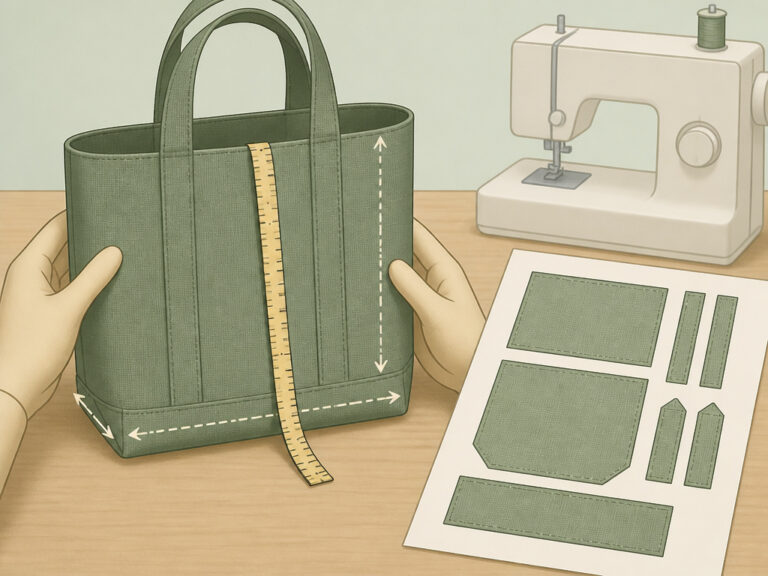
The box construction uses flat panels and long, narrow strips called gussets to create depth. Tote bags, backpacks, and most purses are box-built. You sew the front panel to a gusset, the back panel to the gusset, and then close the corners. This method gives you sharp, structured edges but requires precise cutting and more seams. The beckystern backpack pattern is a classic box construction, using a 10 oz. Cotton canvas and a long gusset to create its 5-inch depth.
The strap-based carrier is essentially a box or barrel bag with an integrated harness system. Backpacks and messenger bags fall here. The complexity isn’t the bag, it’s engineering the strap anchors to handle load without tearing the fabric. This requires reinforcement patches, bar tacking, and often webbing that distributes force away from the stitch line.
| Construction Type | Best For | Primary Challenge | Example Pattern |
|---|---|---|---|
| Barrel (Tube & Ends) | Duffels, storage sacks, simple drawstring bag | Easing the end cap onto the tube | Sailrite Sail Bag Kit |
| Box (Panels & Gussets) | Totes, purses, structured canvas tote bag | Precise alignment of multiple seams | beckystern Backpack |
| Strap-Based (Harness) | Backpacks, messenger bags | Reinforcing anchor points for load-bearing stress | Advanced backpack patterns |
Your first bag should be a barrel. The geometry is simple, the seam count is low, and the result is immediately useful. Trying to build a quilted tote bag or a reversible tote bag as a first project introduces variables, batting, lining, precise pattern matching, that bury the fundamentals.
Tools and Materials: What You Can’t Fake
You can compromise on a lot of things. Your stitch length can be a little uneven. Your circles can be slightly wobbly. The two things you cannot fake are the fabric-thread-needle triad and the method you use to stop edges from fraying.
Fabric dictates thread. This is a physical law, not a suggestion. Lightweight fabrics (like broadcloth) can use all-purpose thread. Medium fabrics (like duck canvas) need a heavier-duty polyester. The Sailrite kit for an 8 oz. Oxford nylon sail bag specifies V-69 polyester thread and a #16 needle. That thread is roughly equivalent to Tex 70. If you use a standard Tex 30 thread on that fabric, the seam will hold initially but the thinner thread will abrade and snap under tension, leaving you with a burst seam. The needle size matters just as much, a #16 needle makes a hole large enough for the thick thread to pass through without shredding it.
Seal every cut edge on synthetics. Nylon, polyester, and canvas blends will fray relentlessly. That fray works its way back into your seam allowance and weakens the stitch line from the inside. The OEM instructions are blunt: use a hotknife (a soldering gun or wood burning tool) to cut and seal simultaneously. No hotknife? Pass a lighter over the raw edges until they melt and bead. Do not skip this. Cotton canvas can be pinked or serged, but for any synthetic, melting is the only permanent fix.
Your machine must be capable. You don’t need an industrial machine, but you do need a motor that can push a #16 needle through 2-4 layers of heavy fabric without stalling. Clean and oil the machine first. Use a fresh, sharp needle for every project, a dull needle will deflect, break thread, and punch ugly holes.
Common mistake: Using pins on thick, slippery nylon. The fabric shifts as you pull the pins, and the holes can weaken the weave. Use spring-clamp sewing clips or even small binder clips to hold layers together without distortion.
The rest of your toolkit is straightforward: fabric scissors, a measuring tape, a marking tool (chalk or fabric pen), and a heavy-duty zipper foot if you’re adding closures. For a barrel bag, you’ll also need a compass or a string to draw perfect circles.
Barrel Bag Step-by-Step (The Sailrite Method)
This process follows the Sailrite large sail bag instructions. It’s a masterclass in pragmatic, strong construction. We’ll break it into the seven stages where things actually go wrong.
1. Cut and Seal the Barrel and End Pieces.
Cut your barrel piece to length and width. For the circular end pieces, you must draw two circles. Tie a pencil to a string. For a 25-inch diameter sewing line, your string radius is 12.5 inches. Draw that circle. Then, lengthen the string by 0.75 inches (for a 1.5-inch larger total diameter) and draw the cutting circle outside the first. Cut on the outer line. Immediately seal all these cut edges with a hotknife or lighter.
2. Attach the Webbing Handle.
Cut a 3-foot length of 1-inch webbing. Find its center and align that with the center of your end piece (the circle). The webbing will be a carrying handle. Do not just stitch a straight line. The instructions call for a box-X stitch. – Sew a 4- to 5-inch square (a box) through the webbing and the fabric. – Then, sew two diagonal lines from corner to corner, forming an X inside the box. – Reverse stitch at the start and end to lock the threads. This stitch distributes pulling force over a wide area instead of concentrating it on a single line of stitches. It’s the difference between a handle that lasts and one that rips out.
3. Sew the First End to the Barrel.
With the bag inside out, align the sewing line of the end piece with one long edge of the barrel tube. The webbing should be facing down, inside the bag. Start sewing the circle to the tube with a straight stitch. This is where you ease the fabric, the barrel will naturally pucker as you rotate the circle under the presser foot. That pucker is the extra 1.5 inches of fabric being taken up. It’s supposed to happen. Go slow.
4. Check the Overlap and Close the Side Seam.
Once the circle is attached, the barrel piece should wrap around it with at least a 1-inch overlap. If you have less, you cut the barrel too short. The fix is to pick the seam and re-sew it 1/8 inch inside your original sewing line, eating into the circle’s seam allowance. Now, match the two short edges of the barrel together to form the side seam. Sew from the top all the way down to where the end piece is attached.
5. Sew the Second End and Close the Circle.
Attach the second end piece to the other open end of the barrel using the same easing method. Then, with the side seam already sewn, you need to go back and finish sewing the circumference of the first end piece where the side seam interrupted you. This ensures the entire circle is secured to the barrel.
6. Create the Drawstring Channel.
Fold over 1/4 inch of the top edge to the outside and stitch it down. This is a tiny hem to clean the edge. Install a grommet about 2.75 inches down from this rolled edge. Then, fold the top edge over again to form a 2-1/8 inch hem, this creates the channel. Before sewing this hem shut, lay your drawstring cord (leech line) inside the fold, leading it out through the grommet. Sew the hem closed, trapping the cord inside the channel.
7. Finish the Drawstring and Turn the Bag.
Seal the ends of the drawstring cord with a hotknife or lighter. Thread the ends through a barrel lock, tie stopper knots, and turn the bag right-side-out.
The entire process relies on two non-negotiable techniques: sealing edges to prevent fraying and using the box-X stitch for stress points. Skip either, and the bag will fail under load.
Why Your Thread and Needle Choice Isn’t a Detail
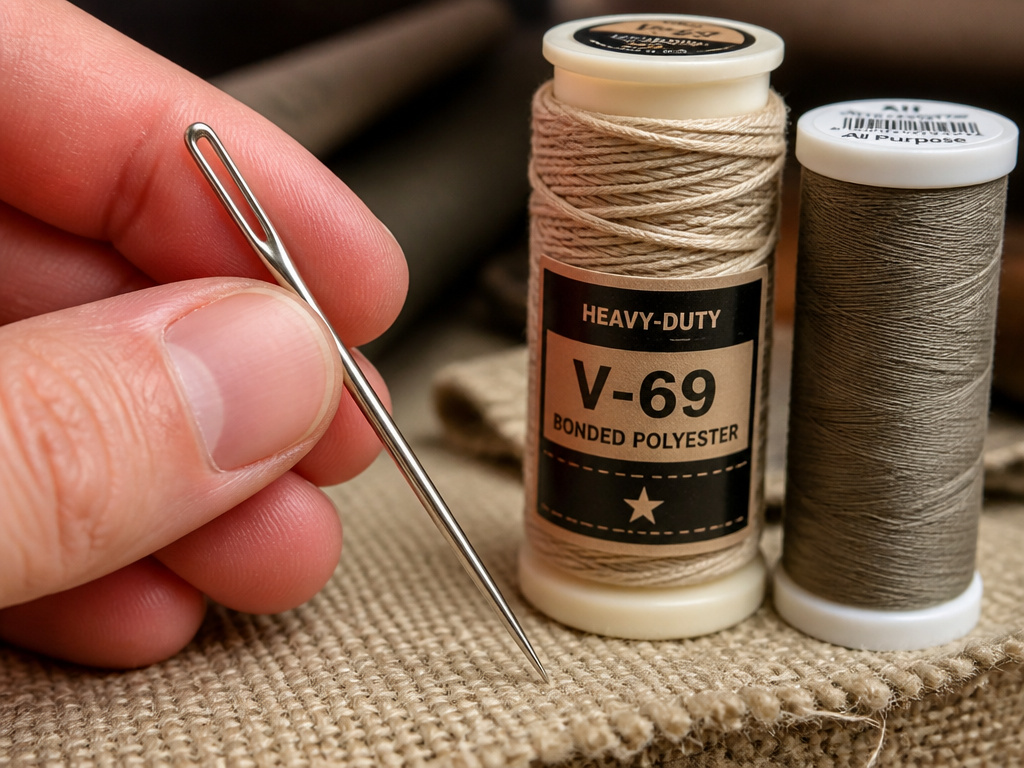
The relationship between thread size (Tex number), needle size, and fabric weight is engineering. It’s about the cross-sectional strength of the thread versus the puncture size of the needle versus the density of the weave.
V-69 polyester thread (approx. Tex 70) has a breaking strength around 8-10 pounds. A typical all-purpose thread (Tex 30) breaks at about 3-4 pounds. When you sew a seam, each stitch shares the load. If you’re making a bag to carry 20 pounds of gear, a seam sewn with all-purpose thread has a much lower safety margin. The heavier thread also resists abrasion from the fabric itself as the bag flexes.
The #16 needle has a larger eye and a sharper point designed for dense fabrics. A smaller needle, like a #12, will struggle to penetrate, causing the thread to fray as it’s forced through a too-small eye. It can also bend or break. The right needle makes a clean hole that closes around the thread, creating a tighter lock.
If you’re using a home machine, get a pack of Schmetz Denim/Jean needles size 16 and a cone of Gutermann Mara 70 thread. That combination will handle 95% of bag-making fabrics. Trying to use the thread that came with your sewing machine is how you spend an afternoon re-threading and re-seaming.
The Box Construction Shortcut (For Totes and Structured Bags)
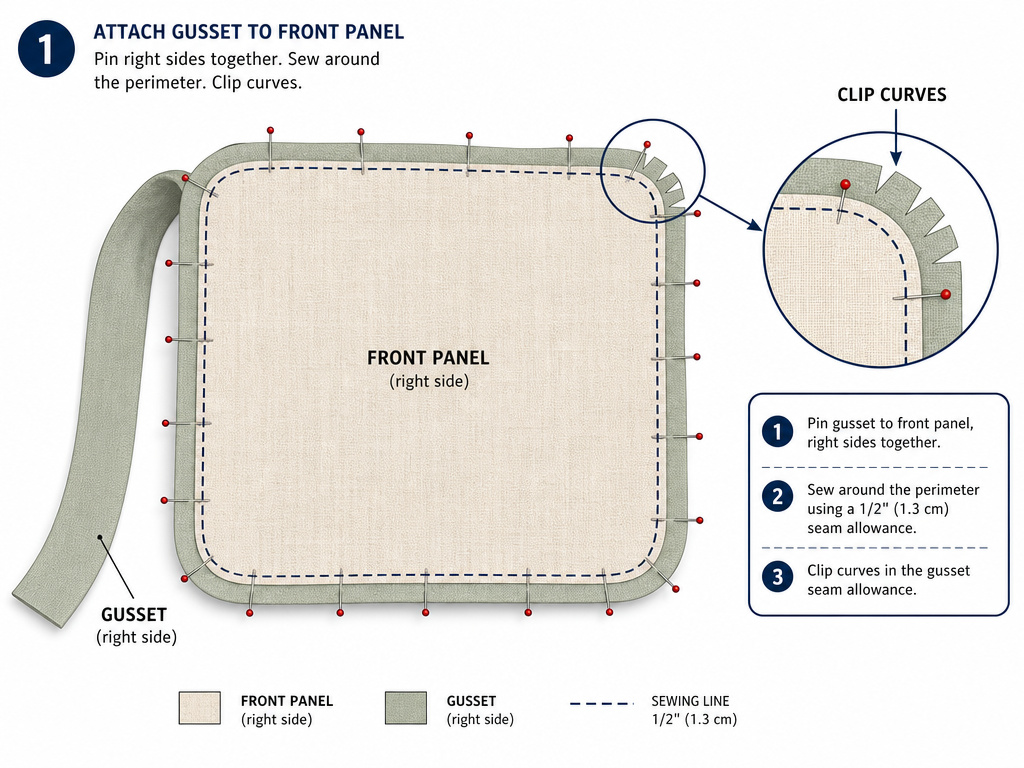
If a barrel bag is a tube, a box bag is a cube. The construction is different, but the principles of strong seams and sealed edges are identical. This is the method for a classic tote bag.
The core addition is the gusset, the strip of fabric that forms the sides and bottom. The width of the gusset is the depth of your bag. The beckystern backpack uses a gusset to achieve its 5-inch depth.
- Cut your panels: one front, one back, and one long gusset strip. For a lined bag like a lined tote bag, cut identical pieces from your lining fabric.
- Attach the gusset: Pin the gusset strip to the front panel, right sides together, starting at one top corner and sewing all the way around the panel’s perimeter. Repeat with the back panel. This creates a 3D shape.
- Box the corners (optional for a flat bottom): For a tote, you can pinch the bottom corners of the gusset to create a flat base. Sew across the pinch, trim, and finish the edge.
- Add straps: The strongest method is to sandwich the strap ends between the outer fabric and the lining, then stitch them in place with a box or X-box stitch during final assembly. Never just stitch straps to the outside of the bag.
Where this goes sideways: Sewing the gusset to the front panel, then trying to attach the back panel without clipping the curves. The fabric buckles, the seams misalign, and the bag twists. Clip the seam allowance of the curved corners every half-inch before you attach the second panel.
For a more secure closure, the process for a zippered tote bag adds a few steps but follows the same panel-and-gusset logic, integrating the zipper into the top seam of the gusset.
Frequently Asked Questions
What is the easiest bag to make for a complete beginner?
Simple barrel-style drawstring bag is the easiest. It requires only a rectangle of fabric, a side seam, a channel for the cord, and no hardware. It teaches you straight seams and edge finishing without complex geometry.
Can I use a regular sewing machine to make a bag?
Yes, but you must use the correct needle and thread. A domestic machine with a size 16 denim needle and heavy-duty (Tex 70) polyester thread can sew multiple layers of canvas or nylon. Go slow, especially over thick seams, and help the fabric through by hand if the motor strains.
How do I prevent the edges of nylon or canvas from fraying?
For nylon, polyester, or blended canvas, you must heat-seal the edges. Use a hotknife, a soldering iron with a flat tip, or carefully pass a lighter flame along the cut edge until it melts and beads. For 100% cotton canvas, you can use pinking shears or a serger, but heat-sealing is still more durable.
What’s the difference between a duffel bag and a tote bag construction?
duffle bag is typically a barrel construction, a tube with circular ends. A tote bag is usually a box construction, flat panels with a gusset for depth. The duffel is better for soft, bulky items; the tote provides more structure.
How do you make a bag stronger?
Strength comes from three places: the correct thread-to-fabric match, reinforced stress points (like strap anchors with box-X stitches), and sealed edges that prevent internal fraying. Using webbing for straps instead of folded fabric also adds tremendous strength.
Can I make a bag without a pattern?
For a simple barrel or rectangular tote, yes. You can work from measurements alone. For more complex shapes like backpacks or upcycled tote bag designs with existing seams, a pattern helps ensure pieces fit together correctly.
Before You Go
Making a bag isn’t about decorative stitches or fancy hardware. It’s about geometry, mechanical strength, and preventing failure at the microscopic level. Choose your construction, barrel, box, or strap-based, based on the shape you need. Then, invest in the correct heavy-duty thread and needles. Seal every cut edge on synthetic fabric without exception.
Start with a barrel bag or a simple canvas tote. Follow the numbers: the 1.5-inch allowance for the circle, the 4-inch box-X stitch, the 2-1/8 inch drawstring channel. Those numbers exist because someone calculated the stress points first.
Your first bag might have a wobbly seam or a slightly off-center grommet. That’s fine. If the thread is right and the edges are sealed, it will still hold everything you put in it. That’s the goal.