How Big Is a 26L Backpack? Dimensions, Uses & What Fits
This post contains affiliate links. As an Amazon Associate, we earn from qualifying purchases.
A 26-liter backpack is a versatile 1-2 day pack with typical external dimensions around 18-21 inches tall, 11-13 inches wide, and 5-9 inches deep. It fits a weekend’s worth of gear: a change of clothes, a 15-inch laptop, a light jacket, toiletries, water, and snacks. This capacity sits between a compact daily commuter pack and a multi-day hiking bag.
That 26-liter label is a manufacturer’s estimate, not a guarantee. Brands use different methods to calculate volume, so two packs both sold as 26L can hold noticeably different amounts of actual stuff. The American Society for Testing and Materials (ASTM) F2153-07 standard is what most reputable brands use, they fill every enclosed pocket with small plastic balls and measure the total volume. Some companies include open side pockets; others don’t. That’s why you must look past the liter claim.
What follows: the exact dimensions of three real 26L models, a detailed list of what you can realistically pack, and a direct comparison to smaller and larger capacities so you can match the bag to your actual load.
Key Takeaways
- A 26L backpack’s external dimensions typically range from 48-53 cm tall, 25-30 cm wide, and 20-30 cm deep (19-21 in x 10-12 in x 8-12 in).
- This size fits gear for a full day hike or a 1-2 night trip with minimalist packing, including a laptop, layers, food, and a compact sleeping system.
- The stated liter capacity is an estimate, manufacturers measure differently, so always check a bag’s specific external and internal dimensions before buying.
- For pure daily commuting with just a laptop and lunch, a 20L or 22L backpack is often sufficient. For frequent travel or carrying bulkier items like a camera cube, step up to a 30L pack.
- A well-organized 26L bag like the Thule Accent or Eagle Creek Ranger can serve as a perfect personal item for most airlines, fitting under the seat.
What Are the Actual Dimensions of a 26L Backpack?
Forget the generic size charts. The only way to know how big a 26L backpack is to look at specific models. The liter number tells you capacity, but the shape and dimensions tell you if it will fit under an airplane seat or feel bulky on your back.
Here are the published specs from three different 26L packs, straight from their official product sheets. Notice how the shapes vary even though the volume is the same.
| Backpack Model | External Dimensions (H x W x D) | Weight | Best Use Case |
|---|---|---|---|
| Thule Accent 26L | 48.0 x 33.0 x 25.0 cm (18.9″ x 13.0″ x 9.8″) | 1.2 kg (2.7 lbs) | Urban commute, business travel, laptop carry |
| Eagle Creek Explore 26L | 53 x 28 cm (20.9″ x 11.0″) – depth not specified | 0.9 kg (2.0 lbs) | Light travel, city exploration, hybrid work |
| Deuter Trail 26 | 55 x 30 x 20 cm (21.7″ x 11.8″ x 7.9″) | Not specified | Day hiking, light overnight trips |
The ASTM F2153-07 standard measures backpack volume by filling all fully enclosed pockets and compartments with 20mm plastic balls, then measuring the displaced volume. This method provides consistency, but not all brands adhere to it, making direct liter comparisons between manufacturers unreliable.
The Thule Accent is boxier, built to protect a laptop and files. The Deuter Trail is taller and slimmer, designed to hug your back on a trail. The Eagle Creek Explore is a middle-ground travel shape. They all hold roughly 26 liters, but they won’t fit the same items in the same way.
Where this goes sideways: Assuming a 26L travel pack will fit the same gear as a 26L hiking pack. The hiking model likely has a taller, narrower main compartment perfect for a sleeping bag. The travel pack is shorter and wider, optimized for folding clothes and tech. Packing cubes that fit perfectly in one might be a frustrating puzzle in the other.
What Fits in a 26L Backpack? (The Real-World Packing List)
A 26-liter capacity is the sweet spot for activities that need more than a laptop but less than a full expedition load. It’s a threshold size. Here’s exactly what you can fit for three common scenarios.
For a Day Hike or Urban Exploration:
- A 2-3 liter hydration bladder or a large water bottle.
- Packable windbreaker or rain jacket.
- Lunch, snacks, and a small coffee thermos.
- Compact first-aid kit, headlamp, and multi-tool.
- Phone, power bank, cables.
- Sunglasses, hat, and gloves.
- Still have room in the outer stretch pockets for a wet layer.
For a 1-2 Night Weekend Trip (with minimalist gear):
- One pair of pants, two shirts, socks, and underwear (rolled or in a thin packing cube).
- Lightweight toiletries bag.
- Compact sleeping bag liner or very lightweight summer sleeping bag.
- Inflatable sleeping pad (strapped to the outside).
- Small travel towel.
- Stove, fuel canister, and cooking cup (if backpacking).
- Food for two days.
For Work or School Commuting:
- 15-inch laptop in a padded sleeve.
- 10-inch tablet or notebook.
- Lunch container and a full-sized water bottle.
- Light sweater or hoodie.
- Chargers, pens, and small accessories.
- A pair of shoes or gym clothes can squeeze in if you pack light.
Common mistake: Overstuffing the main compartment and forgetting about designed pockets. The Thule Accent 26L has a separate “SafeZone” for sunglasses and a phone, plus a dedicated external pocket for a power brick. Using these frees up crucial space in the main cavity for bulkier items.
The Eagle Creek Ranger 26L demonstrates this flexibility well. Its internal sleeve fits either a hydration bladder or a 13-inch laptop. The front drop pocket swallows a jacket. That’s how a 26L bag covers multiple roles, by using every dedicated space for its intended purpose.
26L vs. Other Common Backpack Sizes
You see a 20L, a 26L, and a 30L bag on the shelf. The difference of a few liters might seem trivial, but it changes what you can carry and how you’ll use the pack. This isn’t about minor increments; it’s about stepping between different use categories.
Let’s compare. A 20L backpack is a true daily driver. It holds a laptop, a notebook, a lunch, and a jacket. That’s it. There’s no spare room for impulse buys or extra layers. It’s for the disciplined commuter.
The jump to a 26L backpack adds that crucial buffer. You get the same daily basics plus a full change of clothes, a pair of shoes, or a dedicated camera insert. It transitions from “day bag” to “overnight bag.” This is why it’s the most recommended size for “one-bag” travel on short trips.
Step up to a 30L backpack, and you’re entering dedicated travel or long-day territory. This size can typically fit a bulky DSLR camera with multiple lenses in a padded cube alongside your laptop and clothing. It’s also the starting point for comfortable winter day hikes where you need more insulation.
| Capacity | Best For | Limitations | Example Model |
|---|---|---|---|
| 20-22L | Basic daily commute, minimalist day hikes. | Cannot carry a significant change of clothes or extra gear. Fits under airplane seat easily. | Patagonia Refugio 26L (actually ~22L) |
| 26L | 1-2 night trips, heavy daily carry, full-day hiking with extra gear. | Tight for winter overnight trips or carrying specialized bulky equipment. | Eagle Creek Explore 26L |
| 30-35L | 3-4 night travel, professional camera gear, winter day hikes. | Can be too large for some airline personal item limits. May feel bulky for daily use. | Osprey Talon 33 |
The choice often comes down to your largest regular item. If you never carry more than a laptop and a lunch, a 20L or 22L backpack is cleaner and lighter. If you routinely need a second pair of shoes, a kit for the gym, or a jacket, the 26L is the minimum viable size. For those who carry camera gear or travel for work weekly, the 30L capacity is the default.
I’ve tried to use a 22L pack as an all-in-one bag for years. It always failed on the third day of a trip when I needed a clean shirt or wanted to pick up a souvenir. The 26L size is the difference between packing with anxiety and packing with confidence. You have a margin for error.
Is a 26L Backpack a Carry-On or Personal Item?
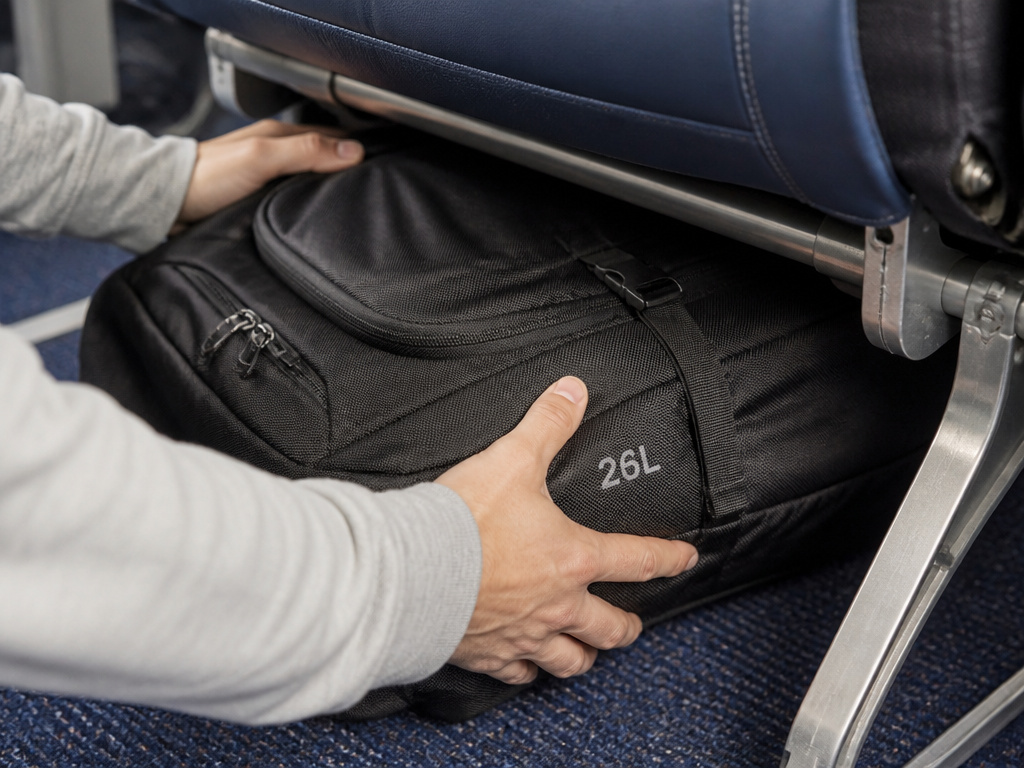
This is the practical question for travelers. A 26L backpack is designed to be a personal item, not an overhead carry-on. Its dimensions are tailored to fit under the seat in front of you on most airlines.
Referencing the dimensions table earlier, the Thule Accent 26L (18.9″ x 13.0″ x 9.8″) is within the typical personal item size limit of 18″ x 14″ x 8″ used by many US airlines. Slightly taller bags like the Deuter Trail 26 (21.7″ tall) might need to be under-packed or placed on its side to squish under the seat.
The key is the bag’s structure. A soft-sided, unpadded 26L hiking pack can be compressed. A rigid, boxy 26L laptop backpack with a hard-shell sunglasses case might not give an inch. Always check your specific bag’s rigid dimensions, not its capacity.
If you plan to use a 26L pack as your only bag for flying, the Eagle Creek Explore 26L is a strong candidate because of its trolley pass-through strap. You can slide it over your rolling suitcase handle and treat it as a personal item that you never have to wear through the airport.
Before you fly: Always verify your airline’s current personal item policy. Budget carriers like Frontier and Spirit are strict and may charge for a bag that exceeds their sizer dimensions, even by an inch. A compressible 26L pack is safer than a rigid one.
How to Choose the Right 26L Backpack for You
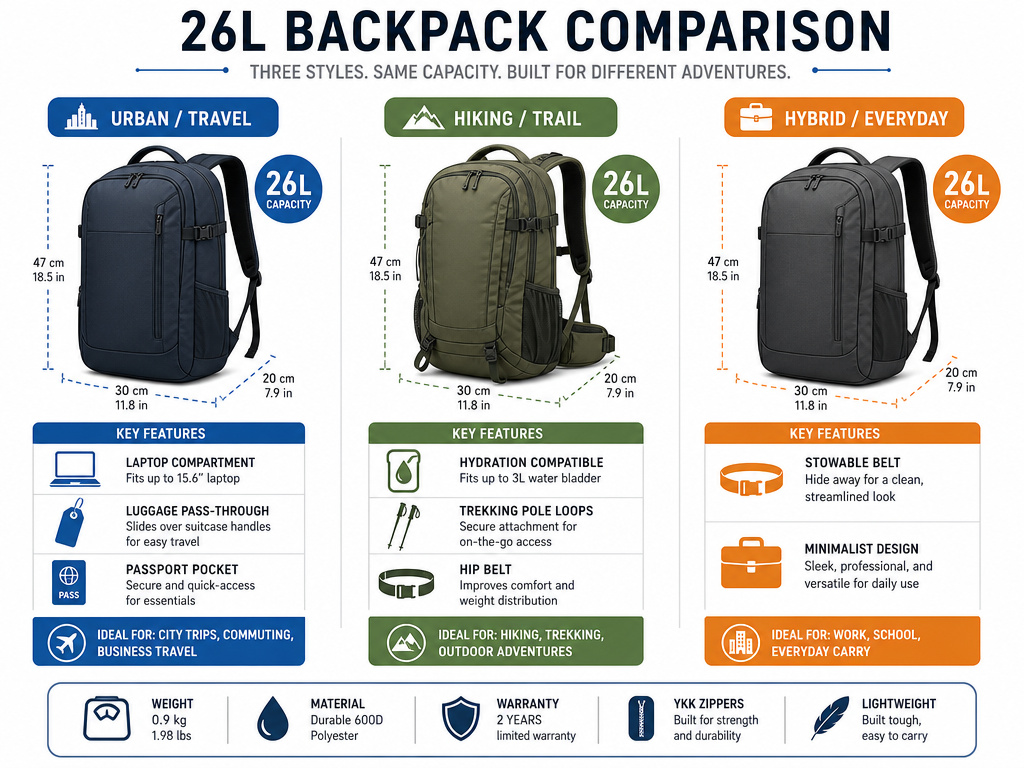
Not all 26-liter bags are equal. The right one depends on what you’re putting inside it. Use this decision framework before you buy.
First, identify your primary use case.
- Urban/Travel: Look for a laptop compartment rated for at least 15 inches, a luggage pass-through, and external quick-access pockets for a passport and phone. The Thule Accent 26L is built for this.
- Hiking/Trail: Prioritize a hydration reservoir sleeve, ventilated back panel, trekking pole attachments, and a hip belt for load transfer. The Deuter Trail 26 has these features.
- Hybrid/Everyday: You need a blend, some organization but not too much bulk, comfortable straps for all-day wear, and a clean look. The Eagle Creek Ranger 26L fits this role with its stowable hip belt and versatile internal sleeve.
Second, understand the material and construction.
A 26L bag made from lightweight 100D nylon will weigh under 2 pounds but might not survive a year of rough use. One made from 400D or 600D polyester or nylon, like the Thule EnRoute 26L, will be more durable but slightly heavier. For travel, a water-resistant coating is valuable. For hiking, look at the denier (D) number, higher is generally tougher.
Finally, try it on with weight.
If possible, load a store model with something heavy. How do the shoulder straps feel? Does the back panel dig in? A 26L bag can carry 20 pounds comfortably if it has a proper frame and hip belt, or miserably if it’s just a sack with straps. For daily carry, padded straps are non-negotiable.
Frequently Asked Questions
Is a 26L backpack big enough for high school or college?
It can be, but it depends on your load. If you carry a laptop, several textbooks, notebooks, and lunch daily, a 26L pack will be full but manageable. For students who also carry gym clothes or musical instruments, it might be tight. A 30L backpack offers more consistent breathing room for a student’s varied daily needs.
Can you use a 26L backpack for overnight hiking?
Yes, for 1-2 nights in fair weather with ultralight gear. You’ll need a compact sleeping bag, an inflatable pad, a small stove, and minimal clothing. It requires disciplined packing and often strapping the tent or sleeping pad to the exterior. For most beginners or those with standard gear, a 40L backpack is a more realistic and comfortable choice for overnight trips.
How does a 26L backpack compare to a 25L backpack?
The difference is negligible in practice, about the volume of a large soda can. You likely won’t notice a functional packing difference. The more significant factor is the bag’s layout and pocket design. A well-organized 25L pack might hold your gear more accessibly than a poorly designed 26L one. Focus on the specific model’s features, not the 1-liter spec difference.
Is a 26L backpack considered a personal item on airlines?
In most cases, yes. A typical 26L backpack’s dimensions (around 18″x12″x8″) are designed to meet common personal item size limits. However, this is not a universal rule. Always check your airline’s specific size requirements, as budget carriers can have stricter, smaller limits. A soft, compressible 26L pack has a better chance of fitting than a rigid, boxy one.
What is the weight of an average empty 26L backpack?
It varies widely by design. A minimalist hiking pack like the Hyperlite Mountain Gear Daybreak can be under 1 pound (450g). A feature-rich travel backpack with laptop protection and multiple panels, like the Thule Accent, will be 2.5 to 3 pounds (1.1-1.4 kg). For daily use, expect most quality 26L packs to weigh between 1.5 and 2.5 pounds empty.
The Bottom Line
A 26L backpack is a Goldilocks size, not too small, not too large. It handles a demanding daily commute, a full day on the trail, and short weekend trips without switching bags. The key is to match the bag’s design to your dominant activity: structured for urban travel, ventilated for hiking, or hybrid for a bit of everything.
Ignore the liter label alone. Look at the specific external dimensions and internal layout. The Eagle Creek Explore 26L, Thule Accent 26L, and Deuter Trail 26 all prove that the same volume can serve very different purposes. Your largest regular item decides the minimum capacity you need. For most people carrying a laptop plus layers or a day’s worth of adventure gear, 26 liters is the starting line.