How Big Is a 25L Backpack? Sizing Guide & What Fits Inside
This post contains affiliate links. As an Amazon Associate, we earn from qualifying purchases.
A 25-liter backpack is a medium-sized pack with typical dimensions around 19 inches tall, 12 inches wide, and 7 inches deep, but the exact size varies drastically by brand and design. This capacity fits a 15-inch laptop, a light jacket, lunch, a water bottle, and tech accessories for a commute, or a full day-hike kit including layers, food, and a first-aid kit.
That 25-liter figure is a total volume promise, not a guarantee for the main compartment. Padding, internal dividers, and material stiffness can eat up to 20 percent of the usable space you think you’re buying. The difference between a pack that feels cavernous and one that feels tight often comes down to the designer’s choices, not the number on the tag.
What follows is a breakdown of real dimensions from six different 25L models, a side-by-side look at what actually fits for three common uses, and the specs that matter more than the advertised liter capacity.
Key Takeaways
- A 25L backpack’s dimensions are not standardized. The HP Travel 25L measures 12.6″ x 6.7″ x 17.3″, while the Carhartt 25L Ripstop is 20.25″ x 12″ x 12″. Always check the manufacturer’s spec sheet.
- Empty weight varies from 1.9 pounds (HP) to 2.9 pounds (Grayl). That one-pound difference is noticeable after eight hours on your shoulders.
- For a day hike, a well-organized 25L pack can hold a 3L hydration bladder, rain shell, first-aid kit, lunch, and a headlamp. It will not hold a bulky winter coat or a full camp kitchen.
- Laptop compatibility is about the internal sleeve dimensions, not the screen size. A “15-inch laptop” sleeve typically means it fits devices up to 11.8 x 8 inches.
- The pack’s shape and organization matter more than raw volume. A clamshell-opening travel pack will feel larger than a top-loading hiking pack with the same 25L rating.
The 25L Backpack in Real Numbers
Forget generic height-width-depth ranges. The only way to know how big a 25L backpack is to look at specific models. The advertised volume is a calculated interior space, but the external footprint and how that space is divided change everything.
The HP Travel 25 Liter backpack measures 12.6 inches wide, 6.7 inches deep, and 17.32 inches tall in its non-expanded state, per its official product datasheet. It weighs 1.9 pounds and supports laptops up to 15.6 inches diagonally.
That depth of 6.7 inches is key. It’s a slim profile designed for urban carry and fitting under airplane seats. Compare it to a hiking-focused model.
The Carhartt 25L Ripstop Backpack is a full 20.25 inches tall and 12 inches deep. It’s a boxier, more heavy-duty shape meant to hold bulkier gear like work supplies or outdoor layers. The Thule AllTrail Daypack 25L splits the difference with outdoor-ready features but a streamlined 22.5-inch height.
| Backpack Model | Dimensions (H x W x D) | Weight | Best For |
|---|---|---|---|
| HP Travel 25L | 17.32″ x 12.6″ x 6.7″ | 1.9 lbs | Commuting, business travel, student carry |
| Carhartt 25L Ripstop | 20.25″ x 12″ x 12″ | Not specified | Work, rugged daily use, hauling tools |
| Thule AllTrail 25L | 22.5″ x 11.8″ x 8.7″ | 2.43 lbs | Day hiking, trekking, travel with a rain cover |
| Grayl Transport EXP 25L | 20″ x 12″ x 9.5″ | 2.9 lbs | Adventure travel, EDC with heavy organization |
| Deuter Trail 25 (spec) | 20″ x 11″ x 7.9″ | 2.25 lbs | Dedicated hiking with a fitted back system |
| Pacsafe GO 25L | 18.1″ x 12.2″ x 5.5″ (approx. From cm) | 1.59 lbs | Urban travel, anti-theft priority |
You see the spread. A 26-liter backpack might actually have a smaller external footprint than a bulky 25L model if it’s designed with thinner materials and less padding.
Where this goes sideways: Buying a pack based solely on the “25L” label. A hiking pack like the Deuter Trail 25 uses its volume for a tall, narrow cylinder suited to sleeping bags and layers. A travel pack like the HP uses it for a rectangular prism that fits folders and tech cubes. They hold the same amount of water, but not the same shapes of gear.
What Fits in a 25L Backpack? The Activity Test
Capacity is abstract until you try to pack it. Let’s move from dimensions to real contents. A 25L pack is the quintessential “daypack” size—it’s meant to support an activity from morning to evening, not for multi-day travel.
The Commute & Work Day
For the urban user, a 25L backpack is often the perfect one-bag solution. It swallows a workday’s essentials without becoming a cumbersome burden on public transit.
- A 15-inch laptop in a padded sleeve. This is the anchor item. Most 25L packs are built around this.
- A tablet or e-reader. Fits in a separate slip pocket.
- A lightweight packable jacket. Stuff it in the main compartment or an external shove-it pocket.
- A lunch container and a reusable water bottle. Side pockets are mandatory.
- A tech pouch for cables, a mouse, charging bricks, and headphones.
- A few small personal items like a wallet, keys, and sunglasses.
The HP Travel 25L or a Pacsafe GO 25L excel here. Their organization is designed for this exact load-out. You’re not just throwing things in; you’re assigning them to dedicated homes. This load would leave a little room to spare, maybe for a small umbrella or a book.
Common mistake: Overstuffing a commuter pack with gym clothes on top of a full work load. A 25L pack can do one or the other comfortably, not both a full work setup and a full set of sneakers, clothes, and toiletries. That’s when you need to step up to a 30-liter backpack.
The Day Hike
This is where 25 liters earns its reputation. It’s the gold standard for a summer or shoulder-season day on the trail. The pack must carry safety gear, sustenance, and layers.
- A 3-liter hydration bladder in a dedicated sleeve.
- A puffy jacket or fleece mid-layer. Compresses down fairly small.
- A rain shell or windbreaker. Non-negotiable.
- A comprehensive first-aid kit.
- Lunch, snacks, and extra calories.
- A headlamp, a multi-tool, a map, and a power bank.
- Trekking poles attached externally.
A pack like the Thule AllTrail 25L or the Deuter Trail 25 is built for this. They have hip belts to transfer weight, external attachment points, and a focus on easy access to water and layers. Every liter is accounted for. There’s no space for luxury items like a camp chair or a giant camera with multiple lenses.
The Weekend Overnight (The Tight Squeeze)
Can a 25L backpack work for a weekend trip? Yes, but it demands minimalism and smart packing. This is not for beginners. You’ll be wearing your bulkiest items on the plane.
- 2-3 changes of lightweight, packable clothing (merino wool is your friend).
- Minimal toiletries in tiny containers.
- A thin pair of shoes or sandals.
- Your 15-inch laptop (if needed for work).
- Phone, charger, cables.
You will have no space for souvenirs. You will use packing cubes to compress everything. A clamshell-opening pack like the Grayl Transport EXP 25L makes this easier than a top-loader. Success here means you can use your pack as a backpack on a plane without ever needing to check a backpack. For most people, a more comfortable choice is a 35-liter backpack.
Weight, Materials, and the “Feel” Test
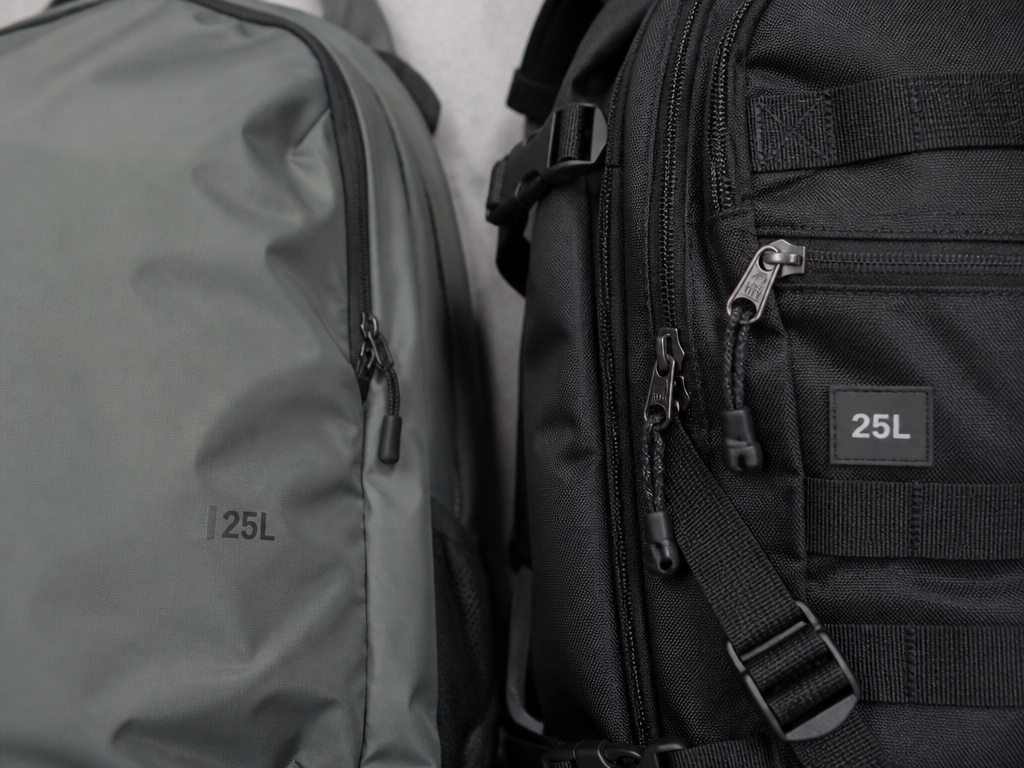
The liter capacity is half the story. A pack’s empty weight and construction materials determine how it carries and how durable it will be. This is where you feel the difference between a $50 pack and a $150 pack.
The HP Travel 25L, at 1.9 pounds, uses lightweight polyester and minimal padding. It’s designed for comfort when carrying a laptop and a few folders. The Grayl Transport EXP 25L, at 2.9 pounds, is built from 1000D coated nylon and has a robust harness system. It’s built to carry heavier, more uneven loads comfortably over distance.
The part nobody mentions: That extra pound of pack weight is made up of thicker padding, heavier zippers (like YKK Aquaguard), reinforced stitching, and better load-transfer straps. You don’t feel it on your back as “heavier”—you feel it as “more comfortable” when the pack is full.
Material dictates weather resistance and longevity. A pack with a “water-resistant” coating (like the Carhartt’s DWR finish) will shed a light shower. A pack made with waterproof laminate (less common in this category) might keep things dry in a downpour. No 25L pack is submersible unless it’s a dry bag first and a backpack second.
Laptop Compatibility: It’s About the Sleeve, Not the Screen
Manufacturers love to say “fits 15-inch laptops.” That’s a diagonal screen measurement, which is useless for knowing if your specific device will fit. What matters are the internal sleeve dimensions.
The HP datasheet is refreshingly specific: its sleeve accommodates laptops up to 11.8 x 8 inches. That’s the actual footprint of most 15.6-inch devices. The Grayl Transport EXP 25L specifies a “side-entry 15″ laptop pocket,” which implies a similar dimension.
| Laptop Size (Diagonal) | Typical Max Dimensions for Sleeve | Will It Fit in a Standard 25L Pack? |
|---|---|---|
| 13 inches | Up to 11.5″ x 8.5″ | Yes, easily. |
| 15.6 inches | Up to 11.8″ x 8″ | Yes, in most dedicated laptop compartments. |
| 17 inches | Up to 15″ x 10″ | Unlikely. The pack’s height or width will be the constraint. |
| Gaming Laptop (15.6″) | Often 14″ x 10″+ | Probably not. The extra thickness and width are dealbreakers. |
Always check the spec sheet for the maximum laptop dimensions, not just the screen size. If your 15-inch gaming rig is thicker than 1 inch, it might not zip into the sleeve even if it slides in. This is a common point of failure for students and remote workers.
Choosing Your 25L Backpack: A Decision Framework
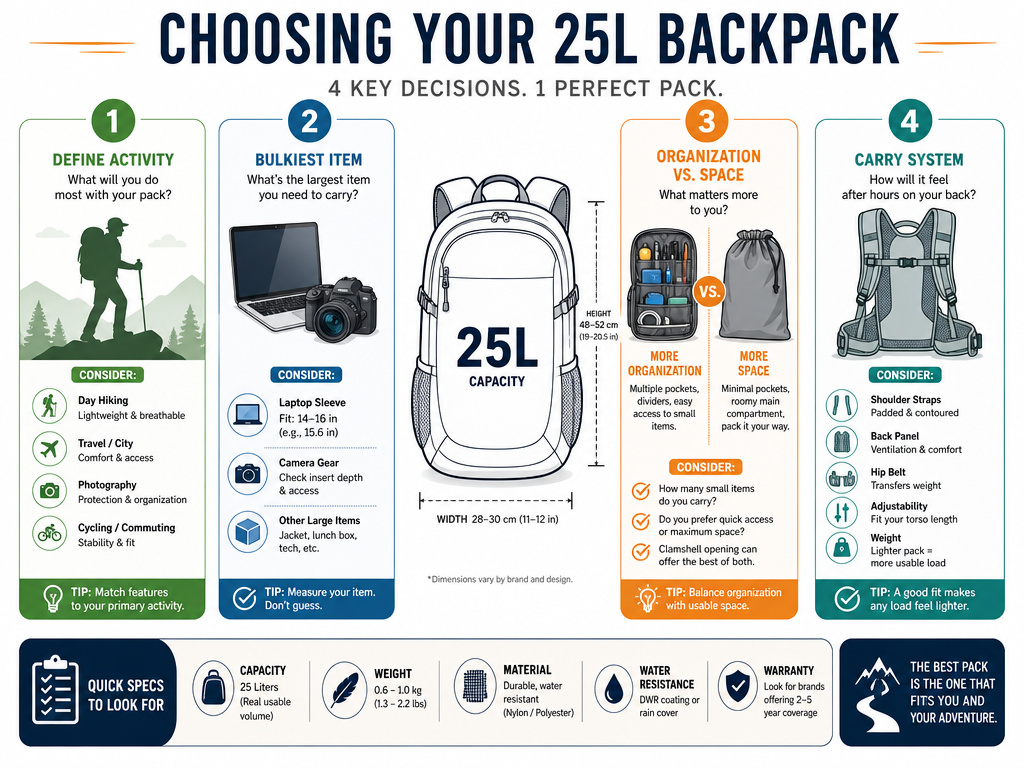
With so many variations, how do you pick? Stop looking at volume first. Start with your primary use case and work backwards.
- Define your #1 activity. Is this 70% for commuting, 70% for hiking, or 70% for weekend travel? Be honest.
- Identify your bulkiest mandatory item. Is it a 15-inch laptop? A 3L hydration bladder? A full-frame camera? That item dictates the pack’s core compartment design.
- Prioritize organization vs. Open space. Do you want a pocket for everything (urban/travel) or one big cavity you can stuff (hiking)?
- Consider the carry system. Will you wear it for 10 minutes or 10 hours? Padded hip belts and sternum straps are non-negotiable for hiking.
For most people who want one bag for mixed use—some commuting, some light hiking, some travel—the Thule AllTrail 25L is a standout. It has a clean look, a included rain cover, a laptop sleeve, and a decent hiking harness. It’s a true hybrid.
If you live in a city and need anti-theft features, the Pacsafe GO 25L with its lockable zippers and slash-resistant material is the clear pick. For pure, unadulterated day hiking, the Deuter Trail 25’s ergonomics are hard to beat, though the 22-liter backpack might be enough for ultralight hikers.
TL;DR: Your perfect 25L backpack is defined by its shape and features, not its volume. Match the pack’s design to your one primary task.
Frequently Asked Questions
Is a 25L backpack a personal item?
On most airlines, yes. A 25L backpack like the HP Travel 25L or the Thule AllTrail will typically fit under the seat in front of you, which is the standard for a personal item. Always double-check your airline’s specific size limits, as budget carriers like Spirit have stricter Spirit backpack fee policies.
Can a 25L backpack hold a week’s worth of clothes?
Not for most people. A 25L pack is ideal for 1-3 days of travel if you pack very minimally. For a full week, you’ll need packing discipline and specialized travel clothing. Most travelers would find a 40-liter backpack or even a 50-liter backpack more realistic for a week-long trip.
How does a 25L backpack compare to a 20L?
20-liter backpack is noticeably smaller. It’s great for a light commute (laptop, lunch, jacket) but will struggle with extra layers or gear for a full day hike. The 5-liter difference is often the space needed for a hydration bladder, a packed lunch, and a first-aid kit.
Is 25L enough for high school or college?
For high school, absolutely. It can hold textbooks, a laptop, binders, and supplies. For college, it depends on your major. It’s fine for carrying a laptop and a few notebooks to lectures, but it won’t hold giant textbooks, a lab coat, and supplies all at once. Many college students prefer the extra room of a 30L pack.
Are 25L backpacks comfortable for hiking?
Yes, when they are designed for it. Hiking-specific 25L packs like the Deuter Trail 25 have proper hip belts, sternum straps, and breathable back panels that transfer weight to your hips. A 25L urban backpack without these features will be uncomfortable on a trail with a full load.
The Bottom Line
A 25L backpack is a versatile, medium-capacity workhorse, but “25 liters” is a starting point for conversation, not a precise measurement. The HP Travel 25L and the Carhartt 25L Ripstop are both 25-liter packs, but they are different tools for different jobs. Your decision hinges on the specific dimensions, the empty weight, and how the internal space is organized.
Look past the volume label. Find the pack whose shape matches your gear and whose features support your activity. For the majority of users seeking a single bag for daily duties and weekend adventures, a well-chosen 25-liter backpack is the sweet spot.