How Big Is a 35L Backpack? Real-World Sizing & Key Uses
This post contains affiliate links. As an Amazon Associate, we earn from qualifying purchases.
A 35L backpack is a versatile mid-size pack, typically measuring between 50-60cm tall, 25-35cm wide, and 15-25cm deep. It fits 2-4 days of hiking gear, a week’s worth of minimalist travel clothing, or a full load of daily essentials with room to spare. The key is matching the pack’s specific dimensions to your torso length and intended use, not just the volume number.
That volume number is a starting point, not a guarantee. Two packs labelled 35 liters can carry and feel completely different based on their shape, suspension, and how they distribute that space. A mountaineering pack like the Deuter Guide 35+ uses its liters for heavy, dense gear and needs a robust frame. An ultralight pack like the Hyperlite Mountain Gear Waypoint 35 uses the same volume for fluffy sleeping bags and lightweight shelter.
What follows is a breakdown of the real dimensions from eight popular models, a detailed look at what you can practically fit inside, and how to tell if 35 liters is the right size for your back and your next trip.
Key Takeaways
- Torso length, not your height, decides fit. A 35L pack with a 50cm back panel will hang painfully low on someone with a 45cm torso, regardless of the pack’s listed volume.
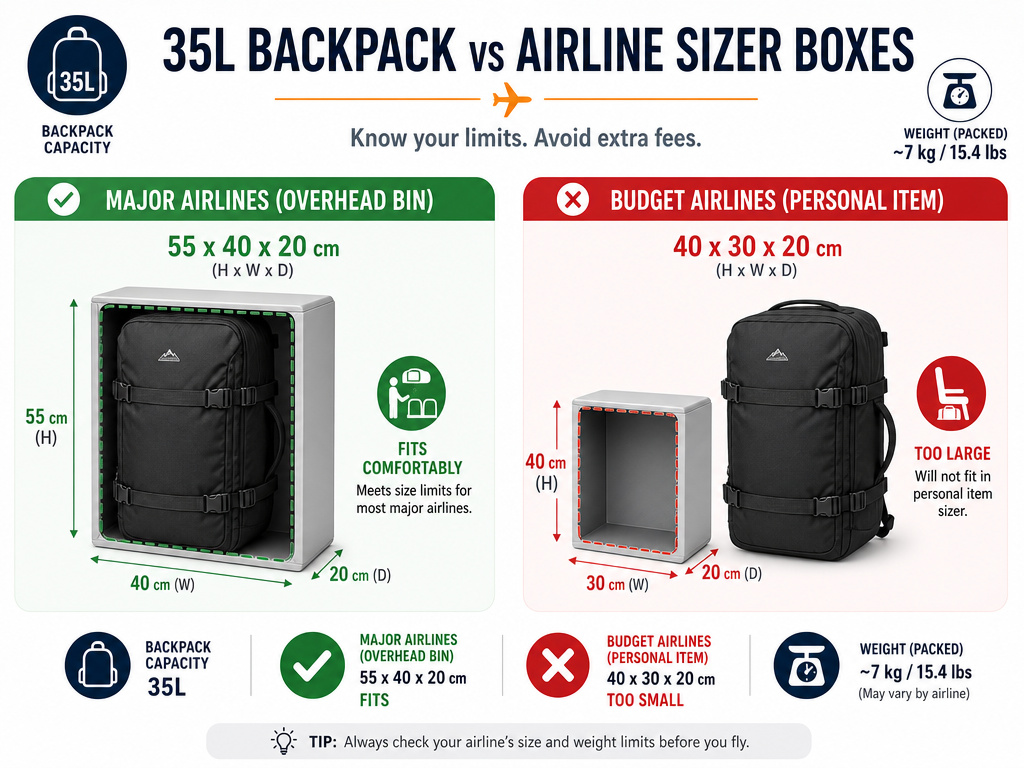
- Carry-on viability is a roll of the dice. While many 35L packs meet generic carry-on size limits (typically 55 x 40 x 20 cm), budget airlines enforce stricter personal-item dimensions that a full 35L pack will often exceed.
- The “daypack vs. Multi-day” line sits at 35L. It’s the maximum volume most people can carry comfortably without a load-bearing hip belt for long distances, making it the upper limit for heavy day hikes and the lower limit for lightweight overnight trips.
- Material and frame add weight before you pack. A burly 35L mountaineering pack can weigh over 1.5kg empty, while an ultralight frameless model can be under 500g—that’s a full kilogram of gear you lose before you start.
- External features eat into main volume. A pack claiming 35L total volume often includes exterior pockets, lid space, and stretchy side panels in that count. The main compartment might only hold 28-30L.
The 35L Backpack in Real Numbers
Forget the abstract idea of 35 liters. Look at the tape measure. A pack’s physical dimensions—height, width, depth—and its back length tell you if it will fit your body and your airline’s overhead bin.
A 35-liter backpack typically has external dimensions between 55-60cm in height, 30-35cm in width, and 18-25cm in depth. The critical measurement for fit is the back panel length, which should match your torso length (measured from your C7 vertebra to your iliac crest) within 2-3cm.
Here’s how that volume translates across different designs, from sleek travel bags to rugged hiking packs. This table shows why you can’t judge a pack by its liter label alone.
| Model | Best Use | Dimensions (H x W x D) | Back Length | Empty Weight |
|---|---|---|---|---|
| Exped Core 35 | Fastpacking, Light Hiking | 62 x 30 x 22 cm | 48-52 cm | 680-880 g |
| Deuter Guide 35+ | Mountaineering, Alpine Climbing | 72 x 26 x 19 cm | 48 cm | 1550 g |
| Trakke Storr 35L | Urban Travel, One-Bag Travel | 52 x 36 x 15 cm | Not Specified | 1350 g |
| Mystery Ranch Blitz 35 | Tactical, Load Hauling | 53 x 32 x 37 cm | Adjustable | 2000 g |
| Arva Equipment ST 35 | Ski Touring, Backcountry | 60 x 33 x 18 cm | 45-50 cm | Not Specified |
| Millet Parmelan 35L | Trekking, General Hiking | 56 x 32 x 30 cm | 43/47 cm (S/M) | 980 g |
The Deuter Guide 35+ is tall and narrow, built to carry a rope and climbing gear close to your spine. The Trakke Storr 35L is shorter and wider, designed to meet carry-on depth restrictions while opening like a suitcase. One is for vertical terrain, the other for airport queues.
Where this goes sideways: Choosing a pack based only on the 35L label and not its shape. A tall, narrow 35L pack might fit a sleeping bag perfectly but leave no room for a bulky winter jacket. A short, wide 35L travel pack might be carry-on compliant but force you to pack your shoes sideways, wasting space.
Why Torso Length is Your First Filter
The most comfortable 40-liter backpack in the world is miserable if the hip belt sits on your stomach instead of your iliac crest. Pack fit is not about your height; it’s about the distance between your shoulders and your hips.
Manufacturers list back length or torso size ranges (e.g., 48-52cm). To find yours: 1. Tilt your head forward and feel for the bony bump at the base of your neck (the C7 vertebra). 2. Place your hands on your hips, fingers pointing forward. Your thumbs will rest on the top of your pelvic bones (iliac crest). 3. Have someone measure the distance between the C7 and an imaginary line connecting your thumbs.
If your torso measures 48cm, look for packs with a back length around 48cm. A pack with a 52cm back will drop the hip belt too low, transferring weight to your shoulders. This is why trying on a loaded pack is non-negotiable for hiking models. For a simple 20-liter backpack used as a daypack, fit is less critical.
What Actually Fits in 35 Liters?
Volume is an imaginary cube. Your gear is not. How you fill that space—with dense food, fluffy insulation, or rigid electronics—changes everything. Here’s a breakdown by activity.
The 3-Day Summer Hiking Loadout
For a fast-and-light backpacking trip in fair weather, 35L is the sweet spot. You’ll be carrying: * A 30-40°F sleeping bag (compressed to 4-6L) * An ultralight tent or tarp (8-12L) * A sleeping pad (2-3L) * A lightweight stove, pot, and fuel (2L) * Food for 3 days (6-8L) * Clothing layers, rain gear, and essentials (8-10L)
This load pushes a frameless 35L pack to its limit but fits comfortably in a framed model like the Millet Parmelan 35L. The frame keeps the weight organized and transferable to your hips.
The One-Week Minimalist Travel Pack
The 35L travel pack is the darling of the one-bag travel community. It forces discipline. A clamshell design like the Trakke Storr 35L lets you pack like a suitcase. * 4-5 shirts, 2 pants, 1 shorts * 5-7 pairs of socks & underwear * 1 lightweight sweater or jacket * Dopp kit and small tech pouch * Maybe a slim laptop or tablet
Common mistake: Assuming a 35L travel pack is an automatic carry-on. Its 52cm height might be fine, but a 15cm depth is critical. Many budget airlines (Ryanair, Frontier) have personal item sizers as small as 40 x 30 x 20 cm. A full 35L pack won’t fit. Always check your specific airline’s backpack as personal item rules.
The Overstuffed Day Hike or Commute
For a daypack, 35L is cavernous. It’s for the person who carries everything: extra layers, a full lunch, a large water bladder, a camera, a book, and a first-aid kit. It’s also the choice for tradespeople or students who haul bulky items. The downside is temptation. An empty 35L daypack invites you to fill it, often leading to a heavier load than you need for a 4-hour hike.
35L vs. 30L vs. 40L: Choosing Your Size Tier
The difference between a 30-liter backpack and a 35L isn’t just five liters. It’s often the difference between “fits easily under the seat” and “might have to gate-check.” This comparison table lays out the trade-offs.
| Volume | Best For | Carry-On Viability | Limitations |
|---|---|---|---|
| 25-30L | Day hikes, gym, daily commute, weekend overnight (ultralight) | High (fits most personal item sizers) | Tight for multi-day trips; requires very disciplined packing. |
| 35L | 3-4 season day hikes, 2-4 day summer backpacking, one-bag travel | Medium (fits overhead, often too big for strict personal item) | The “in-between” size; can be too much for daily use, not enough for winter camping. |
| 40-50L | Week-long backpacking, travel with bulkier gear, winter expeditions | Low (often exceeds carry-on dimensions) | Overkill for day use; can encourage overpacking. |
If you’re constantly stuffing your 26-liter backpack to the point of straining the zippers, step up to 35L. If your 35L pack is never more than half full on day hikes, step down to a 22-liter backpack. The right size is the smallest one that comfortably holds your regular load.
The 35L as a “Do-It-All” Compromise
It can work, but with caveats. A 35L pack will be bulky for a daily commute. It will be snug for a 5-day backpacking trip. But if you only want one bag for occasional travel, weekend hikes, and hauling gear, a 35L with a clean, adaptable design (like the Exped Core 35) is the most logical single-bag solution. It’s the largest volume that still looks like a normal backpack, not expedition luggage.
Critical Features That Change the 35L Experience
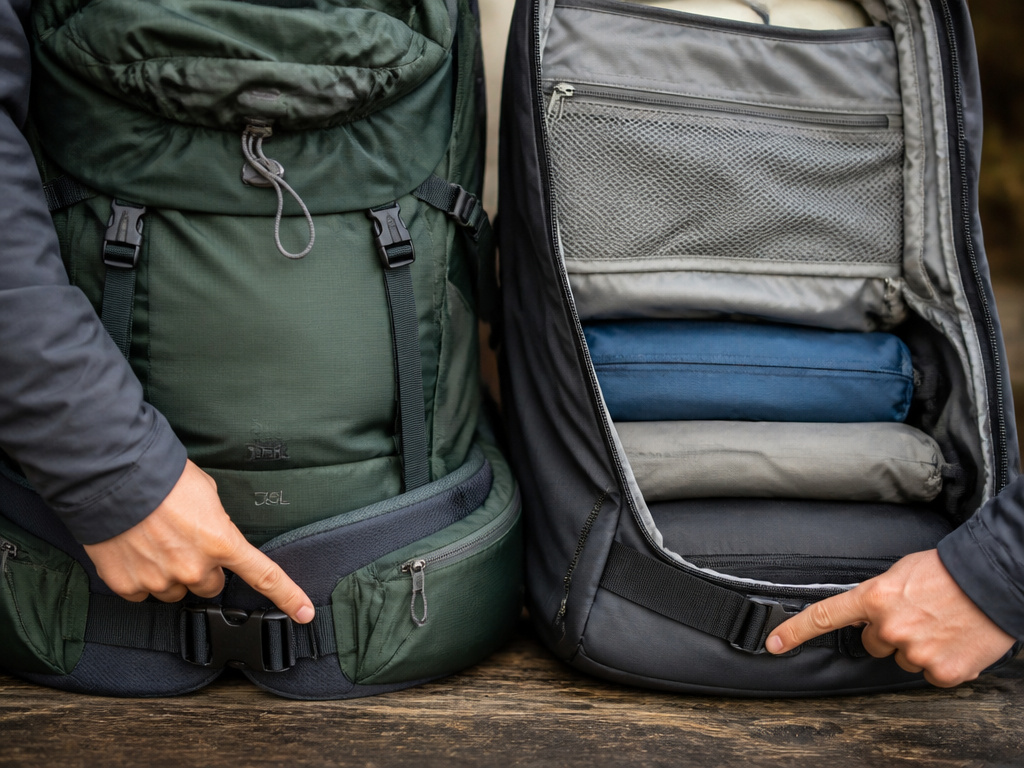
Two 35L packs are not interchangeable. The features built around that volume dictate what you can do with it.
Hip Belts: Load-Bearing vs. Stabilizing
A structured, padded hip belt is essential if you plan to carry more than 10-12 kg (22-26 lbs) for more than an hour. It transfers weight from your shoulders to your hips. The Deuter Guide 35+ has a full-weight-transfer belt. A simple webbing strap, like on many travel packs, only stops the pack from bouncing; it does not bear weight.
Frame: Internal, External, or None
- Frameless: Packs like the Hyperlite Mountain Gear Contour 35 rely on a rolled-up sleeping pad or your packed gear to create structure. They are ultralight (<1 kg) but uncomfortable over 12 kg.
- Internal Frame: A flexible plastic or aluminum stay sheet molds to your back. This is the standard for hiking packs (e.g., Millet Parmelan 35L) and offers the best balance of comfort and weight.
- Full Frame: Heavy-duty packs like the Mystery Ranch Blitz 35 use a ladder-style external or burly internal frame for loads exceeding 20 kg. This adds weight but makes heavy loads manageable.
Access: Top-Loader vs. Clamshell
Top-loaders (common in hiking) are simple, weather-resistant, and weight-efficient. You pack from the top, and items at the bottom are buried. Clamshell or panel-loading packs (common in travel) open like a book. You see and access everything instantly, which is terrible for compressing a sleeping bag but perfect for finding your passport at check-in.
The part nobody mentions: A clamshell’s full-zip design is a single point of failure. If that zipper fails on the trail, your pack is fully open. Top-loaders with a drawstring closure have a simpler, more redundant system.
Will a 35L Backpack Fit as a Carry-On?
This is the most common question, and the honest answer is: it depends entirely on the specific pack and the airline.
Most 35L packs are designed with common airline carry-on dimensions in mind (usually around 55 x 40 x 20 cm). The Trakke Storr 35L (52 x 36 x 15 cm) is a prime example of a pack built to these rules. Its 15cm depth is the key.
However, “carry-on” is not a universal standard. * Major Legacy Airlines (Delta, United, American): A compliant 35L pack will almost always fit in the overhead bin. * Budget Airlines (Ryanair, Spirit, Frontier): They have two size categories: carry-on (goes overhead, usually for a fee) and personal item (free, goes under seat). Their personal item sizers are much smaller. A full 35L pack will not fit as a personal item.
Your 35L pack is far more likely to be accepted as a backpack on a plane if it’s not fully expanded. Roll-top packs can be shortened; packs with compression straps can be cinched down. The goal is to make it look small and compliant. If you’re forced to checking a backpack, always use the pack’s internal straps to secure the load and consider a protective cover.
The Bottom Line
A 35L backpack is a Goldilocks size for a specific person: someone who needs more space than a daypack offers but wants to avoid the bulk and temptation of a 50L expedition pack. It’s the perfect volume for a serious hiker tackling long days with extra safety gear, a minimalist traveler on a week-long trip, or an active commuter who also uses it for weekend adventures.
Before you buy, measure your torso. Decide if you need a frame and a load-bearing hip belt for heavy carries, or if a lighter, simpler design will do. Hold the pack’s exact dimensions against your most frequent airline’s size limits. The number 35 is just an entry point. The right 35L pack for you is the one whose physical shape and features match the shape of your needs.
Frequently Asked Questions
Is a 35L backpack too big for high school or college?
For most students, yes, it’s too big. A typical student load of a laptop, notebooks, and a few books fits better in a 25-30L pack. A 35L backpack will be mostly empty, leading to sloppy organization and unnecessary weight on your back. It’s overkill unless you’re regularly carrying gym clothes, a lunch, and bulky art supplies every day.
Can you use a 35L backpack for a 5-day trip?
Yes, but it requires ultralight, minimalist packing and likely no laptop. It’s tight. You’ll be wearing the same outfit multiple times, using a tiny travel towel, and packing only essential toiletries. For traditional backpacking with standard gear, a 50-liter backpack is a more comfortable choice for 5 days.
What is the weight limit for a 35L backpack?
There’s no universal limit; it depends on the pack’s construction. A frameless ultralight 35L pack becomes uncomfortable over 10-12 kg (22-26 lbs). A framed hiking pack like the Deuter Guide 35+ can comfortably carry 15-18 kg (33-40 lbs). Always check the manufacturer’s stated load limit, which is often listed in the specs.
How do I know if my 35L backpack is a carry-on?
Compare its packed dimensions (Height x Width x Depth) to your airline’s published carry-on size limits on their website. Be strict. If your pack is 56 x 35 x 22 cm and the limit is 55 x 40 x 20, your pack is 1cm too tall and 2cm too deep. It might still fit, but you’re at the gate agent’s discretion.
Is 35L enough for winter hiking?
For a winter day hike, 35L is excellent for carrying extra insulation, a thermos, more food, and safety gear. For winter backpacking, it’s almost always insufficient. Winter sleeping bags, sleeping pads, and clothing are vastly more bulky. A 4-season winter overnight typically requires a 50L+ pack.