Carry On Luggage Weight Limits: How Much Should Yours Weigh?
This post contains affiliate links. As an Amazon Associate, we earn from qualifying purchases.
Carry-on luggage should weigh 7 kg (15 lbs) or less for most international airlines, with some carriers allowing up to 10 kg. Many US airlines have no official weight limit, relying instead on size restrictions and a passenger’s ability to lift the bag into the overhead bin. The strictest airlines, like Qatar Airways and ANA, enforce a 7kg limit that includes your personal item.
That 7kg figure isn’t random. It’s the most common ceiling for carriers in Europe, Asia, and the Middle East, and it’s the number that will get your bag gate-checked if you’re flying with them. US travelers often get a pass on weight, but that leniency vanishes the moment you book an international ticket.
What follows is a breakdown of where the limits come from, how airlines actually check, and the precise gear and tricks that keep you under the line without leaving essentials behind.
Key Takeaways
- International airlines are strict about the 7-10 kg carry-on limit; US carriers often aren’t.
- Your personal item’s weight usually counts toward your total allowance on weight-restricted airlines.
- A portable luggage scale is the only reliable way to know your bag’s weight before you reach the airport.
- Packing heavy items in your worn jacket or personal item is a common last-ditch strategy.
- Choosing a lightweight carry-on bag like the Travelpro Platinum Elite or the Briggs & Riley Baseline can give you a 1-2 kg head start.
The Global Standard: 7kg and 115cm
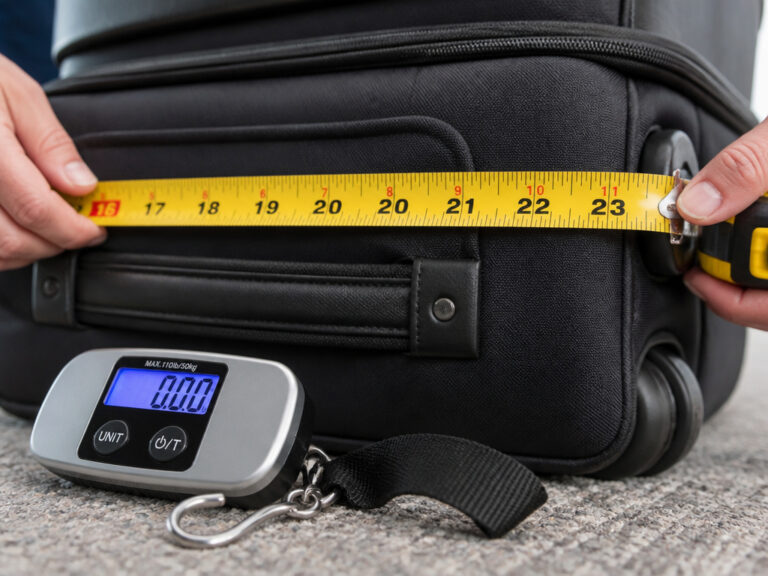
Most of the world’s airlines converge on two numbers: 7 kilograms for weight and 115 centimeters for total linear dimensions (length + width + height). This isn’t a global law but a de facto standard driven by aircraft bin capacity, ground crew safety, and the simple physics of what a typical passenger can safely hoist overhead.
The International Air Transport Association (IATA) provides guidelines, but each carrier sets its own final rules. Their IATA passenger baggage rules document is the industry’s reference playbook, though you’ll never see it at the check-in desk.
A standard carry-on bag should not exceed 7 kg in mass and 115 cm in total linear dimensions. This ensures compatibility with overhead bin dimensions and weight limits, reduces strain on baggage handling infrastructure, and maintains cabin safety by preventing bins from being overloaded.
The 115 cm size limit is about the bin. The 7 kg weight limit is about the person lifting it. Flight attendants aren’t required to lift your bag, and a bin loaded with 10 kg bags exceeds its structural rating quickly.
Why Checked Baggage Standards Don’t Apply
You might see references to ISO 12604-1:2017, which sets a 23 kg (50 lb) limit for standard checked baggage. That standard exists for the safety of baggage handlers and automated conveyor systems, not for carry-on. It’s a critical distinction. The muscle strain from lifting heavy bags into aircraft holds is a documented occupational hazard, which is why the ISO standard exists. Carry-on weight limits address a different risk: a 12 kg bag falling from an overhead bin during turbulence.
| Limit Type | Typical Allowance | Primary Reason | Who Enforces |
|---|---|---|---|
| Carry-on Weight | 7-10 kg (15-22 lbs) | Passenger safety & bin capacity | Check-in/Gate Agent |
| Carry-on Size | 115 cm (45 in) total | Overhead bin dimensions | Sizer Box at Gate |
| Checked Baggage Weight | 23 kg (50 lb) per ISO | Handler safety & equipment | Check-in Scale |
The table shows the split. Confusing them is how travelers assume their 12 kg checked bag is fine for the cabin. It isn’t.
Airline-Specific Limits: A World of Difference
Enforcement is everything. You can split airlines into three tiers: strict, moderate, and hands-off.
Strict Airlines weigh bags at check-in and the gate. Your personal item is included in the total. Qatar Airways, ANA, and Singapore Airlines are in this camp. A Qatar passenger reported being forced to check a 6.7 kg roller bag because their thin laptop backpack pushed the combined total over 7 kg. The agent showed zero flexibility.
Moderate Airlines have a limit but may only spot-check. British Airways allows a generous 23 kg (51 lbs) for carry-on, but that’s an outlier. Most European carriers like Lufthansa and Air France post 8-12 kg limits.
Hands-Off Airlines are mostly in the US. Delta, American, and United don’t publish a weight limit for domestic flights. Their rule is “if it fits in the sizer and you can lift it, it flies.” This is why the question “how much should carry on luggage weigh” has two different answers depending on your departure airport.
Common mistake: Assuming your US domestic experience applies overseas. That 12 kg backpack you carried onto Southwest will be rejected at the Qatar Airways check-in desk in Doha, with a fee to check it.
The 7kg Club vs. The No-Limit Zone
The contrast is stark. Frontier Airlines, a US budget carrier, is one of the few with a strict 35 lb (15.9 kg) limit. Meanwhile, British Airways’ 23 kg allowance is more than some airlines allow for checked bags. This inconsistency is the core of passenger confusion.
For a reliable trip, default to the strictest rule on your itinerary. If you’re flying Delta to London then connecting on Qatar Airways, Qatar’s 7kg limit is the one that matters.
How Airlines Enforce Weight Limits
They use scales. Sometimes at check-in, sometimes at the gate. The process is straightforward but brutal if you’re over.
- The Check-in Scale: The agent places your bag on a counter scale. If your personal item is included, they might ask you to place it on top. The display shows red if you’re over.
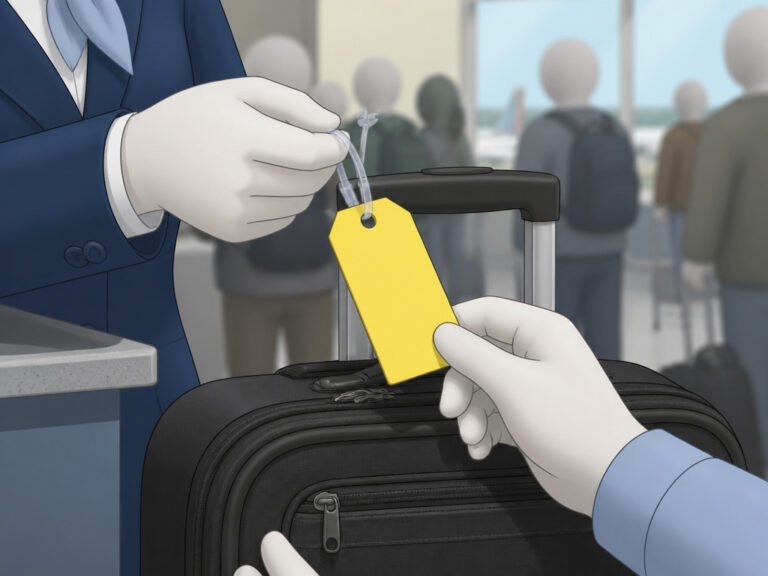
- The Gate Scale: A mobile scale appears just before boarding. This is a last-chance weigh-in for bags that look bulky.
- The Sizer Box: This checks dimensions, not weight. But a bag that struggles to fit the sizer is often heavy, triggering a weight check.
The FAA’s FAA carry-on baggage advisory outlines that airlines must have a program to ensure bags are stowed safely, which is the regulatory backbone for these checks. It doesn’t mandate a specific weight, but it gives airlines the authority to set and enforce their own limits for safety.
What happens if you’re over? You have three choices: pay an excess baggage fee (often $50-$200), repack on the spot, or check the bag. Checking at the gate usually means your bag meets you at baggage claim, not the carousel.
Tools & Tips to Stay Under the Limit
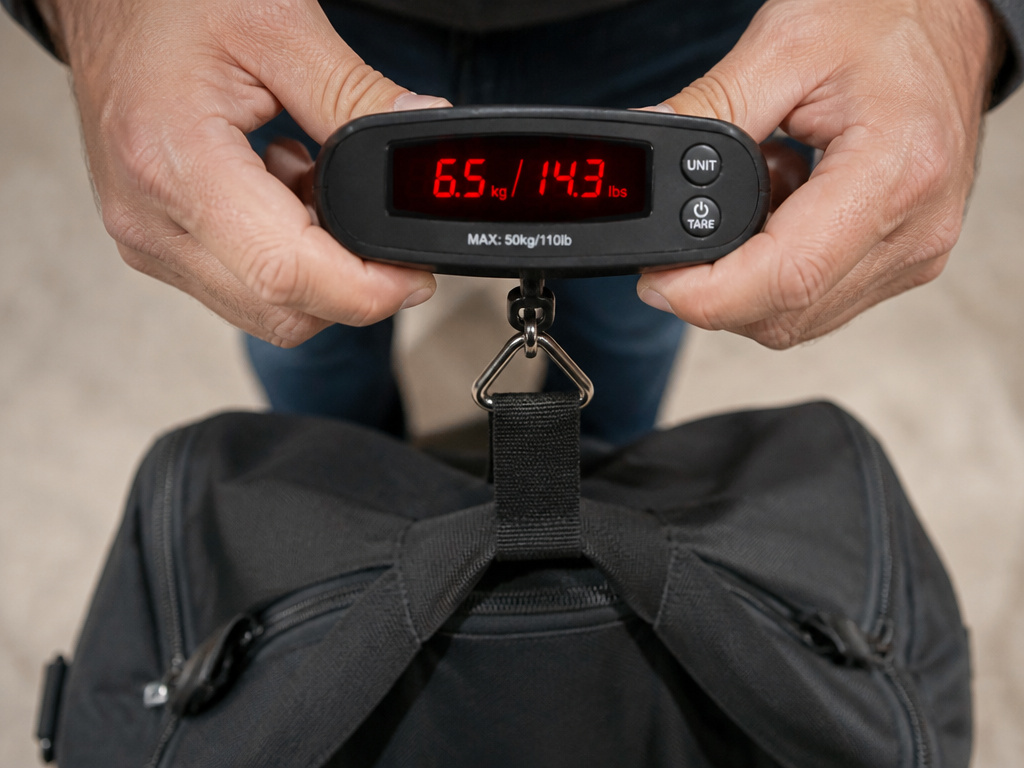 Knowing the limit is useless if you can’t measure your bag. A bathroom scale is inaccurate for small weights. Your hand is a terrible judge.
The Non-Negotiable Tool: A Portable Luggage Scale. A $15 digital hook scale is the difference between guessing and knowing. Use it at home, then again at your hotel before the return flight. It eliminates all surprise.
Packing Strategy is Weight Strategy. Wear your heaviest shoes and jacket. Pack your laptop, camera, and books in your personal item, which is often weighed separately or not at all on some airlines. Choose a soft-sided bag like the The North Face Base Camp Voyager or the Patagonia Black Hole MLC—they can compress to fit a sizer even when full, and their fabric weighs less than hard-shell polycarbonate.
Where this goes sideways: Forgetting about your personal item’s weight. On strict airlines, your 2 kg laptop bag plus your 6.5 kg roller bag equals 8.5 kg. That’s 1.5 kg over, and the fee applies to the total, not just the roller.
The Last-Resort Move. If you’re barely over at check-in, do what the Reddit traveler did: remove heavy layers and wear them. A winter coat and scarf can weigh over 2 kg. Put them on, re-weigh the bag, then stuff them back in after you get your boarding pass. It works because the agent only certifies the bag’s weight at that moment.
| Packing Move | Weight Saved | Best For | Risk If Skipped |
|---|---|---|---|
| Use a luggage scale | N/A (prevents overage) | Every trip | Gate-check fees start at $50 |
| Wear heavy jacket/shoes | 1.5 – 3 kg | Cold-weather travel | No viable last-minute fix |
| Pack tech in personal item | 2 – 4 kg | Business/photo trips | Combined weight busts limit |
| Choose a soft-sided bag | 0.5 – 1.5 kg vs hard-shell | One-bag travelers | Bag may not fit sizer when full |
Frequently Asked Questions
Do US airlines have carry-on weight limits?
Most major US airlines (Delta, American, United, Southwest) do not publish weight limits for domestic flights. Their rule is that the bag must fit in the overhead bin and you must be able to lift it yourself. The exception is Frontier (35 lbs) and Hawaiian Airlines (25 lbs).
Is the 7kg limit for one bag or all bags?
On airlines that enforce a 7kg limit, it is almost always a combined weight for your carry-on suitcase and your personal item (backpack, purse, laptop bag). Check your airline’s specific wording: “one cabin bag” might mean one total piece, while “one carry-on bag plus one personal item” means two pieces with a combined weight.
How can I weigh my luggage without a scale at the hotel?
Some hotels have a luggage scale at the concierge desk—ask. Many airports also have public-use scales near the check-in area or before security. The most reliable method is to bring your own portable scale. It fits in a side pocket and removes all guesswork.
What’s the best lightweight carry-on luggage?
The best lightweight carry-on luggage saves weight without sacrificing durability. Look at the Travelpro Platinum Elite for maximum features, the Briggs & Riley Baseline for lifetime repair, or the Away Carry-On for a balance of price and polish. Avoid extra pockets and complex expanding systems—they add weight you can’t afford under a 7kg limit.
Why do airlines care about 1 or 2 extra kilograms?
It’s cumulative. One bag 2kg over is a minor issue. A full flight where every bag is 2kg over adds hundreds of kilograms to the aircraft’s load, affecting fuel burn and balance. For ground staff, repeatedly lifting heavier bags increases injury risk. The limit is a bright line for consistent, safe operations.
Before You Go
Your carry-on’s weight isn’t a suggestion. It’s a rule with teeth on half the planet. Default to 7kg. Buy a scale. Pack your heaviest items on your body or in your personal item.
The difference between a smooth boarding process and a costly argument at the gate is about three pounds—the weight of a large laptop. Pack like you’re flying Qatar Airways, even if you’re not. That’s the only guarantee you’ll never pay an overweight fee again.