Calories in a Bag of Popcorn: Counts for Every Major Brand
This post contains affiliate links. As an Amazon Associate, we earn from qualifying purchases.
A regular bag of microwave popcorn contains between 160 and 457 calories, with the majority falling between 210 and 250 calories. The exact number depends entirely on the brand, flavor, and bag size, with butter-flavored bags landing on the higher end due to added palm oil and salt. A plain, unsalted microwave bag hits the calorie ceiling because it uses more oil to pop without flavorings for balance.
That 300-calorie swing isn’t marketing noise. It’s the difference between a snack and a meal, dictated by the type of oil and how much of it coats the kernels before they ever hit your microwave.
What follows is a breakdown of the numbers from the USDA’s own database, a translation guide for the intentionally confusing label math, and the one preparation switch that cuts the calorie count by more than half without sacrificing the bowl.
Key Takeaways
- A standard butter-flavored microwave bag (like Pop-Secret or Orville Redenbacher’s) typically delivers 210–250 calories, with 14–16g of fat.
- The highest-calorie option is often a plain, unsalted microwave bag (over 450 calories), because manufacturers use extra oil to compensate for the lack of butter flavoring.
- “Serving size” on the label is a trap. It’s usually listed as “2 tbsp unpopped” or “X cups popped,” forcing you to calculate the total for the bag, which often contains 2.5 servings.
- Switching to air-popped popcorn slashes calories to about 93 per 3-cup serving and cuts fat to just over 1 gram.
- Movie theater popcorn is in a different league. A small, without extra butter, can be 370–400 calories; a large with “butter” topping can exceed 1,500.
The Calorie Range for a Regular Microwave Bag
Forget averages. The calorie count on a popcorn bag is a direct report on its oil content. Butter flavor doesn’t add calories, the palm or coconut oil that carries that flavor does.
According to USDA FNNDS data, a standard 85g bag of plain microwave popcorn contains 457 calories and 26.4g of fat. The same size bag in an unsalted variety has 422 calories and 23.7g of fat. The fat is the engine.
The numbers tighten when you look at named brands you actually buy. These aren’t estimates; they’re pulled from the nutrition facts that brands file.
| Brand & Flavor | Bag Size (Unpopped) | Calories Per Bag | Total Fat | Saturated Fat |
|---|---|---|---|---|
| Pop-Secret Movie Theater Butter | 1.75 oz (49g) | 250 | 16g (21% DV) | 8g (40% DV) |
| Orville Redenbacher’s Butter | 1.5 oz (42.5g) | 210 | 14g (18% DV) | 7g (35% DV) |
| Orville Redenbacher’s Tender White | 2 tbsp (33g) | 160 | 11g (14% DV) | 6g (30% DV) |
| Newman’s Own Microwave Popcorn | 30g | 160 | 10g (13% DV) | 4.5g (23% DV) |
Why does plain popcorn have more calories than buttered? It seems backwards. The answer is in the oil-to-flavor ratio. A butter-flavored oil blend has other ingredients (salt, flavorings, milk solids) that displace some of the pure fat by volume. A plain bag uses straight oil to get the kernels to pop and nothing else, so gram for gram, it’s more calorically dense. You’re eating more pure fat.
The saturated fat column is the one to watch. For a snack, hitting 35-40% of your daily limit in one bag is significant. That’s the palm oil. It’s a stable fat for shelf life and popping, but it’s not a health food.
How to Read the Bag (Without Losing Your Mind)
The nutrition label on a popcorn bag is a masterclass in obfuscation. It’s designed to make the numbers look smaller, and it works every time.
Common mistake: Looking only at the “Calories” number at the top of the label. That number almost never represents the entire bag. You must find the “servings per container” and do the math.
Here is the standard, frustrating layout: 1. Serving Size: “2 tbsp unpopped (28g)” or “About 5 cups popped.” 2. Servings Per Container: “2.5” or “3.” 3. Calories: “130” (This is per serving, not per bag).
To get the bag’s total calories: Multiply the calories per serving by the servings per container. A bag stating “130 calories per serving” and “2.5 servings per container” contains 325 calories total. They don’t put “325” anywhere on the front.
This practice isn’t unique to popcorn. It’s the same reason checking a backpack as luggage requires you to find the separate fee chart, or why understanding your backpack on a plane allowance means digging into the “personal item” dimensions on the airline’s site. The true cost, whether in calories or dollars, is often one layer down.
The “Per Cup Popped” Misdirection
Some bags include a second column labeled “Per 1 Cup Popped.” This is virtually useless. Nobody eats exactly one cup of popcorn, and cup measurements are inconsistent, a tightly packed cup holds far more than a loosely filled one. As commenters on Reddit pointed out, this info is a decoy. The data you need is “per bag” or, at the very least, “per 100g” for an honest weight-based comparison.
Microwave vs. Air-Popped vs. Movie Theater: The Calorie Multipliers
Changing how you pop the corn doesn’t just tweak the count; it changes the food category. This is where the 300% calorie spreads come from.
| Preparation Method | Calories (Per 3 Cups / ~24g) | Total Fat | Why the Difference |
|---|---|---|---|
| Air-Popped (Plain) | 93 | 1.1g | No added oil. The popped kernel itself is low-calorie. |
| Oil-Popped (Stovetop) | 165 | 9g | Adds the fat content of whatever oil you use (usually 1-2 tbsp). |
| Microwave (Butter) | 105-150 | 6-10g | Pre-measured oil and seasoning packet in the bag. |
| Movie Theater (Small, no extra butter) | 370-400 | 20-25g | Popped in coconut oil, then heavily salted. |
The movie theater mark-up is mechanical, not magical. Theaters use coconut oil, which is solid at room temperature, to pop the corn. This gives it that distinct flavor and mouthfeel. A small bag uses about 3 tablespoons of that oil in the popping process alone. Then the salt adherence requires a slight surface moisture, which often comes from… More oil. The “butter” topping is just flavored oil, adding roughly 130 calories per pump.
The switch to air-popping is the single biggest lever you can pull. An air popper like the West Bend or Presto models uses hot air to expand the kernel. No oil means the only calories are from the corn itself, a whole grain with fiber and protein. You go from a 250-calorie microwave bag to a 93-calorie bowl three times the size.
Breaking Down the Macros: It’s Not Just Calories
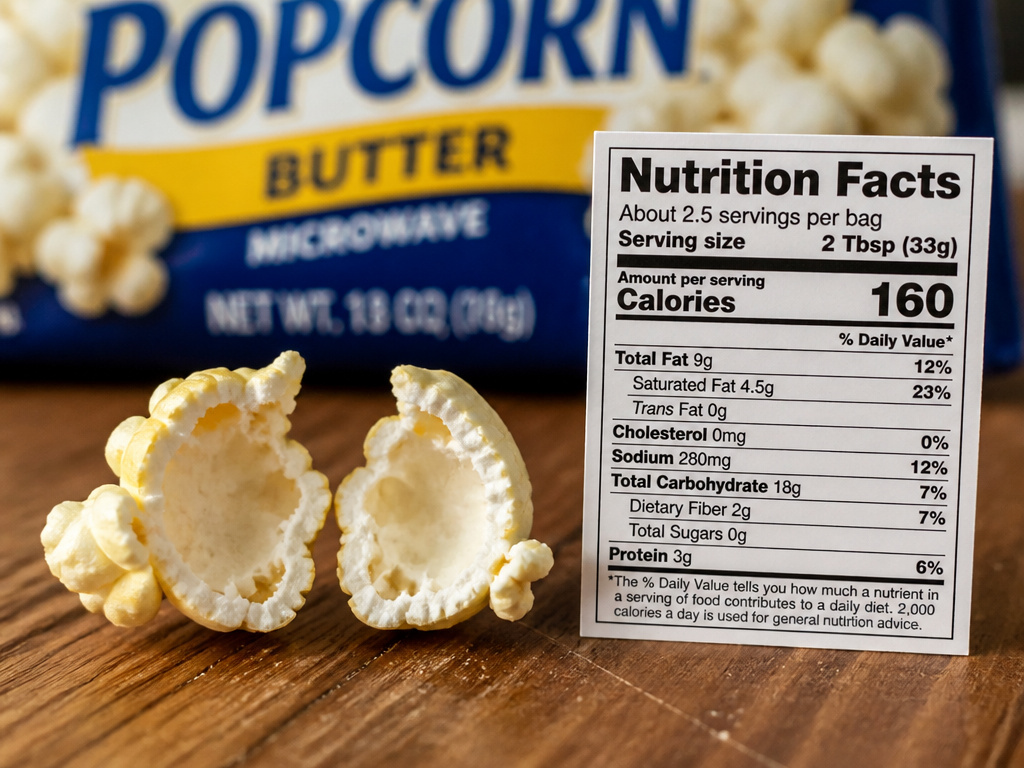
Calories tell you the energy amount. The macronutrient breakdown, fat, carbs, protein, tells you where that energy comes from and how it will affect you.
For a standard butter microwave bag (using the Pop-Secret 250-calorie data): * Fat: 57% of calories (16g). Primarily from palm oil. This is the satiety factor, but also the calorie driver. * Carbohydrates: 38% of calories (24g). Almost all from the popcorn itself, which is a complex carb and a whole grain. * Protein: 5% of calories (3g). A modest amount, but more than most salty snacks.
Where this goes sideways: Choosing a “light” or “94% fat-free” microwave popcorn. These cuts often reduce fat to 2-5g per serving, but some brands compensate with added sugar or artificial flavors to make up for the lost mouthfeel. You save 50-80 calories but might ingest chemistry you didn’t want. Read the ingredient list.
The fiber is popcorn’s secret weapon. That same 250-calorie bag provides 8-10g of dietary fiber, which is nearly a third of your daily need. Fiber slows digestion, helps manage blood sugar, and contributes to the feeling of fullness. It’s the reason popcorn is more satisfying than chips at a similar calorie count.
This macro awareness is similar to planning for burning calories on a hike. You wouldn’t just consider the total distance; you’d think about the terrain (carbs for energy) and the pack weight (sustained energy needs). The composition matters as much as the total.
What About Other Popcorn Types?
The microwave bag is just one avatar. Kettle corn, pre-popped bags, and caramel corn follow different rules.
Pre-popped Bagged Popcorn (e.g., SkinnyPop, Boomchickapop):
These are typically air-popped or lightly oil-popped, then seasoned. A serving (about 3.5 cups) usually ranges from 130-160 calories. The advantage is portion control, the entire bag is often one serving, so the math is done for you. The disadvantage is cost per ounce and sometimes a drier texture.
Kettle Corn:
The sweet-and-salty profile comes from sugar added during popping. This adds calories from carbohydrates, not fat. A microwave bag of kettle corn can be similar in calories to a butter version (around 220-260 per bag), but with more sugar (often 10-15g) and slightly less fat.
Caramel Corn / Cheese Corn:
These are candy or savory treats, not snacks. The coating is heavy. As demonstrated in a YouTube transcript from a registered dietitian, a bowl of caramel corn comparable in volume to a small movie theater popcorn contained 440 calories and 100g of sugar. This is a dessert.
How to Choose and Control Your Popcorn Calories
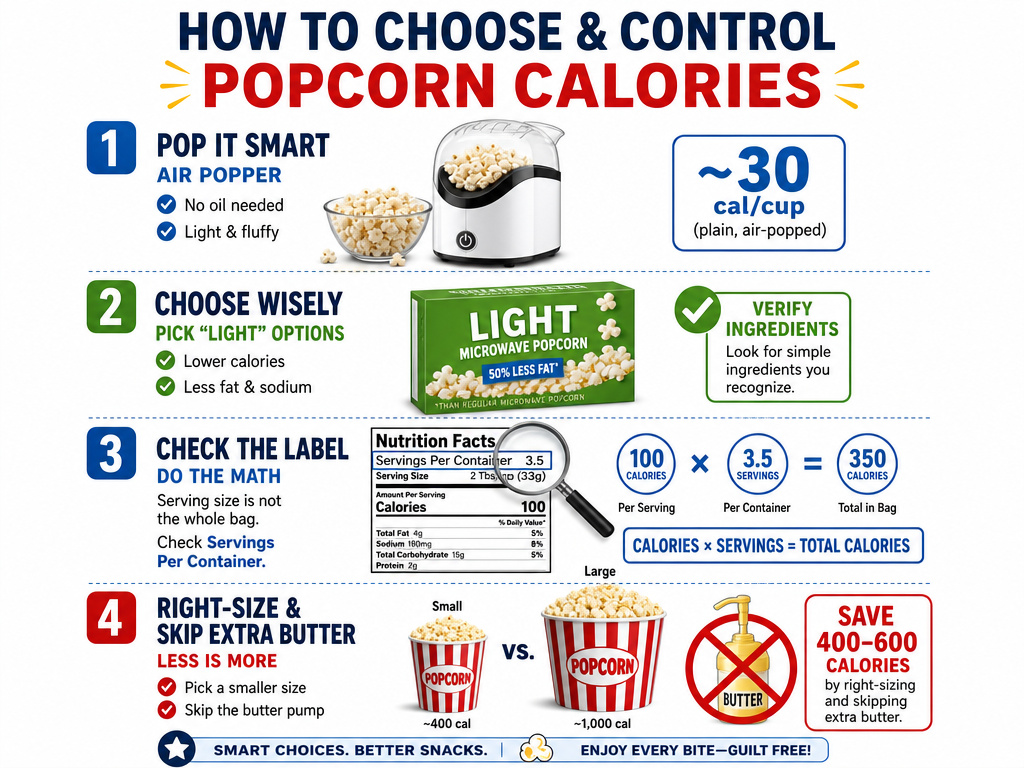
You don’t have to give up popcorn. You have to choose your battlefield.
- For the Lowest Calorie Count: Air-pop at home. Use an air popper or a microwave popcorn bowl with a vented lid. Season with spices (nutritional yeast, chili powder, everything bagel seasoning) or a light spritz of olive oil (about 10 calories per spray).
- For Convenience with Better Control: Buy “Light” Microwave Popcorn. Go with a verified brand like Orville Redenbacher’s 94% Fat Free or Newman’s Own. Verify the ingredients are clean, just popcorn, oil, salt, flavor.
- To Decode Any Bag: Do the “Servings Per Container” Math. Before you buy, flip the box. Find the calories per serving and multiply by the servings per container. That’s your real number.
- At the Movies: Go Small, Skip the Butter Pump. Order the smallest size available and take the “butter” pump off the table. This simple move can save you 400-600 calories on a large popcorn.
Think of it like navigating airline fees. You know a backpack as carry-on is free, but checking it incurs a cost. You know a backpack and carry-on is allowed on Southwest, but Spirit and Frontier have strict size requirements. The rules exist; your job is to learn them to avoid the penalty, whether it’s a $50 baggage fee or 50 grams of unnecessary fat.
Frequently Asked Questions
Why does plain microwave popcorn have more calories than buttered?
It has more pure oil. Butter-flavored oils include other ingredients like salt, flavorings, and milk solids. Plain popcorn uses a higher proportion of straight fat (like palm or coconut oil) to pop the kernels since there’s no flavor mask. That pure fat is more calorically dense per gram, leading to a higher total calorie count in the same sized bag.
How many calories are in a large movie theater popcorn?
Large movie theater popcorn, without any extra butter topping, typically contains between 900 and 1,200 calories. The size varies by chain, but it’s often 20 cups of popcorn popped in coconut oil. Adding one pump of the liquid “butter” topping adds roughly 130 calories. Two pumps can push a large popcorn over 1,500 calories, the equivalent of three full meals for some people.
Is popcorn a healthy snack?
Popcorn is a whole grain and can be an exceptionally healthy, high-fiber, low-calorie snack, when prepared correctly. Air-popped popcorn is the gold standard. The health value plummets as you add fat, sugar, and salt. Microwave and movie theater popcorn, while still providing fiber, often come with excessive saturated fat and sodium, moving them into the “occasional treat” category.
How do I accurately count calories for a bag of microwave popcorn?
You must calculate it. Find the “Servings Per Container” on the nutrition label (often 2 or 2.5). Find the “Calories Per Serving.” Multiply those two numbers. For example: 130 calories per serving x 2.5 servings = 325 calories per bag. The label will not show “325” outright.
What’s the best low-calorie popcorn brand?
For microwave convenience, Orville Redenbacher’s 94% Fat Free Butter or Newman’s Own Microwave Popcorn are solid choices, ranging from 160-210 calories per bag. For the absolute lowest calorie option, buy plain kernels and air-pop them yourself. This gives you complete control over portions and seasoning for about 93 calories per 3-cup bowl.
The Bottom Line
A bag of microwave popcorn isn’t one thing. It’s a 160-calorie Orville Redenbacher’s Tender White bag or a 457-calorie plain unsalted bag. The difference is oil.
The label is a puzzle you have to solve. The “serving size” is a suggestion designed to make the numbers palatable. Your job is to multiply to find the truth.
If you want the snack without the tax, air-pop your own. It’s the only way to get a giant, satisfying bowl for under 100 calories. Everything else is a compromise between convenience, flavor, and the numbers on the scale. Choose with your eyes open.