How Walking With a Backpack Affects Calories Burned: Facts
This post contains affiliate links. As an Amazon Associate, we earn from qualifying purchases.
Yes, walking with a backpack burns more calories. The increase is linear and predictable: for every 1 kilogram (2.2 lbs) of extra load you carry, your body burns an additional 7.6 watts of metabolic power while walking at a normal pace of 1.25 meters per second. That’s a near-doubling of energy expenditure when carrying a load equal to 40% of your body weight.
The 7.6-watt figure comes from a biomechanics study that measured the work performed on the body’s center of mass. That work is the physical reason you burn more fuel. It’s not just “more weight equals more effort”, it’s a measurable, repeatable increase in mechanical work that your muscles must perform, primarily at the ankle and knee.
What follows is a breakdown of that number, the joint-by-joint mechanics behind it, and the practical limits before the extra burn turns into exhaustion or injury. We’ll cover why a 60% body mass load is a breaking point, how load position changes the cost, and what a 30-liter backpack actually means for your calorie math.
Key Takeaways
- For each 1 kg (2.2 lbs) of added load, you burn an extra 7.6 watts of metabolic power while walking at a normal pace. This relationship is linear up to at least 40% of your body weight.
- The greatest increase in muscular work happens at the ankle during push-off and the knee after foot strike. Your hips actually do more negative work to control the load.
- Carrying a load equal to 60% of your body mass pushes energy expenditure past 50% of VO2max, a critical threshold that leads to rapid exhaustion. For a 180-pound person, that’s a 108-pound pack.
- Load position matters. A backpack worn high on the back is more efficient than one worn low. Mass attached to the legs (like weighted ankle straps) costs disproportionately more energy than the same mass on your back.
- The energy cost isn’t just about weight. Pack design, walking speed, and your fitness level dramatically alter the actual calorie burn you’ll experience.
The Simple Physics of Carrying More Weight
The body’s center of mass moves in an arc with each step. Adding weight to your back increases the total mass that must be redirected upward and forward with every stride. Your legs have to push harder against the ground to accomplish this.
For every 1 kg of additional load carried in a backpack, subjects expended approximately 7.62 W of additional metabolic power at a walking speed of 1.25 m/s. This resulted in a nearly doubled net metabolic power across the loads tested. The increase in net metabolic rate with load was approximately linear.
That’s the finding from a controlled study published in the Journal of Experimental Biology. At a steady walking speed (about 2.8 mph), the relationship between load and energy cost is a straight line. Carry 5 kg (11 lbs), burn about 38 extra watts. Carry 20 kg (44 lbs), burn about 152 extra watts.
This linearity holds true because the primary cost is the positive mechanical work performed on the center of mass. The rate of that work increases by roughly 1.40 watts for every additional kilogram you carry. Your metabolic system converts fuel to do that work at an efficiency of about 16%. The remaining energy cost, things like stabilizing the load and moving your limbs, stays relatively constant regardless of weight.
Where That Extra Energy Actually Goes
Your legs aren’t a single engine. The increased workload is distributed across joints, and the distribution isn’t equal. Understanding which muscles are doing the extra labor explains why certain pack weights feel different.
The same study that pinpointed the 7.6W/kg figure used motion capture and force plates to break down the joint contributions. The greatest increase in positive work, the propulsive force that moves you forward, comes from two places:
- The ankle during push-off (45–60% of the stride cycle).
- The knee during the rebound after your foot hits the ground (12–30% of the stride).
Your calf and quadriceps are doing the heavy lifting, literally. Meanwhile, the hip performs increasing amounts of negative work near the end of the stance phase. This means your glutes and hamstrings are working harder to control and brake the motion of your loaded torso, not to propel it.
Where this goes sideways: Assuming all the work is propulsive. A significant portion of the extra burn comes from your hips and core muscles working eccentrically to stabilize the load. If those muscles are weak, you’ll feel fatigue in your lower back long before your calves give out.
This joint-level detail is why simply adding weight to a comfortable walking backpack with a good hip belt is so critical. A belt transfers load from your shoulders to your pelvis, engaging your stronger hip stabilizers more effectively and sparing your spine.
The 60% Body Mass Threshold: When More Burn Becomes Unsustainable
The linear increase in energy cost has a limit. Your cardiovascular system can only output so much power before you cross from sustainable effort into a zone of rapid exhaustion.
Research focused on military load carriage identifies a critical threshold: 50% of your VO2max (your maximum rate of oxygen consumption). Exceed this relative intensity, and you cannot sustain the activity for long. A 2022 study in Medicine & Science in Sports & Exercise found that a load of 37% body mass kept soldiers below this 50% VO2max line. But a load of approximately 60% body mass pushed them significantly above it.
| Load (% of Body Mass) | Relative Intensity (% VO2max) | Sustainable? |
|---|---|---|
| 20% | ~30% | Yes, for hours. |
| 30% | ~41% | At the upper limit of recommended work. |
| 37% | <50% | Sustainable for trained individuals. |
| 60% | >50% | No. Leads to exhaustion. |
For a 180-pound person, a 60% load is a 108-pound pack. That’s an extreme weight, but it illustrates the point: there’s a ceiling. The US Army Load Carriage Decision Aid (LCDA) backpacking equation was developed specifically to model this nonlinear strain, as older equations failed to predict the metabolic cost of modern heavy loads like the MOLLE 4000 rucksack.
The takeaway? While a daypack or a 30-liter backpack loaded with 20-30 lbs will absolutely increase your calorie burn, pushing into expedition territory with a 40-liter backpack at half your body weight changes the game entirely. You’re not just burning more calories; you’re racing your own aerobic capacity.
Why a High Carry Beats a Low Carry (And Why Ankle Weights Are a Terrible Idea)
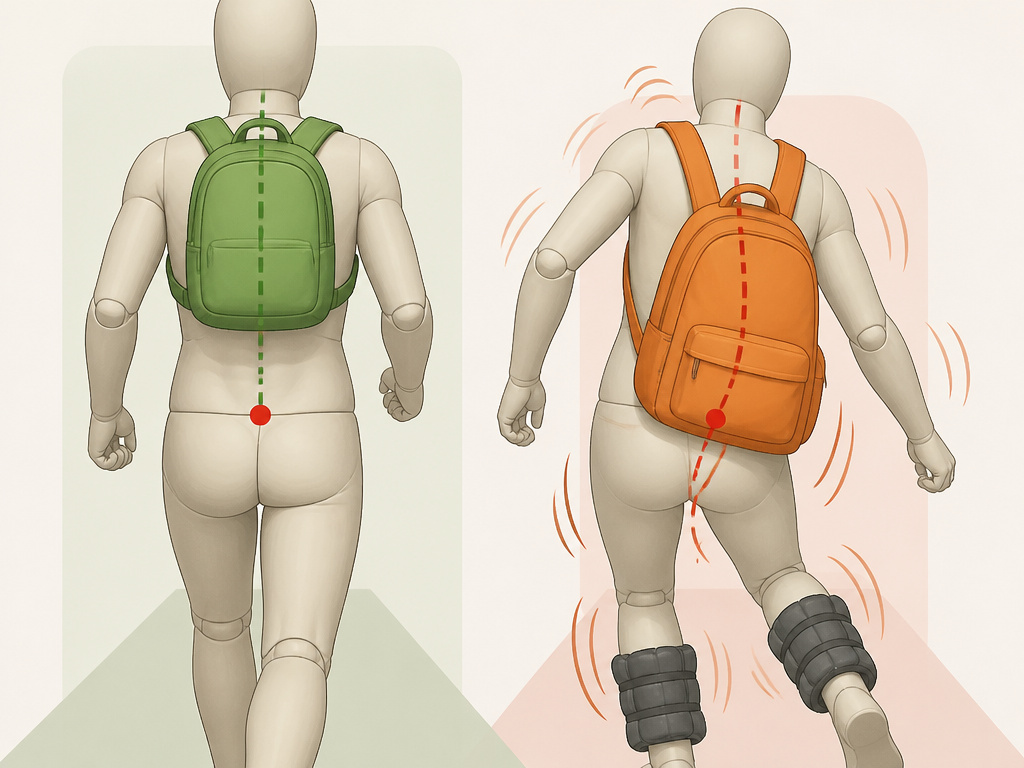
Where you place the weight changes the physics. Your body’s center of mass is around your navel. Adding weight close to that point minimizes the “pendulum effect,” making it easier to control.
A 2022 review in Ergonomics analyzed load position. It concluded that carrying a load equal to 25% of body mass high on the back significantly decreased oxygen consumption (VO2) and minute ventilation compared to a low or central position. A high, tight pack keeps the load’s center of mass aligned with your own, reducing the torque your muscles must fight with each step.
Conversely, mass attached to the legs is brutally inefficient. A separate PubMed added mass walking study proved this. Researchers added weight to ankles, knees, and backs. Their finding was clear: “Contrary to mass carried on the back, mass attached to the leg cannot be modeled simply as an increase in body mass.”
The relative cost of carrying mass on your ankles versus your back changes with speed and the amount of weight. The further the mass is from your core, the more energy it takes to swing it back and forth with each stride. This is why weighted vests are a more efficient training tool than ankle weights for walkers and runners.
How to Calculate Your Actual Calorie Burn

You can’t just take your unloaded walking calorie count and add a flat percentage. The increase depends on three variables: the weight of the pack, your walking speed, and your own body weight.
The LCDA backpacking equation is the current gold standard for modeling this, but it’s complex. For a practical estimate, use the 7.6 watts per kilogram rule as a base, then adjust for speed.
- Convert your pack weight to kilograms. (Weight in lbs / 2.2 = Weight in kg).
- Calculate added metabolic power. Weight in kg * 7.6 = Additional watts burned.
- Convert watts to calories. 1 watt = 0.01433 kilocalories per minute. So, Additional watts * 0.01433 = Extra kcal burned per minute.
- Multiply by time. Extra kcal/min * Minutes walked = Total extra calories.
Example: You carry a 10 kg (22 lb) pack on a 60-minute walk. * Added watts = 10 kg * 7.6 W/kg = 76 W * Extra kcal/min = 76 W * 0.01433 = ~1.09 kcal/min * Total extra burn = 1.09 kcal/min * 60 min = ~65 extra calories.
That’s the added burn just from the pack, on top of what you’d burn walking unloaded. At a moderate pace, a 180-lb person might burn around 300 calories in 60 minutes. The 10 kg pack adds roughly a 20% increase.
Common mistake: Using a generic “10% more calories” rule. The actual increase is a function of the load’s absolute weight, not a percentage of your base burn. A 5 kg pack adds the same 38 watts for a 120-lb person as it does for a 220-lb person, but the relative increase is much larger for the lighter individual.
Remember, this model assumes a steady, moderate walking speed (1.25 m/s or ~2.8 mph). Faster speeds or uneven terrain will increase the cost further. If you’re using a backpack designed for walking with a proper frame and hip belt, you’ll be more efficient than someone with a sling bag, potentially lowering the cost slightly.
The Gear That Changes the Equation
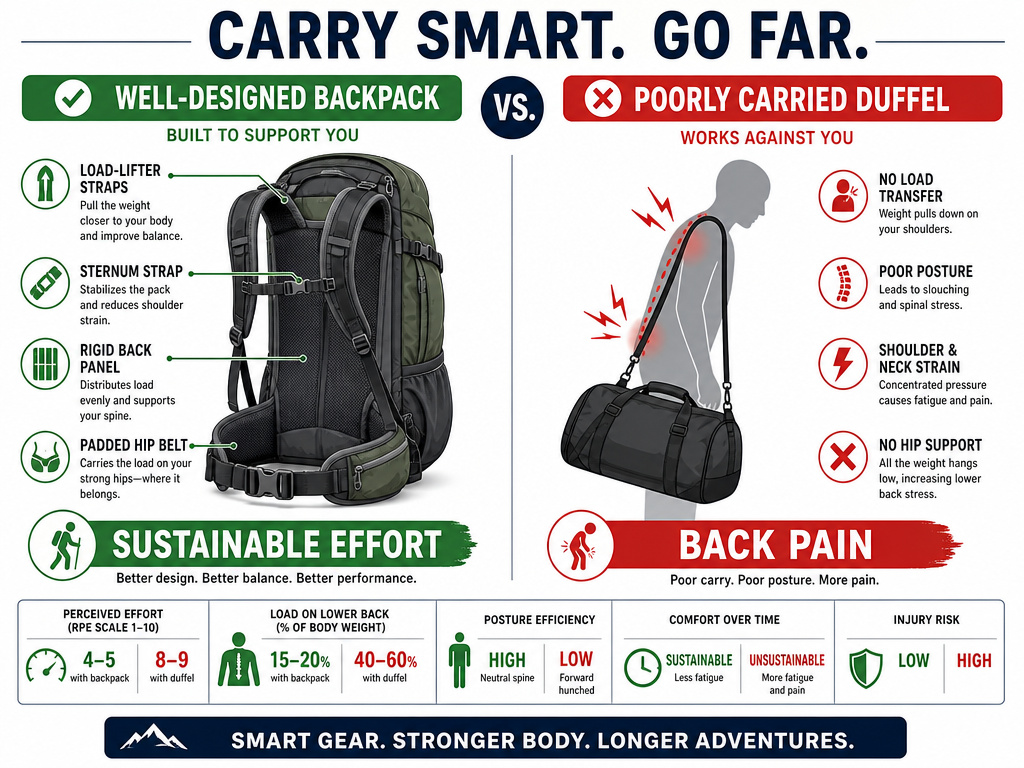
Not all weight is created equal, and not all bags carry it the same way. The research on load position and military rucksacks translates directly to civilian gear.
A well-designed backpack does two things: it positions the load high and close to your spine, and it transfers weight to your hips. Look for these features if you’re walking for fitness or travel:
- A rigid or framed back panel keeps the load from sagging low.
- A adjustable, padded hip belt is non-negotiable for loads over 15-20 lbs. It should carry 80% of the weight.
- Load-lifter straps at the shoulders allow you to pull the top of the pack closer to your body.
- Sternum strap stabilizes the pack and prevents shoulder strap slippage.
The difference between a 35-liter backpack with a proper frame and a stuffed 35L duffel carried by its straps is the difference between sustainable effort and back pain within a mile. This is also why understanding airline rules matters, knowing you can carry a backpack on a plane as a personal item means you can pack a efficient, carry-on sized pack instead of a bulky suitcase you have to check.
Frequently Asked Questions
Does walking with a backpack build muscle?
It builds muscular endurance, not significant muscle size. The primary work is done by your calves, quads, glutes, and core stabilizers in an endurance capacity. You’re training them to work longer under load, not to grow larger. For hypertrophy, you’d need heavier, more concentrated resistance training.
Is it better to walk with a backpack or a weight vest?
Weight vest is almost always better for focused calorie burn and core engagement. It distributes weight closer to your center of mass and doesn’t restrict shoulder movement or pull you backward. A backpack is more practical for carrying gear, but a vest is the superior tool for adding metabolic load efficiently.
How heavy should my backpack be for weight loss?
Start very light. Add only 5-10% of your body weight (e.g., 10-20 lbs for a 200-lb person). The goal is sustainable, increased energy expenditure over time, not acute strain. Using a pack you can wear comfortably for 45-60 minutes is far more effective for weight loss than an unbearably heavy one you ditch after 10 minutes.
Can I use my everyday backpack, or do I need a special one?
You can use any backpack, but its design imposes a hard limit. A simple school backpack or laptop bag lacks a hip belt and frame. Without them, all the weight hangs from your shoulders, increasing strain on your neck and upper back and reducing walking efficiency. For loads over 15 lbs or walks longer than 30 minutes, a dedicated hiking or walking backpack is a worthwhile investment.
Does the type of walking surface change the calorie burn with a backpack?
Absolutely. Walking on sand, gravel, or uphill dramatically increases the mechanical work required per step. The 7.6W/kg figure is for level, firm ground. On soft or inclined surfaces, the cost per kilogram will be higher because your foot strike is less efficient and your muscles work harder for propulsion and stability.
Before You Go
Walking with a backpack burns more calories because your body must perform measurable extra mechanical work, primarily at your ankles and knees. The increase is linear, about 7.6 extra watts of metabolic power for every kilogram you carry.
But the goal isn’t just to burn calories. It’s to do so sustainably. Stick to a load you can carry without hunching forward, use a pack with a hip belt for anything over 20 lbs, and keep the weight high on your back. Pushing past 30-40% of your body weight crosses into a zone of sharply diminishing returns where exhaustion, not fitness, becomes the outcome. For most people, a loaded 20-liter backpack is the sweet spot: enough weight to matter, but not so much that it wrecks your walk.