Can You Bring a Backpack to Disneyland? Size Rules & Guide
This post contains affiliate links. As an Amazon Associate, we earn from qualifying purchases.
You can bring a backpack into Disneyland, but its maximum allowed size is 24 inches long, 15 inches wide, and 18 inches high. All bags are subject to a security screening where every zipper and pocket will be checked, and any item larger than this limit will be denied entry into the theme parks.
That size limit is the first line of defense at the security checkpoint. It’s not a suggestion; it’s the line where a bag stops being a personal carryall and becomes a piece of luggage. The official rules draw a bright line between what’s manageable in a crowded queue and what becomes a hazard.
What follows is a breakdown of that rule and everything it touches: the specific items that will get your bag flagged, the surprising exceptions for things like baby food, and how to pack so you clear security in seconds instead of minutes.
Key Takeaways
- Backpacks over 24″ long x 15″ wide x 18″ high are prohibited. Measure yours before you go.
- Every bag undergoes a full security screening, expect to open all compartments.
- Loose or dry ice is banned; use reusable ice packs instead for cooling snacks.
- Alcohol and glass containers are prohibited in the parks, but have specific exceptions in the resort hotels.
- Strollers larger than 31″ wide x 52″ long and all types of wagons are not allowed.
The 24x15x18 Rule That Actually Matters
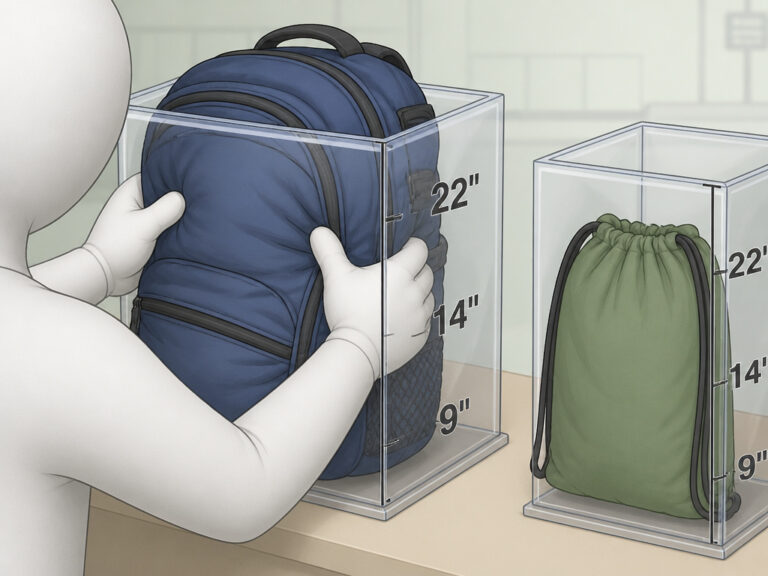
The official Disneyland Resort park rules state a clear dimension: suitcases, bags, coolers, or backpacks larger than 24″ long x 15″ wide x 18″ high are not allowed in any theme park. This applies to bags with or without wheels.
Suitcases, bags, coolers or backpacks, with or without wheels, larger than 24″ long x 15″ wide x 18″ high (61 cm x 38 cm x 46 cm) are not allowed in any theme park. – Disneyland Resort Park Rules
This isn’t a vague “reasonably sized” guideline. It’s a hard limit designed for practical crowd management and ride safety. A bag that fits under a ride vehicle seat or between your feet on a crowded walkway is one thing; a rolling suitcase is another. The rule exists because oversized bags block pathways, become trip hazards in queues, and simply don’t fit in the designated spaces on attractions.
How to measure: Use a tape measure. Length is the longest side, width is the side perpendicular to that, and height is the remaining dimension. If your backpack is a soft shell, don’t pack it to bursting before measuring, the security officer will judge its expanded state.
Where Backpack Size Plays Out on Rides
Most attractions have a small footwell or a mesh bag in front of your seat. A standard school-style backpack or a modern hiking daypack typically fits there. Larger hiking packs with external frames often exceed the 18-inch height limit when you account for the frame structure. If you’re bringing a backpack for a full day, lean towards a streamlined daypack over an expedition pack.
| Backpack Type | Typical Dimensions | Disneyland Compliant? | Best For |
|---|---|---|---|
| Standard Daypack | 17″ x 12″ x 6″ | Yes | Carrying essentials, light jackets, snacks. |
| Laptop Backpack | 18″ x 13″ x 8″ | Check carefully—may push limits if overstuffed. | Park-goers who need a tablet or laptop for later. |
| Hiking Backpack (35L+) | 22″ x 14″ x 10″ | Likely No—height/width often exceed limits. | Not recommended for theme park use. |
| Mini Backpack (Loungefly style) | 10″ x 8″ x 4″ | Yes | Carrying personal items, phone, wallet, keys. |
The security process is built around this rule. As you approach the screening tables, you’ll be asked to place your bag on the table and open every compartment, main zipper, front pockets, side water bottle sleeves. The officer will visually inspect and may use a tool to move items aside. They are looking for prohibited items, but they are also gauging the bag’s size. One that’s visibly overstuffed and bulging beyond the stated dimensions can still be turned away.
What You Absolutely Cannot Bring
The size rule is straightforward. The contents of your backpack are where most delays and denials happen. The prohibited items list is specific, and some of the exceptions are counterintuitive.
Firearms, ammunition, knives, and weapons of any kind are an immediate and absolute prohibition. This includes any object or toy that simulates a weapon. Don’t pack that plastic lightsaber from the Star Wars store you visited yesterday; it will be confiscated at security.
Self-defense devices like pepper spray or mace are also banned. The park’s security posture assumes its own personnel handle any threats.
Alcohol and marijuana are prohibited in the theme parks and the Downtown Disney District. The exception is subtle: alcoholic beverages are allowed in the Hotels of the Disneyland Resort. You can bring wine into the Downtown Disney District, but only to consume at select table-service restaurants that charge a corkage fee. This is a classic edge case, allowed in one part of the resort, banned in another.
Common mistake: Assuming a sealed water bottle is the only liquid rule. Loose or dry ice is not permitted in backpacks or coolers. The official rules recommend reusable ice packs instead. Dry ice sublimates and can displace oxygen in a confined space, making it a safety concern in a queue or on a ride.
Glass containers are another item with a critical exception. They are generally prohibited, excluding small containers such as baby food jars. They are also permitted within the Disney Resort hotels. If you’re packing for an infant, those glass jars are fine. A glass bottle of soda is not.
Recreational devices like drones, skateboards, scooters, and inline skates are banned. This also includes shoes with built-in wheels.
The Stroller and Wagon Ban
Your backpack isn’t the only thing with size limits. Strollers larger than 31″ wide and 52″ long are prohibited. All types of wagons, including popular stroller-wagon hybrids, are completely banned from the theme parks and Downtown Disney District. This is a major point of confusion for families. Your expensive Wonderfold wagon must stay in your car or hotel room.
Wheeled mobility devices (ECVs and wheelchairs) have their own specs: they must be single-rider and cannot exceed 36″ wide and 52″ long. They must have three or more wheels and maintain stability when stopped and unoccupied.
Navigating the Security Screening
All persons, bags, parcels, and other items are subject to screening. This is not a random check; it’s a mandatory step for every guest entering the parks or Downtown Disney.
The process is designed for throughput but hinges on guest cooperation. As you approach the screening tables, have your backpack unzipped and ready. Place it on the table open. The security officer will visually inspect the contents and may use a wand or their hands to move items aside. They are trained to look for the specific prohibited items listed above and for any item that might be a safety or security concern.
To speed it up: Use clear zip-top bags for smaller items like sunscreen, chargers, and snacks. This reduces rummaging and lets the officer see everything at a glance. Avoid packing items in nested layers, if your jacket is wrapped around a water bottle which is stuffed inside a hat, you’ll be asked to unpack it.
Where this goes sideways: Trying to hide a prohibited item in a hidden pocket. Security officers see thousands of bags a day; they know the common hiding spots. Getting caught means confiscation of the item, a longer secondary screening for your entire party, and a delayed start to your day. It’s never worth the attempt.
The official guide map reinforces this: “All loose articles, such as mobile phones, hats/sunglasses, and water bottles, should be securely stowed while riding or left with a non-riding member of your party. Items lost while riding attractions may not be immediately retrievable.”
Backpack Use Inside the Parks: Rides, Lockers, and Etiquette

Once you’re through security, your backpack is your responsibility for the day. On most rides, you can take it with you. Place it at your feet in the ride vehicle or in the provided mesh bag. For high-speed roller coasters like the Incredicoaster, it must be securely at your feet. Loose bags are projectile hazards.
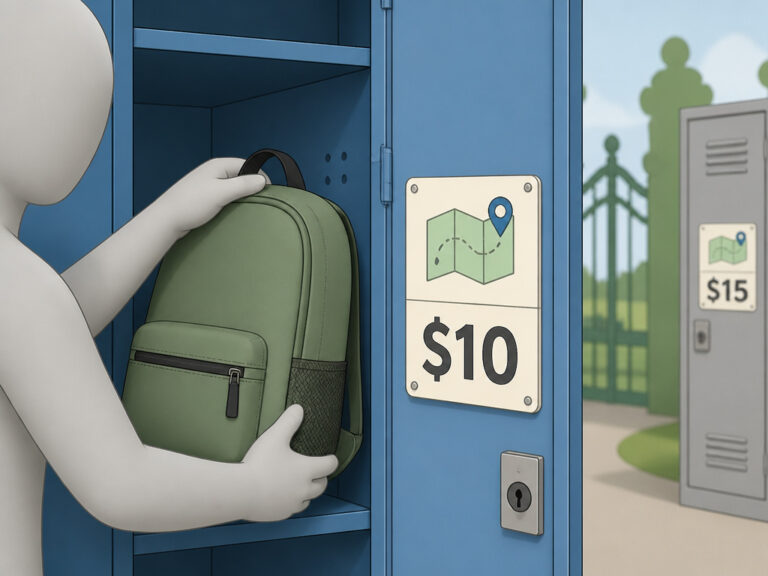
Disneyland offers locker rentals inside the park, typically near the main entrance. If you purchase souvenirs throughout the day, you can store them in a locker instead of carrying them. This is a wise move if your backpack is already full or if you buy a large or fragile item.
Park etiquette with a backpack: Be spatially aware. In tight queues, turn sideways to minimize your profile. When stopping to look at a map or your phone, step to the side of the walkway. Never swing around quickly without checking your surroundings, a loaded backpack can knock into a child or another guest. The park rules state: “Please show common courtesy to fellow Guests and our Cast Members by not using profanity or engaging in unsafe, illegal, disruptive or offensive behavior.”
What About Other Parks?
The core principle, size limits, security screening, prohibited items, is common across major theme parks, but the specifics always differ. For example, the Universal Studios Orlando backpack policy also restricts bag sizes but may have different dimension limits or ride-specific rules for loose articles. Similarly, the Busch Gardens backpack policy and the Six Flags backpack policy operate under their own unique sets of regulations. Always check the official website of the park you’re visiting the night before.
Packing Your Disneyland Backpack: The Smart Way
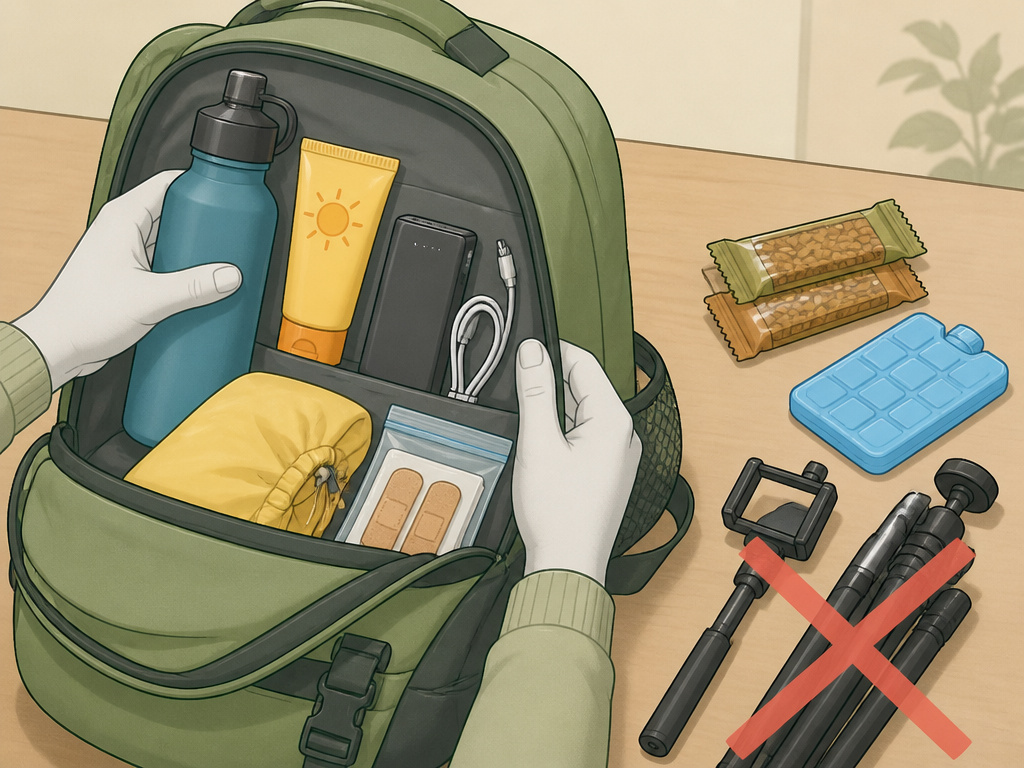
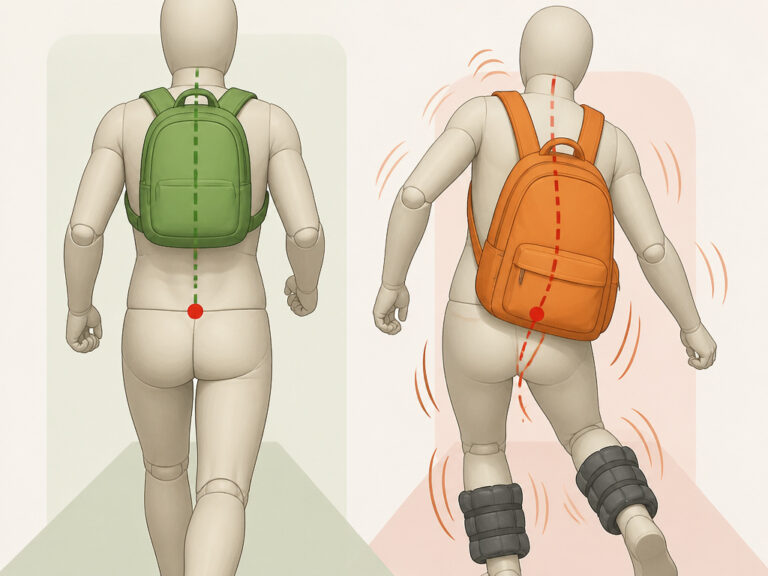
Packing is about balancing preparedness with minimalism. Every ounce you carry, you carry for 12 hours.
Essentials:
- Sun protection: Sunscreen, hats, sunglasses.
- Hydration: Refillable water bottle. There are water stations throughout the parks.
- Power: Portable phone charger and cable. Your phone will die from photos, maps, and the Disneyland app.
- Weather prep: A light, packable rain poncho (not an umbrella, which is awkward in crowds) or a thin layer for evening.
- First aid: Band-aids, pain reliever, blister pads. Walking 8-10 miles on concrete is standard.
Snacks: Pre-packaged, non-messy snacks are allowed and can save you money and time in lines. Think granola bars, trail mix, or crackers. Remember the ice rule: use a reusable ice pack, not loose ice, if you need to keep something cool.
What to leave behind:
- Selfie sticks, tripods, or monopods that extend over 6 feet or can’t fit in a standard backpack.
- Large tripods for professional cameras. If it doesn’t fit inside your backpack, it’s not coming in.
- Anything valuable or irreplaceable that could be lost on a ride. While lockers are available, it’s one less thing to worry about.
Your packing strategy directly impacts your security screening speed. Organize, don’t just stuff.
Frequently Asked Questions
Can I bring a backpack on every ride at Disneyland?
Yes, you can bring your backpack on virtually every attraction. You will place it at your feet, in a provided pouch, or between your legs. For a very small number of rides with intense motion, you may be asked to ensure it is securely wedged. There is no ride that requires you to use a locker beforehand.
Does Disneyland search every backpack?
Yes. Every bag undergoes a security screening at the park entrance. You will be asked to open all compartments for a visual inspection. This is a non-negotiable part of entry.
What happens if my backpack is too big for Disneyland?
If your backpack exceeds the 24″x15″x18″ limit, you will not be allowed to bring it into the theme parks. You have two options: return it to your car or hotel room, or rent a locker outside the park gates (if available) to store it for the day. There is no “bag check” for oversized items at the entrance.
Can I bring food and drinks in my backpack?
Yes. You are allowed to bring outside food and non-alcoholic drinks into Disneyland. Glass containers and loose/dry ice are prohibited. Coolers and backpacks must still adhere to the size limit. This is a great way to manage dietary needs and save on food costs.
Are there any backpack restrictions for costumes?
Yes. Guests ages 14 and older may not wear costumes in the theme parks (with exceptions for special events like Halloween parties). Masks may not be worn by guests 14 or older unless required for medical purposes. Your backpack itself has no costume restrictions, but it cannot be used to carry costume pieces for an adult to change into inside the park.
Before You Go
The rule is simple: a backpack under 24x15x18 inches is welcome. Your day will be smoother if you pack that backpack with the prohibited list in mind, no weapons, no glass, no loose ice. Use clear bags for small items to breeze through security.
Double-check the official Disneyland Resort park rules page the week of your visit. Policies on things like costume wear and smoking areas can update. Your backpack is a tool for a better day: it carries your sunscreen, your phone charger, your snacks. Pack it right, and it disappears into the background, letting you focus on the park itself.
Remember, these rules aren’t unique. If you’re planning a broader trip, understanding the airplane backpack rules for your flight and the specific policies at other destinations like the Disney World backpack policy or the SeaWorld Orlando backpack policy will save you the same hassle at every gate.