Biggest Carry On Luggage Size: Airline Limits & Allowances
This post contains affiliate links. As an Amazon Associate, we earn from qualifying purchases.
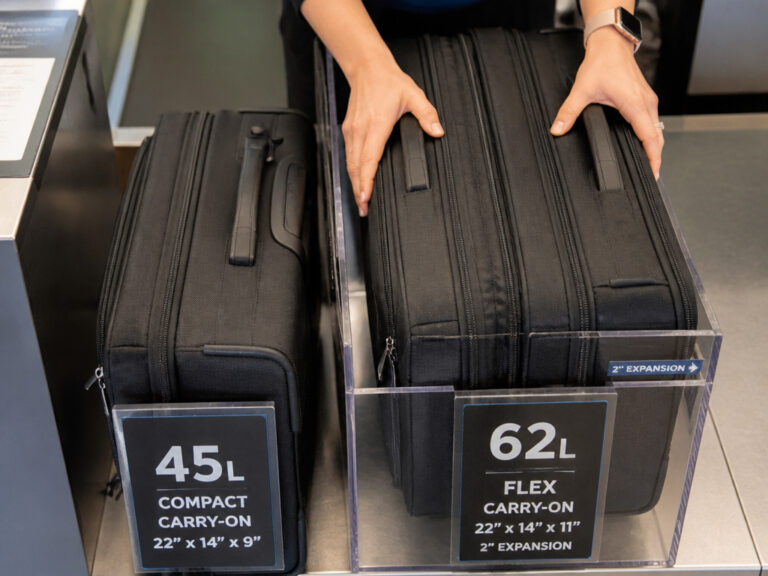
The biggest carry-on luggage size that fits the most airlines is 56 cm × 45 cm × 25 cm (22 × 17.7 × 9.8 in), the IATA guideline. However, the single most generous allowance is Frontier Airlines’ 61×46×25 cm, while the strictest is a cluster of airlines, including Air Senegal, at 55×38×20 cm. Your actual maximum size is dictated by your specific airline, aircraft, and fare class, not by a universal standard.
That IATA guideline is just a recommendation, not a rule. Airlines treat it as a ceiling, not a floor. This turns a simple question into a lookup task with real financial stakes.
What follows is not a list of generic tips. We’ll map the actual boundaries, the ten strictest and ten most generous airlines globally, explain why “linear inches” changes the math, and show you how a bag that passed check-in can still cost you $100 at the gate. We’ll also cover the tools and tricks to push right up against the real limit without getting caught out.
Key Takeaways
- The most common maximum carry-on size is 56×36×23 cm (22×14.2×9.1 in), used by 21 major airlines including American, Delta, and United.
- Frontier Airlines has the single most generous allowance at 61×46×25 cm (24×18.1×9.8 in).
- The strictest size limit is 55×38×20 cm (21.7×15×7.9 in), enforced by airlines like Air Senegal, Emirates, and flydubai.
- European and budget carriers use physical sizer boxes at the gate; US major airlines rarely measure but can deny any bag that obviously won’t fit in the overhead bin.
- Soft bags get no leniency in 2026, if a packed bag doesn’t fit the metal sizer, it gets checked for a fee often double the pre-paid checked bag cost.
The Strictest Carry-On Size in the World
Forget the IATA guideline. The real floor for carry-ons is 55 centimeters tall, 38 wide, and 20 deep. That’s 21.7 by 15 by 7.9 inches. A cluster of ten airlines, primarily in the Middle East, Africa, and South Asia, enforce this exact dimension.
If your bag exceeds 55×38×20 cm at the gate of these airlines, it will not fly in the cabin. You will gate-check it for a fee that typically starts around $60 and can exceed $100.
This group includes Air Senegal, Biman Bangladesh, Emirates, Ethiopian Airlines, flydubai, Nepal Airlines, Pakistan International Airlines (PIA), Royal Air Maroc, and RwandAir. Their consistency isn’t a coincidence, it reflects common aircraft types (like the Airbus A320 family) and operational preferences in those regions. The size is tight. A standard 22-inch roller will fail.
The consequence is a gate-checked bag, which carries a premium fee and the risk of your belongings being separated from you at the last second. This is the core of modern airline carry-on rules: published limits are thresholds for revenue, not just safety.
The Most Generous Carry-On Allowance
On the other end of the spectrum, a few airlines give you noticeably more space. The winner is Frontier Airlines, with a limit of 61×46×25 cm (24×18.1×9.8 in).
Frontier’s policy is an outlier. The next most generous are Southwest Airlines (61×41×27 cm) and Spirit Airlines (56×46×25 cm). This table shows the top five for space.
| Airline | Maximum Dimensions (cm) | Maximum Dimensions (in) | Primary Region |
|---|---|---|---|
| Frontier Airlines | 61 × 46 × 25 | 24 × 18.1 × 9.8 | United States |
| Southwest Airlines | 61 × 41 × 27 | 24 × 16.1 × 10.6 | United States |
| Spirit Airlines | 56 × 46 × 25 | 22 × 18.1 × 9.8 | United States |
| Allegiant Air | 56 × 46 × 25 | 22 × 18.1 × 9.8 | United States |
| Thai Airways | 56 × 45 × 25 | 22 × 17.7 × 9.8 | Asia |
Why would an airline be more generous? Often, it’s about aircraft configuration. Older overhead bins on some MD-80 or Boeing 737 variants can physically hold larger boxes. Also, on ultra-low-cost carriers like Frontier and Spirit, the carry-on size limit is a product they sell. A larger “free” carry-on allowance can be a marketing point against competitors with stricter policies.
But don’t assume bigger is always better. A bag sized for Frontier will be rejected outright on Emirates. Knowing your airline’s specific maximum carry-on size is the only safe move.
How Airlines Measure: Linear Inches vs. Three Dimensions
 This is where people get tripped up. Most of the world measures carry-ons by three separate dimensions: height, width, depth. But several major US and Canadian carriers use a system called linear inches.
Linear inches is the sum of the bag’s height, width, and depth. Delta, American Airlines, Air Canada, and Southwest all use this method. Delta’s limit is 45 linear inches. So a bag measuring 22 x 14 x 9 inches (the common US standard) adds up to exactly 45 linear inches.
Where this goes sideways: Assuming a 22x14x9 bag is “standard” and will automatically pass. A bag that is 23x13x9 is also 45 linear inches and passes Delta’s rule, but would fail an airline that requires each individual dimension to be under a limit (e.g., no side over 22 inches).
This difference matters when you’re shopping for luggage. A product advertised as “22-inch carry-on” is referring to its height. Its width and depth could push it over a linear-inch limit. Always do the math: Height + Width + Depth ≤ Airline’s Linear Inch Limit.
The FAA carry-on baggage circular (AC 121-29B) advises airlines on stowage safety but doesn’t mandate a measurement system, which is why this patchwork exists. For a definitive look at US regulations, the FAA advisory circular is the primary source.
How to Measure Your Bag Like a Gate Agent
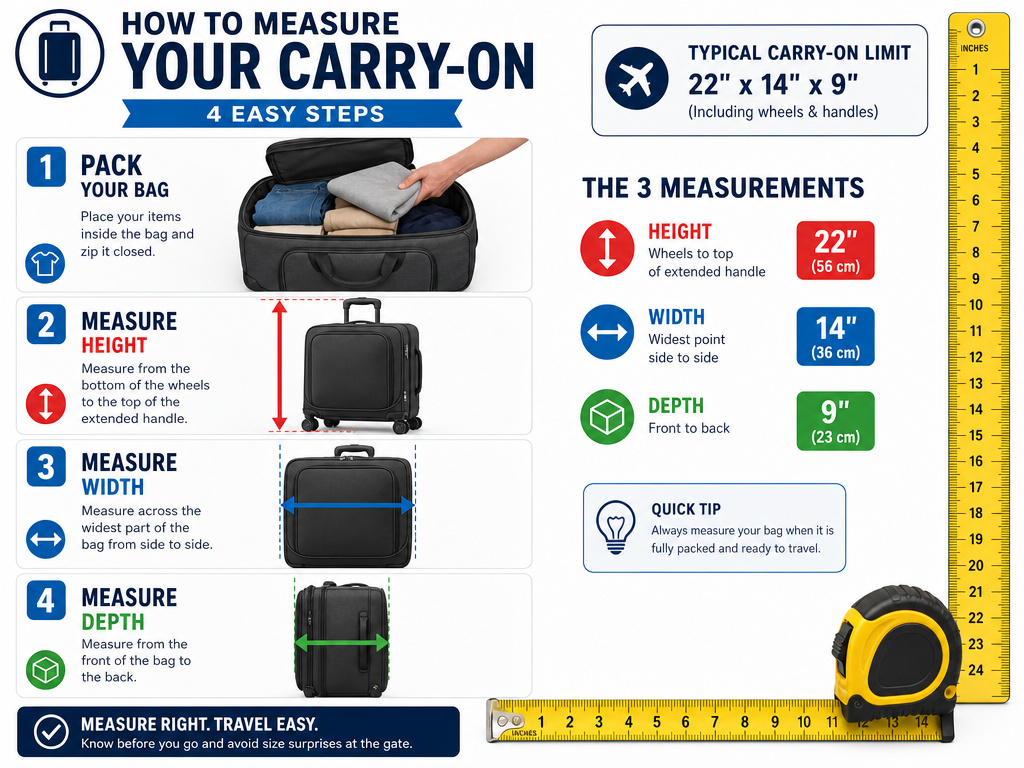 Gate agents don’t measure your empty bag. They judge your packed bag. The sizer box at the gate is the final judge, and it shows no mercy to bulging pockets or extended handles.
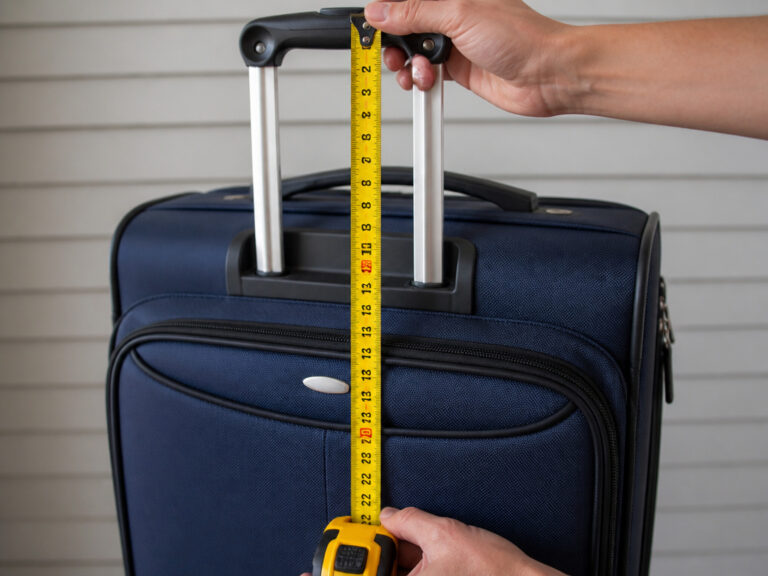
Follow this sequence to measure correctly: 1. Pack your bag completely as you would for your trip. This is non-negotiable. A soft-sided duffel can gain two inches in girth when full. 2. Height: Measure from the very bottom of the wheels to the very top of the retracted handle. This is the most common fail point, people forget the handle. 3. Width: Measure across the bag at its widest point, which is often the middle when packed. Include any side pockets that bulge out. 4. Depth: Measure from the front to the back, including any front organizational panel that adds thickness.
Now, check those numbers against your airline’s published carry-on dimensions. If you’re within half an inch on each side, you’re probably safe for most US carriers. If you’re flying Ryanair or EasyJet, you need to be under. Not “close.” Under.
Common mistake: Measuring an empty bag. The sizer box doesn’t care about your bag’s potential; it cares about its present reality. A bag that fits empty but bulges when packed will jam in the sizer, and the agent will tag it for the hold.
This is also the moment to decide if you need a compliant carry-on bag or if you can risk a larger bag. The latter is a calculated gamble with a known cost if you lose.
The Real-World Consequences of Getting It Wrong
 The penalty for an oversized carry-on is a fee. As of 2026, gate-check fees are a primary revenue driver for budget airlines and a growing trend for majors.
The financial hit is straightforward. Checking a bag at the gate typically costs $60 to $100. Pre-paying for a checked bag online is usually $30 to $40. The delta is pure penalty. But the non-financial risks are messier.
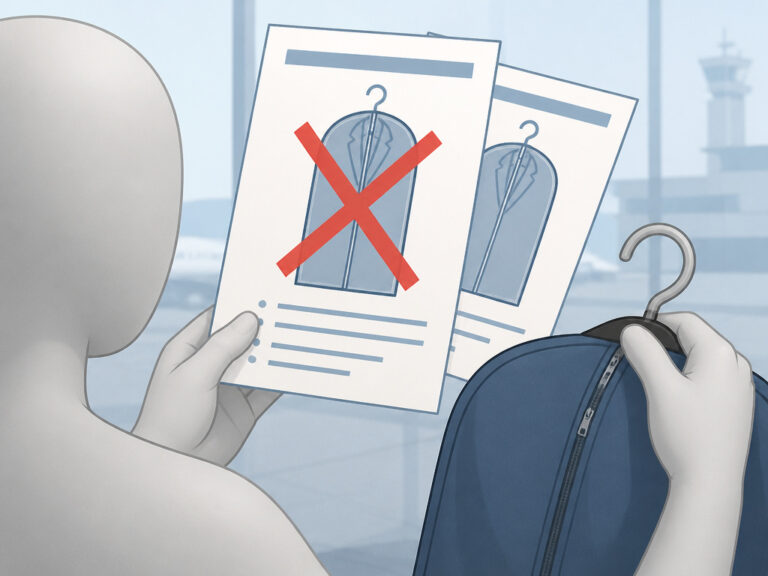
Take the Reddit case from a United flight DFW to SFO. A passenger’s carry-on was taken from the overhead bin by another traveler. The bag, with a bridesmaid dress inside, was gone. The passenger spent $500 on last-minute replacements and only recovered the bag days later through sheer luck and airline intervention. This underscores a hidden consequence: a bag gate-checked at the last minute is handled in a rushed, chaotic process, increasing the risk of loss or misrouting.
Furthermore, as noted in the Wikipedia hand luggage entry, stowing carry-on baggage during an emergency evacuation can block aisles and cost lives, as tragically evidenced in accident reports. Airlines are increasingly strict partly to mitigate this safety risk, not just to collect fees.
Your bag’s size limit is therefore a contract. Exceed it, and you accept the financial and logistical penalties.
Choosing the Right Bag for the Strictest Airlines
If you regularly fly strict airlines like those in the 55×38×20 cm club, you need a bag built to that spec. Off-the-shelf “international carry-ons” often won’t cut it.
You have two paths: ultra-light hard shells or durable soft-sided bags. The Reddit discussion in BuyItForLife highlights the trade-off. A user praised the Horizn Studios H5 Air hard shell for its featherweight 2.1 kg, crucial when facing a 7 kg total weight limit. Another user countered with a warning from a Samsonite rep: ultra-light hard shells are brittle and crack under rough handling, leading to more returns.
The part nobody mentions: A hard shell at 2.1 kg achieves its weight by using thinner polycarbonate. It protects from rain and scuffs, but a direct impact from a falling overhead bin door or a heavy bag stacked on top can fracture the shell along a stress point. It’s a trade-off between weight and durability.
For maximum durability within tight limits, consider a soft-sided bag like a top-tier backpack or a structured duffel. Brands like Osprey or Patagonia make travel packs that compress to fit sizers but are built from rugged, flexible materials. Another Reddit user flying around Alaska swore by a SealLine dry bag, waterproof, lightweight, and adaptable.
The goal is to fit and survive the journey. Always check the carry-on size restrictions of your most frequent airline and buy for that ceiling.
Frequently Asked Questions
What is the most common carry-on luggage size?
The most common maximum carry-on size is 56×36×23 cm (22×14.2×9.1 in). This is the standard for 21 major airlines, including American Airlines, Delta Air Lines, United Airlines, Air Canada, and JetBlue. It’s essentially the North American and transpacific workhorse size.
Do airlines actually measure your carry-on?
Enforcement is inconsistent but predictable. Most US legacy airlines (Delta, American, United) use visual inspection; if your bag looks like it will fit in the bin, they won’t measure. European, Asian, and all budget airlines (Ryanair, EasyJet, Spirit, Frontier) are far stricter. They frequently employ physical sizer boxes at the gate and will measure any bag that looks questionable.
Can I bring a duffel bag as a carry-on?
Yes, a duffel bag is treated as carry-on luggage if it meets the airline’s size requirements. The challenge is that soft duffels are harder to measure consistently and can bulge, causing a gate agent to demand it be sizer-tested. For duffels, it’s wise to stay a full inch under the posted limits in each dimension.
What is the largest carry-on size for international flights?
There is no single “international” size. The IATA guideline of 56×45×25 cm is widely referenced but not universally adopted. For example, the largest carry-on size on a Qatar Airways flight is only 50×37×25 cm, while British Airways accepts the full IATA size. You must check your specific airline’s airline maximum dimensions.
What happens if my carry-on is one inch too big?
If your bag is visibly oversized and the flight is full, an agent will likely ask you to gate-check it. If it’s borderline, they may direct you to the sizer box. If it doesn’t fit, you will be required to check it at the gate for a fee, which is almost always more expensive than pre-paying for a checked bag. There is no “one free inch” rule.
Before You Go
The biggest carry-on luggage size is a variable dictated by your ticket. The safe approach is to identify the strictest airline on your itinerary and size your bag to their limit.Remember Frontier’s generous 61 cm is an exception, not a rule. The standard is far smaller.
Measure your bag packed, not empty. Understand linear inches if flying US carriers. And assume budget airlines will test your bag in their sizer. Getting this right saves you money, time, and the stress of last-minute bag dramas. It turns a variable into a constant.