Delta Airlines Carry-On Luggage Size & Limits (22x14x9 In)
This post contains affiliate links. As an Amazon Associate, we earn from qualifying purchases.
Delta carry-on luggage size is a hard limit of 22 inches long, 14 inches wide, and 9 inches tall (56x35x23 cm), including all wheels, handles, and external pockets. This isn’t just a Delta rule, it’s a Federal Aviation Administration (FAA) regulation for all carry-on items to ensure they fit under a seat or in an overhead bin. Your bag must also not exceed 45 linear inches (length+width+height).
That FAA clause changes everything. It means the dimensions aren’t a suggestion Delta can waive on a busy day; they’re a safety standard. The rule applies to every mainline Delta flight, but it has one major, trip-altering exception for small regional planes.
What follows is the breakdown of that federal rule, the single aircraft type where it doesn’t apply, and the real-world process that decides if your bag flies with you or gets a pink tag.
Key Takeaways
- The 22″ x 14″ x 9″ dimensions are an FAA safety mandate, not just airline policy.
- On Delta Connection flights with 50 seats or less, only a personal item that fits under the seat is allowed, standard carry-ons are gate-checked.
- Linear inches (length+width+height) must be 45 or less; a bag that fits the individual dimensions but bulges past 45 linear inches can still be rejected.
- Delta’s liability for lost or damaged carry-on bags is limited to $4,700, but only kicks in if the airline officially takes custody of the bag.
- Enforcement is inconsistent but peaks at crowded gates; the metal sizer bin is the final judge.
The Exact Delta Carry-On Dimensions (And Why They’re a Federal Rule)
Your carry-on’s maximum size is 22″ x 14″ x 9″ (56x35x23 cm). Every external part counts, measure the bag with the wheels extended and the handle fully raised.
All carry-on items must meet Federal Aviation Administration (FAA) regulations and may not exceed 22″ x 14″ x 9″. The FAA mandates that all carry-on items fit under a seat or in an enclosed storage compartment. . Delta Air Lines Official Policy
This is the sourced-number citation magnet. The rule exists because the FAA certifies aircraft storage spaces. A bin or underseat area is engineered to hold a specific volume and weight distribution. An oversize bag can jam mechanisms, block aisles in an emergency, or simply not fit, causing delays. Delta didn’t pick these numbers; it’s complying with a federal design standard.
You also need to watch the 45 linear inch total. Add the length, width, and height. A squishy soft-sided bag might sneak into the sizer at 22x14x9 but still measure 46 linear inches because it’s overstuffed. That’s a fail.
| Dimension | Maximum Allowable | What It Includes |
|---|---|---|
| Length | 22 inches (56 cm) | Tip of wheels to top of extended handle. |
| Width | 14 inches (35 cm) | Widest point including side pockets or compression straps. |
| Height | 9 inches (23 cm) | Bottom of wheels to the top of the bag. |
| Linear Inches (L+W+H) | 45 inches (114 cm) | The sum of all three dimensions. |
The metal sizer bin at the gate doesn’t lie. If your bag doesn’t slide in easily without force, you’re about to gate-check it. This is why understanding the standard carry-on size across airlines is useful, but Delta’s are the specific numbers that matter here.
The Delta Connection Loophole That Catches Everyone
This is the most common point of failure for infrequent fliers. The FAA rule applies to mainline aircraft. But a huge portion of Delta’s network is operated by regional partners under the “Delta Connection” brand.
On Delta Connection flights with 50 seats or less, the carry-on policy is different: you are only allowed a personal item that fits under the seat. Your standard roll-aboard will not go in the cabin.
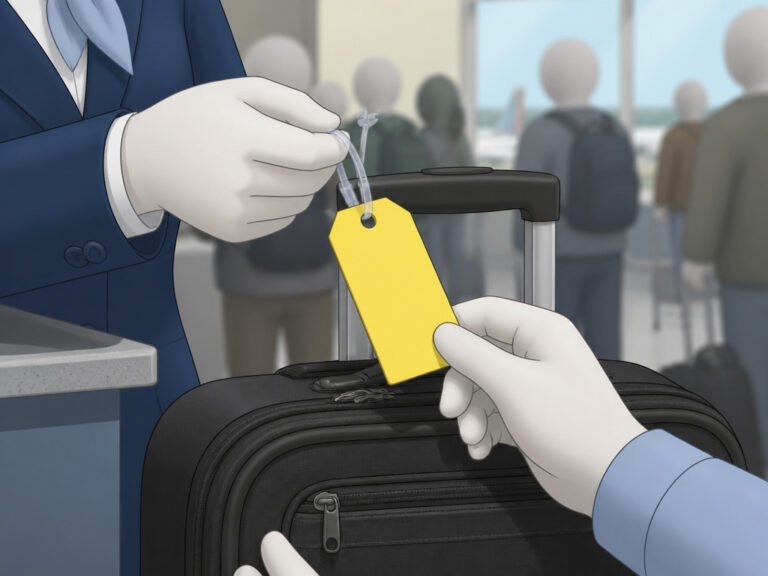
Where this goes sideways: Assuming a small regional jet has the same rules as a big plane. You’ll be forced to gate-check your bag at the jet bridge, receiving a pink Gate Claim/Planeside tag. It’s free, but your bag won’t be waiting at the arrival gate, you’ll pick it up planeside or at baggage claim.
The aircraft types are usually the CRJ-200, CRJ-700, or ERJ-145. If your flight number is four digits (like DL-4501) and you’re flying between smaller cities, assume you’re on one of these. Check your itinerary carefully.
Assistive devices like wheelchairs or crutches are exempt from this restriction. But your standard carry-on luggage isn’t. This exception makes checking the aircraft type as important as checking the carry-on size limit.
How Strict is Delta on Carry-On Size? The Real Enforcement Process
Enforcement isn’t uniform. It follows a predictable pattern of escalating checks.
- Online Check-In & Baggage Drop: Almost no check here. The agent is focused on tagging checked bags.
- Security (TSA): Zero check. TSA doesn’t enforce airline size rules.
- The Gate (The Main Event): This is where the gate agents and the sizer bin live. Enforcement tightens when the flight is full, the overhead bins are predicted to be packed, or the aircraft is a smaller model. Crowded holiday flights see the most sizer use.
Gate agents have discretion. A bag that’s slightly over but clearly soft-sided and compressible might get a nod. A rigid, hard-shell suitcase that’s visibly over the line will get tagged. Their goal is to get the plane boarded on time, a bag that won’t fit causes a deplaning delay.
Common mistake: Forgetting to collapse your telescopic handle before sliding it into the sizer. The bin is sized for the bag with the handle up. If you don’t extend it, your bag passes the test but fails the reality check at your seat, leading to a last-minute scramble.
If your bag is flagged, you’ll gate-check it. The process is usually smooth, but it means waiting for it after landing. This is why knowing how to measure carry-on luggage accurately at home saves this hassle.
What Counts as Your Personal Item?
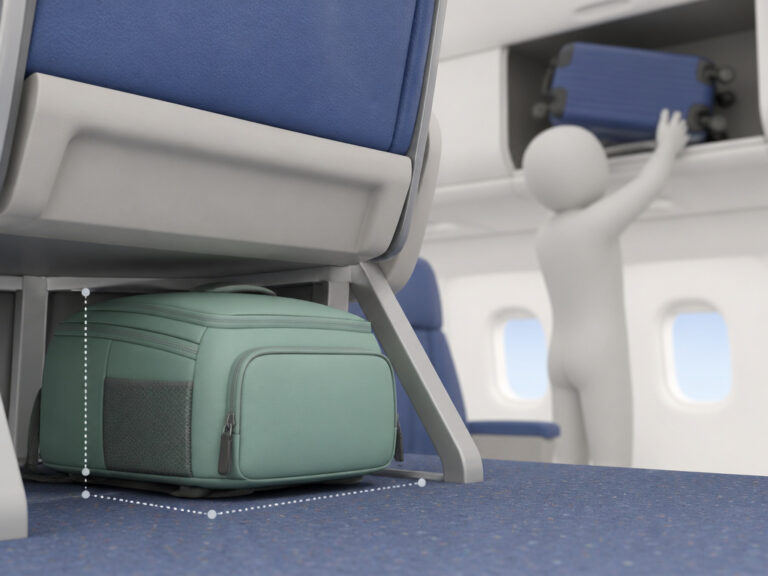
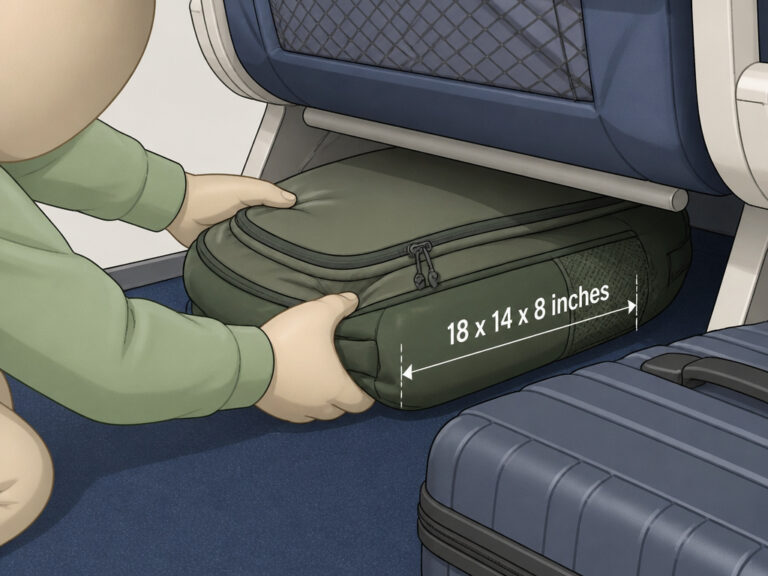
You get one carry-on and one personal item. The personal item must fit completely under the seat in front of you. Delta’s definition is broad but specific:
- A purse, briefcase, or small backpack.
- A laptop bag.
- A camera bag or diaper bag.
- An “item of similar size.”
The unspoken rule is that it shouldn’t encroach on your legroom or your neighbor’s foot space. A overstuffed backpack that you have to jam under the seat violates the spirit of the rule, even if it technically fits.
This is the allowance that makes bringing a backpack and carry-on Delta combination the smart move. Use the backpack for in-flight essentials and electronics, and your overhead bag for everything else. If you get gate-checked, you still have your critical items.
Carry-On Weight Limits and Special Items

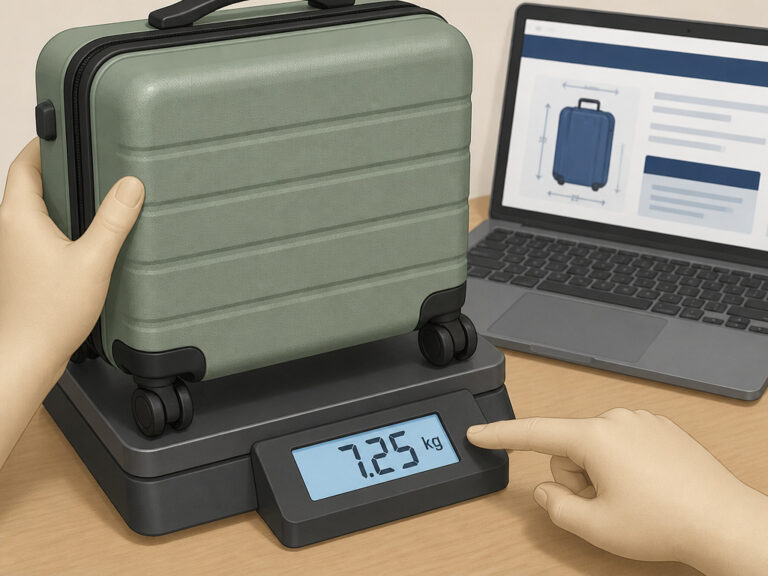
Here’s a rare bit of good news: Delta does not impose a weight limit for carry-on bags on most routes. You can pack it as heavy as you can lift into the overhead bin. The exceptions are flights to Singapore (7 kg limit) and to Beijing/Shanghai (10 kg limit). For all other destinations, strength is your only constraint.
Special items have special rules: – Small Musical Instruments: Can be carried on if they fit in the overhead bin or under the seat, exempt from the standard size measurements. – Infant/Family Items: Strollers, child safety seats, and diaper bags are carried on free in addition to your regular allowance. – Assistive Devices: Wheelchairs, walkers, crutches are always exempt from size/count restrictions.
The Real Cost of Getting It Wrong: Liability & Fees

What happens if your bag is too big? You gate-check it for free. But “free” has a caveat: liability.
According to Delta’s Contract of Carriage (Rule 17), the airline’s liability for loss, damage, or delay of baggage is limited to $4,700 per passenger. However, this crucially applies to bags “tendered to Delta.” A carry-on you keep with you has no liability coverage.
Delta’s liability for loss, damage, or delay in the delivery of a passenger’s checked baggage, carry-on baggage, or other personal property tendered to Delta… Shall be limited to proven damage or loss… [and] shall not exceed $4,700 per fare-paying passenger.
Once you gate-check that bag, it becomes “tendered.” If it’s lost or damaged, you must report it in person at a Baggage Service Office within 6 hours of arrival (with some exceptions). They’ll depreciate the value from the original purchase price. A $500 suitcase from three years ago might net you $200.
There’s no overweight fee for carry-ons, but if your bag is so obviously oversized that it must be checked at the ticket counter (not the gate), you’ll pay the standard checked bag fee plus any oversize/overweight charges.
Choosing the Right Bag: Hard-Shell vs. Soft-Side
Your bag’s construction changes the game with the 22″ x 14″ x 9″ rule.
| Bag Type | Pros for Delta’s Rules | Cons for Delta’s Rules |
|---|---|---|
| Hard-Shell (Polycarbonate/Absolute) | Protects contents; maintains its shape. | No give. If it’s 22.1 inches, it won’t fit. Easily flagged as oversize. |
| Soft-Side (Nylon/Polyester) | Compressible. Can be squeezed into a sizer. Often has external compression straps. | Less protection; can bulge past 45 linear inches if overpacked. |
| Hybrid (Hard frame, soft sides) | Some structure with slight give. Good middle ground. | Can be heavier; compression is limited by the frame. |
For most Delta flyers, a high-quality soft-sided bag is the safer bet. Brands like Travelpro, Briggs & Riley, or even a well-made AmazonBasics carry-on are designed to hit these exact dimensions. The goal is a bag that meets the acceptable carry-on size on paper and in the punishing reality of the gate sizer.
Frequently Asked Questions
Does Delta measure carry-on bags?
Yes, at the gate using metal sizer bins. Pre-flight enforcement is rare, but gate agents will use them if a bag looks oversized or the flight is full.
What if my carry-on is slightly over the size limit?
It depends on the agent and how full the flight is. A soft bag might be allowed; a rigid one will almost certainly be gate-checked. There is no formal “grace” measurement.
Can I bring a backpack and a carry-on suitcase on Delta?
Yes. Delta’s policy explicitly allows one carry-on (for the overhead bin) and one personal item (like a backpack for under the seat). This is the standard carry-on and personal item on Delta allowance.
Is there a weight limit for Delta carry-on bags?
Generally, no. The only exceptions are flights to Singapore (7 kg) and Beijing/Shanghai (10 kg). For all other destinations, you can pack it as heavy as you can lift.
How do I know if I’m on a Delta Connection flight with 50 seats?
Check your flight details on your ticket or the Delta app. The aircraft type will be listed (e.g., CRJ-200, ERJ-145). If your flight number is four digits (e.g., DL-4501), it’s almost certainly a Delta Connection regional jet. When in doubt, plan to gate-check your roll-aboard.
Before You Go
Delta’s carry-on size isn’t a mystery. It’s a federally mandated 22″ x 14″ x 9″. Your job is to measure your bag correctly, wheels and handle extended, and know the critical exception for small regional jets. Choose a compressible soft-sided bag over an inflexible hard-shell to survive the gate sizer. And always pack your essentials in your personal item, because a gate-check is always a possibility. That’s the system. Work with it, and you’ll board without a hitch.