How Much Is a Birkin Bag? Retail vs. Resale Price Analysis
This post contains affiliate links. As an Amazon Associate, we earn from qualifying purchases.
A new Hermès Birkin bag costs between $13,500 and over $66,400 at retail in 2026, depending on size and leather. The iconic Birkin 25 in standard Togo leather starts at $13,500 in the US. On the resale market, that same bag often sells for $20,000 to $30,000, a premium driven by scarcity, craftsmanship, and relentless demand documented by auction houses like Sotheby’s.
Forget guessing. The price isn’t a mystery; it’s a formula. Three variables lock it in: the centimeter measurement of the bag, the type of hide it’s cut from, and which side of the Atlantic you’re standing on when you pay for it. Get one variable wrong and your budget misses by thousands.
What follows is the 2026 math. We’ll walk through the official boutique price for every standard size, the structural change Hermès made this year that rewrote the rules for Togo and Swift leather, and the resale numbers that prove why this bag operates in its own financial universe.
Key Takeaways
- The Birkin 25 in Togo leather retails for $13,500 in the US and €9,600 in Europe as of 2026. After a VAT refund, the European net price can be around $10,165, a potential $3,335 savings.
- Hermès changed its pricing model in January 2026. For the first time, the Birkin 25 in Togo and Swift leather now cost the same in each market, making size the primary price driver for these classic leathers.
- On the secondary market, a pristine Birkin 30 in Togo averaged $22,300 at Sotheby’s in 2025. Sales of Birkin bags at the auction house grew over 70% in 2025 versus 2024.
- Size dictates base price, but condition dictates final value. A “store fresh” Birkin with plastic still on the hardware can sell for nearly triple its retail price, while one with visible corner wear loses 30% or more of its value.
- The most expensive production Birkin is the Shiny Porosus Crocodile Birkin 25, with a 2026 US retail price of $66,400. At auction, rare examples like the diamond Himalayan Birkin have sold for over $400,000.
The 2026 Birkin Bag Price List (By Size & Leather)
You need a map. The retail price for a Birkin bag isn’t one number; it’s a grid defined by size, leather, and region. The 2026 increase also introduced a key change: for core leathers, size now matters more than the specific hide.
In January, Hermès moved to a model where the Birkin 25 in Togo and the Birkin 25 in Swift carry the same retail price in both the US and Europe. This is a first. It signals that for these workhorse leathers, the centimeter measurement is the primary cost driver, not the grain of the calfskin.
The 2026 price adjustment made size, rather than leather, the dominant pricing factor for common quota leathers. A Birkin 25 in Togo and a Birkin 25 in Swift now both retail for $13,500 in the US and €9,600 in Europe, simplifying the baseline for collectors.
Here is what that baseline looks like for the four standard sizes in Togo leather, the most popular and durable option.
| Size | U.S. Retail Price (Togo) | European Retail Price (Togo) | Best For |
|---|---|---|---|
| Birkin 25 | $13,500 | €9,600 | The modern, compact everyday bag. Highest resale demand. |
| Birkin 30 | $14,900 | €10,600 | The classic, versatile size. The original practical choice. |
| Birkin 35 | $16,300 | €11,600 | A roomier tote. Lower resale demand often means better value. |
| Birkin 40 | $20,300 | Price not consistently listed | A travel or work bag. Niche appeal commands a premium. |
The jump from the 25 to the 30 is $1,400 in the US. The jump from the 30 to the 35 is another $1,400. Then the 40 breaks the pattern, costing $5,400 more than the 30. That’s the cost of leather volume and declining economies of scale for a size fewer artisans produce.
When Leather Type Changes the Price
Move beyond Togo, and the price adjusts. For the Birkin 25, Chèvre leather adds about $1,000, and Barenia Faubourg adds about $1,600 to the US retail price. Then you enter the exotic tier.
- Cargo Birkin 25: $21,000. Adds external canvas pockets.
- Picnic Birkin 25: $28,900. Features a hand-woven wicker body.
- Shiny Porosus Crocodile Birkin 25: $66,400. The apex of standard production.
The European price advantage is real but theoretical. That €9,600 Birkin 25 drops to roughly €8,640 after a VAT refund, or about $10,165 USD at 2026 exchange rates. That’s a $3,335 potential saving versus the US price. The barrier isn’t math; it’s the famously opaque Hermès appointment system in Paris. You cannot walk in and buy one. You must be offered one.
Why a Birkin Bag Costs What It Does
The price tag is a symptom, not the cause. It’s the output of a closed system built on three pillars: artificial scarcity, unmatched craftsmanship, and a secondary market that functions as a parallel economy. Understanding this system is more important than memorizing the numbers.
First, supply is physically constrained. Each bag requires a minimum of 18 hours of handwork by a single artisan. Hermès trains those artisans for five years. The company then rations output through its quota system, limiting how many bags a boutique can sell and how many a client can buy. This isn’t marketing; it’s production reality.
Second, the secondary market validates the primary price. When Sotheby’s reports that Birkin sales grew over 70% in 2025 while the average Togo Birkin 30 sold for $22,300, it proves demand isn’t softening. It’s accelerating. The resale price isn’t an inflated guess; it’s the clearing price where global demand meets that limited supply.
The Three Drivers of Resale Value
If you see a Birkin listed for $30,000, three factors put it there.
- Size: The 25 and 30 are the assets. The 35 and 40 are bags. Smaller sizes have broader demand, so they command higher resale multiples. A pristine Birkin 35 might sell close to its $16,300 retail, while a pristine 25 in the same leather can double it.
- Condition: This is the non-negotiable. “Store fresh” or pristine bags with the original plastic on the hardware and no corner wear sell for the highest premiums. Sotheby’s notes that visible wear can reduce value by 30% or more. Handle darkening, scratches on the palladium hardware, and softened structure all subtract from the number.
- Color & Leather: Neutrals, noir, gold, etoupe, win. A bright seasonal pink from five years ago will sell slower and for less. Exotic skins live in their own category, valued for rarity and craftsmanship, not just the material cost.
This is why asking “how much is a Birkin bag?” is like asking “how much is a house?” The address, the square footage, and the condition decide everything.
Retail vs. Resale: Two Different Markets With Two Different Prices
Talking about one Birkin price is misleading. There are two markets, and they operate under completely different rules.
The retail market is about allocation. The price is set, but access is not. You need a purchase history, patience, and luck. You pay $13,500 for a Birkin 25 in Togo if you are offered one. This market is orderly but opaque.
The resale market is about acquisition. The price is fluid, but access is immediate. You can buy a specific size, color, and leather combination today from a platform like Sotheby’s Marketplace or a specialized reseller. You pay the market price, $23,000, $28,000, $35,000, for the exact bag you want. This market is transparent but expensive.
Where this goes sideways: Buying a Birkin at retail and expecting to instantly flip it for a large profit. While pristine models hold value, the transaction costs of resale (seller commissions, authentication, shipping) eat into margins. It’s an asset that appreciates over years, not a quick-trade commodity.
The table below shows how these markets diverge for the same theoretical bag.
| Market | Price for a Birkin 25 in Togo | What You’re Paying For | Timeframe |
|---|---|---|---|
| Retail (Boutique) | $13,500 (US) | The bag + the privilege of allocation. No color/leather guarantee. | Months to years of wait. |
| Resale (Secondary) | $20,000 – $30,000+ | Immediate access to an exact, specific bag in desired condition. | As fast as you can check out. |
For many, the decision between retail and resale is the decision between patience and precision. The former is a lottery with a known entry fee. The latter is a direct purchase with a variable premium.
How the Birkin Stacks Up Against Other Designer Bags
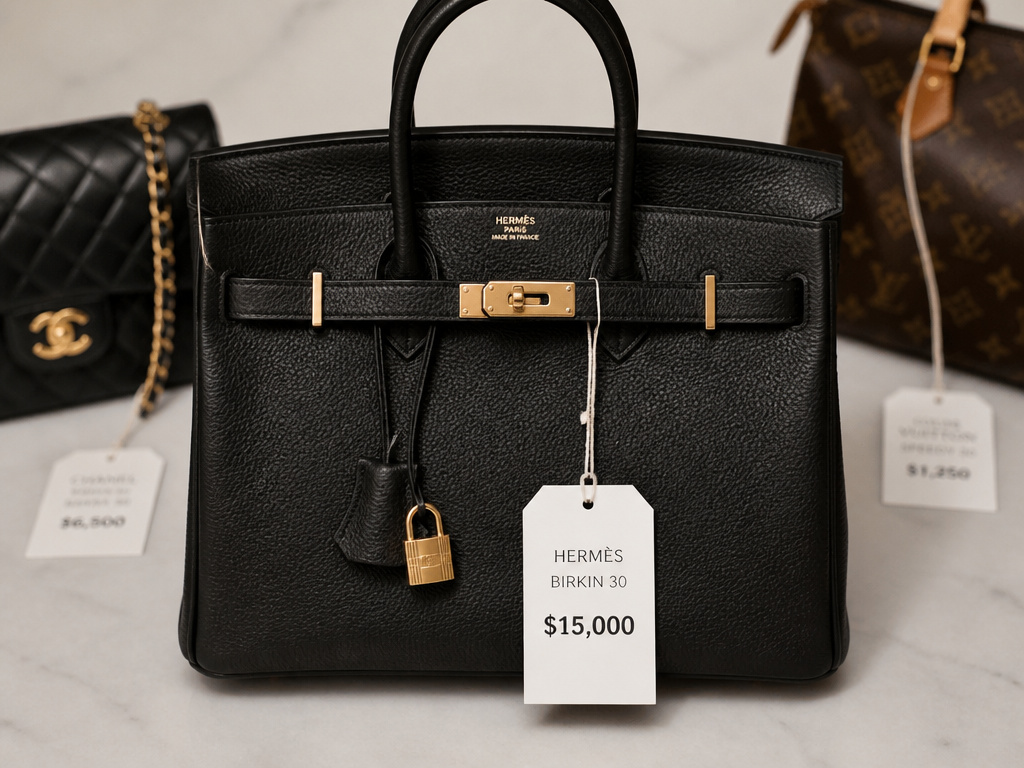
Is a Birkin expensive? Absolutely. But “expensive” only has meaning in context. Compared to other luxury icons, the Birkin’s price and value retention are in a separate category.
A Chanel bag, like the classic flap, now retails in the $10,000+ range. It’s a prestigious accessory that depreciates the moment it leaves the store, typically reselling for 30-50% less. A Louis Vuitton bag from the core canvas line might cost $2,000-$3,000 and holds value moderately better, but it’s still a mass-produced item.
The Birkin is not an accessory. It’s a hand-built, rationed asset. The data shows it: where a Gucci bag or a Fendi bag loses value, a classic leather Birkin often holds or increases it. This isn’t brand hype; it’s the function of that closed system of scarcity and craftsmanship.
This difference in fundamental economics is why the conversation around a Goyard bag (expensive, limited distribution) or a Coach bag (accessible, quality leather) is about style and cost. The conversation around the Birkin is about investment and allocation.
Frequently Asked Questions
What is the cheapest Birkin bag I can buy?
The cheapest new Birkin is the Birkin 25 in Togo or Swift leather at $13,500 USD from a US boutique. The cheapest actual Birkin you can buy is likely a pre-owned Birkin 35 in a seasonal color with visible wear. These can sometimes be found on the resale market for prices close to or even below the current retail of a new 35 ($16,300), as demand is weakest for larger, worn sizes.
Can I buy a Birkin bag online from Hermès?
No. Hermès does not sell Birkin or Kelly bags online. The only official way to purchase one is through an Hermès boutique, by appointment, subject to availability and the store’s allocation policies. All new Birkins found on websites are from the secondary market.
Why are used Birkins often more expensive than new ones?
Used Birkins in high demand (like a pristine Birkin 25 in a neutral color) are more expensive because they are immediately available. The premium you pay on the resale market is for instant, guaranteed access to a specific bag, bypassing the boutique’s waitlist, purchase history requirements, and allocation lottery. You’re paying for certainty and time.
How much does a fake Birkin cost?
The market for replica Birkin handbags is vast, with prices ranging from a few hundred dollars for low-quality copies to several thousand for “super fakes” that mimic craftsmanship details. This is distinct from the market for other Hermès bags or legitimate pre-owned pieces. It’s a different ecosystem entirely, driven by different motivations.
The Bottom Line
So, how much is a Birkin bag? In 2026, the retail price starts at $13,500 and has no upper limit. But the real answer is that its cost is defined by a market that treats it as much as a collectible as a purse.
Your path to acquire a Birkin is a choice between two currencies: time or money. Spend years building a boutique relationship and pay the retail price. Or spend today’s market premium on the resale site and have it by next week. The bag is the same. The price you pay is for everything that surrounds it.